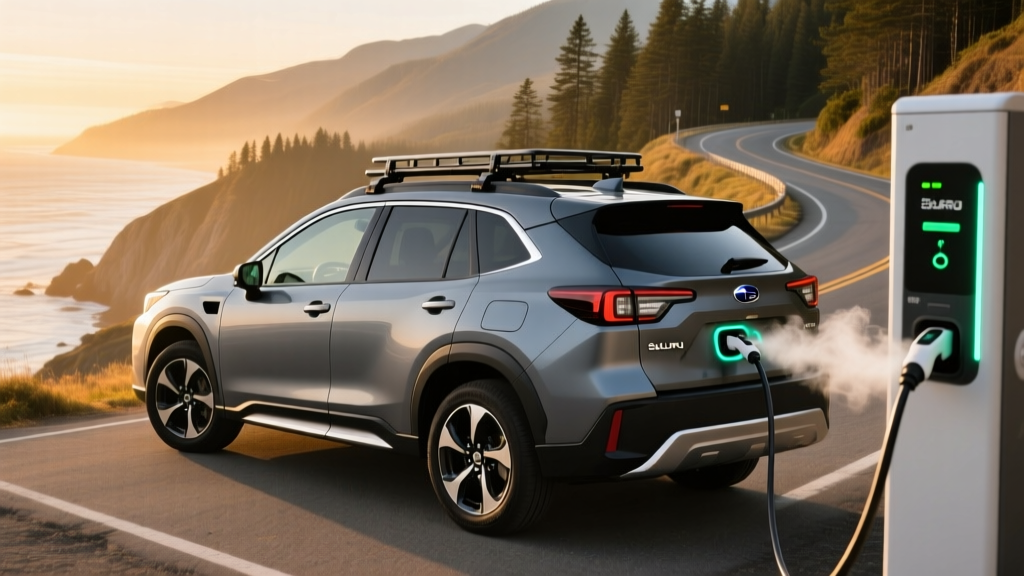
The 2025 Subaru Solterra enters its fourth model year with a critical upgrade that addresses the single biggest complaint from early adopters: DC fast-charging speed. Built on the shared Toyota-Subaru e-TNGA platform alongside the Toyota bZ4X, the Solterra remains the only electric vehicle in Subaru's lineup and the only EV in its class that comes standard with all-wheel drive across every trim. But in an increasingly crowded compact electric SUV segment, does standard AWD and Subaru's rugged reputation justify the Solterra's range and price?
After examining EPA data, real-world driving conditions, charging curves, and current federal incentive rules, here's everything you need to decide whether the 2025 Solterra belongs on your shortlist.
2025 Subaru Solterra Specifications at a Glance
| Specification | 2025 Solterra |
|---|---|
| EPA Range | 222 mi (Touring) / 227 mi (Premium, Limited) |
| Battery Capacity | 72.8 kWh (usable), lithium-ion NMC |
| Drivetrain | Dual-motor AWD (standard all trims) |
| Horsepower / Torque | 215 hp / 249 lb-ft |
| 0–60 mph | ~6.5 seconds |
| Max DC Fast Charge | 150 kW (CCS) |
| 10–80% DC Charge Time | ~35 minutes |
| Level 2 Home Charge Rate | ~11.5 kW (~27 mi/hr) |
| MPGe (Combined) | 102–104 MPGe |
| Efficiency | 32–33 kWh/100 mi |
| Cargo Volume (rear seats up/down) | 23.8 / 56.9 cu ft |
| Rear Legroom | 35.7 in |
| Battery Warranty | 8 years / 100,000 miles |
| Base MSRP (Premium) | $38,495 |
| As-Tested (Touring w/ options) | ~$46,895 |
Range and Efficiency: What the EPA Number Doesn't Tell You
The 2025 Solterra earns an EPA-estimated 227 miles on a full charge for Premium and Limited trims, dropping to 222 miles on the heavier Touring trim with its standard 20-inch alloy wheels. Efficiency ranges from 102 to 104 MPGe combined depending on trim, translating to roughly 32–33 kWh consumed per 100 miles of driving.
The EPA sticker of 222–227 miles reflects a mix of city and highway driving at moderate temperatures. Expect approximately 190–210 miles on sustained highway trips at 70+ mph, where aerodynamic drag reduces efficiency. In cold weather (below 30°F), battery chemistry limitations and cabin heating demands can reduce range by 20–30%, bringing usable range down to roughly 160–180 miles. The Solterra does not offer a heat pump — a notable omission that increases HVAC energy draw in winter climates. If your daily round-trip commute exceeds 150 miles or you live in a region with harsh winters, plan your charging strategy accordingly.
For context, the Hyundai Ioniq 5 (RWD, Long Range) achieves 303 miles EPA, and the Ford Mustang Mach-E (Extended Range, RWD) reaches 320 miles. The Solterra's standard dual-motor AWD system sacrifices roughly 50–80 miles of range versus RWD competitors — a trade-off Subaru has accepted to maintain brand identity.
Charging: The 2025 Upgrade That Matters Most
The headline improvement for the 2025 model year is the upgraded DC fast-charging capability. Previous model years (2023–2024) were limited to approximately 100 kW, making road-trip stops painfully long. The 2025 Solterra now supports up to 150 kW peak DC fast charging via its CCS connector, with Subaru claiming a 10–80% charge in approximately 35 minutes.
| Charging Level | Power / Rate | Time / Speed |
|---|---|---|
| Level 1 (120V household) | ~1.4 kW | ~3–4 mi/hr of range |
| Level 2 (240V home/public) | ~11.5 kW | ~27 mi/hr of range; full charge in ~7.5 hours |
| DC Fast Charge (CCS) | Peak 150 kW | 10–80% in ~35 min; ~120 mi added in 20 min |
Charging-curve reality: The 150 kW figure is a peak, not a sustained rate. In practice, the Solterra will hold its highest charge rate between roughly 10–40% state of charge (SoC), then taper progressively. Expect the rate to drop to approximately 80–90 kW around 55% SoC and further to 40–50 kW as you approach 80%. This taper is standard for NMC lithium-ion chemistry — the battery management system protects cell longevity by reducing current at higher SoC. On a road trip, the most time-efficient strategy is to charge from 10% to 60% (roughly 20 minutes) and drive on, rather than waiting for a full 80%.
The Solterra uses a CCS1 connector, not the Tesla NACS standard. Subaru has not announced a transition to NACS for the Solterra, meaning Tesla Supercharger access is not available without an adapter (and as of early 2025, CCS-to-NACS adapters remain limited in availability and compatibility). Most Electrify America, EVgo, and ChargePoint DC fast stations support CCS natively, so public charging access remains broad, if less seamless than Tesla's network.
For home Level 2 charging, the 11.5 kW onboard charger fills the 72.8 kWh battery from empty in roughly 7.5 hours. A typical overnight session from 30% to 80% takes about 3.5 hours on a 48-amp Level 2 home station (such as a ChargePoint Home Flex or Emporia Level 2). Factor in $500–$1,500 for professional installation of a 240V/50A circuit if you don't already have one.
Performance and Driving Dynamics
Every 2025 Solterra comes with dual electric motors producing a combined 215 horsepower and 249 lb-ft of torque, routed through Subaru's symmetric all-wheel-drive system. The 0–60 mph sprint takes approximately 6.5 seconds — adequate for highway merging and passing but noticeably behind the Hyundai Ioniq 5 AWD (5.2 seconds) and Tesla Model Y Long Range (4.8 seconds).
Where the Solterra earns its keep is off-pavement and in adverse conditions. Subaru's X-MODE traction management system, standard on all trims, adjusts torque distribution, throttle response, and regenerative braking for snow, mud, and gravel. Ground clearance measures 8.3 inches — more than most electric crossovers and comparable to Subaru's gas-powered Forester. This makes the Solterra a credible choice for ski-resort commutes, forest-service-road access, and unplowed neighborhood streets.
The ride quality is composed and slightly firm, with well-damped body control. Steering feel is direct but light, and the low center of gravity from the floor-mounted battery pack minimizes body roll. Regenerative braking offers adjustable levels via steering-wheel paddles, though the Solterra does not provide true one-pedal driving — the vehicle creeps at low speed rather than coming to a complete stop via regen alone.
Interior, Tech, and Cargo
The cabin uses a dual-cockpit layout with a 12.3-inch touchscreen infotainment system (wireless Apple CarPlay and Android Auto on Limited and Touring trims), a digital instrument cluster, and physical climate controls — a welcome choice for drivers who dislike menu-diving for basic temperature adjustments.
Passenger space is competitive for the compact SUV class: front legroom measures 42.1 inches, rear legroom 35.7 inches. Two adults will find the rear seats comfortable; three across is tight. The panoramic fixed glass roof (standard on Limited and Touring) opens up the cabin visually but does not open for ventilation.
Cargo capacity comes in at 23.8 cubic feet behind the rear seats and 56.9 cubic feet with the 60/40 split rear seats folded. There is no front trunk (frunk) — the space under the hood houses power electronics. Compared to the Ioniq 5 (27.2 / 59.3 cu ft) and the Kia EV6 (24.4 / 50.2 cu ft), the Solterra is roughly average in utility.
Driver assistance comes via Subaru's EyeSight suite, which includes adaptive cruise control with lane centering, pre-collision braking, lane departure warning, and blind-spot detection. This is an SAE Level 2 driver-assistance system — the driver must remain fully engaged with hands on the wheel and eyes on the road at all times. It is not a self-driving system. EyeSight performs competently on well-marked highways but does not offer hands-free driving like GM's Super Cruise or Ford's BlueCruise.
Pricing, Trims, and Federal Tax Credit Eligibility
The 2025 Solterra is offered in three trims:
| Trim | MSRP (incl. destination) | Key Features |
|---|---|---|
| Premium | $38,495 | 18" wheels, heated seats, EyeSight, 8" touchscreen, wired CarPlay/AA |
| Limited | $41,995 | 20" wheels, 12.3" touchscreen, wireless CarPlay/AA, power liftgate, panoramic roof |
| Touring | $45,495 | 20" dark alloys, SofTex/leather seats, ventilated front seats, heated rear seats, 360° camera, parking assist |
Does the 2025 Solterra Qualify for the Federal EV Tax Credit?
Under IRS §30D rules, the Solterra's eligibility for the full $7,500 federal tax credit depends on several requirements that change periodically based on battery-component and critical-mineral sourcing:
- MSRP cap: The Solterra qualifies as an SUV under IRS classification, so the MSRP cap is $80,000 — all trims fall well below this limit.
- Buyer income cap: Modified adjusted gross income must not exceed $150,000 (single), $225,000 (head of household), or $300,000 (joint filing).
- Battery sourcing requirements: The Solterra is assembled at Toyota's Motomachi plant in Japan. Battery component and critical-mineral sourcing requirements have been progressively tightening, and partial credit ($3,750) may apply depending on the specific model year's compliance with North American mineral and component thresholds. Verify current eligibility on fueleconomy.gov before purchasing.
- Point-of-sale transfer: If eligible, the credit can be transferred to the dealer at the point of sale, reducing your purchase price directly rather than waiting for a tax refund.
Because sourcing rules are updated periodically and depend on the specific battery batch, always confirm eligibility with your dealer and consult a tax professional. State and utility incentives may stack on top of the federal credit — check your local programs at afdc.energy.gov.
If you qualify for the full $7,500 credit, the Solterra Premium effectively starts at $30,995. With the $3,750 partial credit (which may apply depending on sourcing compliance), the effective price is $34,745. Always verify before signing.
Ownership Costs and Warranty
Subaru covers the Solterra's battery and electric powertrain with an 8-year / 100,000-mile warranty, which includes capacity retention coverage — Subaru warrants that the battery will retain at least 70% of its original capacity during the warranty period. The basic vehicle warranty is 3 years / 36,000 miles, and the powertrain warranty (beyond the EV-specific coverage) is 5 years / 60,000 miles.
Estimated 5-year cost of ownership considerations:
- Electricity cost: At the national average of $0.16/kWh, fully charging the 72.8 kWh battery costs roughly $11.65. Over 15,000 miles per year, annual fuel cost is approximately $720–$780 — compared to $1,800–$2,200 for a comparable gas SUV at 25 MPG and $3.50/gallon.
- Maintenance: No oil changes, minimal brake wear (regen braking saves pads), and no transmission fluid. Expect $300–$500 over 5 years for cabin air filters, wiper blades, and tire rotation.
- Insurance: EV insurance premiums run 15–25% higher than comparable gas vehicles. Expect $1,600–$2,200 annually depending on your profile and state.
- Depreciation: Early Solterra models have experienced steeper-than-average depreciation, partly due to the initial charging-speed concerns and range relative to competitors. Lease deals may offer better financial protection against depreciation risk.
Pros, Cons, and Who Should Buy the Solterra
Pros
- Standard AWD on every trim — unique in its class
- 8.3 inches of ground clearance for genuine light off-road capability
- X-MODE traction system effective in snow and mud
- Improved 150 kW DC fast-charging for 2025
- Physical climate controls and intuitive layout
- Comprehensive EyeSight safety suite standard
- Competitive pricing before incentives
Cons
- 222–227 mi EPA range trails most competitors by 50–100+ miles
- No heat pump — cold-weather range loss is significant
- No front trunk (frunk) for additional storage
- CCS-only connector; no native NACS/Tesla Supercharger access
- 215 hp feels modest in a segment with 300+ hp rivals
- No one-pedal driving mode
- Rear-seat space tighter than some competitors
- Battery sourcing may limit federal credit to $3,750
Buy it if: You live in a snow-belt or mountain region where AWD is non-negotiable, your daily commute is under 120 miles round-trip, you have reliable home Level 2 charging, and you value Subaru's safety reputation and off-pavement capability over maximum range.
Look elsewhere if: You regularly drive 200+ miles between charging stops, you live in an extremely cold climate without garage parking, you want Tesla Supercharger network access, or you prioritize acceleration and tech-forward features over all-weather traction.
How the Solterra Stacks Up Against Key Competitors
| Spec | 2025 Solterra (Limited) | 2025 Ioniq 5 (SEL AWD) | 2025 Mach-E (ER AWD) | 2025 Model Y (LR AWD) |
|---|---|---|---|---|
| EPA Range | 227 mi | 290 mi | 290 mi | 303 mi |
| Battery | 72.8 kWh NMC | 77.4 kWh NMC | 91 kWh NMC | ~75 kWh NMC |
| HP / 0-60 | 215 hp / 6.5s | 320 hp / 5.2s | 312 hp / 5.1s | 384 hp / 4.8s |
| DC Fast Charge | 150 kW | 240 kW | 150 kW | 250 kW |
| 10–80% Time | ~35 min | ~18 min | ~37 min | ~25 min |
| Base MSRP (AWD) | $41,995 | $49,600 | $48,995 | $47,990 |
| Ground Clearance | 8.3 in | 6.1 in | 5.9 in | 6.6 in |
The Solterra's advantage is clear in ground clearance and starting price (when comparing AWD-to-AWD). Its disadvantages — range, charging speed, and power — are equally clear. The Ioniq 5 and Model Y are more efficient, faster-charging, and longer-range vehicles. The Solterra competes on all-weather confidence, Subaru brand loyalty, and lower AWD entry pricing.
Frequently Asked Questions
What is the real-world range of the 2025 Subaru Solterra?
Expect 190–210 miles on highway road trips at 70 mph and 160–180 miles in sub-freezing temperatures, compared to the EPA-rated 222–227 miles. City driving with regenerative braking can approach or slightly exceed the EPA estimate.
How fast does the 2025 Solterra charge?
DC fast charging peaks at 150 kW, achieving a 10–80% charge in approximately 35 minutes. On a 240V Level 2 home charger at 11.5 kW, expect about 27 miles of range per hour of charging, or a full charge in roughly 7.5 hours.
How much does the Solterra cost after tax credits?
The Premium trim starts at $38,495 MSRP. With the full $7,500 federal credit (if eligible), the effective price drops to $30,995. With the $3,750 partial credit (depending on battery sourcing), the effective price is $34,745. Always verify current eligibility on fueleconomy.gov and with your tax professional.
Is the 2025 Solterra worth buying versus competitors?
It is worth serious consideration if standard AWD, high ground clearance, and Subaru's safety and reliability reputation are your top priorities, and your daily driving stays within 120–150 miles. If maximum range, fast charging, and performance are more important, the Ioniq 5, Model Y, or Mach-E are stronger choices.
Does the Solterra have a frunk?
No. The space under the hood is occupied by power electronics. All cargo must go in the rear cargo area (23.8 cu ft behind the rear seats, 56.9 cu ft with seats folded).
Can I charge the Solterra at a Tesla Supercharger?
Not natively. The Solterra uses a CCS1 connector, while Tesla Superchargers use NACS. As of early 2025, CCS-to-NACS adapters are not broadly available or universally compatible with the Solterra. Subaru has not announced a NACS transition for this model.
Does the Solterra come with a heat pump?
No. The 2025 Solterra uses resistive cabin heating, which draws more energy from the battery in cold weather compared to a heat pump system. This contributes to the vehicle's pronounced cold-weather range reduction of 20–30%.