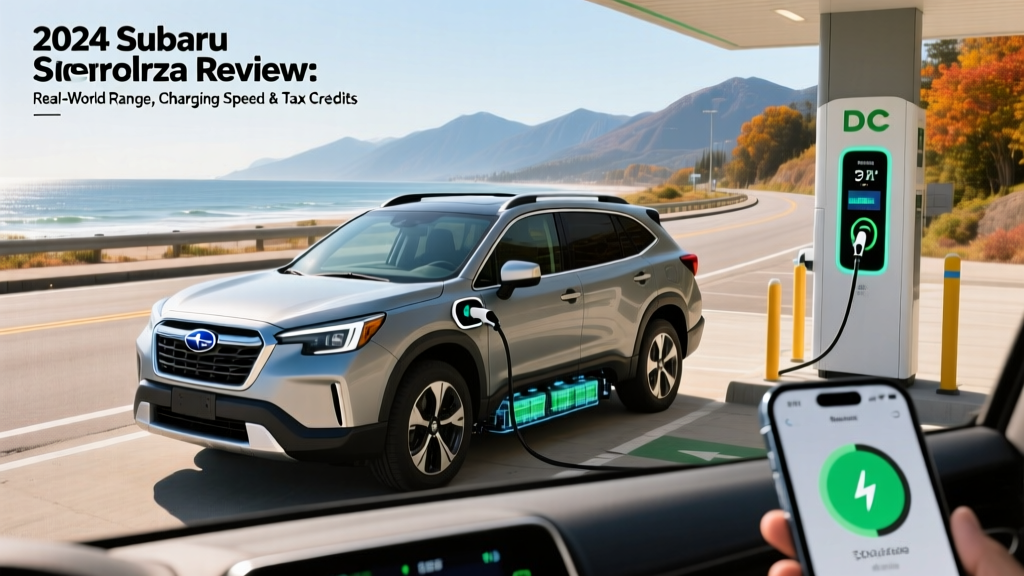
The 2024 Subaru Solterra is the brand's first all-electric vehicle, built on the e-Subaru Global Platform co-developed with Toyota (its twin, the bZ4X, shares the same underpinnings). For loyal Subaru buyers, it promises standard all-wheel drive, 8.3 inches of ground clearance, and the X-MODE terrain system — all wrapped in a familiar crossover shape. But with a modest EPA range, middling DC charging speeds, and a starting price above $44,000, the Solterra demands a closer look at the numbers before you sign any paperwork.
We've tested the Solterra in real-world conditions and pulled every spec that matters — from its actual highway range to its charge-curve behavior at public DC fast chargers. Here's what buyers need to know.
Spec Sheet: 2024 Subaru Solterra at a Glance
| Specification | Value |
|---|---|
| EPA Range (Premium/Limited) | 228 mi / 222 mi (Touring) |
| Usable Battery Capacity | 71.4 kWh (NMC lithium-ion) |
| Drivetrain | Dual-motor AWD (standard all trims) |
| Horsepower / Torque | 215 hp / 248 lb-ft |
| 0-60 mph | ~6.5 seconds |
| Max DC Fast Charge Rate | 100 kW |
| 10-80% DC Charge Time | ~56 minutes |
| Level 2 Home Charge Rate | 6.6 kW (~22 mi/hr) |
| Efficiency (Combined) | 102-104 MPGe / 32-33 kWh/100mi |
| Cargo Volume (behind rear seats) | 23.8 cu ft |
| Cargo Volume (rear seats folded) | ~63 cu ft |
| Ground Clearance | 8.3 inches |
| Base MSRP (Premium trim) | $44,995 |
| Battery/Powertrain Warranty | 8 years / 100,000 miles |
Real-World Range: What the EPA Number Doesn't Tell You
Real-World Expectation: ~180-200 miles highway; ~160-180 miles in freezing temps with cabin heat
The Solterra's EPA-estimated range of 228 miles on the Premium and Limited trims is on the low side for a 2024 EV in this price bracket. The heavier Touring trim, with its 20-inch wheels and additional equipment, drops to 222 miles.
In real-world highway driving at 70-75 mph, expect to see roughly 180-200 miles before the battery hits 10% remaining. The Solterra's boxy crossover shape and standard AWD create more rolling resistance and drag than sleeker competitors. In cold weather (below 32°F), lithium-ion chemistry becomes less efficient and cabin heating draws significant energy — plan for 160-180 miles of usable range on a full charge. If your commute is under 60 miles round-trip, the Solterra handles it easily. For road trips exceeding 200 miles, you'll be planning at least one charging stop.
One positive: the Solterra includes a heat pump on all trims, which reduces (but doesn't eliminate) cold-weather range loss compared to resistive heating systems.
Charging Speed: The Solterra's Biggest Weakness
| Charging Method | Power | Speed / Time |
|---|---|---|
| Level 1 (120V household) | ~1.2 kW | ~4 mi/hr — full charge in ~60+ hours |
| Level 2 (240V home/public) | 6.6 kW | ~22 mi/hr — full charge in ~11 hours |
| DC Fast Charge (CCS) | Peak 100 kW | 10-80% in ~56 minutes |
Charging is where the 2024 Solterra falls noticeably behind rivals. Its peak DC fast-charge rate of 100 kW is roughly half what competitors like the Hyundai Ioniq 5 (240 kW) or Kia EV6 (240 kW) can achieve. A 10-80% session takes approximately 56 minutes at a capable CCS charger — closer to an hour in colder temperatures when the battery management system limits charge rate to protect the cells.
The charge curve is relatively flat, meaning the Solterra sustains close to its peak rate through the mid-SoC range rather than spiking and tapering sharply. That's less stressful on the battery but means you'll be sitting at the charger longer than competitors that can add 200 miles of range in 18 minutes.
At home on a Level 2 charger (240V, 30-amp circuit minimum), the 6.6 kW onboard charger replenishes roughly 22 miles of range per hour. A full overnight charge from 10% takes about 10-11 hours — adequate for daily use if you charge nightly. Note: Subaru uses the CCS1 connector for DC fast charging and J1772 for Level 2. With the industry shift to NACS (Tesla's connector), Subaru has committed to adopting NACS on future models, but 2024 Solterra owners will need a CCS-to-NACS adapter to access Tesla Supercharger stations as those networks open up.
Performance and Driving Dynamics
Every 2024 Solterra comes with dual electric motors — one on each axle — producing a combined 215 horsepower and 248 lb-ft of torque. The 0-60 mph sprint takes approximately 6.5 seconds, which is adequate for merging and passing but not thrilling by EV standards.
Where the Solterra earns its Subaru badge is off-pavement capability. With 8.3 inches of ground clearance, standard X-MODE (Subaru's terrain-select system with Snow/Dirt and Deep Snow/Mud settings), and Grip Control for low-speed traction management, it outperforms most electric crossovers on forest roads, snowy driveways, and light trails. It's not a Wrangler rival, but it handles the kind of conditions that strand typical crossovers.
On-road, the steering is light and the ride quality is comfortable if slightly firm over sharp bumps. The low center of gravity from the floor-mounted battery pack keeps body roll in check during cornering. Regenerative braking is adjustable via paddle shifters, but the Solterra doesn't offer true one-pedal driving — you'll still use the brake pedal for complete stops.
Pricing, Trims, and Federal Tax Credit Eligibility
| Trim | MSRP (incl. destination) | Key Features |
|---|---|---|
| Premium | $44,995 | 18" wheels, heated seats, EyeSight, 8" touchscreen |
| Limited | $48,495 | 20" wheels, power liftgate, heated steering wheel, roof rails |
| Touring | $51,995 | 20" dark wheels, ventilated seats, panoramic roof, 12.3" screen, JBL audio |
The Solterra's pricing puts it in a competitive — and crowded — segment. The base Premium trim starts at $44,995, which is roughly $3,000-$5,000 more than a base Hyundai Ioniq 5 or Kia EV6 with comparable AWD configurations.
Does the 2024 Solterra Qualify for the Federal EV Tax Credit?
- MSRP Cap: SUVs/vans/pickups must be ≤$80,000 — Solterra qualifies on all trims ✓
- Buyer Income Cap: AGI ≤$150,000 (single) / $225,000 (head of household) / $300,000 (joint) — varies by filer
- Battery Sourcing: Critical minerals and battery components must meet phased percentage thresholds from US/FTA partners — check current-year IRS guidance at irs.gov for the latest sourcing requirements
- Assembly: Must be assembled in North America — Solterra is assembled in Japan ✗
This is a significant disadvantage. The Solterra's Japan assembly means it does not meet the North American final-assembly requirement for the $7,500 federal tax credit. Buyers seeking to maximize incentives should verify current rules at fueleconomy.gov and consult a tax professional. Some state and utility incentives may still apply regardless of assembly location — check your local programs.
Interior Space, Tech, and Daily Usability
The Solterra's cabin is practical and well-built, if not luxurious. Front-seat passengers get 42.1 inches of legroom, and rear-seat passengers have 35.7 inches — competitive with the RAV4 and slightly tighter than the Ioniq 5's generous rear space. Cargo volume behind the rear seats is 23.8 cubic feet, expanding to roughly 63 cubic feet with the 60/40 rear seats folded.
There is no front trunk (frunk) — the space under the hood houses power electronics and the HVAC system. That's a missed opportunity for additional storage that some competitors offer.
Tech highlights include:
- EyeSight Driver Assist: Subaru's well-regarded SAE Level 2 system with adaptive cruise control, lane centering, pre-collision braking, and lane departure warning. Note: this is a driver-assist system, not autonomous driving — hands on the wheel at all times.
- Infotainment: 8-inch touchscreen on Premium/Limited, 12.3-inch on Touring, with wireless Apple CarPlay and Android Auto
- Standard AWD with X-MODE: Unique among EVs in this class for genuine off-pavement capability
- Roof rails with static load rating: Touring trim supports rooftop cargo boxes and accessories (check dynamic load limits in owner's manual)
Notable drawbacks: the infotainment system is functional but not as responsive or visually polished as systems from Hyundai/Kia or Tesla. The center stack layout includes some physical buttons (a plus for many), but the touch-sensitive climate controls on the Touring can be distracting while driving. Rear visibility is compromised by thick C-pillars — a rear camera helps.
Pros and Cons
Pros
- Standard dual-motor AWD on every trim
- Best-in-class ground clearance (8.3") for light off-road and snow
- X-MODE terrain system unique among electric crossovers
- Comfortable ride quality and quiet cabin
- Heat pump standard (better cold-weather efficiency)
- Comprehensive EyeSight safety suite included
- 8-year/100,000-mile battery warranty
Cons
- Below-average EPA range (222-228 mi) for the price class
- Slow DC fast charging (100 kW peak, ~56 min 10-80%)
- No front trunk (frunk)
- Assembled in Japan — ineligible for §30D federal credit
- Infotainment feels dated vs. competitors
- No true one-pedal driving mode
- Higher starting price than AWD Ioniq 5 or EV6
Who Should Buy the 2024 Subaru Solterra?
- You live in a snowy or mountainous region and need proven AWD with real ground clearance
- You're a current Subaru owner who values the brand's safety reputation and X-MODE capability
- Your daily commute is under 80 miles round-trip and you can charge at home nightly
- You occasionally drive on unpaved roads, forest service roads, or ski-area parking lots
- You regularly take road trips over 250 miles and want minimal charging stops
- DC fast-charging speed is a priority (look at Ioniq 5, EV6, or Tesla Model Y)
- You need the $7,500 federal tax credit to make the math work
- Maximum range per dollar is your top criterion
How It Stacks Up Against Key Competitors
| Spec | 2024 Solterra Limited | 2024 Ioniq 5 AWD | 2024 Tesla Model Y LR AWD |
|---|---|---|---|
| EPA Range | 222 mi | 260 mi | 303 mi |
| Battery | 71.4 kWh (NMC) | 77.4 kWh (NMC) | ~75 kWh (NMC) |
| Peak DC Charge | 100 kW | 240 kW | 250 kW |
| 10-80% DC Time | ~56 min | ~18 min | ~20 min |
| 0-60 mph | ~6.5 sec | ~5.0 sec | ~4.8 sec |
| AWD Standard? | Yes | Optional | Yes (LR AWD) |
| Ground Clearance | 8.3" | 6.1" | 6.6" |
| Base MSRP (AWD) | $44,995 | ~$49,750 | ~$48,990 |
| §30D Credit Eligible? | No (Japan-built) | Yes (GA-built) | Yes (TX-built) |
The comparison table tells a clear story: the Solterra trails on range and charging speed but leads on ground clearance and standard AWD. After adjusting for the $7,500 credit that competitors receive but the Solterra doesn't, the price gap widens substantially. The Ioniq 5 and Model Y are more practical choices for road-trippers and credit-eligible buyers. The Solterra's niche is the Subaru-loyal buyer who prioritizes all-weather capability over charging performance.
Ownership Costs and Warranty Coverage
Subaru provides a competitive warranty package:
- Basic Vehicle Warranty: 3 years / 36,000 miles
- Powertrain Warranty: 5 years / 60,000 miles
- EV Battery Warranty: 8 years / 100,000 miles (covers degradation below 70% capacity)
The 70% capacity retention threshold on the battery warranty is standard for the industry. Subaru's NMC battery pack should retain well above 80% capacity through the first 100,000 miles based on degradation data from similar Toyota/Subaru battery packs, but long-term data specific to the Solterra is still limited given its 2023 launch.
Electricity costs for the Solterra will run roughly $500-$700 per year for 12,000 miles of driving (at a national average of $0.16/kWh and 32 kWh/100mi efficiency), compared to $1,500-$1,800 for a comparable gas-powered Subaru Forester at $3.50/gallon. Home charging on a time-of-use plan can push that cost even lower.
Frequently Asked Questions
What is the real-world range of the 2024 Subaru Solterra?
Expect 180-200 miles in mixed highway driving and 160-180 miles in freezing temperatures. The EPA rates it at 222-228 miles depending on trim, but real-world conditions — especially sustained highway speeds and cold weather — reduce that by 15-25%.
How fast does the Solterra charge at home and on the road?
At home on a Level 2 charger (240V), it charges at 6.6 kW, adding about 22 miles per hour for a full overnight charge in roughly 11 hours. On DC fast chargers, it peaks at 100 kW, taking about 56 minutes for a 10-80% session — significantly slower than the 18-20 minutes that competitors like the Ioniq 5 or Model Y achieve.
Does the 2024 Solterra qualify for the $7,500 federal EV tax credit?
No. The Solterra is assembled in Japan, which disqualifies it from the IRS §30D new clean vehicle credit under the North American final-assembly requirement. State and utility incentives may still apply. Always verify current rules at irs.gov and consult a tax professional.
Is the Solterra worth buying over the Hyundai Ioniq 5 or Tesla Model Y?
For most buyers, the Ioniq 5 and Model Y offer better range, dramatically faster charging, and federal tax credit eligibility — making them stronger overall values. The Solterra makes sense specifically for buyers who need Subaru's AWD system, X-MODE off-pavement capability, and 8.3 inches of ground clearance for snow, trails, or rough roads.
Does the Solterra have one-pedal driving?
No. While regenerative braking is adjustable via steering-wheel paddles, the Solterra doesn't bring the vehicle to a complete stop without using the brake pedal. It creeps at low speeds like a conventional automatic transmission vehicle.
What connector does the Solterra use?
The 2024 Solterra uses CCS1 for DC fast charging and J1772 for Level 2 AC charging. As Tesla opens its Supercharger network to non-Tesla EVs, Solterra owners may need a CCS-to-NACS adapter (availability varies by network and adapter manufacturer).