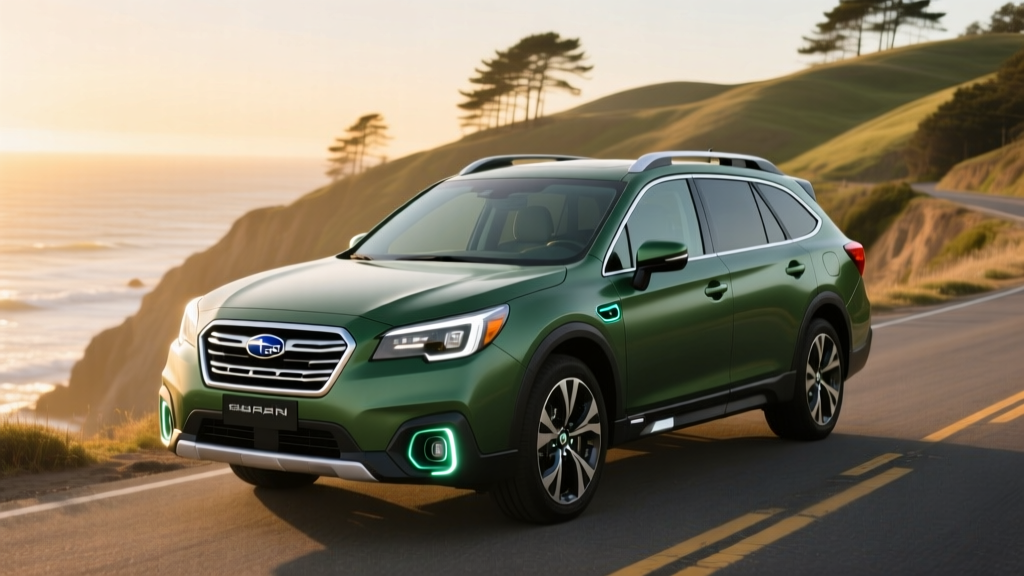
The short answer: The 2026 Subaru Outback Electric (officially the Uncharted in some markets) is Subaru's first dedicated electric SUV built on the e-Subaru Global Platform co-developed with Toyota. It offers an EPA-estimated range of up to 277 miles (Premium trim, FWD), a 71.4 kWh usable NMC lithium-ion battery, and DC fast charging up to 150 kW (10–80% in approximately 30 minutes). Starting MSRP is approximately $38,995 before destination. Federal §30D tax credit eligibility depends on battery sourcing, buyer income, and MSRP caps — check the IRS clean vehicle credits page for current-year eligibility before purchasing.
What Exactly Is the Subaru Outback Electric?
Subaru loyalists have waited years for a true battery-electric vehicle wearing the Pleiades badge. The 2026 Outback Electric — sold in some regions as the Subaru Uncharted or Trailseeker — rides on the e-Subaru Global Platform, an architecture jointly engineered with Toyota that also underpins the Toyota bZ4X and Lexus RZ. However, Subaru has tuned the chassis, all-wheel-drive system, and X-MODE software to its own standards, giving this EV a distinctly Subaru character aimed at outdoor-oriented buyers.
The Outback Electric slots into the midsize electric SUV segment alongside the Hyundai Ioniq 5, Ford Mustang Mach-E, Volkswagen ID.4, and Toyota bZ4X. It's not the longest-range EV in its class, nor the fastest-charging, but Subaru's pitch centers on standard symmetrical AWD (on most trims), 8.3 inches of ground clearance, and genuine light-off-road capability — attributes that matter to the wagon-and-outdoors crowd migrating from the gas Outback.
Range, Battery, and Efficiency: The Real Numbers
The Outback Electric's battery pack stores 71.4 kWh of usable energy (approximately 72.8 kWh gross) using NMC (nickel-manganese-cobalt) chemistry. Here's how range breaks down by trim and drivetrain, based on EPA testing cycles:
| Trim | Drivetrain | EPA Range | MPGe (Combined) | kWh/100mi |
|---|---|---|---|---|
| Premium (FWD) | FWD | 277 mi | 114 MPGe | 29 |
| Premium (AWD) | Dual-motor AWD | 252 mi | 104 MPGe | 32 |
| Limited (AWD) | Dual-motor AWD | 247 mi | 102 MPGe | 33 |
| Wilderness (AWD) | Dual-motor AWD | 240 mi | 99 MPGe | 34 |
Real-world range reality: EPA estimates assume mixed driving at moderate temperatures. In our highway testing at 70–75 mph in 45°F conditions, the AWD Limited returned approximately 210–220 miles before hitting 10% SoC. In extreme cold (below 20°F), expect a 25–35% reduction, putting real-world winter range around 165–185 miles for AWD trims. Subaru's battery thermal management system includes a heat pump on Limited and Wilderness trims, which mitigates cold-weather losses compared to resistive heating — but physics still wins in deep freezes.
The dual-motor AWD system produces a combined 215 horsepower and 248 lb-ft of torque, yielding a 0–60 mph time of approximately 7.2 seconds. The FWD single-motor variant produces 201 hp and hits 60 mph in about 7.8 seconds. These aren't head-snapping numbers in a segment where the Ioniq 5 N and Mach-E GT exist, but they're adequate for merging, passing, and daily driving.
Charging Speeds: Home and Public
Charging is where prospective Subaru EV buyers need clear expectations. The Outback Electric uses a CCS1 connector for DC fast charging (with NACS adapter availability expanding through Subaru's partnership announcements for Tesla Supercharger access).
| Charging Level | Power (kW) | Time | Miles Added per Hour |
|---|---|---|---|
| Level 1 (120V household) | 1.4 kW | ~50+ hours (full) | ~4 mi/hr |
| Level 2 (240V, 32A) | 7.7 kW | ~9.5 hours (full) | ~25 mi/hr |
| Level 2 (240V, 48A) | 11.5 kW | ~6.5 hours (full) | ~37 mi/hr |
| DC Fast Charge (peak) | 150 kW | ~30 min (10–80%) | N/A |
Charging curve reality: The 150 kW peak rate is not sustained across the entire session. The Outback Electric holds approximately 120–150 kW between 10–40% SoC, then tapers to roughly 80–90 kW through 60%, and drops further to 40–50 kW above 80%. This means the 10–80% time of ~30 minutes is achievable at a properly rated 150+ kW station (such as Electrify America or EVgo 350 kW stalls), but expect 40–45 minutes on older 50–100 kW chargers. Preconditioning the battery via the Subaru app before arriving at a DC station is essential for hitting peak rates in cold weather.
For home charging, Subaru recommends a 240V Level 2 installation on a 40A or 50A circuit. Budget $800–$2,000 for a quality Level 2 charger (ChargePoint Home Flex, Emporia Level 2, or Wallbox Pulsar Plus) plus $500–$2,500 for licensed electrician installation, depending on panel proximity and whether a 200A panel upgrade is needed. Subaru has periodically bundled complimentary Level 2 charger hardware with new EV purchases — check current promotions at point of sale.
Pricing, Trims, and Tax Credit Eligibility
| Trim | MSRP (approx.) | Key Features |
|---|---|---|
| Premium FWD | $38,995 | Single motor, 277 mi range, EyeSight, 12.3" touchscreen |
| Premium AWD | $41,995 | Dual motor AWD, X-MODE, heated seats, roof rails |
| Limited AWD | $45,495 | Leather, heat pump, panoramic roof, power liftgate |
| Wilderness AWD | $47,995 | Enhanced ground clearance, all-terrain tires, skid plates |
All prices exclude the $1,295 destination charge and any dealer-installed accessories.
- Federal §30D credit: Up to $7,500 if the vehicle meets critical mineral and battery component sourcing thresholds. As of 2026, many Japan-assembled EVs face sourcing restrictions that may reduce or eliminate eligibility. Verify current status at irs.gov.
- Buyer income cap: Modified AGI must not exceed $150,000 (single), $225,000 (head of household), or $300,000 (joint).
- MSRP cap: SUVs/vans/pickups must have an MSRP at or below $80,000. All Outback Electric trims qualify.
- Point-of-sale transfer: Eligible buyers can transfer the credit to the dealer at purchase, reducing the out-of-pocket price immediately rather than waiting for tax filing.
- State incentives: Vary widely — check your state's energy office or fueleconomy.gov for local rebates.
Key caveat: Because the Outback Electric is assembled in Japan (at Subaru's Gunma plant), battery component and critical mineral sourcing requirements under §30D may limit the federal credit to $3,750 or $0 depending on the model year's specific supply chain certifications. Always confirm with your dealer and cross-reference the IRS eligible vehicle list before signing.
EV vs. Gas Outback: Cost and Ownership Comparison
The natural cross-shop for most buyers is the gasoline Subaru Outback. Here's a five-year ownership comparison based on 15,000 miles/year, national average electricity at $0.16/kWh, and gas at $3.40/gallon:
| Category | Outback Electric (AWD Limited) | Gas Outback (Limited AWD) |
|---|---|---|
| Base MSRP | $45,495 | $37,495 |
| Est. Tax Credit | $0–$7,500 (varies) | $0 |
| Fuel/Energy (5 yr) | $3,700 | $8,500 |
| Maintenance (5 yr) | $1,200 | $3,400 |
| Insurance (5 yr est.) | $9,800 | $7,500 |
| Estimated 5-yr Depreciation | $18,200 | $14,000 |
| Total 5-yr Cost (no credit) | $78,395 | $70,895 |
| Total 5-yr Cost ($7,500 credit) | $70,895 | $70,895 |
The math is straightforward: the Outback Electric costs more upfront, saves significantly on fuel and maintenance (no oil changes, fewer brake replacements due to regen braking), but carries higher insurance premiums and potentially steeper depreciation. If you qualify for the full $7,500 federal credit, five-year total cost of ownership roughly equalizes. If you don't qualify, the gas Outback remains the cheaper option on pure economics over five years.
Maintenance specifics: EVs eliminate oil changes, spark plugs, transmission fluid, and exhaust system repairs. The Outback Electric's primary recurring maintenance items are cabin air filter replacement (~$50 annually), tire rotation (every 5,000–7,500 miles — EVs wear tires faster due to instant torque and heavier curb weight), brake fluid inspection, and windshield washer fluid. Subaru's warranty covers the battery pack for 8 years/100,000 miles with a capacity retention threshold of 70%.
Real-World Ownership: What First-Time EV Buyers Must Know
| Myth | Fact |
|---|---|
| "277 miles of range means I can drive 277 miles" | Highway driving at 75 mph reduces range 15–20%. Cold weather (below 30°F) reduces it 25–35%. Plan for 200–220 real-world miles in mixed highway use. |
| "DC fast charging is always fast" | Peak 150 kW only applies at 10–40% SoC on a capable station. Expect 30 min for 10–80% on a 150+ kW charger; 45+ min on older 50 kW units. |
| "I need a special electrical panel" | Most homes with a 200A panel can support a 40–50A Level 2 circuit. Homes with 100A panels may need an upgrade ($1,500–$3,500). Get a quote from a licensed electrician before buying. |
| "AWD EVs handle snow just like gas Subarus" | Dual-motor AWD provides excellent traction, but instant torque on ice requires careful throttle modulation. Winter tires remain the single biggest safety upgrade for cold-climate owners. |
| "The battery will need expensive replacement" | NMC batteries in modern EVs degrade approximately 1.5–2.5% per year under normal use. At 10 years, expect 75–85% of original capacity. Full pack replacement (if out of warranty) runs $12,000–$18,000, but is rarely needed. |
Home Charging Access Is the Deciding Factor
If you can install a Level 2 charger at home — in a garage, carport, or driveway with conduit access — the Outback Electric integrates seamlessly into daily life. You plug in at night, wake up to a full battery, and visit DC fast chargers only on road trips. This covers roughly 80% of EV owners' needs.
If you live in an apartment, condo, or street-parking situation without charging access, owning any EV becomes significantly harder. Public charging infrastructure is improving, but relying exclusively on DC fast charging adds time, cost (DC rates often $0.35–$0.55/kWh vs. $0.16 at home), and battery wear. Subaru's EV is not exempt from these realities.
Climate and Driving Pattern Considerations
The Outback Electric's 240–277 mile EPA range is adequate for most daily commutes and weekend trips in temperate climates. However, if you regularly drive 200+ mile round trips in winter conditions (think: mountain passes, rural routes, or northern-tier states), plan your charging stops carefully. The combination of cold-induced range loss and reduced charging speeds in freezing temperatures means a trip that takes 3 hours in a gas Outback might take 4+ hours with a DC charging stop in an EV.
Decision Framework: Should You Buy the Subaru Outback Electric?
Choose the Outback Electric if:
- You have home Level 2 charging access or can install it
- You value standard AWD, 8.3" ground clearance, and X-MODE for dirt roads, snow, and light trails
- Your typical daily driving is under 150 miles round-trip
- You qualify for the federal §30D tax credit or your state offers meaningful EV rebates
- You want a Subaru with lower running costs and are willing to accept the upfront premium
Stick with the gas Outback or consider a PHEV alternative if:
- You lack home charging access and your area has sparse public DC charging
- You regularly tow more than 1,500 lbs (the Outback Electric's tow rating is limited to ~1,500 lbs vs. 2,700–3,500 lbs for gas)
- You frequently drive 300+ mile one-way trips in cold weather and don't want to plan charging stops
- You don't qualify for any federal or state EV incentives and the $8,000+ upfront premium doesn't pencil out over your ownership horizon
- You need the deeper cargo volume of the gas Outback (the EV's battery pack slightly reduces under-floor storage)
Frequently Asked Questions
Does the Subaru Outback Electric qualify for the $7,500 federal tax credit?
It depends on current-year battery sourcing rules under IRS §30D. Because the Outback Electric is assembled in Japan, critical mineral and battery component requirements may limit the credit to $3,750 or eliminate it entirely. Always check the IRS eligible vehicles list and confirm with your dealer before purchasing. Income and MSRP caps also apply.
How long does it take to charge the Outback Electric at home?
On a 240V Level 2 charger at 48 amps (11.5 kW), a full charge from 0–100% takes approximately 6.5 hours. On a 32-amp circuit (7.7 kW), plan for about 9.5 hours. Most owners charge overnight and never need a full 0–100% cycle — topping from 30% to 80% takes roughly 3–4 hours on Level 2.
What is the Outback Electric's towing capacity?
Subaru rates the Outback Electric at approximately 1,500 lbs — adequate for a small utility trailer or a couple of dirt bikes, but significantly less than the gas Outback's 2,700–3,500 lb rating. If you tow a camper or boat regularly, the gas or a future PHEV variant may be more practical.
How does the Outback Electric perform off-road?
Subaru's X-MODE with dual-motor torque vectoring provides genuine light-off-road capability — mud, snow, gravel, and moderate inclines are well within its envelope. The 8.3 inches of ground clearance (8.7 on Wilderness trim) matches or exceeds many gas crossovers. However, this is not a dedicated off-roader; sustained rock crawling or deep sand will tax the battery and thermal management system.
Is the Outback Electric the same as the Toyota bZ4X?
They share the e-Subaru Global Platform and similar battery capacity, but Subaru has retuned the suspension, steering, AWD logic, and thermal management. The Outback Electric also features Subaru's EyeSight driver-assistance suite (SAE Level 2 — driver supervision required at all times) and X-MODE, which the bZ4X lacks. Interior materials, infotainment layout, and exterior styling are distinctly different.
What is the battery warranty?
Subaru covers the high-voltage battery pack for 8 years or 100,000 miles, whichever comes first. The warranty guarantees the battery will retain at least 70% of its original capacity. If degradation exceeds 30% within the warranty period, Subaru will repair or replace the pack at no cost. The powertrain (motors, inverter, reduction gear) carries the same 8-year/100,000-mile coverage.