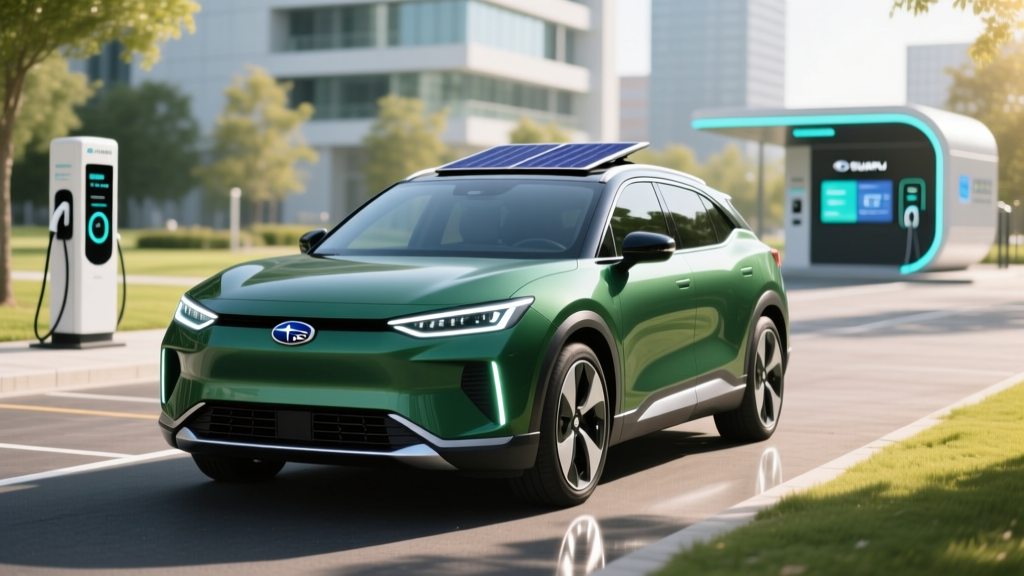
Subaru currently sells one fully electric vehicle: the Solterra SUV, with a second model — the Uncharted compact crossover — arriving in late 2025 as a 2026 model. The 2026 Solterra offers up to 227 miles of EPA range, DC fast charging up to 150 kW (10–80% in ~28 minutes), and a starting MSRP around $38,495. The upcoming Uncharted targets ~250 miles of range and a lower entry price near $34,000. Neither currently qualifies for the full $7,500 federal §30D tax credit due to battery-sourcing rules, though point-of-sale lease credits may apply. Subaru's EVs prioritize all-wheel-drive capability and rugged utility over maximum range — a trade-off buyers should weigh against rivals like the Hyundai Ioniq 5 (311 mi EPA) and Tesla Model Y (320 mi EPA).
Subaru's Current and Upcoming Electric Vehicles
Subaru's electrification strategy has been deliberate, lagging behind competitors but rooted in the brand's core identity: symmetrical all-wheel drive, off-road competence, and practical utility. As of early 2026, here's where the lineup stands.
2026 Subaru Solterra
The Solterra, co-developed with Toyota (which sells it as the bZ4X), is Subaru's first and currently only battery-electric vehicle on sale. Built on the e-TNGA/e-Subaru Global Platform, it comes standard with dual-motor all-wheel drive on every trim — a deliberate choice that sacrifices some efficiency for the traction Subaru buyers expect.
| Spec | Value |
|---|---|
| EPA Range (Premium/Limited trim) | 227 miles (222 mi Touring) |
| Battery Capacity (usable) | 71.4 kWh (lithium-ion, NMC chemistry) |
| Drivetrain | Dual-motor AWD, 215 hp, 249 lb-ft torque |
| 0–60 mph | ~6.5 seconds |
| Max DC Fast Charge Rate | 150 kW (CCS1 connector) |
| 10–80% DC Fast Charge Time | ~28 minutes |
| Level 2 AC Charging (240V) | 6.6 kW onboard charger (~11 hours 0–100%) |
| MPGe (combined) | 102 MPGe |
| Efficiency | 33 kWh/100 mi |
| Cargo Volume | 23.8 cu ft (rear seats up), 56.9 cu ft (folded) |
| Ground Clearance | 8.3 inches |
| Towing Capacity | Not rated for towing |
| Starting MSRP | $38,495 (Premium), $41,995 (Limited), $46,795 (Touring) |
| Battery/Powertrain Warranty | 8 years / 100,000 miles |
2026 Subaru Uncharted (Announced — Expected Late 2025)
The Uncharted is Subaru's second EV, a compact crossover positioned below the Solterra. Announced for the 2026 model year, preliminary specs suggest a smaller battery, available front-wheel drive (a first for a Subaru EV), and a lower starting price. Final EPA figures and MSRP have not been confirmed as of this writing; the figures below are manufacturer estimates.
| Spec | Estimated Value |
|---|---|
| EPA Range (estimated) | ~250 miles (FWD), ~230 miles (AWD) |
| Battery Capacity | ~65 kWh (estimated) |
| Drivetrain | FWD or AWD, ~200 hp |
| Max DC Fast Charge | ~150 kW (estimated) |
| Starting MSRP (estimated) | ~$34,000 |
| Availability | Late 2025 (as 2026 model) |
Note: The Uncharted has not yet begun customer deliveries. All specs above are preliminary and subject to change. We will update this guide when EPA-certified figures are published on fueleconomy.gov.
Real-World Range: What the EPA Sticker Doesn't Tell You
Solterra EPA range: 227 miles. In real-world driving, expect approximately 180–200 miles on sustained highway trips at 70+ mph, and as low as 150–170 miles in sub-freezing temperatures (below 32°F). The Solterra's standard AWD, boxy aerodynamics, and relatively modest 71.4 kWh battery all contribute to efficiency that trails segment leaders.
The EPA test cycle blends city and highway driving at moderate temperatures. Here's how the Solterra's range behaves under conditions EPA testing doesn't fully capture:
- Highway driving (70–75 mph, flat terrain, 65°F): ~190–200 miles. The Solterra's drag coefficient and dual-motor AWD consume more energy at sustained speed than single-motor competitors.
- Cold weather (20°F, highway, cabin heat on): ~150–170 miles. NMC batteries lose 20–30% of usable capacity in deep cold, and the Solterra uses resistive heating rather than a heat pump on most trims, which draws significant energy.
- City/regenerative driving (50°F, mixed stop-and-go): ~215–230 miles — closest to the EPA sticker, since regenerative braking recaptures energy in stop-and-go traffic.
- Mountain/steep grades: Varies dramatically. Ascending passes can temporarily halve your displayed range; descending recovers some via regen.
For context, the Hyundai Ioniq 5 (Long Range AWD) achieves 290 miles EPA from an 84 kWh battery with a more aerodynamic shape and available heat pump, making it meaningfully more efficient per kWh.
Charging Speed and Infrastructure
The Solterra uses the CCS1 (Combined Charging System) connector, not the Tesla NACS plug. This means it charges natively on Electrify America, EVgo, and ChargePoint DC fast-charging networks. Subaru has not announced a NACS adapter timeline for the Solterra as of early 2026.
| Level | Power | Time (0–100% or 10–80%) | Miles Added per Hour |
|---|---|---|---|
| Level 1 (120V household) | 1.2 kW | ~60+ hours (0–100%) | ~4 mi/hr |
| Level 2 (240V home/public) | 6.6 kW | ~11 hours (0–100%) | ~22 mi/hr |
| DC Fast Charge | Peak 150 kW | ~28 min (10–80%) | ~155 mi/hr (at peak) |
Charging-curve reality check: The Solterra's 150 kW peak rate applies only between roughly 10–30% State of Charge. Above 50% SoC, the rate tapers significantly — expect ~80 kW from 50–70%, and ~40 kW from 70–80%. This is why the 10–80% time is 28 minutes rather than the ~20 minutes some competitors with 250+ kW peak rates achieve. On a road trip, plan for 30–35 minute charging stops including plugging in and stretching.
Level 2 home charging is the practical daily solution. A full overnight charge on a 240V Level 2 station replenishes the 71.4 kWh battery in about 11 hours. Installation of a home Level 2 charger (e.g., ChargePoint Home Flex or Emporia Vue) typically costs $500–$1,500 for the equipment plus $500–$2,000 for electrician labor and permitting, depending on your panel capacity and wiring run. Homes with older 100-amp electrical panels may need a $1,500–$3,000 panel upgrade — factor this into your budget.
Solterra vs Gas and Hybrid Subarus: The Cost Comparison
Most Subaru shoppers cross-shop the Solterra against the Outback (gas) and Outback Hybrid or Crosstrek Hybrid. Here's how the numbers stack up over five years of ownership, assuming 12,000 miles/year and national average energy prices.
| Cost Factor | 2026 Solterra (Limited) | 2026 Outback (2.5i Premium) | 2026 Outback Hybrid (est.) |
|---|---|---|---|
| Base MSRP | $41,995 | $34,195 | $37,500 (est.) |
| Federal Tax Credit (§30D) | $0 (battery sourcing)* | $0 | $0 (est.)* |
| Fuel/Energy (5 yr, 60k mi) | $4,200 (electric, $0.14/kWh avg) | $9,450 (gas, $3.15/gal, 28 MPG) | $6,750 (gas, $3.15/gal, 35 MPG) |
| Maintenance (5 yr) | $1,200 (est.) | $3,500 (est.) | $3,200 (est.) |
| Insurance (5 yr avg) | $9,500 (est.) | $7,500 (est.) | $7,800 (est.) |
| Est. 5-Year Depreciation | $18,000 | $14,000 | $15,500 |
| Total 5-Year Cost | ~$74,895 | ~$68,645 | ~$70,750 |
| Cost per Mile | $0.70/mi | $0.57/mi | $0.59/mi |
*The Solterra's battery cells are manufactured by Panasonic in Japan and do not currently meet the §30D critical-minerals or battery-component sourcing requirements for the full $7,500 credit. Lease transactions may qualify for the $7,500 commercial clean vehicle credit (§45W) passed through as a lease incentive — confirm with your dealer and tax professional. Rules are per IRS §30D guidelines and subject to change.
Key takeaway: The Solterra costs roughly $6,000–$7,000 more to own over five years than a gas Outback, driven primarily by higher upfront cost, steeper depreciation, and no current purchase tax credit. The fuel and maintenance savings are real (~$5,250 and ~$2,300 respectively), but they don't fully close the gap. The Solterra makes financial sense primarily if you secure a favorable lease with the pass-through credit, have access to cheap home charging (solar or off-peak rates below $0.10/kWh), or place high value on the driving experience and emissions reduction.
Tax Credit Eligibility: What Subaru EV Buyers Need to Know
Federal EV tax credit eligibility under IRS §30D involves multiple requirements that the Solterra currently does not satisfy for a purchase:
- Battery component sourcing: Battery components must be manufactured in North America. The Solterra's Panasonic battery is sourced from Japan — does not meet this requirement.
- Critical minerals sourcing: A percentage of critical minerals must be sourced from the US or a free-trade-agreement country. The Solterra's supply chain does not currently qualify.
- MSRP cap: SUVs must be under $80,000 MSRP. The Solterra passes this test.
- Buyer income cap: Modified AGI must be under $150,000 (single) or $300,000 (joint). Buyer-dependent.
- Final assembly: Must occur in North America. The Solterra is assembled at Toyota's Motomachi plant in Japan — does not meet this requirement.
The lease loophole: Under §45W (commercial clean vehicle credit), vehicles leased through a qualified lessor can access a $7,500 credit that the leasing company may pass through as a capitalized-cost reduction. This does not require the same sourcing rules. Many Subaru dealers offer Solterra leases with this credit applied, effectively reducing monthly payments by $100–$150/month over a 36-month term. Always ask the dealer whether the lease includes the pass-through credit and verify it in writing.
Common Misconceptions About Subaru's EVs
| Myth | Fact |
|---|---|
| "The Solterra is just a rebadged Toyota bZ4X." | While they share the e-TNGA platform and battery, Subaru tunes the suspension, AWD system, and off-road modes (X-MODE) differently. The Solterra has 8.3 inches of ground clearance vs the bZ4X's 7.0 inches, and Subaru's AWD calibration prioritizes low-traction scenarios. Interior materials and infotainment also differ. |
| "Subaru EVs can't handle cold weather." | All Subarus sold in the US have battery thermal management systems. However, the Solterra lacks a heat pump (it uses resistive PTC heating), which means cabin heating in deep cold draws more from the battery than competitors with heat pumps. Expect 25–30% range loss at 20°F — similar to most EVs without heat pumps, but worse than the Hyundai Ioniq 5 or Tesla Model Y which include heat pumps. |
| "You can't take a Subaru EV off-road." | The Solterra includes X-MODE with dedicated Snow/Dirt and Deep Snow/Mud settings, 8.3 inches of ground clearance, and hill descent control. It's genuinely more capable on fire roads and light trails than most EVs. It is not a Wrangler competitor, but it matches the Subaru brand's light-off-road ethos. |
| "The battery will need expensive replacement in 5 years." | The Solterra's battery is warrantied for 8 years/100,000 miles against dropping below 70% capacity. Industry data from Recurrent Auto shows modern NMC batteries typically retain 85–90% capacity after 5 years and 75,000 miles. Full replacement, if ever needed out of warranty, is estimated at $12,000–$18,000 but is exceedingly rare for vehicles under 10 years old. |
| "Subaru is switching to Tesla's NACS plug soon." | Subaru has not announced NACS adoption for the Solterra. The current model uses CCS1. If you need Tesla Supercharger access, you'd need an approved third-party adapter (none officially supported by Subaru as of 2026) or rely on CCS networks. |
First-Time EV Buyer's Guide: Owning a Subaru Solterra
Home Charging Is Non-Negotiable for Most Owners
If you cannot install a Level 2 (240V) charger at home — whether you own a home with adequate electrical capacity or rent with landlord permission — the Solterra's 227-mile range and 28-minute DC fast-charge time become significant daily friction. Public DC fast charging costs $0.30–$0.50/kWh in most markets, roughly 3–4× the cost of home charging at $0.10–$0.14/kWh. Over 12,000 miles/year, exclusive public charging could cost $1,800–$2,500/year vs $500–$850/year at home.
Understand the Charge-Curve Taper
The Solterra's 150 kW peak rate is not sustained. On a road trip, your second charging stop of the day (starting at a lower SoC) will be faster than your third (starting at ~40% SoC with a warmer battery). Preconditioning — warming the battery before arriving at a charger — is not available as a user-selectable feature on the Solterra, unlike Tesla or Hyundai's systems. This means cold-weather DC charging may be slower than the rated 28 minutes until the battery warms through use.
Insurance Costs Are Higher
EV insurance premiums run 15–25% higher than equivalent gas vehicles, driven by higher repair costs (battery replacement, specialized bodywork). Expect $1,700–$2,100/year for the Solterra depending on your state, driving record, and coverage level — get quotes before purchasing.
Safety Ratings
The Solterra earned a GOOD rating from IIHS in most crash-test categories. Standard EyeSight driver-assistance includes adaptive cruise control, lane-centering, and pre-collision braking — this is SAE Level 2 driver assistance, meaning you must remain engaged with hands on the wheel and eyes on the road at all times. It is not autonomous or self-driving.
SAE Automation Level: Level 2. Subaru EyeSight provides steering, acceleration, and braking assistance, but the driver must continuously supervise and remain ready to take full control. This is comparable to Toyota Safety Sense, Honda Sensing, and Tesla Autopilot (not FSD). No production Subaru offers Level 3 or higher autonomy.
Decision Framework: Is a Subaru EV Right for You?
Choose the Subaru Solterra if:
- You need standard AWD and light off-road capability in an EV
- You have home Level 2 charging and drive under 180 miles/day
- You can access the $7,500 lease credit through your dealer
- You value Subaru's brand identity (X-MODE, visibility, safety reputation) and are willing to accept below-average EV range
- You live in a moderate climate or accept 25–30% cold-weather range loss
Choose the upcoming Subaru Uncharted if:
- You want a smaller, more affordable Subaru EV and can wait for late-2025 availability
- You primarily drive in urban/suburban settings where ~250 miles of range is sufficient
- You don't need AWD (FWD will be available)
Look at competitors instead if:
- Maximum range is your top priority → Hyundai Ioniq 5 (311 mi EPA), Tesla Model Y (320 mi EPA)
- You need DC fast charging under 20 minutes → Hyundai Ioniq 5 (peak 240 kW, 10–80% in ~18 min), Kia EV6 (peak 240 kW)
- You need NACS/Supercharger access without an adapter → Tesla Model Y
- You need a third row or minivan space → Kia EV9 (3-row, 300 mi EPA)
- You need to tow → Ford F-150 Lightning (7,700 lb), Rivian R1T (11,000 lb)
Frequently Asked Questions
Does the Subaru Solterra qualify for the $7,500 federal tax credit?
Not for a direct purchase — the Solterra fails the battery-sourcing, critical-minerals, and final-assembly requirements under IRS §30D. However, leasing through a qualified dealer may unlock the $7,500 commercial credit (§45W) passed through as a lease incentive. Confirm with your dealer and consult a tax professional before relying on this.
How much does it cost to charge a Solterra at home vs. public stations?
At home on a Level 2 charger with average US electricity rates (~$0.14/kWh), a full 71.4 kWh charge costs about $10.00, delivering ~227 miles — roughly 4.4 cents per mile. Public DC fast charging averages $0.35–$0.50/kWh, making a full charge $25–$36, or 11–16 cents per mile. For comparison, a gas Outback at 28 MPG and $3.15/gallon costs about 11.3 cents per mile.
Can I charge a Subaru Solterra at a Tesla Supercharger?
Not natively. The Solterra uses the CCS1 connector, while Tesla Superchargers use NACS. As of early 2026, Subaru has not announced an official NACS adapter for the Solterra. You can charge on Electrify America, EVgo, ChargePoint, and other CCS-compatible networks.
How long will the Solterra's battery last?
The battery is warrantied for 8 years / 100,000 miles against dropping below 70% of original capacity. Based on industry data from Recurrent Auto and Geotab, modern NMC lithium-ion batteries in liquid-cooled packs (like the Solterra's) typically retain 85–92% capacity after 5 years and 75,000 miles. Catastrophic failure requiring full replacement is rare; when it occurs out of warranty, estimated cost is $12,000–$18,000 including labor.
Is the Solterra good in snow and winter?
The Solterra's standard dual-motor AWD, X-MODE traction settings, and 8.3 inches of ground clearance make it one of the more capable EVs in snow. However, cold temperatures reduce range by 25–30%, and the lack of a heat pump means cabin heating is less energy-efficient than competitors. Plan for shorter range in winter and precondition the cabin while still plugged in to conserve battery.
How does the Solterra compare to the Toyota bZ4X?
They share the e-TNGA platform, 71.4 kWh battery, and similar powertrains. Key differences: the Solterra has more ground clearance (8.3" vs 7.0"), standard AWD on all trims (bZ4X offers FWD), Subaru's X-MODE off-road software, and slightly different interior styling. EPA range is comparable (222–227 mi Solterra vs 222–252 mi bZ4X depending on drivetrain). Pricing is similar, and neither qualifies for the purchase tax credit.