Quick Answer: Subaru's EV Lineup in 2026
Subaru currently sells one battery-electric vehicle, the Solterra, a midsize SUV co-developed with Toyota (bZ4X). For the 2026 model year, it carries an EPA range of 227–242 miles, a 71.4 kWh battery, and starts around $39,995. A second EV, the compact Subaru Uncharted, is slated to arrive in late 2025/early 2026 with a target range of roughly 250 miles and a sub-$35,000 starting price. Subaru also continues to sell the Crosstrek Hybrid (PHEV) for buyers not ready to go fully electric.
Subaru Solterra: The Current EV Option
The Solterra is Subaru's first ground-up battery-electric vehicle, built on the e-TNGA platform shared with the Toyota bZ4X. After a disappointing 2023 launch plagued by a wheel-detachment recall and underwhelming range, Subaru has made meaningful updates for 2025 and 2026, including faster DC charging and refined thermal management.
| Spec | Value |
|---|---|
| EPA Range | 242 mi (Premium/Limited AWD), 227 mi (Touring AWD) |
| Real-World Range Expectation | ~195–215 mi highway; ~170–190 mi in freezing temps |
| Battery | 71.4 kWh usable, NMC lithium-ion |
| Peak DC Fast Charge | ~150 kW (10–80% in ~30 min) |
| Level 2 Charge Rate | 11 kW (~7.5 hours, 0–100%) |
| Drivetrain | Dual-motor AWD, 215 hp, 249 lb-ft |
| 0–60 mph | ~6.5 seconds |
| MPGe (Combined) | 104 MPGe |
| Towing Capacity | Not rated for towing |
| Battery Warranty | 8 years / 100,000 miles (70% capacity retention) |
| Starting MSRP | $39,995 (Premium), up to ~$46,995 (Touring) |
Real-World Range Reality Check
The EPA sticker says 242 miles, but real-world testing and owner data tell a more nuanced story. On sustained highway driving at 70+ mph, expect 195–215 miles before needing a charge. In sub-freezing temperatures, that drops to 170–190 miles due to cabin heating demands and battery chemistry limitations. The Solterra's NMC battery lacks the cold-weather resilience of an LFP pack, and Subaru does not include a heat pump on all trims, which further impacts winter efficiency. If your daily commute is under 80 miles round-trip and you charge at home, this range is manageable. For road trips exceeding 200 miles, plan at least one DC fast-charging stop.
Charging the Solterra: Home and Public Networks
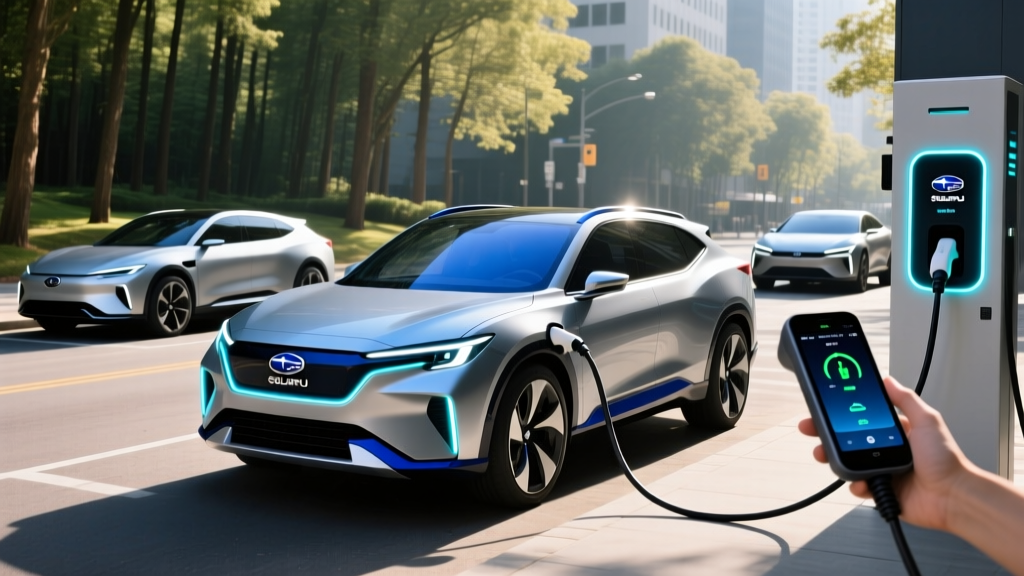
Subaru equips the Solterra with a CCS1 connector for DC fast charging and a J1772 inlet for Level 2 AC charging. Starting in late 2025, Subaru began offering a NACS adapter, granting Solterra owners access to the Tesla Supercharger network—a significant improvement over relying solely on Electrify America, EVgo, and ChargePoint stations.
| Level | Power | Miles Added per Hour | Use Case |
|---|---|---|---|
| Level 1 (120V) | ~1.4 kW | ~4–5 mi/hr | Emergency / overnight trickle |
| Level 2 (240V, 48A) | 11 kW | ~32 mi/hr | Home daily charging, full overnight fill |
| DC Fast Charge | Up to 150 kW peak | ~180 mi in 30 min (10–80%) | Road trips, public stations |
The 150 kW peak charge rate is adequate but trails competitors like the Hyundai Ioniq 5 (240 kW peak, 10–80% in ~18 minutes). The Solterra's charge curve tapers noticeably above 80%, so plan to unplug at 80% on road trips to avoid wasting time at diminishing returns.
Subaru Uncharted: The Upcoming Compact EV
Subaru announced the Uncharted, a compact electric SUV positioned below the Solterra in size and price. Expected to arrive as a 2026 model, preliminary specifications suggest:
- Target EPA Range: ~250 miles
- Battery: ~65 kWh (estimated, chemistry TBD)
- Starting MSRP: Sub-$35,000 (before incentives)
- Platform: Dedicated EV architecture (not e-TNGA)
- Drivetrain: AWD standard (Subaru brand DNA)
Note: The Uncharted has not yet begun customer deliveries as of early 2026. Specs above are based on Subaru's preliminary announcements and may change at launch. Check subaru.com for finalized figures.
EV vs. Gas vs. Hybrid: What Subaru Buyers Are Really Choosing
Most Subaru shoppers cross-shop the Solterra against the Outback (gas), Forester (gas), and Crosstrek Hybrid (PHEV). Here's how the math works over 5 years of ownership, assuming 15,000 miles/year, $3.50/gallon gas, and $0.14/kWh home electricity:
| Cost Category | Solterra EV | Outback (Gas) | Crosstrek Hybrid (PHEV) |
|---|---|---|---|
| Purchase Price (base MSRP) | $39,995 | $32,695 | $36,995 |
| Fed. Tax Credit (§30D, est.) | $0–$7,500* | $0 | $0–$3,750* |
| Fuel/Energy (5 yrs, 75k mi) | $5,250 | $10,500 | $7,200 |
| Maintenance (5 yrs) | $1,800 | $3,600 | $3,000 |
| Insurance (5 yrs, avg) | $9,500 | $7,800 | $8,200 |
| Estimated Depreciation | $16,000 | $12,500 | $14,000 |
| Total 5-Yr Cost (pre-credit) | $72,545 | $67,095 | $69,395 |
| Total 5-Yr Cost (w/ max credit) | $65,045 | $67,095 | $65,645 |
*Federal tax credit eligibility under IRS §30D depends on buyer income caps ($150k single / $300k joint AGI), vehicle MSRP caps ($80k SUVs), and battery critical-mineral sourcing requirements. The Solterra's eligibility fluctuates based on supply-chain compliance. Verify current-year status at fueleconomy.gov before purchasing. Point-of-sale transfer is available through participating dealers.
The Solterra's higher upfront cost and insurance premiums (EVs typically cost 15–25% more to insure) are offset by dramatically lower fuel and maintenance costs. If you qualify for the full $7,500 credit and charge primarily at home, the Solterra can break even with the Outback within 5 years. Without the credit, the Outback remains the cheaper option on pure economics.
Real-World Ownership Considerations
Home Charging Access
The Solterra's viability as a daily driver hinges on reliable home charging. A Level 2 (240V, 48A) home charger installation typically costs $1,200–$2,500 including a quality EVSE (e.g., ChargePoint Home Flex, Emporia Level 2) and electrician labor. If your home has a 200-amp electrical panel with spare capacity, installation is straightforward. Older homes with 100-amp panels may require a $2,000–$4,000 panel upgrade—a cost many first-time EV buyers overlook. Without home charging, relying on public Level 2 or DC fast chargers increases both cost (public charging averages $0.30–$0.48/kWh vs. $0.14/kWh residential) and inconvenience.
Climate and Driving Patterns
Subaru owners skew toward colder climates and outdoor lifestyles. If you live in the Mountain West, New England, or the Upper Midwest, expect 15–25% range loss in sustained sub-30°F driving. The Solterra's NMC battery and optional heat pump (standard on Touring, not all trims) mitigate this somewhat, but it remains a real limitation versus gas vehicles whose waste heat warms the cabin for free. For ski-trip-heavy owners who regularly drive 200+ miles in winter, a PHEV like the Crosstrek Hybrid may offer more flexibility.
The AWD Factor
Subaru's brand identity rests on symmetrical all-wheel drive. The Solterra delivers dual-motor AWD standard on all trims, providing genuine traction capability in snow and rain. However, it is not a hardcore off-roader—ground clearance is 8.3 inches (vs. 9.5 on the Outback Wilderness), and there's no tow rating. For light trail use and winter commuting, the Solterra's AWD is excellent. For serious overlanding, Subaru's gas models remain more capable.
Common Misconceptions About Subaru EVs
| Myth | Fact |
|---|---|
| "The Solterra can't handle road trips." | It can, with planning. A 400-mile trip requires one 30-minute DC fast-charge stop. The NACS adapter opens the Tesla Supercharger network, greatly improving route flexibility. |
| "Subaru EVs aren't real Subarus—they're just rebadged Toyotas." | The Solterra shares its platform with the bZ4X, but Subaru tuned the suspension, AWD logic, and X-Mode software independently. The Uncharted will use a different architecture. |
| "EV batteries need replacing after a few years." | The Solterra's battery is warrantied for 8 years/100,000 miles at 70% capacity. Industry data from fueleconomy.gov shows most NMC packs retain 85–90% capacity at 100k miles. |
| "I'll save money immediately by going electric." | Not always. Higher purchase price, insurance, and possible home charger installation mean the break-even point is typically 3–5 years, depending on your mileage and electricity rates. |
| "The Solterra qualifies for the full $7,500 tax credit." | Eligibility varies by model year, battery sourcing compliance, and your personal income. Check the latest IRS guidance and the dealer's point-of-sale credit availability before committing. |
Decision Framework: Which Subaru Is Right for You?
If-This-Then-That: Choosing Your Subaru
Choose the Solterra EV if:
- You have reliable home Level 2 charging (or can install it)
- Your daily driving is under 150 miles round-trip
- You qualify for the federal tax credit (income under $150k single / $300k joint)
- You want lower running costs and don't mind a 30-minute road-trip charge stop
- You value the latest tech, quiet cabin, and instant torque
Choose the Uncharted (when available) if:
- You want a smaller, more affordable Subaru EV (sub-$35k target)
- You're a city or suburban driver with shorter commutes
- You can wait for production and early-build availability
Choose the Crosstrek Hybrid (PHEV) if:
- You lack reliable home charging access
- You regularly drive 200+ miles in winter or remote areas
- You want electric commuting (~17 miles EV range) with gas flexibility for longer trips
- You prefer a lower purchase price and proven reliability track record
Choose a gas Outback or Forester if:
- You tow regularly (Solterra has no tow rating; Outback tows 2,700–3,500 lbs)
- You do serious off-roading or overlanding
- Your budget is strictly under $35,000 and you don't qualify for EV credits
- You live in an area with very limited public charging infrastructure
Frequently Asked Questions
Does Subaru make any fully electric cars besides the Solterra?
As of early 2026, the Solterra is the only Subaru BEV available for purchase. The Uncharted compact EV is expected to begin deliveries in 2026 but has not yet reached customer hands. Subaru also sells the Crosstrek Hybrid, which is a plug-in hybrid (PHEV)—not a full EV.
Is the Subaru Solterra eligible for the $7,500 federal tax credit?
Possibly. Eligibility under IRS §30D depends on three factors: your adjusted gross income (must be under $150k single / $225k head of household / $300k joint), the vehicle's MSRP (must be under $80,000 for SUVs), and battery critical-mineral and component sourcing requirements that change annually. The Solterra's eligibility has shifted between model years. Always verify on fueleconomy.gov and confirm point-of-sale transfer availability with your dealer before signing.
How long does it take to charge the Solterra at home?
On a Level 2 home charger (240V, 48A, 11 kW), a full 0–100% charge takes approximately 7.5 hours. Most owners plug in overnight and wake up to a full battery. On a standard 120V outlet (Level 1), a full charge takes over 50 hours—only practical for emergency trickle charging or very low daily mileage.
What happens if the Solterra battery degrades?
Subaru warranties the battery for 8 years or 100,000 miles against capacity loss below 70%. Industry data suggests NMC batteries typically retain 85–90% capacity at 100,000 miles under normal use. If a replacement is needed out of warranty, expect a cost in the $12,000–$18,000 range based on current NMC pack pricing, though costs continue to decline year over year.
Can I take the Solterra off-road?
The Solterra has 8.3 inches of ground clearance and Subaru's X-Mode traction management, making it capable on maintained dirt roads, snowy passes, and light trails. However, it is not rated for towing and lacks the underbody protection and clearance of an Outback Wilderness or Forester Wilderness. Think gravel-road capable, not rock-crawler.
Is the Solterra's AWD system as good as a gas Subaru's?
Different, but effective. The Solterra uses independent front and rear electric motors for AWD, which provides instant torque distribution and excellent traction in slippery conditions. It doesn't replicate the mechanical feel of Subaru's traditional symmetrical AWD, but for snow, rain, and light off-road use, it performs well. In some scenarios (e.g., low-speed traction control), electric AWD reacts faster than mechanical systems.