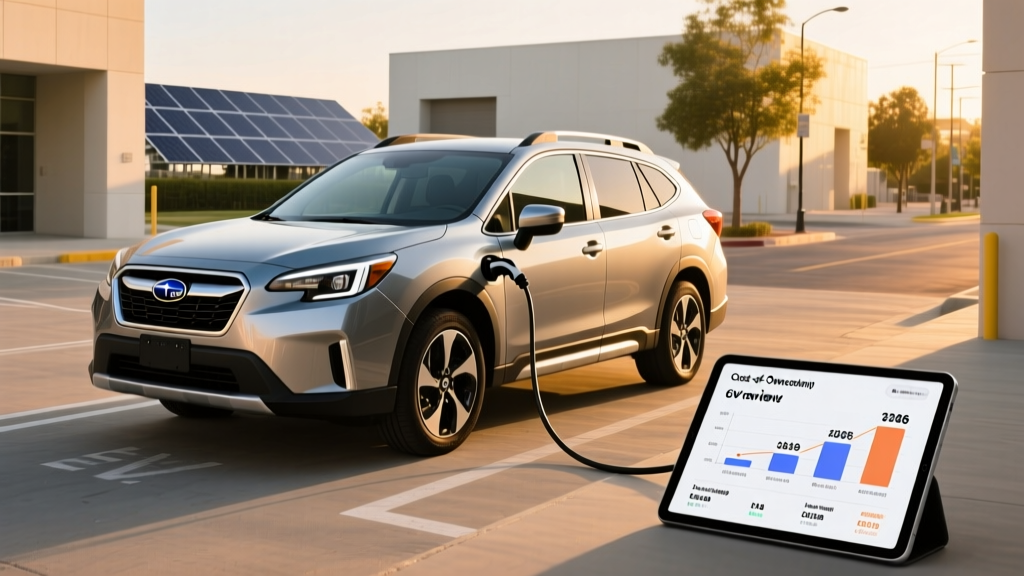
Subaru's all-electric Solterra has carved out a niche among buyers who want standard all-wheel drive, genuine off-road capability, and a practical crossover footprint — all without burning a drop of gas. But with a starting MSRP hovering around $44,995 for the 2026 model year, many shoppers are asking whether a Subaru EV lease makes more financial sense than buying outright, and what the real ongoing costs look like once you drive it off the lot.
This guide breaks down every ownership cost variable for the 2026 Subaru Solterra — from federal tax credit eligibility and state incentives to charging costs, insurance premiums, maintenance savings, and depreciation trends. We use concrete numbers, not marketing promises.
2026 Subaru Solterra: The Baseline Specs That Affect Your Wallet
Before calculating total cost, you need the hard numbers. The 2026 Solterra is built on the e-TNGA platform co-developed with Toyota (it's the mechanical twin of the bZ4X). Here's what matters for your budget:
| Specification | 2026 Solterra Premium | 2026 Solterra Limited | 2026 Solterra Touring |
|---|---|---|---|
| Base MSRP | $44,995 | $48,995 | $52,995 |
| Battery Capacity (usable) | 71.4 kWh (NMC lithium-ion) | ||
| EPA Range | 228 mi | 222 mi | 214 mi |
| Real-World Range (highway/cold) | ~170–195 mi (cold); ~190–210 mi (highway summer) | ||
| Peak DC Fast Charge Rate | 150 kW (CCS1) | ||
| 10–80% DC Charge Time | ~35 minutes (preconditioned) | ||
| Level 2 Charge Rate | 7.2 kW (~25 mi/hr) | ||
| Powertrain | Dual-motor AWD, 215 hp, 248 lb-ft torque | ||
| 0–60 mph | 6.5 seconds | ||
| EPA Efficiency | 104 MPGe combined (Premium) | ||
| Battery/Powertrain Warranty | 8 years / 100,000 miles | ||
The 5-Year Total Cost of Ownership: Buying vs. Leasing the Solterra
Whether you buy or lease, the total cost of operating the Solterra over five years includes the vehicle price (or lease payments), electricity, insurance, maintenance, and depreciation. Here's a realistic breakdown assuming 15,000 miles driven annually and national-average electricity rates.
| Cost Category | 5-Year Purchase (Financed) | 5-Year Lease (Two Consecutive Leases) |
|---|---|---|
| Vehicle Cost / Lease Payments | $44,995 (base) + $6,200 interest ≈ $51,195 | ~$450/mo × 60 mo + $3,000 down = $30,000 |
| Federal Tax Credit (§30D) | Up to –$7,500 (if eligible) | Passed through as lease cap reduction* |
| Electricity (75,000 mi total) | $4,500 (home charging dominant) | $4,500 |
| Insurance (avg. $2,100/yr) | $10,500 | $10,500 |
| Maintenance | $1,200 | $1,200 (may be partially covered) |
| Depreciation / Disposition | –$18,000 (est. resale at year 5) | $0 (return vehicle) |
| Estimated 5-Year Net Cost | ~$39,395 – $46,895 | ~$36,200 – $46,200 |
*Under IRS rules, the §30D credit on a leased vehicle is technically claimed by the lessor (the financing company). Most major lessors pass the $7,500 value through as a capitalized-cost reduction, effectively lowering your monthly payment — but this is not guaranteed. Always confirm with the dealer that the lease quote reflects the credit.
Federal Tax Credit Eligibility: Do You Qualify for §30D?
The IRS §30D Clean Vehicle Credit can knock up to $7,500 off your tax liability — or, as of 2024 onward, be transferred to the dealer at the point of sale for an immediate price reduction. But eligibility depends on a matrix of rules that trip up many buyers.
- MSRP Cap: The Solterra's base price must be ≤ $80,000 for SUVs (all trims qualify).
- Buyer Income Cap: Modified AGI must not exceed $150,000 (single), $225,000 (head of household), or $300,000 (joint filers).
- Battery Sourcing — Critical Minerals: A percentage of critical minerals must be sourced from the U.S. or FTA partners. This requirement tightens annually. Verify the 2026 Solterra's current compliance at fueleconomy.gov before purchasing.
- Battery Components: A percentage of battery components must be manufactured or assembled in North America. This threshold also increases yearly.
- Assembly: The Solterra is assembled in Japan (Toyota's Motomachi plant). This does not disqualify it from §30D (that rule applies to commercial vehicles under §45W), but battery sourcing requirements still apply.
- Point-of-Sale Transfer: You can elect to transfer the credit to the dealer, reducing your purchase price upfront — even if you owe less than $7,500 in taxes. If you later discover you didn't qualify, you must repay the credit on your tax return.
- Lease Loophole: Leased vehicles are technically eligible under a separate commercial credit (§45W) claimed by the lessor, which has fewer sourcing restrictions. This is why many lessees find the $7,500 passed through even when purchase buyers face sourcing limitations.
Key takeaway for Subaru EV lease seekers: Leasing may actually be the most reliable path to capturing the full $7,500 incentive on the Solterra, because the commercial-credit pathway for leases has historically had fewer battery-sourcing restrictions than the direct §30D purchase credit. Consult a tax professional to confirm your specific situation.
Charging Costs vs. Gasoline: The Per-Mile Math
The Solterra's 104 MPGe combined rating translates to roughly 32 kWh per 100 miles of driving. What that costs depends entirely on where and when you charge.
| Charging Scenario | Rate | Cost per 100 Miles | Cost per Mile |
|---|---|---|---|
| Home Level 2 (national avg. residential) | $0.16/kWh | $5.12 | $0.051 |
| Home with off-peak/utility EV rate | $0.09/kWh | $2.88 | $0.029 |
| Public DC Fast Charger (avg.) | $0.40/kWh | $12.80 | $0.128 |
| Tesla Supercharger (where accessible via adapter) | $0.30/kWh | $9.60 | $0.096 |
| Gasoline Vehicle (25 MPG combined) | $3.40/gallon | $13.60 | $0.136 |
At 15,000 miles per year, a Solterra owner charging primarily at home on a standard residential rate spends roughly $768/year on electricity. That same mileage in a 25 MPG gas crossover costs about $2,040/year in fuel — a savings of approximately $1,272 annually, or $6,360 over five years.
If you have access to an off-peak utility EV rate (many utilities offer $0.07–$0.10/kWh overnight), annual charging costs drop to roughly $435, widening the savings to over $1,600/year.
Maintenance Savings: Fewer Parts, Lower Bills
EVs eliminate the most common recurring maintenance items that gas-car owners accept as routine. The Solterra has no engine oil, no transmission fluid, no spark plugs, no exhaust system, and no timing belt. Regenerative braking dramatically reduces wear on the friction brake pads and rotors.
| Maintenance Item | Gas Crossover (5-Year Cost) | Solterra EV (5-Year Cost) |
|---|---|---|
| Oil Changes (synthetic, 2×/yr) | $750 | $0 |
| Transmission Fluid Service | $200 | $0 |
| Engine Air Filter | $150 | $0 |
| Spark Plugs | $400 | $0 |
| Brake Pad Replacement | $600 | $0–$200 (regen extends life significantly) |
| Cabin Air Filter | $150 | $150 |
| Tire Rotation | $250 | $250 |
| Tire Replacement (heavier EV wear) | $1,200 | $1,400 (EVs are heavier, wear tires ~15–20% faster) |
| Coolant / Misc. | $300 | $200 |
| Total Estimated 5-Year Maintenance | $4,000 | ~$2,200 |
Net maintenance savings over five years: approximately $1,800. This doesn't include the time value of fewer dealer visits or the reduced risk of unexpected powertrain failures (no head gasket, no turbo, no catalytic converter to replace).
Insurance Costs: The Line Item That Cuts the Other Way
Here's where honesty matters. EVs, including the Solterra, typically cost 15–25% more to insure than comparable gas-powered crossovers. National average data puts Solterra insurance at roughly $2,100–$2,400/year depending on your state, driving record, and coverage level, compared to approximately $1,600–$1,800/year for a gas Subaru Outback.
Why the premium?
- Higher repair costs: EV battery packs, power electronics, and specialized sensors are expensive to replace after a collision. Body shops need EV-specific training and equipment.
- Higher vehicle value: The Solterra's MSRP is higher than many gas competitors, so comprehensive and collision payouts are larger.
- Specialized parts supply chain: Replacement body panels and high-voltage components may have longer lead times, increasing rental-car reimbursements and labor.
Some insurers (Geico, Progressive, State Farm) now offer EV-specific discounts or usage-based programs that can narrow the gap. Always get quotes from at least three carriers before committing to a purchase or lease.
Depreciation and Resale Value: What the Solterra Is Worth Later
EV depreciation has been volatile. The Solterra (and its twin, the Toyota bZ4X) experienced steeper-than-expected depreciation in 2023–2024, partly due to aggressive initial pricing, the competitive EV market, and early concerns about charging speed and range relative to rivals like the Hyundai Ioniq 5 and Tesla Model Y.
Based on current resale data and industry projections from sources like Kelley Blue Book and iSeeCars, expect a Solterra to retain roughly 45–55% of its original MSRP after five years / 75,000 miles. That translates to a resale value of approximately $20,000–$25,000 for a base Premium trim.
This is the strongest argument for leasing: if depreciation accelerates due to new battery technology, updated competitors, or shifting consumer preferences, the lessor absorbs the loss — not you. At lease-end, you simply return the vehicle (or purchase it at the pre-set residual if it's worth more than anticipated).
Conversely, if you plan to keep the Solterra for 8–10 years and drive it well past 100,000 miles, depreciation matters less, and you'll benefit from the full battery warranty coverage period.
Is a Subaru EV Lease the Right Financial Move?
Choose a Subaru EV lease if:
- You want to capture the $7,500 incentive without worrying about battery-sourcing rule changes that affect purchase buyers.
- You drive 10,000–15,000 miles/year and can stay within typical lease mileage limits (10k/12k/15k options).
- You want to upgrade to a newer EV with better range or charging speed in 3 years as the market evolves rapidly.
- You prefer predictable monthly payments without long-term depreciation risk.
Choose to purchase the Solterra if:
- You plan to keep the vehicle 7+ years, driving well past the warranty period.
- You drive more than 15,000 miles/year (lease overage penalties of $0.15–$0.25/mile add up fast).
- You qualify for the full §30D purchase credit and want to own an asset outright.
- You want to modify the vehicle (lift kits, roof racks for heavy gear — Subaru's core audience).
Frequently Asked Questions
How much does it really cost to own a Subaru Solterra over 5 years?
Between $36,000 and $47,000 over five years depending on whether you buy or lease, your electricity rates, insurance premiums in your state, and actual depreciation. The purchase path with the full $7,500 federal credit and home charging can be as low as ~$39,000 net. Leasing two consecutive 36-month terms typically runs $36,000–$46,000 net including the passed-through incentive.
Do I qualify for the federal EV tax credit on the Solterra?
You likely qualify if your modified AGI is under $150,000 (single) or $300,000 (joint), and the vehicle's battery sourcing meets current-year thresholds. Because the Solterra is built in Japan, battery-component and critical-mineral sourcing determine the exact credit amount ($3,750 or $7,500). Check the latest status at fueleconomy.gov and confirm with your tax professional. Leasing typically bypasses sourcing restrictions entirely.
How much do I save on fuel and maintenance vs. a gas Subaru?
Expect to save roughly $1,200–$1,600 per year on electricity vs. gasoline (depending on your utility rate), and approximately $360/year on maintenance. Over five years, combined fuel and maintenance savings total roughly $7,500–$9,500. These savings partially offset the Solterra's higher purchase price and insurance premiums.
Are EVs more expensive to insure than gas cars?
Yes, typically 15–25% more. The Solterra averages $2,100–$2,400/year nationally vs. roughly $1,600–$1,800 for a gas Outback. Higher repair costs for battery and power electronics, plus higher vehicle values, drive the difference. Shop multiple insurers and ask about EV-specific discounts.
How well does the Subaru Solterra hold its value?
Current projections suggest 45–55% value retention after five years — lower than Subaru's historically strong gas-vehicle residuals but typical for EVs in a rapidly evolving market. This depreciation uncertainty is the primary reason many financial analysts recommend leasing EVs rather than buying, at least until the market stabilizes.
Can I install a home Level 2 charger for the Solterra?
Yes. The Solterra uses a J1772 connector for Level 2 AC charging (CCS1 for DC fast charging). A 48-amp Level 2 home charger on a 240V/60A circuit will fully replenish the 71.4 kWh battery in roughly 10–11 hours, adding about 25 miles of range per hour of charging. Expect $500–$1,500 for the charger unit and $800–$2,500 for professional electrical installation depending on your panel capacity and run length. Many utilities offer rebates covering $300–$1,000 of this cost.