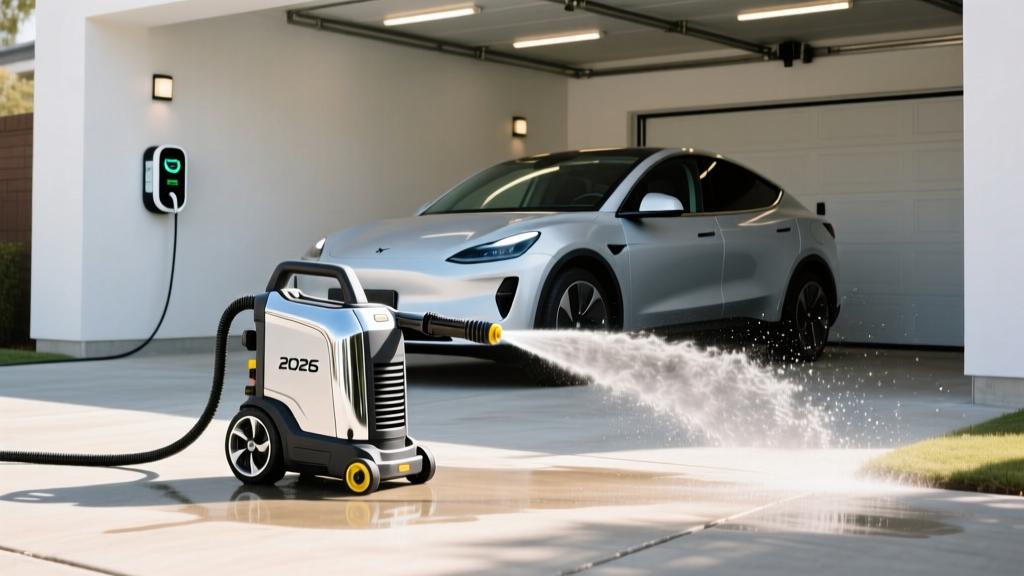
Washing an electric vehicle requires a pressure washer that is powerful enough to remove road salt, brake dust, and bug splatter, yet safe enough to avoid damaging sensors, cameras, and charging port seals. If you are searching for the strongest electric pressure washer for your EV, the answer depends on whether you need raw power for driveway detailing or a balanced unit that protects your vehicle's sensitive exterior electronics.
Quick Answer: Strongest Electric Pressure Washer for EVs
The strongest electric pressure washer currently available for residential EV detailing is the Sun Joe SPX3000, delivering 2030 PSI and 1.76 GPM. For commercial-grade power, the AR Blue Clean AR383 reaches 1900 PSI with superior build quality. However, for safe EV washing, experts recommend staying between 1200-1800 PSI to avoid damaging ADAS sensors and charging port gaskets.
Why PSI and GPM Matter for Electric Vehicle Washing
When evaluating the strongest electric pressure washer, two specifications dominate: PSI (pounds per square inch) and GPM (gallons per minute). PSI measures the force of the water stream, while GPM measures the volume. For EV owners, the balance between these two figures is critical.
Modern electric vehicles like the Tesla Model Y, Ford Mustang Mach-E, and Hyundai Ioniq 5 are equipped with external sensors, cameras, and radar units that support Level 2 driver-assistance systems such as Autopilot, BlueCruise, and Hyundai SmartSense. These components are sealed against weather, but high-pressure water streams above 2000 PSI can compromise gaskets, force water into sensor housings, and potentially damage charging port seals.
According to detailing professionals, the ideal pressure range for washing an EV is 1200-1800 PSI with a 40-degree nozzle tip to disperse the water stream. This provides enough force to remove contaminants without risking damage to sensitive electronics.
Top 5 Strongest Electric Pressure Washers for EV Owners in 2026
| Model | PSI | GPM | Motor (Amps) | Price (MSRP) | Best For |
|---|---|---|---|---|---|
| Sun Joe SPX3000 | 2030 | 1.76 | 14.5A | $169 | Maximum power, budget-friendly |
| AR Blue Clean AR383 | 1900 | 1.5 | 12A | $189 | Durability, commercial use |
| Greenworks GPW1702 | 1700 | 1.2 | 13A | $129 | Compact, safe for EV sensors |
| Karcher K5 Premium | 2000 | 1.4 | 15A | $299 | Premium features, detergent tank |
| Stanley SHP2150 | 2150 | 1.4 | 14A | $199 | Highest PSI, heavy-duty grime |
Electric Pressure Washer vs. Gas: Cost and Convenience Comparison
Many EV owners wonder whether an electric pressure washer is sufficient or if a gas-powered unit is necessary for heavy-duty cleaning. The comparison mirrors the broader EV vs. gas vehicle debate: electric units offer lower operating costs and zero tailpipe emissions, while gas models provide higher peak power and portability.
Electric vs. Gas Pressure Washer: Key Differences
| Factor | Electric Pressure Washer | Gas Pressure Washer |
|---|---|---|
| Max PSI (Residential) | 2030-2150 PSI | 3000-4000 PSI |
| Noise Level | 60-75 dB | 85-95 dB |
| Operating Cost (per hour) | $0.10-$0.20 (electricity) | $1.50-$2.50 (gasoline) |
| Maintenance | Minimal (no oil, spark plugs) | Oil changes, air filters, winterization |
| Emissions | Zero tailpipe | CO2, NOx, particulates |
| Portability | Limited by cord length | Fully portable |
| Cold-Weather Starting | Instant | Choke, priming, potential failure |
For most EV owners washing their vehicles at home, an electric pressure washer is the practical choice. The strongest electric pressure washer models deliver sufficient power for routine detailing, and the lower noise level is appreciated in residential neighborhoods. Gas models are better suited for large properties, fleet washing, or removing deeply embedded stains from concrete.
Real-World Ownership Costs: Electric Pressure Washer Breakdown
Understanding the total cost of ownership helps EV buyers make informed decisions. The same principle applies to pressure washers. Here is a five-year cost breakdown comparing a high-end electric model to a mid-range gas unit:
5-Year Cost of Ownership: Electric vs. Gas Pressure Washer
| Cost Factor | Sun Joe SPX3000 (Electric) | Honda GC190 (Gas) |
|---|---|---|
| Purchase Price | $169 | $399 |
| Annual Energy/Fuel (20 hrs/yr) | $4 (electricity) | $60 (gasoline) |
| 5-Year Energy/Fuel Total | $20 | $300 |
| Maintenance (oil, filters, winterization) | $0 | $150 |
| 5-Year Total Cost | $189 | $849 |
The electric pressure washer saves approximately $660 over five years, primarily due to lower fuel and maintenance costs. This mirrors the total cost of ownership advantage that electric vehicles hold over gas cars, as documented by the U.S. Department of Energy's fueleconomy.gov.
Common Misconceptions About Electric Pressure Washers
EV owners researching the strongest electric pressure washer often encounter myths that can lead to poor purchasing decisions. Let's address these with facts:
Myth vs. Fact: Electric Pressure Washers
| Myth | Fact |
|---|---|
| "Electric pressure washers are too weak for cars." | Models like the Sun Joe SPX3000 (2030 PSI) exceed the 1200-1800 PSI recommended for safe vehicle washing. |
| "You need a gas pressure washer to remove brake dust." | Brake dust requires chemical dissolution (iron remover spray) followed by 1500+ PSI rinse. Electric units handle this easily. |
| "Higher PSI always means better cleaning." | Excessive PSI (>2500) can strip clear coat, damage rubber seals, and force water into EV sensor housings. |
| "Electric models can't run long enough for a full wash." | Electric pressure washers have no duty cycle limits like gas engines. They run as long as you need. |
| "Corded electric limits your range." | A 50-foot extension cord plus 25-foot high-pressure hose provides 75 feet of reach—sufficient for most driveways. |
How to Safely Wash Your EV with a Pressure Washer
Electric vehicles require specific washing techniques to protect their advanced electronics. Follow these steps to avoid damage:
- Pre-rinse with low pressure: Use a 40-degree tip and maintain 12 inches of distance to loosen surface dirt.
- Avoid direct spray on sensors: Do not aim the nozzle directly at cameras, radar units, or ultrasonic sensors. These are typically located in the front bumper, side mirrors, and rear fascia.
- Protect the charging port: Ensure the charging port door is fully closed and latched. Do not spray directly at the port seal.
- Use foam cannon attachment: Many electric pressure washers accept foam cannon adapters. Apply pH-neutral car shampoo foam, let it dwell for 3-5 minutes, then rinse.
- Rinse from top to bottom: Start at the roof and work downward to prevent re-contamination of clean surfaces.
- Dry with microfiber or air blower: Standing water can leave mineral deposits. Use a clean microfiber towel or electric leaf blower to dry crevices around sensors and cameras.
Decision Framework: Which Electric Pressure Washer Should You Buy?
Choosing the strongest electric pressure washer for your needs depends on your specific use case. Use this framework to decide:
If X, Then Y: Pressure Washer Selection
- If you wash only your EV and occasional patio furniture: Choose the Greenworks GPW1702 (1700 PSI, $129). It's lightweight, safe for sensors, and budget-friendly.
- If you want maximum power for heavy grime and winter salt: Choose the Sun Joe SPX3000 (2030 PSI, $169). It's the strongest electric pressure washer in its price class.
- If you need commercial durability for frequent use: Choose the AR Blue Clean AR383 (1900 PSI, $189). Its axial cam pump outlasts wobble pumps in budget models.
- If you want premium features like onboard detergent injection: Choose the Karcher K5 Premium (2000 PSI, $299). It includes a water-cooled motor for extended life.
- If you need the absolute highest PSI for concrete and decks: Choose the Stanley SHP2150 (2150 PSI, $199). Use a wider nozzle tip when washing your EV to reduce effective pressure.
Frequently Asked Questions
Can I use a pressure washer on my Tesla Model Y or Ford Mustang Mach-E?
Yes, but keep the pressure below 2000 PSI and avoid direct spray on Autopilot cameras, radar sensors, and the charging port. Tesla recommends a maximum of 1500 PSI in their owner's manual for routine washing.
What is the strongest electric pressure washer available in 2026?
The Stanley SHP2150 delivers 2150 PSI, making it the strongest electric pressure washer for residential use. However, for EV washing, the Sun Joe SPX3000 (2030 PSI) offers a better balance of power and value.
Do I need a special nozzle for washing my EV?
Yes. Use a 40-degree (white) or 25-degree (green) nozzle tip. Avoid 0-degree (red) or 15-degree (yellow) tips, which concentrate the stream and can damage paint and seals.
How much does it cost to run an electric pressure washer?
A 14-amp electric pressure washer consumes approximately 1.7 kWh per hour. At the U.S. average electricity rate of $0.16/kWh (per the U.S. Energy Information Administration), that's about $0.27 per hour of operation.
Can I use an extension cord with an electric pressure washer?
Yes, but use a 12-gauge or 10-gauge outdoor-rated extension cord no longer than 50 feet. Thinner cords (14- or 16-gauge) cause voltage drop, reducing motor performance and potentially damaging the pump.
The strongest electric pressure washer for EV owners in 2026 is the Sun Joe SPX3000, offering 2030 PSI and 1.76 GPM at an accessible $169 price point. For safe vehicle washing, pair it with a 40-degree nozzle tip and maintain proper distance from sensitive ADAS components. Electric pressure washers deliver lower operating costs, zero emissions, and sufficient power for routine detailing—making them the ideal companion for your electric vehicle ownership journey.