Quick Answer: Are Street Legal Electric Carts Worth It?
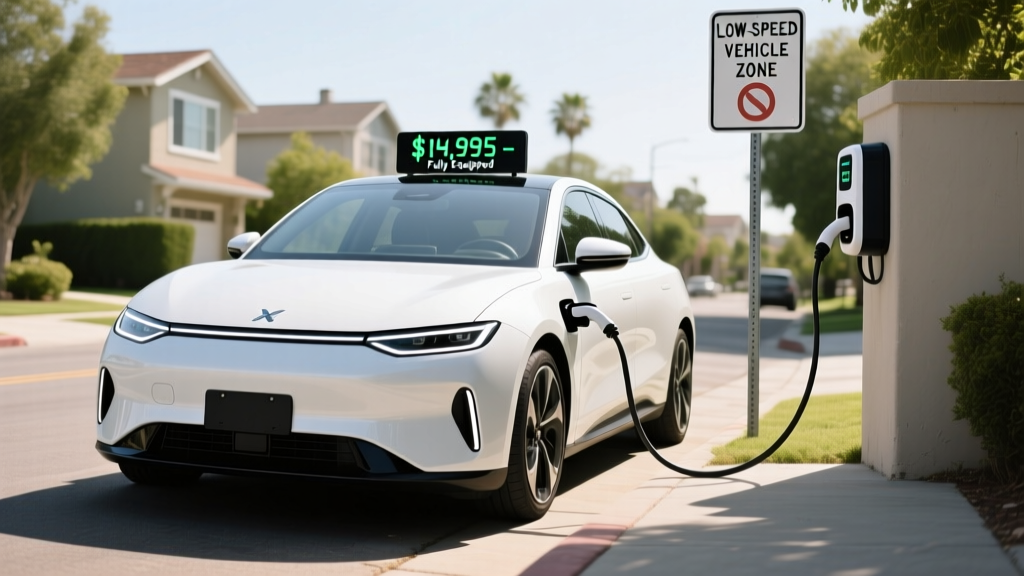
Street legal electric carts—federally classified as Low-Speed Vehicles (LSVs)—are small, battery-electric vehicles limited to a top speed of 25 mph and legal on roads posted at 35 mph or lower in most states. Expect to pay between $8,000 and $18,000, with typical ranges of 40 to 80 miles on a full charge. They cost roughly $0.03 to $0.05 per mile to "fuel" at home—about one-tenth the cost of gasoline. However, they are not substitutes for full-size EVs: they lack highway capability, advanced crash protection, and long-distance range. They work best as neighborhood runabouts, campus vehicles, or retirement-community daily drivers.
What Exactly Is a Street Legal Electric Cart?
A street legal electric cart is not a golf cart. Under Federal Motor Vehicle Safety Standard (FMVSS) No. 500, a Low-Speed Vehicle (LSV) must meet specific requirements to be driven on public roads:
- Top speed between 20 and 25 mph
- Headlamps, turn signals, stop lamps, tail lamps
- Exterior mirrors (driver and passenger side)
- Parking brake
- Windshield (glazed, per DOT standards)
- VIN (Vehicle Identification Number)
- Seat belts for all seating positions
Standard golf carts—those without these features—are not street legal in most jurisdictions unless a local ordinance creates an exception. Several manufacturers produce purpose-built LSVs with lithium battery packs, including brands like GEM (Polaris), Club Car (Onward LSV), and newer entrants such as Wink Motors and Kandi America.
2026 LSV Models: Range, Battery, and Specs
Here's what the current street legal electric cart landscape looks like for key models available or on order in 2026. Note that LSVs are not EPA-rated for MPGe the way full-size EVs are, so range figures come from manufacturer testing under ideal conditions—expect real-world reductions of 15–30% depending on terrain, temperature, and payload.
| Model | Battery (kWh) | Chemistry | Claimed Range (mi) | Real-World Range (mi) | Top Speed | Charge Time (120V) | Base MSRP |
|---|---|---|---|---|---|---|---|
| GEM e2 (2026) | 11.5 kWh usable | NMC Lithium-ion | 55 | 38–48 | 25 mph | 6–8 hours | $12,499 |
| GEM e4 (4-seat) | 14.4 kWh usable | NMC Lithium-ion | 50 | 35–45 | 25 mph | 8–10 hours | $15,299 |
| Club Car Onward LSV | 10.2 kWh | LFP (Lithium Iron Phosphate) | 45 | 32–42 | 25 mph | 6–8 hours | $13,999 |
| Wink Motors Model 1 | 7.7 kWh | NMC Lithium-ion | 50 | 35–43 | 25 mph | 5–7 hours | $8,999 |
| Kandi America Kruiser 4 | 12.0 kWh | LFP | 62 | 45–58 | 25 mph | 7–9 hours | $11,499 |
Chemistry note: LFP (lithium iron phosphate) batteries trade some energy density for longer cycle life and better thermal stability. If you plan to keep your LSV for 8+ years, an LFP pack may degrade more gracefully than NMC. NMC packs offer more range per pound—important in weight-constrained LSV platforms.
Real Costs: Street Legal Electric Cart vs. Gas Car
Most LSV buyers are choosing between an electric cart and either a used gas car, a new subcompact, or a gas-powered golf cart. Let's break down the numbers over a typical 5-year ownership period, assuming 3,000 miles driven per year (neighborhood use).
| Cost Category | Street Legal EV Cart (5 yr) | Used Gas Subcompact (5 yr) | Gas Golf Cart (5 yr) |
|---|---|---|---|
| Purchase Price | $12,000 (avg) | $14,000 (avg used) | $9,500 (avg) |
| Fuel/Energy | $450 (3,000 mi/yr × $0.03/mi) | $3,750 (3,000 mi/yr × $0.25/mi at 30 MPG, $3.75/gal) | $2,250 (3,000 mi/yr × $0.15/mi) |
| Maintenance | $300 (brake pads, tire rotation, cabin filter) | $3,500 (oil, filters, belts, transmission, brakes) | $1,800 (oil, spark plugs, carburetor, belts) |
| Insurance | $1,200 ($240/yr avg for LSV policy) | $5,500 ($1,100/yr avg) | $900 ($180/yr avg, liability only) |
| Battery Replacement Reserve | $2,500 (prorated, if out of warranty) | $0 | $0 |
| 5-Year Total | ~$16,450 | ~$26,750 | ~$14,450 |
The electric cart wins decisively on operating costs. Over five years, you'll spend roughly $450 on electricity versus $3,750 on gas for a comparable subcompact. Maintenance is minimal—no oil changes, no transmission fluid, no spark plugs. However, the gas golf cart can edge out the LSV on total cost if you don't need street legality and already have a paved path or private property to drive on.
Charging cost math: A typical LSV battery holds 10–14 kWh. At the US average residential electricity rate of roughly $0.16/kWh (per EIA data), a full charge costs about $1.60 to $2.24. That translates to 3–5 cents per mile—dramatically cheaper than gasoline.
Charging at Home: What You Actually Need
Unlike full-size EVs, street legal electric carts do not require a dedicated Level 2 home charger. Nearly all LSVs charge from a standard 120V household outlet using an onboard charger and a NEMA 5-15 plug. Here's what to expect:
- Level 1 (120V standard outlet): 1.0–1.5 kW draw. Full charge in 6–10 hours depending on battery size. This is the default and, for most owners, the only charging method needed.
- Level 2 (240V): Some newer models (GEM e2/e4 2026, select Kandi models) offer optional Level 2 onboard chargers at 2.5–3.3 kW, cutting charge time to 3–5 hours. This requires a 240V outlet (NEMA 14-50 or hardwired), which may need an electrician—budget $400–$1,200 for installation depending on your panel's capacity and distance to the outlet.
- DC Fast Charging: Not available on LSVs. The battery packs are too small to benefit from DCFC architecture, and the cost would be disproportionate.
Real-world charging consideration: If you live in an apartment or condo without garage access, you'll need to verify that you can run an extension cord or install an outdoor-rated outlet. LSV batteries are not large enough to justify public charging infrastructure, and most public chargers use connectors (CCS, NACS) that LSVs don't have. Plan your charging around a standard outlet you control.
Federal Tax Credits and State Incentives
This is where many buyers get confused. Under the current IRS §30D Clean Vehicle Credit rules, LSVs occupy a gray area:
- The §30D credit applies to vehicles with a gross vehicle weight rating (GVWR) under 14,000 lbs and a battery capacity of at least 7 kWh. Most LSVs meet the battery threshold.
- However, the vehicle must be manufactured primarily for use on public streets, roads, and highways. LSVs technically qualify under this definition, but the vehicle must also be from a qualified manufacturer that has registered with the IRS and met battery sourcing and critical mineral requirements.
- MSRP caps: Vans, SUVs, and pickup trucks are capped at $80,000; other vehicles (including LSVs, classified as "other") are capped at $55,000. All current LSVs fall well under this cap.
- Income caps: Modified adjusted gross income (MAGI) must not exceed $150,000 (single), $225,000 (head of household), or $300,000 (joint).
The practical reality: As of early 2026, very few LSV manufacturers have completed the IRS registration and battery-sourcing documentation required for the credit to apply at point of sale. Always verify with the dealer and your tax professional whether a specific LSV model qualifies. Do not assume the $7,500 credit applies. Some states offer additional rebates for neighborhood electric vehicles—check your state's energy office or DMV for specifics.
Common Misconceptions About Street Legal Electric Carts
| Myth | Fact |
|---|---|
| "I can just add seat belts and lights to my golf cart to make it street legal." | Converting a standard golf cart to LSV status requires meeting all FMVSS 500 standards, obtaining a proper VIN, and passing state registration. Many conversions fail inspection. Purpose-built LSVs are the safer, more reliable path. |
| "LSVs can be driven on any road." | LSVs are generally restricted to roads with speed limits of 35 mph or lower. Crossing higher-speed roads at intersections is usually permitted, but driving along them is not. Local ordinances vary—always check your city and state rules. |
| "Electric carts don't need insurance." | If it's street legal, it needs insurance. Most states require minimum liability coverage for LSVs. Specialized LSV policies are available from carriers like Progressive and Hagerty, typically $150–$350/year. |
| "The battery will need replacing every 2–3 years." | Modern lithium-ion LSV batteries (NMC or LFP) are rated for 1,500–3,000+ charge cycles before dropping to 80% capacity. At one charge per day, that's 4–8+ years of useful life. Lead-acid batteries (found on budget/used models) degrade much faster—2–4 years. |
| "LSVs are as safe as regular cars." | LSVs are not required to pass crash testing (no NHTSA star ratings). They lack airbags, crumple zones, and stability control. They are appropriate for low-speed neighborhood use only—never a substitute for a full-size vehicle on higher-speed roads. |
Real-World Ownership: What Buyers Overlook
Cold weather range loss: Lithium-ion batteries lose 15–30% of usable capacity in freezing temperatures. A GEM e2 rated for 55 miles may deliver only 35–40 miles on a 25°F morning. If you live in the upper Midwest or Northeast, plan your routes accordingly. LFP chemistry suffers slightly more cold-weather loss than NMC.
Terrain matters: LSV motors are typically 4–8 kW (5–11 hp). Hills drain batteries fast. If your neighborhood has steep grades, expect 20–40% range reduction on hilly routes versus flat terrain. Some models offer a "tow" or "hill" mode that increases current draw at the cost of range.
Safety on shared roads: You'll be sharing roads with 4,000-pound vehicles traveling at 30–35 mph. An LSV weighs 1,000–1,500 pounds. The speed differential is real, and LSVs have minimal crash protection. Stick to roads where you feel visible and safe, and use turn signals and reflective tape liberally.
Resale value: The LSV market is niche. Expect depreciation of 40–60% over five years, depending on brand reputation and battery condition. GEM (backed by Polaris) and Club Car hold value better than lesser-known imports. Always document battery health (state of health percentage) when selling.
Decision Framework: Should You Buy a Street Legal Electric Cart?
Choose a street legal electric cart (LSV) if:
- Your daily trips are under 20 miles round-trip on roads posted 35 mph or lower
- You have access to a standard 120V outlet for overnight charging (garage, carport, or outdoor-rated outlet)
- You want near-zero maintenance and fuel costs under $50/month
- You live in a retirement community, college town, island, or neighborhood with short errand distances
- You don't need highway access, crash protection, or all-weather capability
Choose a full-size EV (or skip the LSV) if:
- You regularly drive on roads posted above 35 mph
- You need to carry more than 2–4 passengers or significant cargo
- You live in a region with harsh winters and need reliable range in sub-freezing temperatures
- You want NHTSA crash ratings, airbags, and modern driver-assist features
- Your daily driving exceeds 30 miles
Choose a gas golf cart (non-street-legal) if:
- You only drive on private property, golf courses, or gated communities without street-legal requirements
- You need longer range without charging downtime
- Your budget is under $10,000 and you want simpler mechanical maintenance
Frequently Asked Questions
Do I need a driver's license to operate a street legal electric cart?
Yes, in nearly all states. An LSV is a registered motor vehicle. You need a valid driver's license, registration, and insurance—just like any other car. A few states have exceptions for low-speed operation by licensed minors on private roads, but these are rare.
Can I drive an LSV on roads with speed limits above 35 mph?
Generally, no. Federal law permits LSVs on roads posted at 35 mph or lower. You may cross higher-speed roads at intersections. Some states allow local governments to permit LSVs on roads up to 45 mph, but this is uncommon. Always verify local ordinances with your city clerk or DMV.
How long do LSV batteries last before replacement?
Modern lithium-ion LSV batteries (NMC or LFP) typically last 5–10 years or 1,500–3,000 charge cycles before degrading to 80% of original capacity. Replacement costs range from $2,000 to $4,500 depending on the model and battery size. Lead-acid batteries, found on older or budget models, last only 2–4 years and cost $800–$1,500 to replace.
Are street legal electric carts eligible for the $7,500 federal tax credit?
It depends. The vehicle must meet IRS §30D requirements including minimum 7 kWh battery, manufacturer registration, and battery sourcing/critical mineral standards. As of 2026, most LSV manufacturers have not completed the documentation required for point-of-sale credit. Verify with your dealer and tax professional before counting on the credit.
What's the difference between an LSV and a Neighborhood Electric Vehicle (NEV)?
They're the same thing. "NEV" is the colloquial term; "LSV" is the federal regulatory classification under FMVSS 500. You'll see both terms used interchangeably by manufacturers and DMVs.
Can I charge an LSV at a public EV charging station?
No. Public charging stations use CCS, NACS, or CHAdeMO connectors. LSVs charge via standard 120V AC plugs (NEMA 5-15) or, on some models, 240V outlets. You need access to a household-style outlet, not a public DC fast charger or Level 2 pedestal.
Sources: FMVSS No. 500 via eCFR, IRS Clean Vehicle Credits via irs.gov, EIA electricity pricing via eia.gov.