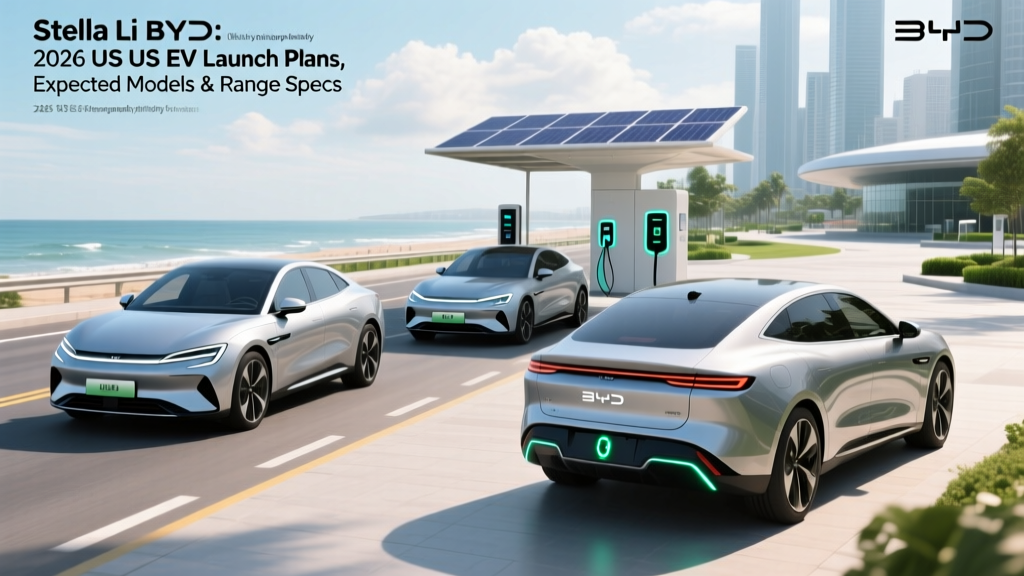
BYD executive Stella Li has been the public face of the Chinese automaker's global expansion for years, and her statements about a potential US market entry have drawn intense scrutiny from EV buyers and industry analysts alike. As of early 2026, BYD has not launched any consumer passenger EV in the United States — but the company's growing global footprint, new factory announcements, and Li's public remarks keep the question alive: When will BYD sell cars in the US, and what should American EV buyers expect?
This profile breaks down everything we know — and clearly separates confirmed facts from speculation — about BYD's US ambitions under Stella Li's leadership, the models most likely to arrive, and the specs, pricing, and tax-credit implications American buyers should watch.
Who Is Stella Li and What Is Her Role at BYD?
Stella Li (李路) serves as BYD's Executive Vice President and is widely regarded as the architect of the company's international passenger-vehicle strategy. Under her direction, BYD has expanded from a China-dominant brand to the world's largest producer of new-energy vehicles (NEVs), surpassing 3 million annual NEV sales globally. Li has overseen BYD's entry into Europe, Southeast Asia, Latin America, and Australia — markets where models like the Atto 3 (known as the Yuan Plus in China), Seal, and Dolphin have gained significant traction.
Her public comments about the US market have been measured. In interviews through 2024 and 2025, Li acknowledged the US as an important market but cited tariff barriers, geopolitical tensions, and the need for local manufacturing as prerequisites for entry. BYD's announcement of a passenger-vehicle factory in Mexico (focused on the Latin American market) and continued investment in European production (including a plant in Hungary) signal a strategy of building regional manufacturing hubs before approaching the US directly.
Which BYD Models Could Come to the US?
If BYD enters the US market, industry analysts and Li's own hints point to a handful of models most likely to lead the charge. Here's what the global lineup looks like with confirmed international specs:
| Model | Body Style | Battery (kWh) | Chemistry | WLTP Range | 0-100 km/h | Drivetrain |
|---|---|---|---|---|---|---|
| BYD Seal | Sedan | 82.5 kWh | LFP (Blade) | ~354 mi (570 km) | 5.9s (RWD) / 3.8s (AWD) | RWD / AWD |
| BYD Atto 3 | Compact SUV | 60.5 kWh | LFP (Blade) | ~260 mi (420 km) | 7.3s | FWD |
| BYD Dolphin | Hatchback | 60.4 kWh | LFP (Blade) | ~265 mi (427 km) | 7.0s | FWD |
| BYD Seal U | Mid-Size SUV | 87.0 kWh | LFP (Blade) | ~310 mi (500 km) | 5.9s | RWD / AWD |
| BYD Han | Full-Size Sedan | 85.4 kWh | LFP (Blade) | ~323 mi (521 km) | 3.9s (AWD) | AWD |
Important note on range figures: The ranges above are WLTP estimates used in European and Asian markets. EPA range ratings — the standard in the US — are typically 10-15% lower than WLTP due to more demanding test cycles. If the BYD Seal were EPA-rated, a reasonable estimate would place it around 300-315 miles EPA, though official numbers would require US-market certification.
BYD Blade Battery Technology: LFP Chemistry Explained
Every BYD passenger EV uses the company's proprietary Blade Battery, a cell-to-pack design using lithium iron phosphate (LFP) chemistry. This is a deliberate choice that distinguishes BYD from competitors like Tesla (which uses both LFP and NMC depending on model and market) and Hyundai/Kia (primarily NMC).
| Attribute | LFP (BYD Blade) | NMC (Most Competitors) |
|---|---|---|
| Energy Density | Lower (~160 Wh/kg cell-level) | Higher (~250-300 Wh/kg) |
| Cycle Life | 3,000-5,000+ cycles | 1,000-2,000 cycles |
| Thermal Stability | Excellent — resists thermal runaway | Good — requires more active cooling |
| Cold-Weather Performance | More range loss in freezing temps | Better cold-weather retention |
| Cost | Lower (no cobalt/nickel) | Higher (cobalt/nickel supply chain) |
| State-of-Charge Recommendation | Can be charged to 100% regularly | Best kept 20-80% for longevity |
| Critical Mineral Sourcing | Iron + phosphate — fewer geopolitical supply risks | Cobalt + nickel — higher sourcing scrutiny |
BYD claims the Blade Battery can withstand nail-penetration tests without thermal runaway — a significant safety claim that has been independently verified in some testing scenarios. For US buyers, the LFP trade-off is clear: you get exceptional longevity and safety, but at the cost of slightly lower range per kilogram and greater cold-weather sensitivity.
Expected Charging Specs and Infrastructure Compatibility
BYD's global models currently use CCS2 connectors in Europe and GB/T in China. For a US launch, BYD would need to adopt either the NACS (Tesla) connector — which has become the de facto US standard with Ford, GM, Rivian, and others adopting it — or retain CCS1 with an adapter strategy.
Based on international-market BYD Seal charging data, here's what US buyers could reasonably expect:
| Charging Level | Power / Rate | Estimated Speed |
|---|---|---|
| Level 1 (120V household) | ~1.4 kW | ~4-5 miles per hour |
| Level 2 (240V home) | ~7-11 kW | ~25-35 miles per hour |
| DC Fast Charge (peak) | ~150 kW (Seal) | 10-80% in ~26-30 minutes |
| DC Fast Charge (sustained) | ~80-100 kW average | Charge curve tapers significantly above 80% |
Charging-curve reality check: BYD's LFP batteries charge at peak rate only in a narrow state-of-charge window (roughly 10-50%). Above 80%, charging speed drops substantially to protect battery health. A "30-minute" 10-80% time is competitive but not class-leading — the Hyundai Ioniq 5 and Kia EV6, with 800V architectures, achieve 10-80% in roughly 18 minutes at 350 kW chargers. BYD's current 400V architecture limits peak charge rates compared to these competitors.
Pricing, Tax Credits, and the Tariff Barrier
This is where Stella Li's US strategy faces its steepest challenge. BYD's global pricing is aggressively competitive — the Atto 3 starts around €38,000 in Europe (~$41,000 USD), and the Seal starts around €45,000 (~$49,000 USD). In China, these vehicles sell for significantly less.
However, US market entry faces multiple pricing headwinds:
- Section 301 tariffs: As of 2026, Chinese-made EVs face a 100% tariff under US trade policy, effectively doubling the import cost of any BYD vehicle manufactured in China.
- IRA battery-sourcing rules: The IRS §30D federal tax credit requires that battery components and critical minerals meet specific North American sourcing thresholds. BYD's vertically integrated Chinese supply chain would almost certainly disqualify its vehicles from the up-to-$7,500 credit under current rules.
- FEOC restrictions: The "foreign entity of concern" rules under the Inflation Reduction Act specifically target Chinese government-linked battery manufacturers, adding another layer of credit ineligibility.
| Model | Global Base Price | + 100% Tariff (if China-built) | Federal Tax Credit (§30D) | Estimated US Effective Price |
|---|---|---|---|---|
| BYD Dolphin | ~$35,000 | ~$70,000 | $0 (sourcing ineligible) | ~$70,000+ |
| BYD Atto 3 | ~$41,000 | ~$82,000 | $0 (sourcing ineligible) | ~$82,000+ |
| BYD Seal | ~$49,000 | ~$98,000 | $0 (sourcing ineligible) | ~$98,000+ |
These numbers make clear why BYD has hesitated to enter the US market directly. Even building a US factory — which would avoid the tariff — would not resolve the §30D battery-sourcing problem unless BYD fundamentally restructured its supply chain to source critical minerals and battery components from North America or FTA-partner countries.
How BYD Compares to US-Market Competitors
If BYD were to overcome the tariff and tax-credit barriers, here's how its flagship Seal sedan would stack up against established US-market rivals:
| Spec | BYD Seal (Global) | Tesla Model 3 LR | Hyundai Ioniq 6 SE | BMW i4 eDrive40 |
|---|---|---|---|---|
| Battery | 82.5 kWh LFP | 75 kWh NMC | 77.4 kWh NMC | 81.5 kWh NMC |
| EPA Range (est.) | ~300-315 mi | 363 mi | 361 mi | 301 mi |
| Peak DC Charge | ~150 kW | 250 kW | 350 kW | 205 kW |
| 10-80% DC Time | ~26-30 min | ~25 min | ~18 min | ~31 min |
| 0-60 mph | ~5.5s (RWD) | 4.2s | 5.1s | 5.5s |
| Horsepower | 313 hp (RWD) | 346 hp | 225 hp | 335 hp |
| Base Price (US) | N/A (not sold) | $42,380 | $39,750 | $57,900 |
| Federal Credit | $0 (est.) | Up to $7,500 | Up to $7,500 | $0 (MSRP cap) |
The comparison reveals BYD's challenge: even if priced aggressively, the Seal would need to compete against vehicles with longer EPA range, faster charging, and — critically — federal tax-credit eligibility that effectively lowers the buyer's net cost by $7,500.
What Stella Li Has Said About US Market Timing
In public statements through 2024 and 2025, Li has consistently framed US entry as a long-term possibility rather than an imminent plan. Key quotes and positions attributed to Li include:
- On tariffs: Acknowledging that current US tariffs on Chinese EVs make direct import economically unviable.
- On local manufacturing: Stating that BYD would consider US production only after establishing sufficient market demand and navigating regulatory requirements.
- On competition: Emphasizing that BYD's competitive advantage lies in vertical integration (battery, motor, semiconductor production in-house) — an advantage that is difficult to replicate outside China.
- On commercial vehicles: BYD's US presence currently focuses on electric buses and commercial trucks, a segment where the company has established operations in Lancaster, California.
Industry analysts at firms like BloombergNEF and Rhodium Group have estimated that a realistic US passenger-vehicle launch would require either (a) a significant reduction in trade barriers, (b) a US-based factory with restructured supply chains, or (c) a partnership with an established US-market brand — none of which appear imminent as of early 2026.
Warranty, Safety, and Ownership Considerations
In international markets, BYD offers competitive warranty coverage:
- Battery warranty: 8 years / 160,000 km (~100,000 miles) in most markets, with a capacity-retention threshold of 70%
- Vehicle warranty: 6 years / 150,000 km (~93,000 miles) in European markets
- Safety ratings: The BYD Atto 3 earned a 5-star Euro NCAP rating; the Seal achieved 5 stars in Euro NCAP testing as well. US NHTSA and IIHS ratings do not exist, as these vehicles are not sold in the US.
For US buyers, the absence of a domestic dealer network, US-specific crash-test data, and established service infrastructure represents a significant ownership risk — even if the vehicles themselves prove reliable.
✅ Potential Pros (If US Launch Occurs)
- Industry-leading LFP battery longevity (3,000+ cycles)
- Competitive base pricing before tariffs
- Strong safety performance in Euro NCAP
- Vertical integration may yield long-term cost advantages
- 100% charge-friendly LFP chemistry (no 80% daily limit needed)
❌ Notable Drawbacks
- 100% tariff makes China-built models prohibitively expensive
- No federal tax credit eligibility under current §30D rules
- No US dealer or service network
- Slower DC charging vs. 800V competitors (Ioniq 5, EV6)
- LFP cold-weather range loss more pronounced than NMC
- No NHTSA/IIHS US safety testing
Who Should Watch BYD's US Plans?
While you cannot buy a BYD passenger EV in the US today, certain buyers have reason to monitor Stella Li's strategy:
- Budget-conscious EV shoppers: If BYD ever solves the tariff and sourcing puzzle, its vehicles could undercut competitors by $5,000-$10,000 on base price.
- LFP battery advocates: Buyers who prioritize battery longevity and safety over maximum range may find BYD's Blade Battery appealing.
- Commercial fleet operators: BYD's existing US commercial-vehicle presence (electric buses, delivery vans) could expand into passenger fleets.
- Industry watchers: BYD's global growth trajectory may force US automakers to accelerate cost reduction, benefiting all EV buyers through increased competition.
Frequently Asked Questions
Can I buy a BYD car in the United States right now?
No. As of early 2026, BYD does not sell passenger vehicles in the US. The company's only US operations involve commercial electric buses and trucks manufactured in Lancaster, California.
When might BYD launch in the US?
There is no confirmed timeline. Stella Li has indicated that US entry depends on resolving tariff barriers and establishing local manufacturing. Most industry analysts consider a US passenger-vehicle launch unlikely before 2028 at the earliest.
Would a BYD EV qualify for the $7,500 federal tax credit?
Under current IRS §30D rules, almost certainly not. BYD's battery components and critical minerals are sourced primarily through its vertically integrated Chinese supply chain, which fails the North American sourcing and FEOC requirements. Even if BYD built a US assembly plant, the battery-sourcing rules would require fundamental supply-chain restructuring.
How does BYD's Blade Battery compare to Tesla's batteries?
BYD's Blade Battery uses LFP chemistry with a cell-to-pack design, offering superior cycle life (3,000+ cycles vs. ~1,500 for NMC) and thermal stability. Tesla uses LFP in Standard Range Model 3/Y vehicles (sourced from CATL) and NMC in Long Range and Performance variants. The trade-off is energy density: BYD's LFP packs are heavier for equivalent range.
What is the real-world range of the BYD Seal?
Based on the 82.5 kWh LFP battery and WLTP rating of 570 km (~354 mi), a reasonable EPA-equivalent estimate is 300-315 miles. Real-world highway driving in moderate temperatures would likely yield 250-280 miles. In cold weather (below freezing), expect 180-220 miles — LFP chemistry is more sensitive to low temperatures than NMC.
Is BYD's charging speed competitive?
Benchmarked at roughly 150 kW peak DC fast charging (10-80% in ~26-30 minutes), BYD's charging performance is adequate but not class-leading. The Hyundai Ioniq 5 and Kia EV6 charge at up to 350 kW (10-80% in ~18 minutes), and the Tesla Model 3 peaks at 250 kW. BYD's 400V architecture limits its peak charge rate compared to 800V competitors.
Will BYD's US entry affect EV prices from other brands?
Possibly. BYD's global pricing pressure has already pushed European automakers to accelerate cost reduction. If BYD eventually enters the US market — even at tariff-inflated prices — it could pressure Tesla, Hyundai, and others to lower margins or improve value. Competition benefits buyers regardless of which brand wins.