Can You Use an Electric Spray Gun on Your EV?
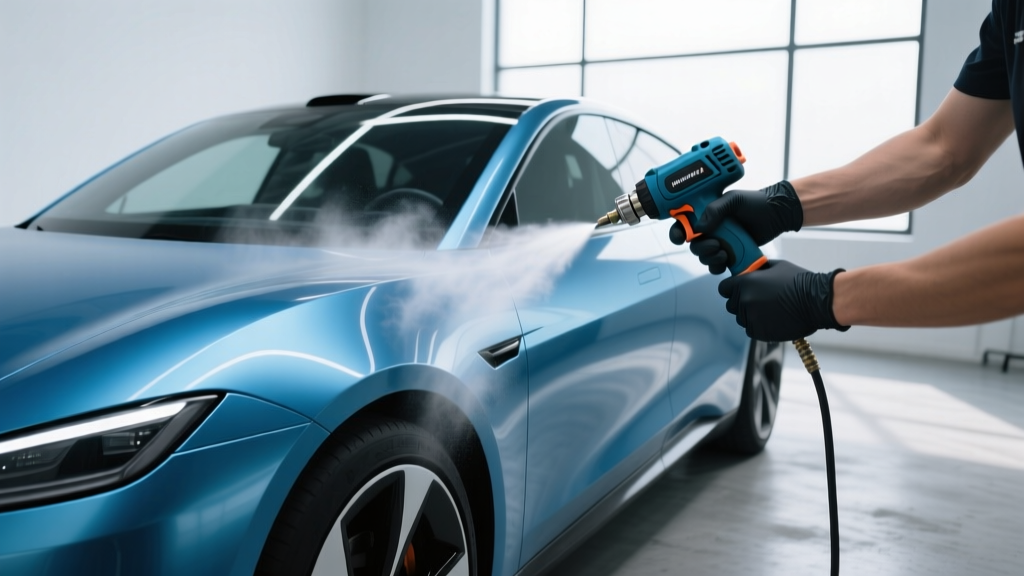
Yes. Spraying your car with an electric spray gun is a practical DIY approach for applying touch-up paint, ceramic coatings, vinyl wrap primers, or rust-preventive undercoatings on any electric vehicle. Electric spray guns — typically HVLP (High Volume Low Pressure) models — atomize liquid coatings using an electric turbine rather than a bulky air compressor, making them portable, quieter, and suitable for home-garage use. For a basic EV paint touch-up job, expect to spend $60–$180 on an entry-level electric spray gun and $20–$80 on automotive-grade paint or coating materials. Professional body shops charge $300–$1,500+ for the same work, so DIY spraying can save hundreds on minor cosmetic maintenance.
Electric vehicles like the Tesla Model Y, Hyundai Ioniq 5, and Ford Mustang Mach-E share the same factory clear-coat paint systems as their gas-powered counterparts. There is no electrical hazard in spraying the exterior body panels — the high-voltage traction battery (typically 60–100 kWh, operating at 400V or 800V) is fully sealed beneath the floor and isolated from the body shell. However, EV ownership introduces some unique maintenance economics and considerations that affect whether DIY paint spraying makes financial sense.
Why EV Owners Are Turning to DIY Paint and Coating Work
EV ownership already shifts your maintenance spending away from oil changes, transmission fluid, and spark plugs toward tires, cabin air filters, and cosmetic care. According to fueleconomy.gov, battery-electric vehicles eliminate roughly $1,200–$1,800 in annual powertrain maintenance compared to gas cars. That freed-up budget makes DIY cosmetic maintenance — including spraying touch-up paint, applying ceramic coatings, or laying down undercoating — an attractive way to preserve resale value without dealer service-center markups.
EVs also tend to carry higher insurance premiums. Data from the Insurance Information Institute shows EV insurance costs averaging 15–25% more than equivalent gas vehicles, partly due to higher repair costs after collisions. Keeping your EV's exterior in top condition with proactive paint maintenance can help minimize claim-worthy cosmetic damage and support stronger resale values in a market where used EV depreciation has been steeper than the gas-car average.
What an Electric Spray Gun Actually Does
An electric spray gun uses a built-in electric motor to drive a small turbine that generates airflow, atomizing paint or coating material as it passes through the nozzle. This differs from traditional pneumatic spray guns, which require a separate air compressor rated at 2–6 CFM (cubic feet per minute) at 30–50 PSI. The electric approach eliminates the compressor entirely, reducing noise from 70–90 dB down to roughly 55–65 dB and cutting total equipment weight by 30–60 pounds.
For automotive use, the key specs to evaluate are:
- Nozzle size: 1.0–1.4 mm for basecoat/clearcoat; 1.7–2.0 mm for primers and thicker undercoatings
- Fluid delivery rate: 100–300 mL/min for detail work; 300–500 mL/min for full-panel spraying
- Power draw: 300–700 watts for consumer HVLP models — easily run from a standard 120V/15A garage outlet (which delivers up to 1,800 watts)
- Transfer efficiency: HVLP guns achieve 65–85% transfer efficiency vs. 30–45% for conventional spray guns, meaning less wasted paint and fewer overspray issues in a home garage
Cost Breakdown: DIY Electric Spray Gun vs. Professional Body Shop
| Item | DIY with Electric Spray Gun | Professional Body Shop |
|---|---|---|
| Electric HVLP spray gun (consumer) | $60–$180 | N/A (included in labor) |
| Automotive touch-up paint (OEM-matched, 8 oz) | $20–$45 | $40–$80 (markup) |
| Clear coat (8 oz aerosol or spray-gun formula) | $15–$35 | Included |
| Prep materials (sandpaper, masking tape, tack cloth, degreaser) | $15–$40 | Included |
| Labor | 2–4 hours (your time) | $200–$800 (at $75–$125/hr) |
| Total: single-panel touch-up | $110–$300 | $300–$1,500 |
| Total: ceramic coating application (full car) | $150–$400 | $800–$2,500 |
For EV owners already paying a purchase-price premium — the average transaction price for a new EV in early 2026 sits around $48,000 according to Kelley Blue Book — recouping $200–$1,200 per cosmetic repair adds up over a 5-year ownership cycle. If you plan to keep your EV for 150,000+ miles (well within the battery warranty coverage of 8 years/100,000 miles mandated by federal law, with many batteries lasting 200,000+ miles), maintaining exterior condition helps protect trade-in value.
EV-Specific Considerations When Spraying Paint or Coatings
While the paint on an EV is chemically identical to a gas car's, the ownership context creates practical differences you should plan for:
Charging Port and Sensor Awareness
Modern EVs are studded with sensors: ultrasonic parking sensors (typically 8–12 per vehicle), camera lenses (8 on a Tesla with HW4/AI5), radar units behind the front bumper, and the charge port door mechanism. When masking your EV for spray work, avoid taping over sensor apertures or applying coating material to camera lens covers. Overspray on a radar-transmissive bumper panel can theoretically affect signal propagation if the coating is metallic or applied too thickly — stick to the manufacturer's recommended paint thickness of 4–6 mils total (primer + base + clear).
Weight and Panel Material
EVs are heavier than comparable gas cars — a Tesla Model Y Long Range weighs approximately 4,398 lbs vs. a gas Toyota RAV4 at roughly 3,615 lbs. This extra mass means stone chips and road debris impacts are marginally more common on EV lower panels and rocker areas. If you're spraying undercoating or bed-liner-style protective coatings on wheel arches and lower body, an electric spray gun with a 1.7–2.0 mm nozzle handles the thicker material better than a fine-detail 1.0 mm setup.
Warranty Implications
DIY paint work does not void your EV's battery or powertrain warranty under the Magnuson-Moss Warranty Act. However, if you damage a sensor, camera, or charge-port actuator during masking or spraying, the repair for that component will not be covered. Work carefully around the charge port door — many EVs (including Hyundai/Kia E-GMP vehicles and the Ford F-150 Lightning) use motorized charge-port doors that can be sensitive to paint overspray in the hinge mechanism.
Common Misconceptions About Spraying EVs
| Myth | Fact |
|---|---|
| "You can't spray paint near an EV's battery — it's dangerous." | The traction battery is hermetically sealed in a structural pack beneath the floor. Exterior paint spraying poses zero electrical risk. The 12V auxiliary battery under the hood/frunk area is the same lead-acid or lithium 12V unit found in any car. |
| "EV paint is special and requires dealer-only products." | EVs use the same OEM waterborne or solvent-based basecoat/clearcoat systems as gas vehicles. You can order exact color-matched paint by your vehicle's paint code (found on the driver's door jamb sticker) from suppliers like AutomotiveTouchup, Dupli-Color, or your dealer's parts counter. |
| "Electric spray guns are too weak for automotive paint." | Consumer HVLP electric guns (300–700W) handle single-panel repairs, touch-ups, and ceramic coating applications effectively. For full-respray work on an entire vehicle, a professional pneumatic or turbine-fed HVLP system is still preferable — but that's true for gas cars too. |
| "Ceramic coating an EV is pointless because EVs don't rust." | EVs use the same steel and aluminum body panels as gas cars. Rock chips, road salt, and UV exposure degrade clear coat identically. Ceramic coatings (SiO₂-based, lasting 2–5 years) protect the clear coat regardless of what powers the drivetrain. |
Step-by-Step: Spraying Your EV with an Electric Spray Gun
- Identify your paint code. Open the driver's door and locate the manufacturer sticker. Note the paint code (e.g., Tesla's PPSB for Pearl White Multi-Coat, Hyundai's M2T for Magnetic Silver). Order matched basecoat and a compatible 2K clear coat.
- Prep the surface. Wash the panel with automotive soap, then wipe with a wax-and-grease remover (prepsol). Sand the damaged area with 600-grit wet sandpaper, feathering the edges into surrounding clear coat. Wipe with a tack cloth.
- Mask surrounding areas. Use automotive masking tape and paper/plastic to cover adjacent panels, trim, rubber seals, and — critically — any nearby cameras, sensors, or the charge port. Do not spray near exposed sensor housings.
- Mix and load paint. Thin your basecoat per the manufacturer's ratio (typically 1:1 with reducer for HVLP). Pour into the spray gun's gravity-feed cup. Set the fluid knob to roughly 2 turns out and the fan pattern to medium-wide.
- Spray in passes. Hold the gun 6–8 inches from the surface, moving at a steady pace with 50% overlap between passes. Apply 2–3 light coats of basecoat, waiting 10–15 minutes between coats (follow product flash-time specs). The goal is 2–3 mils of basecoat.
- Apply clear coat. After the basecoat flashes (typically 30–60 minutes), spray 2K clear coat in 2–3 passes. Clear coat builds thickness quickly — target 1.5–2 mils per coat. Allow to cure per manufacturer instructions (usually 24 hours before wet-sanding and polishing).
- Color-sand and buff. Once fully cured, wet-sand with 1500–3000 grit to level any orange peel, then compound and polish to restore gloss. This step is what separates a visible repair from a professional-looking result.
EV vs. Gas: Does Powertrain Choice Change Paint Maintenance?
| Factor | Electric Vehicle | Gas Vehicle |
|---|---|---|
| Paint system | Same OEM basecoat/clearcoat | Same OEM basecoat/clearcoat |
| Stone chip frequency | Slightly higher (heavier vehicle, more momentum) | Baseline |
| Exhaust soot staining on rear panels | None | Common on rear bumper/liftgate — requires more frequent cleaning before coating |
| Engine bay heat exposure on hood paint | Minimal (electric motor generates far less radiant heat) | Moderate — hood undersides may show heat-related clear coat degradation over 100k+ miles |
| Annual cosmetic maintenance budget (typical) | $200–$500 (wax/coating, touch-ups) | $200–$500 (same) |
| Resale value sensitivity to exterior condition | Higher — EV buyers scrutinize condition more given steeper depreciation curves | Moderate |
The takeaway: the physical act of spraying your car with an electric spray gun is identical whether you own a Chevrolet Bolt EV or a Chevrolet Equinox gas model. The difference lies in the economic context — EV owners benefit more from proactive cosmetic maintenance because preserving exterior condition helps offset the steeper depreciation that has affected many EV models in the 2024–2026 used market.
Decision Framework: Should You DIY Spray Your EV?
Choose DIY electric spray gun if:
- You have a garage or covered workspace with access to a 120V outlet
- The damage is limited to 1–3 panels (stone chips, minor scratches, scuffs)
- You're comfortable with a 2–4 hour time investment and basic sanding technique
- You want to save $200–$1,000 per repair vs. body shop pricing
- You plan to apply a ceramic coating to the full vehicle (spray application is faster and more even than hand-wiping)
Choose a professional body shop if:
- Damage spans multiple panels or involves structural dent repair
- The repair requires blending into adjacent panels (color-match blending is difficult without professional lighting and experience)
- Your EV has advanced metallic or multi-coat paint (e.g., Tesla's Ultra Red, Hyundai's Gravity Gold Matte) that requires specialized application technique
- The repair is insurance-covered anyway (your deductible is met and the shop guarantees the work)
Frequently Asked Questions
Is it safe to spray paint near my EV's charging port?
Yes, as long as you mask the charge port door and its hinge mechanism to prevent overspray buildup. The port itself is sealed when closed. Avoid spraying directly into the port opening or allowing paint to accumulate on the door's motorized actuator (if equipped). If your EV has a manual charge-port door, simply close it and mask around the edges.
Can I use an electric spray gun to apply ceramic coating to my EV?
Yes, and it's increasingly popular. Spray-applied ceramic coatings (SiO₂ formulations designed for HVLP application) provide more uniform coverage than hand-wiped methods. Use a 1.0 mm nozzle, low fluid delivery, and apply in thin, even passes. A full-vehicle ceramic coating via spray gun uses roughly 100–200 mL of product and takes 1–2 hours of spray time, plus curing time.
Will spraying my EV's undercarriage affect the battery pack?
No. The battery pack is housed in a sealed, waterproof enclosure rated to IP67 or higher. Spraying rubberized undercoating on the chassis, suspension components, and wheel wells will not penetrate the battery housing. However, avoid spraying directly onto the pack's cooling lines, high-voltage cable connectors (typically orange-sleeved), or the pack's ventilation/breather ports (if visible). Consult your owner's manual for specific underbody diagrams.
What's the best electric spray gun for automotive EV touch-ups?
For single-panel touch-ups and coating work, well-reviewed consumer HVLP electric guns in the $80–$180 range from brands like Wagner, Fuji, and HomeRight deliver adequate atomization for basecoat/clearcoat work. For thicker materials like undercoating or truck-bed liner products, look for models with 1.7–2.0 mm nozzles and higher fluid delivery rates. Professional-grade electric turbine HVLP systems (Fuji SemiPRO, Earlex) cost $250–$500 and approach pneumatic-gun quality for full-panel resprays.
Does DIY paint work affect my EV's federal tax credit or warranty?
No. The IRS §30D federal tax credit (up to $7,500 for qualifying new EVs, subject to MSRP caps, buyer income limits, and battery-sourcing requirements per irs.gov) is determined at the time of purchase and is unaffected by subsequent cosmetic maintenance. Your battery and powertrain warranty (minimum 8 years/100,000 miles per federal mandate) covers manufacturing defects in the drivetrain — exterior paint work has no bearing on that coverage. Cosmetic paint is covered separately under the vehicle's general warranty (typically 3 years/36,000 miles).