Quick Verdict: Tesla Model 3 as a Rolling Media Hub
If you've searched for Spotify in Tesla, you already know the integration is native — no CarPlay, no Android Auto, just a deeply embedded Spotify app baked into the 15.4-inch center touchscreen. The 2026 Tesla Model 3 (Highland refresh carryover) delivers the most seamless in-car Spotify experience of any EV on the market: voice-activated playback, steering-wheel controls, album art on the dash, and a 17-speaker premium audio system that makes your playlists genuinely sound good at highway speed. But infotainment alone doesn't make an EV purchase. Below, we break down the 2026 Model 3's range, charging, pricing, and ownership economics so you can decide if the car behind the Spotify integration actually earns your money.
Spotify Integration: What You Actually Get
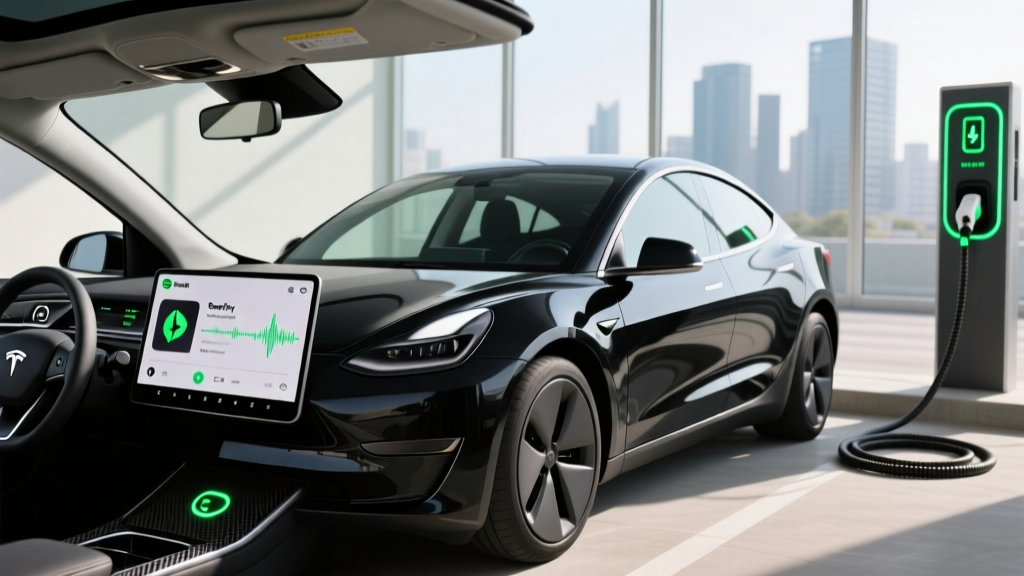
Tesla's Spotify app runs natively on the vehicle's Linux-based infotainment OS. Unlike Bluetooth streaming from your phone, native Spotify delivers lossless-quality playback through the car's amplifier without phone-battery drain or connection drops. Key features:
- Voice commands: "Play my Discover Weekly" via the steering-wheel voice button
- Full library access: Playlists, podcasts, Liked Songs, and Spotify Radio — all without your phone
- Account linking: Log in once via QR code; the car remembers your profile per driver
- Data included: Streaming uses Tesla's built-in LTE (Premium Connectivity, $9.99/month after the first 30 days)
- Limitations: No Spotify Connect handoff from home speakers at ignition; no video podcasts; UI is Tesla's custom skin, not the phone-app layout
The 17-speaker system (Long Range AWD) with dual subwoofers and immersive audio is a legitimate upgrade over the 9-speaker base RWD setup. For Spotify-heavy drivers, it's one of the best factory audio experiences under $60,000.
2026 Model 3 Specs: Range, Battery, and Efficiency
| Spec | RWD (Base) | Long Range AWD | Performance |
|---|---|---|---|
| EPA Range | 363 mi | 346 mi | 315 mi |
| Battery (usable) | ~60 kWh (LFP) | ~75 kWh (NMC) | ~75 kWh (NMC) |
| MPGe (combined) | 132 MPGe | 125 MPGe | 118 MPGe |
| Efficiency | 25 kWh/100mi | 27 kWh/100mi | 29 kWh/100mi |
| 0–60 mph | 5.8 sec | 4.2 sec | 2.9 sec |
| Horsepower | 271 hp | 384 hp | 510 hp |
| Drivetrain | RWD (single motor) | AWD (dual motor) | AWD (dual motor) |
Charging Speed: DC Fast, Level 2, and Level 1
Tesla's Supercharger network remains the gold standard for reliability, and the 2026 Model 3 takes full advantage. Here's what charging actually looks like:
| Charging Level | Power | Miles Added/Hour | Notes |
|---|---|---|---|
| DC Fast Charge (Supercharger V3/V4) | Peak 250 kW | ~175 mi in 15 min | 10–80% in ~25 min; tapers sharply above 80% |
| Level 2 (Tesla Wall Connector, 48A) | 11.5 kW | ~44 mi/hr | Full charge in ~6–7 hours overnight |
| Level 2 (Public J1772 w/ adapter) | Up to 7.2 kW | ~28 mi/hr | NACS port native; J1772 adapter included |
| Level 1 (120V household) | ~1.4 kW | ~3–5 mi/hr | Emergency/trickle only; 60+ hours for full charge |
Charging-curve reality check: The 250 kW peak only holds between roughly 10–30% State of Charge (SoC). By 50% SoC, the rate drops to ~150 kW, and above 80% it falls below 50 kW. This is standard lithium-ion behavior driven by cell-level thermal and voltage limits, not a Tesla limitation. The practical takeaway: plan stops around the 10–80% window for the fastest experience.
The LFP battery in the RWD trim can (and Tesla recommends you do) charge to 100% daily without degradation concerns — a genuine advantage over NMC for drivers who want full range available every morning. NMC trims (Long Range, Performance) are best kept at 80% daily, charging to 100% only before road trips.
Pricing, Trims, and Federal Tax Credit Eligibility
| Trim | Base MSRP | Federal Credit (§30D) | Effective Price* |
|---|---|---|---|
| Model 3 RWD | $44,130 | Up to $7,500 | ~$36,630 |
| Model 3 Long Range AWD | $51,130 | Up to $7,500 | ~$43,630 |
| Model 3 Performance | $57,630 | Up to $7,500 | ~$50,130 |
*Effective price assumes full $7,500 credit eligibility. Destination fee ($1,390) not included in MSRP above.
- Income caps: AGI ≤ $150,000 (single), $225,000 (head of household), $300,000 (joint)
- MSRP cap: Vehicle base price must be ≤ $55,000 (sedans) — this means the Model 3 Performance at $57,630 does NOT qualify
- Battery sourcing: Critical minerals and battery components must meet phased-in domestic/FPA-sourcing thresholds (Tesla's U.S. and partner supply chains currently meet these for RWD and Long Range)
- Point-of-sale transfer: You can transfer the credit to the dealer at purchase for an instant price reduction, or claim it on your tax return
Interior, Cargo, and Daily Practicality
The Highland-refreshed Model 3 interior is materially better than pre-2024 models — ventilated front seats, ambient lighting, rear-seat touchscreen, and improved sound insulation. The minimalist cabin remains polarizing, but build quality has reached competitive levels with Korean and German rivals.
- Front legroom: 42.2 inches
- Rear legroom: 35.3 inches (adequate for adults, tight for tall passengers on long trips)
- Cargo (trunk): 21.0 cu ft
- Frunk (front trunk): 3.1 cu ft (enough for a charging cable bag and small backpack)
- Total cargo with rear seats folded: ~50 cu ft (not class-leading — Hyundai Ioniq 6 offers less, but the Model Y crossover offers 72 cu ft if cargo matters)
For Spotify listeners, the cabin's improved acoustic isolation (laminated glass all around, redesigned door seals) means music clarity at 70 mph is noticeably better than the pre-Highland generation.
Driver Assistance: Autopilot and FSD Supervised
- Autopilot (standard): Adaptive cruise + lane centering. Competent for highway commuting but not class-leading — GM's Super Cruise and Ford's BlueCruise offer hands-off operation on mapped highways.
- FSD Supervised ($8,000 option or $99/month): Adds automatic lane changes, traffic-light/stop-sign response, and city-street navigation. Impressive in low-complexity suburban environments; still requires active supervision in construction zones, complex intersections, and adverse weather. The cabin camera monitors driver attention.
Warranty and Long-Term Ownership
- Basic vehicle warranty: 4 years / 50,000 miles
- Battery & drive unit warranty: 8 years / 100,000 miles (RWD, LFP) — 8 years / 120,000 miles (Long Range & Performance, NMC)
- Capacity retention threshold: Tesla warrants that the battery will retain at least 70% of original capacity during the warranty period
LFP chemistry in the RWD trim offers longer cycle life and less degradation over time compared to NMC, making it the lower-anxiety choice for high-mileage commuters who plan to keep the car past 150,000 miles.
Pros and Cons
- Best-in-class native Spotify integration with premium audio
- Supercharger network reliability (19,000+ U.S. stalls)
- Class-leading efficiency: 132 MPGe combined (RWD)
- LFP battery allows daily 100% charging without degradation worry
- Strong resale value relative to EV segment average
- Over-the-air updates continuously add features
- No Apple CarPlay or Android Auto — Spotify is native-only
- Rear-seat legroom is tight for adults on long trips
- FSD Supervised still requires constant driver attention despite the name
- Turn-signal stalk removed (steering-wheel buttons) — polarizing
- No rear wiper (hatchback glass accumulates rain/snow)
- Insurance premiums run 15–25% higher than comparable sedans
Is the 2026 Model 3 Worth It vs. Competitors?
- Native Spotify integration and premium audio are high priorities
- You want access to the Supercharger network for road trips
- You value efficiency (lowest kWh/100mi in its class)
- You prefer OTA software updates that add features over time
- Hyundai Ioniq 6: You want CarPlay/Android Auto and 800V ultra-fast charging (10–80% in ~18 min at 350 kW chargers)
- BMW i4: You prefer a traditional luxury interior and hands-free highway driving (BMW Highway Assistant)
- Tesla Model Y: You need more cargo space (72 cu ft) and easier rear-seat access for kids/car seats
FAQ: Spotify in Tesla and Model 3 Ownership
Does Spotify work without my phone in the Tesla Model 3?
Yes. Once you link your Spotify account (via QR code or credentials on the touchscreen), the car streams directly over its built-in LTE connection. Your phone can stay in your pocket, turned off, or out of the car entirely. Premium Connectivity ($9.99/month) is required for streaming after the initial trial period.
Can I use Apple Music or other services instead of Spotify?
Tesla supports Apple Music natively (added in a 2024 OTA update), as well as Tidal, TuneIn, and simple Bluetooth audio from any phone app. However, Spotify and Apple Music remain the only services with deep native integration — voice commands, steering-wheel controls, and full library browsing on the touchscreen.
What is the real-world range of the 2026 Model 3?
The RWD's EPA rating is 363 miles, but real-world highway driving at 75 mph yields approximately 290–310 miles in mild weather. In freezing temperatures (below 30°F), expect 220–250 miles due to LFP chemistry's cold sensitivity and cabin heating load. The Long Range AWD (EPA 346 mi) performs slightly better in cold, delivering ~270–290 highway miles in winter.
How fast does the Model 3 charge on a road trip?
At a Tesla Supercharger V3 or V4, the Model 3 peaks at 250 kW and charges from 10–80% in approximately 25 minutes. The charge rate tapers significantly above 80%, so plan to unplug at 80% for the most time-efficient stops. On Level 2 at home (11.5 kW Wall Connector), a full charge takes about 6–7 hours — ideal for overnight charging.
Does the 2026 Model 3 qualify for the federal EV tax credit?
The RWD ($44,130) and Long Range AWD ($51,130) qualify for the full $7,500 federal tax credit under IRS §30D for eligible buyers (income caps apply: ≤$150K single / ≤$300K joint). The Performance trim ($57,630) exceeds the $55,000 MSRP cap for sedans and does NOT qualify. Battery sourcing requirements are currently met for U.S.-built RWD and Long Range trims. Confirm with a tax professional before purchase.
Is the Tesla Model 3 a good car for families?
It works for small families (one or two children) but isn't ideal for larger ones. Rear legroom (35.3 in) is adequate for kids and shorter adults but snug for tall teenagers on long trips. Cargo space (21 cu ft trunk + 3.1 cu ft frunk) handles strollers and groceries but not bulk hauls. Families needing more space should cross-shop the Model Y or Hyundai Ioniq 5.
What are the biggest drawbacks of the Model 3?
The lack of Apple CarPlay/Android Auto is the top complaint for non-Spotify users. The removal of the turn-signal stalk (replaced by steering-wheel buttons) frustrates some drivers. Insurance costs are above average for the class. And while FSD Supervised is technologically impressive, it is not autonomous driving — constant supervision is required. For a full safety assessment, check NHTSA ratings and IIHS test results.