Quick Answer: Is a Solo EV Worth It?
For a single driver commuting 30–40 miles daily with access to home Level 2 charging, a solo EV like the Chevrolet Equinox EV (EPA 319 mi, ~$33,600 MSRP) or Hyundai Kona Electric (EPA 261 mi, ~$32,975 MSRP) typically costs $0.04–$0.06 per mile to charge at home versus $0.12–$0.15 per mile for a comparable gas car. Over five years and 75,000 miles, a solo EV driver can save $4,500–$7,200 in fuel and maintenance, even after accounting for higher insurance premiums. The math breaks down if you lack home charging, regularly drive over 300 miles in a single day, or live in extreme cold climates without a garage.
What "Solo EV" Means and Why It Matters for Your Purchase
The term "solo EV" refers to electric vehicle ownership optimized for a single driver — no family hauling, no carpool lanes full of passengers, no weekend road trips with five people and their luggage. This matters because it fundamentally changes which EV specs you should prioritize. A solo driver doesn't need 100 kWh of battery or a three-row SUV. What you need is efficient daily range, fast enough charging for the occasional long trip, and a total cost of ownership that undercuts the gas car you'd otherwise buy.
For the single-driver use case, the sweet spot in 2026 is a compact or subcompact electric crossover with 230–320 miles of EPA range, a battery between 58–85 kWh, and DC fast charging capability of at least 150 kW peak. This covers 95%+ of daily driving without excess weight or cost from battery capacity you'll never use.
Solo EV vs. Gas Car: The Real Cost Comparison
Let's compare a realistic solo EV purchase against a comparable gas compact SUV — the kind of vehicle a single professional or commuter would actually cross-shop. We'll use the 2026 Hyundai Kona Electric (SEL trim, $34,475 MSRP before incentives) against the 2026 Honda HR-V (EX-L trim, ~$30,100 MSRP) over five years and 75,000 miles (15,000 mi/year).
| Cost Category | Hyundai Kona Electric (EV) | Honda HR-V (Gas) |
|---|---|---|
| Purchase Price (MSRP) | $34,475 | $30,100 |
| Federal Tax Credit (§30D) | −$3,750 to $7,500* | $0 |
| Fuel/Energy (75k mi) | $2,625 (home charging @ $0.14/kWh) | $9,375 (30 MPG @ $3.75/gal) |
| Maintenance (5 yr) | ~$1,200 | ~$3,500 |
| Insurance (5 yr avg.) | ~$8,750 | ~$7,500 |
| Net 5-Year Cost | $33,300–$37,050 | $50,475 |
*The IRS §30D credit depends on battery sourcing, buyer income caps ($150k single / $300k joint), and MSRP limits ($55k for SUVs). The Kona Electric's credit eligibility varies by model year and production batch — verify at purchase. Many buyers qualify for $3,750 rather than the full $7,500 due to critical-mineral sourcing phase-in rules.
The Kona Electric's advantage comes almost entirely from fuel savings ($6,750 less) and maintenance savings ($2,300 less — no oil changes, fewer brake replacements due to regenerative braking, no transmission fluid). Insurance runs roughly 15–20% higher for EVs due to repair cost data, eating back about $1,250 of your savings over five years.
Best Solo EV Picks for 2026: Range, Charging, and Price Data
Here are the top contenders for a single-driver EV buyer, ranked by how well they serve the solo commuting and occasional road-trip use case:
| Model | EPA Range | Battery (kWh) | Peak DC Charge | 10–80% Time | Base MSRP |
|---|---|---|---|---|---|
| Chevrolet Equinox EV LT | 319 mi | 85 kWh (NMC) | 150 kW | ~34 min | $33,600 |
| Hyundai Kona Electric SEL | 261 mi | 65 kWh (NMC) | 100 kW | ~43 min | $34,475 |
| Tesla Model 3 RWD | 272 mi | 60 kWh (LFP) | 170 kW | ~25 min | $38,990 |
| Volvo EX30 Core | 265 mi | 69 kWh (NMC) | 153 kW | ~27 min | $36,950 |
| Nissan Leaf SV Plus | 212 mi | 60 kWh (NMC) | 100 kW (CHAdeMO) | ~45 min | $33,470 |
Real-World Range Reality Check
EPA range figures assume mixed driving at moderate temperatures. For a solo highway commuter at 70–75 mph, expect to use 80–85% of the EPA sticker in fair weather and 65–75% in freezing conditions (below 30°F). The Equinox EV's 319-mile EPA rating translates to roughly 260–275 real-world highway miles in summer and 210–240 miles in winter. The LFP-equipped Model 3 holds up slightly better in cold due to its heat pump and thermal management system, but all EVs lose range when the mercury drops.
Home Charging: The Make-or-Break Factor for Solo EV Owners
Single drivers who can install a Level 2 home charger unlock the full economic and convenience advantage of EV ownership. Without home charging, the math changes dramatically — public DC fast charging costs $0.30–$0.50 per kWh at networks like Electrify America and EVgo, pushing your per-mile energy cost to $0.09–$0.14, nearly matching gasoline.
| Level | Power (kW) | Miles Added/Hour | Typical Use Case | Cost per kWh |
|---|---|---|---|---|
| Level 1 (120V outlet) | 1.4 kW | 3–5 mi/hr | Overnight top-up (under 40 mi/day) | $0.12–$0.18 (home) |
| Level 2 (240V, 32–48A) | 7.7–11.5 kW | 25–40 mi/hr | Daily home charging | $0.12–$0.18 (home) |
| DC Fast Charge | 50–350 kW | 150–800+ mi/hr | Road trips, quick top-ups | $0.30–$0.55 (public) |
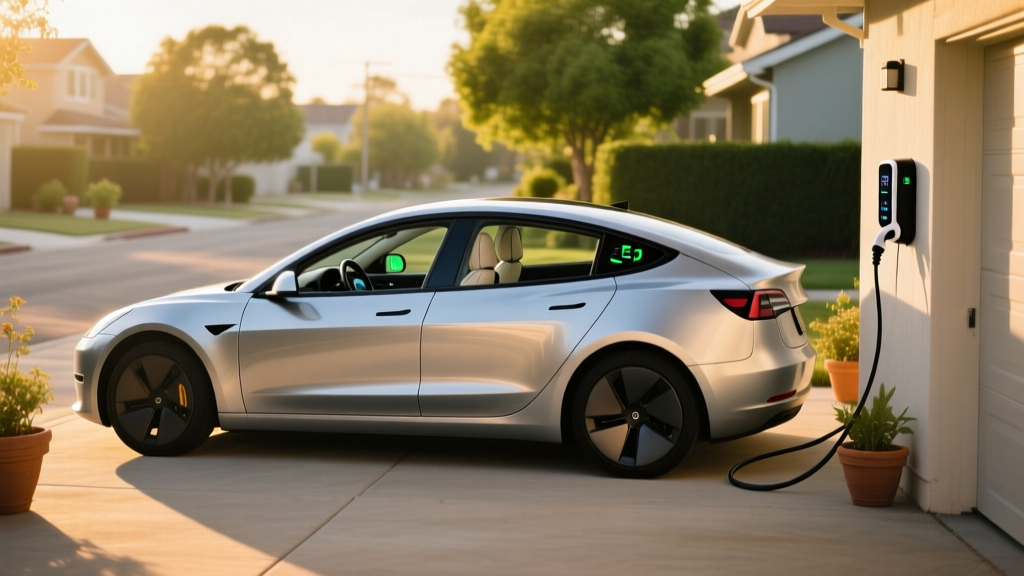
For a solo driver covering 40 miles per day, a Level 2 home charger (like the Emporia Vue or ChargePoint Home Flex, $400–$700 for equipment) replenishes your daily driving in about 60–90 minutes. Most solo owners plug in when they get home and wake up to a full battery every morning — no gas station stops required.
Installation cost reality: A 240V/48A Level 2 circuit typically costs $800–$2,500 for a licensed electrician to install, depending on panel proximity and whether your electrical panel needs an upgrade from 100A to 200A service (which adds $1,500–$3,000). Always get a quote from a licensed electrician before committing to an EV purchase if you're unsure about your panel capacity.
What First-Time Solo EV Buyers Get Wrong
| Myth | Fact (With Data) |
|---|---|
| "I need 400+ miles of range." | A solo driver averaging 37 miles/day needs ~185 usable miles for a 5-day buffer. 260–320 EPA miles is ample; extra range means extra battery weight and cost you carry daily. |
| "EV batteries need replacing every few years." | Modern NMC and LFP packs are warrantied for 8 years/100,000 miles at 70% capacity retention minimum. Real-world DOE data shows most packs retain 85–92% capacity at 100k miles. |
| "Charging takes too long on road trips." | A 150 kW-capable EV like the Equinox EV adds ~180 miles in a 30-minute DC fast charge session (10–80%). Plan a meal or restroom break and the stop feels natural. The EPA's fueleconomy.gov site lists charge times per model. |
| "I'll save $7,500 on taxes automatically." | The §30D credit requires meeting income caps, MSRP limits, and battery-sourcing rules that change yearly. Many EVs qualify for $3,750 (half credit) due to critical-mineral requirements. Point-of-sale transfer is available at participating dealers. |
| "All EVs charge at the same speed." | Charge speed varies enormously. The Tesla Model 3 RWD peaks at 170 kW (10–80% in ~25 min) while the Kona Electric peaks at 100 kW (10–80% in ~43 min). Always check peak kW and the charge curve — peak rate only holds between ~10–50% SoC before tapering. |
Solo EV Decision Framework: Should You Buy, and Which One?
If / Then Decision Guide for the Solo EV Buyer
- IF you drive under 50 miles/day AND have a garage or driveway for a Level 2 charger → THEN a compact EV like the Kona Electric or Equinox EV is ideal. Prioritize home charging convenience over DC fast-charge speed.
- IF you drive 50–100 miles/day AND take monthly road trips over 250 miles → THEN prioritize DC fast-charge speed (150+ kW peak) and 300+ EPA range. The Model 3 Long Range (EPA 363 mi, 250 kW peak) or Equinox EV RS (319 mi, 150 kW) serve this pattern.
- IF you live in an apartment without charging access AND rely on public charging → THEN reconsider a BEV. A PHEV like the Toyota Prius Prime (EPA 44 mi electric-only, 52 MPG combined on gas) eliminates range and charging-access risk while still delivering daily electric commuting.
- IF you live in a climate with extended sub-20°F winters → THEN budget for 30–35% winter range loss and prioritize an EV with a heat pump (standard on Tesla Model 3, Hyundai Kona Electric, and Volvo EX30). Garage parking helps enormously.
- IF your budget is under $30,000 after incentives → THEN the used EV market is your best bet. A 2023–2024 Chevrolet Bolt EUV (EPA 247 mi) runs $18,000–$22,000 used and qualifies for the up-to-$4,000 used EV credit (IRC §25E) if you meet income caps.
Real Ownership Costs: Insurance, Maintenance, and Depreciation
Beyond the sticker price and fuel savings, solo EV ownership carries costs that gas-car buyers don't face — and savings they don't get:
Insurance: EV insurance premiums run 15–25% higher than equivalent gas vehicles, driven by higher repair costs (specialized body shops, battery-safe procedures) and higher total-loss thresholds. A solo driver with a clean record insuring a Kona Electric might pay $1,650–$1,900/year versus $1,400–$1,600 for an HR-V. Shop quotes before buying — Tesla's in-house insurance can be competitive in some states.
Maintenance: EVs eliminate oil changes ($40–$80 each), transmission fluid service, spark plugs, and exhaust system repairs. You'll still replace cabin air filters ($30–$60), wiper blades, brake fluid (every 2–3 years), and tires — EVs wear tires 20–30% faster due to instant torque and heavier curb weight. Budget $200–$300/year for EV maintenance versus $600–$800/year for gas.
Depreciation: EV depreciation has been volatile. According to IIHS and industry data, mainstream compact EVs like the Kona and Equinox EV hold 45–55% of value after three years, slightly below comparable gas crossovers (55–60%). Tesla's price cuts in 2023–2024 hammered resale values industry-wide, but the market has stabilized. Solo buyers who plan to keep their EV 5–7+ years largely sidestep depreciation risk.
Battery replacement: The fear that looms largest. Out-of-warranty battery replacement runs $8,000–$18,000 depending on pack size and chemistry, but this is a rare event. Most packs outlast the car. If it does fail within warranty (8 yr/100k mi federally mandated minimum), replacement is free.
Frequently Asked Questions
Is a solo EV practical if I only have a standard 120V outlet?
Yes, if your daily driving is under 40 miles. Level 1 charging at 1.4 kW adds about 3–5 miles of range per hour — roughly 35–50 miles over a 10-hour overnight session. This covers most solo commutes. However, if you ever need to recharge from near-empty (say, after a 200-mile day trip), Level 1 takes 40+ hours. A Level 2 upgrade is strongly recommended for flexibility.
Should I get an LFP or NMC battery for my solo EV?
For a solo daily commuter who charges at home nightly, LFP (lithium iron phosphate) is excellent — it tolerates regular 100% charging without degradation concerns, offers longer cycle life (3,000+ cycles vs ~1,500 for NMC), and costs less. The trade-off: LFP is heavier and has lower energy density, so LFP-equipped cars tend to have slightly less range per kWh. The Tesla Model 3 RWD uses LFP. If you prioritize maximum range in a lighter package or live in very cold climates (LFP performs worse below freezing), NMC remains the better choice.
How does the §30D point-of-sale transfer work?
Starting in 2024, eligible buyers can transfer the federal tax credit to the dealer at purchase, reducing the vehicle price upfront rather than waiting to claim it on your tax return. The dealer must be registered with the IRS. You still must meet all income, MSRP, and sourcing requirements — the transfer just changes when you receive the benefit. Verify eligibility on irs.gov before signing.
What happens to my solo EV's range after 5 years?
Based on aggregated fleet data, expect 5–12% battery degradation over five years and 75,000 miles, depending on chemistry, charging habits, and climate. An Equinox EV rated at 319 EPA miles new might deliver 285–300 miles at the five-year mark. Avoiding frequent DC fast charging above 80% SoC and not regularly draining below 10% helps preserve long-term capacity.
Is a PHEV a better solo choice than a full EV?
It depends on your charging access and driving pattern. If you can charge at home and drive under 40 miles daily, a full BEV saves more money and eliminates gas entirely. If you lack reliable home charging or frequently drive 300+ miles in a day, a PHEV like the Toyota Prius Prime (44 mi electric-only, then 52 MPG on gas) gives you electric commuting without range anxiety. The PHEV is the pragmatic hedge; the BEV is the optimal play when conditions support it.