Buying a smart electric car in 2026 is no longer a leap of faith — it's a calculated decision. But the math only works if you match the right EV to your driving pattern, charging access, and budget. A smart electric car pairs a battery-electric powertrain with connected software, over-the-air updates, and Level 2 driver-assistance (like Tesla Autopilot, Ford BlueCruise, or Hyundai's Highway Driving Assist). These features make daily driving easier, but they don't eliminate the core EV ownership variables: range, charging logistics, and total cost.
Quick Answer: Should You Buy a Smart Electric Car?
Yes, if you have reliable home Level 2 charging, drive under 300 miles per day, and can leverage the federal §30D tax credit (up to $7,500, with income and MSRP caps). Think twice if you regularly tow heavy loads in cold weather, live in a charging desert, or lack access to overnight charging. A PHEV may bridge the gap for mixed-use drivers.
What Makes an EV a "Smart" Electric Car?
The term "smart electric car" isn't an official classification — it's shorthand for a BEV (battery electric vehicle) with an advanced software stack. In 2026, that typically includes:
- Over-the-air (OTA) updates that improve range estimates, add features, or refine braking behavior without a dealer visit.
- SAE Level 2 driver-assistance — adaptive cruise, lane-centering, and in some cases hands-off/highway-supervised driving (Ford BlueCruise, GM Super Cruise). Remember: Level 2 still requires an attentive driver. No consumer vehicle sold today is fully self-driving.
- Connected route planning that factors in battery state of charge, elevation, weather, and DC fast-charger availability along your route.
- App-based controls for preconditioning the battery before fast charging, scheduling off-peak charging, and monitoring State of Health (SoH).
Smart Electric Car vs. Gas Car: The Real Numbers
Marketing materials love "zero emissions" and "instant torque," but buyers need hard data. Here's how a mainstream smart electric car — the 2026 Hyundai Ioniq 6 SE Long Range — stacks up against a comparable gas midsize sedan (2026 Toyota Camry LE) over five years and 75,000 miles.
| Category | Ioniq 6 SE (EV) | Camry LE (Gas) |
|---|---|---|
| Base MSRP | $42,750 | $29,500 |
| Federal §30D Credit (est.) | Up to $7,500* | $0 |
| Effective Purchase Price | ~$35,250 | $29,500 |
| EPA Efficiency | 140 MPGe (combined) | 32 MPG (combined) |
| Energy/Fuel Cost (75k mi) | ~$3,900 (home L2, $0.14/kWh avg) | ~$7,875 ($3.50/gal avg) |
| Maintenance (75k mi) | ~$1,200 | ~$3,400 |
| 5-Year Total Cost | ~$40,350 | ~$40,775 |
*§30D credit eligibility depends on buyer AGI ($150k single / $300k joint cap), vehicle MSRP cap ($55k sedans), and battery critical-mineral sourcing rules that shift annually. Always verify current-year rules at IRS.gov. Credit can now be transferred to the dealer at point of sale, reducing your out-of-pocket at purchase.
The Ioniq 6 achieves near cost-parity with a gas sedan over five years, even before accounting for state rebates, HOV-lane access, or potential time-of-use electricity discounts. The gap widens if you charge primarily on free workplace or apartment-building chargers.
Real-World Range: What the EPA Sticker Doesn't Tell You
The 2026 Ioniq 6 SE Long Range carries an 77.4 kWh usable NMC battery and an EPA-estimated 361 miles of range. That's impressive on paper, but real-world conditions compress it:
- EPA Sticker: 361 miles
- Mixed driving (city/highway, 65-75°F): ~310-330 miles
- Sustained 75+ mph highway: ~270-290 miles
- Cold weather (20-35°F, cabin heat): ~230-260 miles (30-35% loss)
- Cold + highway + mountain terrain: ~200-220 miles
Cold-weather range loss is the single most under-communicated EV reality. Lithium-ion batteries are less efficient at low temperatures, and resistive cabin heating draws 2-5 kW continuously. A heat pump (standard on the Ioniq 6) recovers some of that, but physics is physics. If you live in Minnesota or Maine and need 300 miles of reliable winter range, spec a larger battery or plan charging stops.
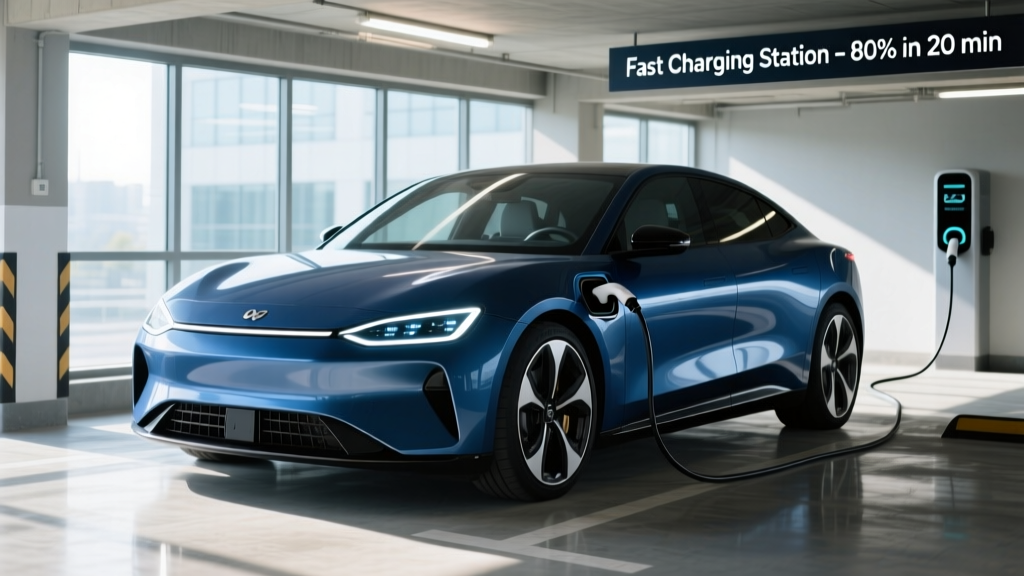
On the charging side, the Ioniq 6 supports a peak DC fast-charge rate of 240 kW on 800V architecture. In controlled testing, that translates to a 10-80% charge in approximately 18 minutes. However, the charge curve tapers sharply above 80% — an 80-100% top-off can take an additional 20+ minutes. For road trips, plan to charge to 80% and go.
Charging Logistics: The Make-or-Break Variable
A smart electric car is only as convenient as your charging setup. Here's the cost and speed breakdown by level:
| Level | Power (kW) | Miles Added/Hour | Typical Cost | Best For |
|---|---|---|---|---|
| Level 1 (120V) | 1.4 kW | 3-5 mi/hr | $0.12-0.18/kWh | Overnight top-off, PHEVs |
| Level 2 (240V home) | 7.2-11.5 kW | 25-44 mi/hr | $0.10-0.20/kWh | Daily primary charging |
| DC Fast Charge | 50-350 kW | 150-800+ mi/hr | $0.30-0.60/kWh | Road trips, quick stops |
Most smart electric car owners do 85-95% of their charging at home on Level 2. A 240V, 48-amp home charger (like a ChargePoint Home Flex or Emporia Level 2) costs $500-$800 for hardware. Professional installation by a licensed electrician runs $800-$2,500, depending on panel proximity and whether your electrical panel needs a 200-amp upgrade ($1,500-$3,000 additional). Total typical home charging setup: $1,300-$3,300.
If you can't charge at home — apartment living, street parking, or an older electrical panel — a smart electric car becomes significantly less convenient. Public DC fast charging costs 2-4x more per kWh than home charging, and reliability varies by network. Electrify America, EVgo, and the Tesla Supercharger network (now open to NACS-equipped non-Tesla EVs) have improved uptime, but 5-10% session failure rates are still documented in urban areas. A PHEV with 30-40 miles of electric-only range may be a smarter fit if home charging isn't an option.
Common Smart EV Misconceptions — Myth vs. Fact
| Myth | Fact |
|---|---|
| "EV batteries need replacing every 5 years." | 2026 NMC and LFP batteries are warrantied for 8 years/100,000 miles (10 years/150,000 in CARB states) to retain ≥70% capacity. Real-world data shows ~8-12% degradation at 100k miles for liquid-cooled packs. |
| "Self-driving is here — I can nap." | No consumer vehicle is self-driving. All current systems are SAE Level 2 and require active supervision. |
| "EVs are worse for the environment because of battery mining." | Lifecycle analyses from the EPA consistently show BEVs produce fewer lifetime emissions than gas cars, even accounting for battery manufacturing — especially as the grid decarbonizes. |
| "I'll save $7,500 no matter what." | The §30D credit has income caps ($150k single, $300k joint), MSRP caps ($55k sedans, $80k SUVs/trucks), and battery-sourcing requirements that change annually. Not every EV or buyer qualifies. |
| "All EVs charge at the same speed." | Charge rates range from 50 kW (older/entry-level EVs) to 350 kW (800V platforms like the Ioniq 6, Porsche Taycan, Lucid Air). Peak kW is also not sustained — the charge curve tapers above ~80% SoC. |
Decision Framework: Which Electrified Vehicle Fits You?
Choose a Smart Electric Car (BEV) If:
- You have Level 2 home charging or reliable workplace charging
- Your daily driving is under 200 miles round-trip
- You want the lowest per-mile energy cost (~$0.04-0.06/mi at home)
- You qualify for the §30D credit and/or state rebates
- You value OTA updates and connected trip planning
Choose a PHEV If:
- You lack reliable home charging but want some electric miles
- You frequently drive 300+ miles in a day and don't want to plan charging stops
- You want electric-only commuting (30-45 mi) with gas flexibility for road trips
- Models like the Toyota RAV4 Prime or Jeep Wrangler 4xe fit your needs
Choose a Gas/HEV If:
- You live in a charging desert with no home/work charging
- You tow heavy trailers regularly (EV range drops 40-50% when towing)
- Your budget is strictly under $28,000 and you can't wait for used-EV credits
First-Time EV Buyer Checklist
- Audit your charging access. Can you install a 240V outlet or hardwired charger? Get an electrician quote before buying.
- Check §30D eligibility. Verify your AGI, the vehicle's MSRP against the cap, and current battery-sourcing rules at IRS.gov. Consult a tax professional for your specific situation.
- Test the real-world route. Drive your actual commute and a simulated road-trip segment. Monitor kWh/mi consumption on the trip computer.
- Understand the warranty. Federal law mandates 8yr/100k-mi battery and powertrain coverage. Note the capacity-retention threshold (typically 70%).
- Factor insurance. EV insurance premiums run 10-20% higher than comparable gas cars due to repair costs and battery replacement expense. Get quotes before committing.
- Plan for cold weather. If you live below the Mason-Dixon line, precondition your battery before fast charging and budget 30% range loss in winter.
Frequently Asked Questions
What is the cheapest smart electric car in 2026?
The 2026 Nissan Leaf S starts around $28,140 and includes connected navigation and ProPILOT Assist. However, its 149-mile EPA range and CHAdeMO connector limit road-trip practicality. The Chevrolet Equinox EV LT (~$33,000) offers 319 miles of range and NACS compatibility, making it a more versatile entry point.
Do smart electric cars need oil changes?
No. BEVs have no engine oil, transmission fluid, or spark plugs. Routine maintenance is limited to tire rotations, cabin air filter replacement, brake fluid checks, and windshield washer fluid. Expect $200-$350/year in scheduled maintenance — roughly 60-70% less than a gas car.
How long does an EV battery actually last?
Data from Recurrent Auto and manufacturer warranty claims show most liquid-cooled NMC and LFP packs retain 88-92% capacity at 100,000 miles. At 200,000 miles, 80-85% retention is common. Full battery replacement is rare and typically costs $8,000-$18,000 out of warranty, depending on pack size and chemistry.
Can I use Tesla Superchargers with a non-Tesla smart electric car?
Yes — if your EV has a NACS (North American Charging Standard) port, which most 2025+ models now feature natively. CCS-equipped EVs can use a manufacturer-approved NACS adapter. The Supercharger network offers 150-250 kW speeds and industry-leading uptime. Check fueleconomy.gov for your specific model's connector type.
Is a smart electric car safe in a crash?
EVs undergo the same NHTSA and IIHS crash testing as gas vehicles. The low-mounted battery pack gives EVs a lower center of gravity, reducing rollover risk. Multiple 2026 EVs — including the Ioniq 6, Tesla Model Y, and BMW i5 — hold IIHS Top Safety Pick+ ratings. Post-crash battery fire risk is statistically lower than gas-vehicle fuel fires, according to NTSB data.