The Smallest Electric Motor: A Quick Answer for EV Buyers
The smallest electric motor in the world is a molecular-scale device measuring approximately 12 nanometers across — roughly the width of a single strand of DNA. Developed by researchers at Tufts University and published in Nature Nanotechnology, this nanoscale motor spins a single molecule using an electric current. For context, a human hair is about 80,000 nanometers wide.
What does this mean for EV buyers? Not much today. This technology exists in laboratory settings, not in any production vehicle. But it represents the extreme endpoint of a trend that already affects your EV purchase: the relentless miniaturization and efficiency improvement of electric motors that directly impacts range, cost, and packaging in cars you can buy right now.
If you landed here searching for the smallest electric motor in the world, you're likely curious about where electric drivetrain technology is heading — or you've seen a headline and want to separate laboratory breakthroughs from showroom reality. This guide connects the dots between nanoscale motor research and the concrete EV buying decisions you face in 2026: which motor types deliver the best efficiency, how motor advances translate to EPA range, and what you'll actually pay to own and charge an EV versus a gas car or hybrid.
Why Electric Motor Size Matters for EV Range and Cost
The electric motor is where stored battery energy (measured in kilowatt-hours, or kWh) becomes forward motion. Motor efficiency directly determines how many of those kWh translate into miles on the road. A more efficient, compact motor means automakers can either install a smaller, lighter, cheaper battery pack for the same range — or keep the battery the same and deliver more miles.
Consider the progression: the original Nissan Leaf (2011) used an 80 kW motor paired with a 24 kWh battery for an EPA-rated 73 miles. The 2026 Nissan Ariya uses a 178 kW front motor with a 91 kWh battery for up to 304 miles of EPA range. Motor efficiency improvements — better magnet designs, reduced iron losses, higher power density — account for a meaningful share of that gain, alongside battery chemistry advances.
Today's production EV motors fall into three main categories:
| Motor Type | Efficiency | Used By | Trade-off |
|---|---|---|---|
| Permanent Magnet Synchronous (PMSM) | 95-97% | Tesla (rear), Hyundai, most OEMs | Requires rare-earth magnets (neodymium) |
| AC Induction | 90-94% | Tesla (front, AWD disengage), older designs | Lower efficiency, no rare earths needed |
| Externally Excited Synchronous (EESM) | 93-96% | BMW (Gen5 eDrive), Renault | Requires brush/slip-ring assembly, avoids rare earths |
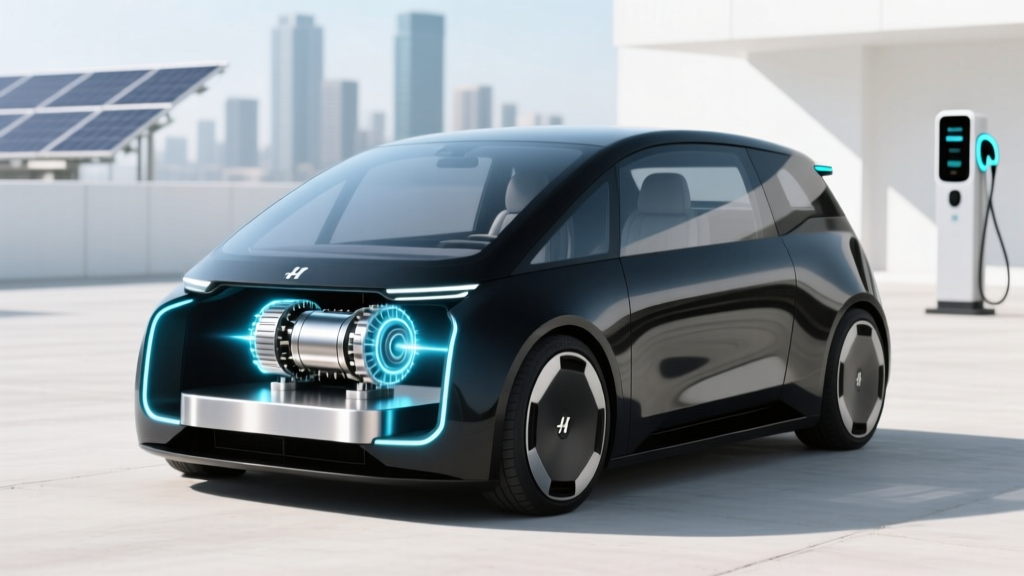
The nanoscale motor research that produces the "smallest electric motor in the world" operates on fundamentally different physics — quantum tunneling, molecular conformational changes — that won't appear in a car axle anytime soon. But the broader engineering principle is identical: convert electrical energy to mechanical work with minimal waste heat. Every percentage point of motor efficiency gained at the lab bench eventually filters into production powertrains, shaving pounds off the battery and dollars off the MSRP.
Smallest Motor Tech vs. Today's EV Drivetrains: A Reality Check
Myth vs. Fact: Nanoscale Motors and Your Next EV
| Myth | Fact |
|---|---|
| The smallest electric motor will power future EVs directly | It produces roughly 1 attowatt of power — about one trillionth of what a car needs. It's a proof of concept for nanomachines, not traction motors. |
| EV motors can't get much more efficient | PMSM motors already exceed 95% peak efficiency, but engineers are improving part-load efficiency, reducing weight, and eliminating heavy rare-earth magnets — gains that compound over a vehicle's lifetime. |
| Smaller motors always mean better EVs | Power density matters more than raw size. A compact motor that produces 250 kW from a 40 kg package (like Tesla's carbon-wrapped rotor) outperforms a larger, heavier unit — but packaging, cooling, and NVH all factor in. |
| Motor tech is the main reason EV range keeps improving | Motor efficiency contributes, but battery energy density (kWh per kg), aerodynamics, and thermal management (heat pumps, battery preconditioning) are equally or more impactful. |
The Tufts molecular motor and similar research from institutions like Rice University and the University of Tokyo represent foundational science. The practical timeline from lab discovery to production drivetrain typically spans 15-25 years. What affects your 2026 EV purchase today is the mature, proven motor technology already on showroom floors.
EV vs. Gas vs. Hybrid: Real Cost Comparison in 2026
Electric motor efficiency is one reason EVs convert energy to motion far more effectively than internal combustion engines. A gas engine converts roughly 20-35% of fuel energy into forward motion; the rest becomes waste heat. An EV powertrain (battery to wheels) achieves 77-90% efficiency, according to fueleconomy.gov.
| Category | 2026 Toyota Camry (Gas) | 2026 Toyota Camry Hybrid | 2026 Hyundai Ioniq 6 SE (EV) |
|---|---|---|---|
| Base MSRP | $29,495 | $30,195 | $38,650 |
| EPA Efficiency | 32 MPG combined | 52 MPG combined | 140 MPGe / 24 kWh/100mi |
| EPA Range | ~448 mi (14.5 gal) | ~572 mi (11 gal) | 361 mi |
| Fuel/Energy Cost (5 yr, 75k mi) | $7,812 ($3.50/gal) | $4,808 ($3.50/gal) | $3,750 ($0.15/kWh avg) |
| Maintenance (5 yr est.) | $3,200 | $2,800 | $1,400 |
| Federal Tax Credit (§30D) | $0 | $0 | Up to $3,750-$7,500* |
| 5-Year Total Operating Cost | ~$11,012 | ~$7,608 | ~$5,150 (before credit) |
*Federal EV tax credit eligibility under IRS §30D rules depends on your adjusted gross income (single: ≤$150k, joint: ≤$300k), vehicle MSRP caps (cars ≤$55k, SUVs/trucks ≤$80k), battery critical-mineral sourcing, and North American assembly requirements. Credits can now be transferred to the dealer as a point-of-sale discount. Always verify current-year eligibility with a tax professional.
The Ioniq 6's advantage in operating cost comes directly from motor and drivetrain efficiency: 24 kWh to travel 100 miles versus the gas Camry burning roughly 3.1 gallons for the same distance. At national average electricity and gas prices, that's a roughly $1,600 annual fuel savings for the EV driver — and that's before factoring in reduced maintenance (no oil changes, fewer brake replacements thanks to regenerative braking).
Real-World Ownership: What First-Time EV Buyers Must Know
Motor efficiency and range stickers only tell part of the story. Here are the practical ownership factors that no laboratory breakthrough — however small the motor — can solve for you:
Home Charging Access Is the Single Biggest Factor
If you can install a Level 2 home charger (240V, typically 7.7-11.5 kW), you'll wake up to a full battery every morning and do 80-90% of your "fueling" at home for $0.10-$0.18/kWh depending on your utility. A Level 2 installation typically costs $800-$2,500 including equipment, electrician labor, and permits — more if your electrical panel needs a 200A upgrade ($1,500-$3,500 additional).
If you cannot charge at home (apartment, street parking, no garage), your EV experience depends entirely on public charging infrastructure reliability and pricing, which varies enormously by region. DC fast charging at public stations typically costs $0.30-$0.50/kWh — eroding much of the fuel-cost advantage over gas.
Cold Weather Reduces Range 20-40%
Battery chemistry slows down in cold temperatures, and cabin heating draws energy from the traction battery. An EV rated at 300 miles EPA might deliver 200-240 real-world miles at 20°F. Vehicles with heat pumps (standard on most 2026 Hyundai, Kia, Tesla, and BMW models) mitigate this by 5-10 percentage points compared to resistive heating. If you live in Minnesota or Maine, plan for worst-case winter range, not EPA stickers.
Charging Speed: kW Matters More Than You Think
Peak DC fast-charge rate (measured in kilowatts, or kW — the rate of energy delivery, not to be confused with kWh, which is total energy capacity) determines how long road-trip stops take. A vehicle that peaks at 240 kW can add 10-80% in roughly 18 minutes on a compatible charger. One that peaks at 50 kW needs 55-65 minutes for the same session. The Hyundai Ioniq 5/6 platform (800V architecture, 240 kW peak) remains among the fastest-charging in its class, while the Chevy Equinox EV peaks around 150 kW.
Real-world charging also follows a taper curve: the battery management system reduces charge rate above ~80% State of Charge to protect battery health. You'll rarely see the advertised peak rate for more than a few minutes.
Decision Framework: Should You Buy an EV, Hybrid, or Stick With Gas?
If-Then EV Buying Guide
- IF you have home Level 2 charging access AND drive under 250 miles/day AND your household income qualifies for the §30D credit → THEN a battery EV (BEV) likely offers the lowest 5-year total cost of ownership. Prioritize models with ≥300 mi EPA range, ≥150 kW DC fast charging, and a heat pump if you face cold winters.
- IF you lack home charging BUT have reliable workplace or public Level 2 access nearby → THEN a BEV can still work, but budget for higher per-kWh public charging costs ($0.30-$0.50/kWh vs. $0.12-$0.18 home rates) and factor in the time cost of 20-40 minute charging sessions 2-3 times per week.
- IF you frequently drive 400+ miles in a day, live in a charging-desert region, OR cannot install home charging → THEN a plug-in hybrid (PHEV) like the Toyota RAV4 Prime (42 mi electric-only, 38 MPG combined after battery depletion) gives you electric daily driving with gas-engine range insurance. No range anxiety, no route-planning apps.
- IF your budget is under $30,000 and you drive under 12,000 miles/year → THEN a conventional hybrid (HEV) like the Camry Hybrid (52 MPG, no plug needed) delivers substantial fuel savings without the EV premium, charging logistics, or battery-replacement concerns. Total 5-year fuel cost is roughly $4,800 vs. $7,800 for the gas model.
- IF you tow over 5,000 lbs regularly → THEN EV towing range drops 40-60% (the Ford F-150 Lightning's 320-mi EPA range falls to ~150-180 mi when towing 7,000 lbs). A diesel or gas truck remains more practical until battery energy density improves further.
What's Next: Motor Technology on the Horizon
While the smallest electric motor in the world won't appear in your next car, several near-term motor advances will affect EVs arriving in 2027-2030:
- Rare-earth-free motors: Tesla has announced its next-generation drive unit will eliminate rare-earth magnets entirely, reducing supply-chain risk and cost. BMW's EESM design already achieves this in production today.
- Axial-flux motors: Companies like YASA (now a Mercedes-Benz subsidiary) produce motors that are 30% lighter and more compact than equivalent radial-flux designs, enabling lower vehicle weight and better packaging.
- Integrated drive modules: Combining motor, inverter, and reduction gear into a single housing (as seen in Hyundai's E-GMP and Tesla's structural-pack designs) reduces weight, cost, and manufacturing complexity.
- Silicon carbide (SiC) inverters: Not the motor itself, but the power electronics that drive it. SiC switching reduces inverter losses by 50-80%, improving overall drivetrain efficiency by 2-4% — which translates to 6-12 extra miles of range on a 300-mile vehicle.
These advances compound. A 2028 EV with an axial-flux motor, SiC inverter, and next-generation LFP battery could deliver 350+ miles of range at a $35,000 price point — something no current model achieves.
Frequently Asked Questions
Will the smallest electric motor in the world ever power a car?
Not directly. The Tufts molecular motor produces roughly one attowatt (10⁻¹⁸ watts) of mechanical power — about a quintillion times less than the 100-300 kW a car needs. Its value is in nanoscale drug delivery, molecular sensors, and materials science, not vehicle propulsion. However, the fundamental physics research informs the broader field of electromechanical energy conversion that does improve EV motors over time.
What's the smallest electric motor actually used in a production EV?
Production EV traction motors are roughly the size of a large watermelon (about 25-35 cm in diameter, 15-25 kg). The smallest production-grade automotive traction motors are found in mild-hybrid systems — integrated starter-generators producing 10-15 kW, roughly the size of a coffee can. These are far larger than nanoscale lab motors but tiny compared to the 200+ kW main drive motors.
Does a more efficient motor mean I get more range?
Yes, but incrementally. Going from 93% to 96% motor efficiency on a 300-mile vehicle adds roughly 9-10 miles of range, all else equal. Bigger range gains come from larger battery packs (more kWh), better aerodynamics (lower drag coefficient), lighter vehicle weight, and heat-pump climate control. Motor efficiency is one piece of a system-level optimization.
Are EV motors maintenance-free?
Nearly so. Unlike gas engines, EV traction motors have no oil to change, no timing belts, no spark plugs, and typically just one moving part (the rotor). The bearings and cooling system may need attention after 150,000-200,000 miles, but motor failures are rare. Most manufacturers warranty the motor and battery for 8 years/100,000 miles (10 years/150,000 miles in California Air Resources Board states). The NHTSA and manufacturer warranty documents detail specific coverage terms.
How do I check if I qualify for the federal EV tax credit?
The IRS §30D credit has multiple requirements: your modified adjusted gross income must fall below thresholds ($150k single, $225k head of household, $300k joint); the vehicle MSRP must be ≤$55,000 for cars or ≤$80,000 for SUVs/pickups/vans; the vehicle must undergo final assembly in North America; and the battery must meet critical-mineral and component-sourcing requirements that tighten annually. As of 2026, you can transfer the credit to the dealer at point of sale as an immediate price reduction. Verify details at irs.gov and consult a tax professional — rules change frequently and individual eligibility varies.