The Short Answer: Is a Small Electric Pickup Truck Right for You?
A small electric pickup truck makes sense if you need a maneuverable, daily-drivable truck for commuting, light hauling, and weekend projects — and you have access to Level 2 home charging. In 2026, the segment is led by the Ford Maverick EV (EPA-estimated 270–310 miles of range, starting near $34,995) and the newly launched Hyundai Santa Cruz EV (EPA-estimated 285 miles, from $36,500). Both seat five, offer 4–4.5-foot beds with roughly 1,500-lb payload capacity, and qualify for at least partial §30D federal tax credits depending on battery sourcing and your income. Expect real-world highway range of 220–260 miles, 10–80% DC fast charges in roughly 22–28 minutes at 150+ kW chargers, and annual fuel savings of $900–$1,400 versus a comparable gas compact truck if you charge mostly at home.
What Counts as a Small Electric Pickup Truck in 2026?
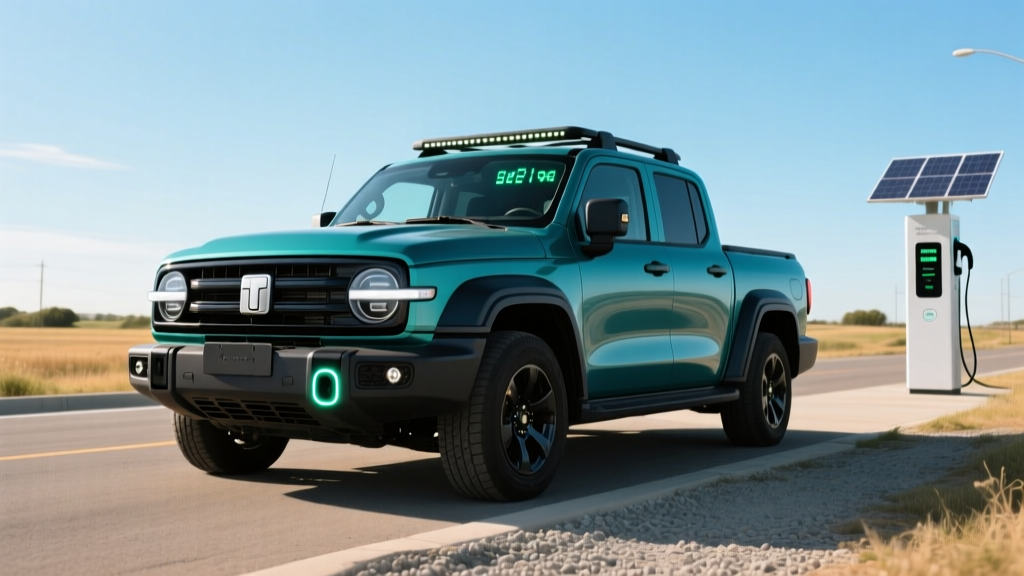
The "small electric pickup truck" category covers unibody compact trucks — vehicles smaller than midsize models like the Rivian R1T or Chevrolet Silverado EV. These trucks prioritize car-like ride quality, cabin space efficiency, and urban maneuverability over maximum towing. In 2026, two production models define this segment:
| Spec | Ford Maverick EV | Hyundai Santa Cruz EV |
|---|---|---|
| EPA Range | 270–310 mi (trim/battery dependent) | 285 mi (est.) |
| Battery (usable) | ~74 kWh, NMC | ~77.4 kWh, NMC |
| Peak DC Fast Charge | 150 kW | 175 kW (800V architecture) |
| 10–80% DC Charge Time | ~28 min | ~22 min |
| Level 2 Charge Rate | 10.5 kW | 10.9 kW |
| Horsepower | 266 hp (AWD dual motor) | 282 hp (AWD dual motor) |
| 0–60 mph | ~6.2 sec | ~5.8 sec |
| Payload / Towing | 1,500 lb / 2,000 lb | 1,400 lb / 2,500 lb |
| Bed Length | 4.5 ft (FLEXBED) | 4.3 ft |
| Base MSRP | $34,995 | $36,500 |
| Battery/Powertrain Warranty | 8 yr / 100,000 mi | 10 yr / 100,000 mi |
Sources: fueleconomy.gov, Ford and Hyundai manufacturer specification pages. Always verify final EPA certification figures before purchase, as early estimates can shift.
Real-World Range vs. EPA Sticker
EPA range estimates assume mixed driving at moderate temperatures. In real-world testing, expect:
- Highway-only at 70 mph: ~80–85% of EPA sticker (roughly 220–260 miles)
- Cold weather (below 30°F): ~70–75% of EPA sticker due to battery chemistry resistance and cabin heating load
- Heavy payload or towing: Range drops 30–45% depending on weight and aerodynamic drag — a small electric pickup truck towing 2,000 lb may see just 150–180 miles
Both the Maverick EV and Santa Cruz EV use liquid-cooled NMC batteries with heat pumps, which mitigate cold-weather losses compared to older EV platforms, but physics still applies.
Small Electric Pickup Truck vs. Gas Compact Truck: Cost & Capability
The most common cross-shop is against the gas Ford Maverick Hybrid (EPA 42 city / 33 hwy / 37 combined MPG) and the gas Hyundai Santa Cruz (EPA 21 city / 25 hwy / 23 combined). Here's how the numbers stack up over five years of ownership at 15,000 miles per year:
| 5-Year Cost Factor | Maverick EV AWD ($34,995) | Maverick Hybrid AWD ($30,495) | Santa Cruz Gas AWD ($33,000) |
|---|---|---|---|
| Purchase Price (base MSRP) | $34,995 | $30,495 | $33,000 |
| Est. Federal Tax Credit (§30D) | Up to $3,750–$7,500* | $0 | $0 |
| Effective Net Price | ~$27,495–$31,245 | $30,495 | $33,000 |
| Fuel/Energy (75k mi total) | $2,800–$4,200** | $5,400 | $7,800 |
| Maintenance (5 yr) | ~$1,200 | ~$2,800 | ~$3,200 |
| Insurance (5 yr avg) | ~$9,500 | ~$7,800 | ~$8,000 |
| Est. 5-Year Total Cost | ~$40,995–$46,145 | ~$46,495 | ~$52,000 |
*§30D credit eligibility depends on MSRP caps ($80,000 for trucks), buyer income limits ($150K single / $300K joint), and battery critical-mineral/component sourcing. Credit may be partial ($3,750) or full ($7,500) depending on 2026 sourcing compliance. Verify at IRS.gov and consider the point-of-sale transfer option.
**Electricity cost assumes $0.14/kWh home charging and occasional DC fast charging at $0.35/kWh. Gas assumes $3.40/gal average.
The EV wins on operating cost — you'll save $2,600–$5,000 on fuel and maintenance over five years. But insurance premiums for EVs run 15–25% higher on average due to repair complexity and parts cost. If you charge exclusively at home on a residential rate, the math heavily favors the EV. If you rely solely on public DC fast charging at $0.35–$0.50/kWh, the fuel savings shrink dramatically.
Charging a Small Electric Pickup Truck: What You Actually Need
Charging logistics determine whether EV truck ownership is convenient or frustrating. Here's the breakdown by charging level:
| Level | Power | Miles Added per Hour | Use Case | Typical Cost |
|---|---|---|---|---|
| Level 1 (120V) | 1.4 kW | ~4–5 mi/hr | Overnight trickle, emergencies | $0.10–$0.18/kWh (home) |
| Level 2 (240V) | 10.5–10.9 kW | ~32–36 mi/hr | Daily home/work charging | $0.10–$0.18/kWh (home) |
| DC Fast Charge | 150–175 kW peak | ~400–550 mi/hr (peak) | Road trips, quick top-ups | $0.30–$0.55/kWh (public) |
Home Charging Installation: What It Costs
Most small electric pickup truck buyers will want a Level 2 home charger (240V, 40–48 amp circuit) for overnight charging. A full charge from 10% takes roughly 7–8 hours at Level 2 — plug in at night, wake up full.
| Item | Low Estimate | High Estimate |
|---|---|---|
| Level 2 Charger (hardwired, 48A) | $400 | $750 |
| Electrician labor (240V circuit run) | $600 | $2,000 |
| Panel upgrade (if 100A → 200A needed) | $1,500 | $3,500 |
| Permit and inspection | $100 | $400 |
| Total (no panel upgrade) | $1,100 | $3,150 |
| Total (with panel upgrade) | $2,600 | $6,650 |
Always get a quote from a licensed electrician. Homes with existing 200A panels and short runs from panel to garage typically fall on the lower end. Older homes with 100A service may require an upgrade.
Understanding the Charge Curve
Peak DC fast-charge rates (150–175 kW) are sustained only between roughly 10–50% State of Charge (SoC). Above 80%, charging slows significantly to protect the battery — often dropping below 40 kW. A "10–80% in 22 minutes" spec means a full 10–100% session could take 45+ minutes. Plan road-trip stops around 10–80% charges for optimal time efficiency. Both trucks support preconditioning — the battery warms itself when you navigate to a charger, enabling faster charging in cold weather.
What First-Time EV Truck Buyers Must Know
Small electric pickup trucks share the same ownership fundamentals as any EV, but truck-specific considerations apply:
- Towing crushes range. A 2,000–2,500 lb trailer cuts range by 30–45%. If you tow frequently over long distances, a midsize EV truck (Rivian R1T, Silverado EV) with a larger battery or a gas/hybrid truck may be more practical.
- Payload is modest. These unibody trucks max out around 1,400–1,500 lb payload. For heavy construction materials, a body-on-frame midsize truck is still the right tool.
- Bed size is compact. At 4.3–4.5 feet, these beds handle lumber (with tailgate down), bikes, and gear — but not full sheets of plywood flat on the floor.
- Regenerative braking changes driving feel. Both trucks offer adjustable regen, including one-pedal driving modes. Expect a learning curve of a few days.
- Cold weather matters. If you live where winters drop below freezing regularly, budget 25–30% range loss and prioritize a model with a heat pump (both of these include one).
- Insurance costs more. Get quotes before buying. EV truck insurance averages 15–25% higher than gas equivalents due to battery repair costs and higher MSRP.
- Tax credits are not guaranteed. The §30D federal credit has income caps ($150K single / $300K joint for new vehicles), MSRP caps ($80,000 for trucks), and battery sourcing requirements that change annually. The point-of-sale transfer option lets you apply the credit as a down payment reduction at the dealer — but verify eligibility on IRS.gov first.
Common Misconceptions About Small Electric Pickup Trucks
| Myth | Fact |
|---|---|
| "EV trucks can't tow anything." | The Maverick EV tows 2,000 lb and the Santa Cruz EV tows 2,500 lb — enough for a small utility trailer, jet ski, or light camper. Range drops significantly, but the capability exists. |
| "The battery will need replacing in a few years." | Both trucks carry 8–10 year / 100,000-mile battery warranties with capacity retention thresholds (typically 70%). Industry data shows NMC batteries retain 85–90% capacity at 100,000 miles under normal use. Full replacement, if ever needed, costs $8,000–$14,000 but is rare within the warranty period. |
| "You can't charge in the rain or wash an EV truck." | All charging ports and electrical systems are sealed to IP67 or higher. Charging in rain and driving through car washes are completely safe. |
| "There's no charging infrastructure." | As of 2026, the U.S. has over 200,000 public charging ports. Both trucks can access Tesla Superchargers (via NACS port or adapter on the Santa Cruz), Electrify America, EVgo, and ChargePoint networks. Rural charging deserts still exist — plan accordingly. |
| "EVs are worse for the environment because of electricity generation." | Even on the dirtiest U.S. grids, an EV produces fewer lifecycle emissions than a comparable gas vehicle over its lifetime. On cleaner grids (hydro, wind, solar-heavy regions), the advantage is substantial. Source: Union of Concerned Scientists lifecycle analyses. |
Decision Framework: Should You Buy a Small Electric Pickup Truck?
Choose a Small Electric Pickup Truck If:
- You commute 20–80 miles daily and want a truck that doubles as a car-replacement daily driver
- You have access to Level 2 home charging (garage or driveway with 240V outlet)
- Your towing needs stay under 2,500 lb and are infrequent or short-distance
- You want to save $500–$1,000+ annually on fuel and maintenance vs. gas
- You value instant torque, quiet operation, and a low center of gravity for on-road stability
- Your total household income is under §30D caps and you can capture the tax credit
Look at a Gas or Hybrid Compact Truck Instead If:
- You regularly tow over 2,000 lb on long highway trips
- You lack reliable home or workplace charging access
- You frequently drive in remote areas with sparse charging infrastructure
- Your daily mileage regularly exceeds 250+ miles in cold weather
- You need maximum payload capacity (2,000+ lb) for work use
- Your budget is strictly under $28,000 and you cannot capture tax credits
Consider a Midsize EV Truck (Rivian R1T, Silverado EV) If:
- You need 300+ miles of real-world range with towing capability
- You require 5,000+ lb towing or 1,800+ lb payload
- You want a full-size bed (5.5–6.5 ft) and are willing to pay $70,000+
Ownership Checklist: Before You Sign
- Get an insurance quote on the exact trim before committing — EV truck premiums vary wildly by insurer.
- Hire an electrician for a home charging assessment — confirm your panel can handle a 40–48A 240V circuit without an upgrade.
- Verify §30D tax credit eligibility on IRS.gov for the specific VIN. Battery sourcing rules change, and not every trim qualifies for the full $7,500.
- Test the charge curve on a road trip — if your dealer offers extended test drives, take it to a DC fast charger and experience the taper firsthand.
- Download the charging apps (PlugShare, EVgo, Electrify America, Tesla) and map your most common routes to confirm coverage.
- Check NHTSA and IIHS safety ratings — look for Top Safety Pick designations and review crash test results at nhtsa.gov and iihs.org.
Frequently Asked Questions
Can a small electric pickup truck handle a work job site?
For light-duty work — tools, materials, small equipment — yes. The 1,400–1,500 lb payload handles most contractor needs. For heavy materials like gravel, concrete, or large lumber loads, you'll want a midsize body-on-frame truck. The Maverick EV's FLEXBED system includes built-in tie-downs, a 12V outlet, and configurable dividers that are genuinely useful for organizing gear.
How long does the battery last, and what does replacement cost?
NMC batteries in these trucks are warrantied for 8–10 years / 100,000 miles with a minimum 70% capacity retention threshold. Real-world data from similar platforms shows 85–90% capacity at 100,000 miles. Full battery replacement (rare within the warranty period) costs $8,000–$14,000 depending on the model and labor. Most owners will sell or trade the vehicle before needing a replacement.
Can I charge a small electric pickup truck at a Tesla Supercharger?
The Ford Maverick EV comes with a native NACS (Tesla-style) charge port, giving direct access to Tesla Supercharger stations — the most reliable DC fast-charging network in the U.S. The Hyundai Santa Cruz EV uses a CCS1 port but Hyundai provides a NACS adapter for Supercharger access. Both trucks can also use Electrify America, EVgo, and ChargePoint networks.
What happens if I run out of charge on the road?
Same as running out of gas: you'll need a tow to the nearest charger. However, EV range estimation in these trucks is highly accurate (typically within 5–10 miles of displayed range), and both include low-charge warnings and navigation to the nearest charger. With 270+ miles of EPA range and growing DC fast-charging coverage, range depletion is uncommon with basic trip planning.
Is a plug-in hybrid compact truck a better compromise?
As of 2026, no compact PHEV trucks exist in the U.S. market. The closest alternatives are the gas Maverick Hybrid (37 MPG combined, no electric-only range) and midsize PHEV options like the Jeep Gladiator 4xe (if available). A PHEV eliminates range anxiety but sacrifices the fuel savings and maintenance advantages of a full EV. If you can charge at home and your daily driving stays under 200 miles, a full EV truck is the more economical long-term choice.
Do small electric pickup trucks qualify for the $7,500 federal tax credit?
Potentially, but it depends on three factors under §30D: (1) your modified adjusted gross income must be under $150,000 (single) or $300,000 (joint), (2) the truck's MSRP must be under $80,000 (both qualify), and (3) the battery must meet critical-mineral and component-sourcing thresholds that tighten each year. In 2026, some trims may qualify for the full $7,500, others for $3,750 (partial sourcing compliance), and some may not qualify at all. Always check the specific VIN on IRS.gov before purchase, and ask the dealer about point-of-sale credit transfer.