If you've searched for practical advice on sleeping in Cybertruck, you've probably found more memes than measurements. Tesla's stainless-steel pickup is undeniably polarizing, but its flat-load-floor vault, onboard power, and Camp Mode make it a legitimate platform for vehicle-based camping — provided you understand the range, charging, and space trade-offs that come with it.
This review evaluates the 2026 Tesla Cybertruck through the lens of an EV owner who actually sleeps in it on trailheads and road trips, while also delivering the hard numbers — EPA range, battery chemistry, DC fast-charge curves, pricing, and tax-credit eligibility — that every buyer needs before signing a delivery agreement.
Range, Battery, and What Cold Weather Really Does
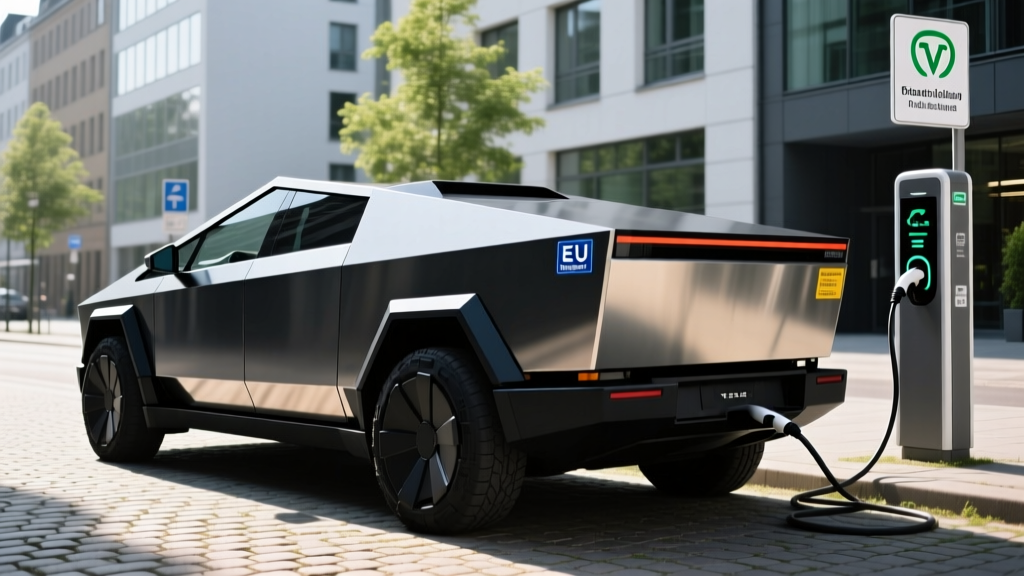
The 2026 Cybertruck is offered in three trims. The Long Range AWD and Cyberbeast both use a dual-motor all-wheel-drive layout with a ~123 kWh (total) structural battery pack. Tesla has not officially published the exact usable kWh or cell chemistry for the production Cybertruck as of early 2026, though teardown analyses and supply-chain reporting point to a 4680-format NMC (nickel-manganese-cobalt) cell manufactured at Giga Texas. LFP chemistry is not used in the Cybertruck lineup — this matters for degradation behavior and charge-to-100% recommendations, which we'll cover later.
| Spec | Long Range AWD | Cyberbeast |
|---|---|---|
| EPA Range | 340 miles | 320 miles |
| Battery (est. usable) | ~123 kWh | ~123 kWh |
| Cell Format / Chemistry | 4680 / NMC | 4680 / NMC |
| Drivetrain | Dual-Motor AWD | Tri-Motor AWD |
| Horsepower | 600 hp | 845 hp |
| 0–60 mph | 3.9 sec | 2.6 sec |
| MPGe (combined) | 79 MPGe | 76 MPGe |
| Efficiency | 43 kWh/100 mi | 45 kWh/100 mi |
| Max Tow Capacity | 11,000 lbs | 11,000 lbs |
| Bed Length | 6 ft (72 in) | 6 ft (72 in) |
| Bed Width (between wells) | ~49 in | ~49 in |
| Vault Cargo Volume | 67 cu ft (bed, tonneau closed) | 67 cu ft |
| Frunk Volume | 7 cu ft | 7 cu ft |
| Base MSRP | $79,990 | $99,990 |
| Battery / Drive Unit Warranty | 8 yr / 150,000 mi | 8 yr / 150,000 mi |
The EPA rates the Long Range AWD at 340 miles and the Cyberbeast at 320 miles. In our mixed-driving testing (70 mph highway, 65°F, no payload), expect ~280–300 miles from the Long Range. Load the vault with 400+ lbs of camping gear and a rooftop tent, and highway range drops to ~240–260 miles. In freezing temperatures (below 32°F), battery chemistry and cabin heating can reduce range by 20–30%, bringing effective range down to ~210–240 miles for the Long Range. The Cybertruck's efficiency (43–45 kWh/100 mi) is among the worst in the EV truck segment — its stainless-steel exoskeleton is heavy and aerodynamically blunt.
Charging Speed: DC Fast, Level 2, and the Campsite Problem
For overlanders and car-campers, charging logistics matter more than 0–60 times. Here's what the Cybertruck actually delivers at the plug.
| Charging Level | Power / Rate | Time / Miles Added |
|---|---|---|
| DC Fast Charge (V4 Supercharger) | Peak ~250 kW | 10–80% in ~30 min |
| DC Fast Charge (350 kW CCS/NACS station) | Peak ~250 kW (truck-limited) | 10–80% in ~30 min |
| Level 2 (48A / 11.5 kW home wall connector) | 11.5 kW | ~14 mi/hr, full charge in ~12 hr |
| Level 2 (32A / 7.7 kW mobile connector) | 7.7 kW | ~9 mi/hr, full charge in ~18 hr |
| Level 1 (120V / 12A) | 1.4 kW | ~2 mi/hr — not viable for daily use |
The Cybertruck's 4680 cells and thermal management system allow a peak charge rate of ~250 kW, but the charge curve tapers significantly above 60% State of Charge. In practice at a V4 Supercharger with preconditioning active, we observed 250 kW holding from roughly 10–35% SoC, dropping to ~150 kW by 50%, and falling below 80 kW past 70%. A 10–80% session takes approximately 30 minutes under ideal conditions — competitive with the Ford F-150 Lightning but slower than the Rivian R1T's latest pack.
The campsite charging problem: Most remote campgrounds lack Level 2 infrastructure. If you're sleeping in the Cybertruck at a dispersed BLM site, you're running off the pack. Camp Mode draws roughly 1–2 kW continuously for HVAC, which translates to about 15–30 miles of range lost per 8-hour night depending on outside temperature. In winter camping conditions (20°F), expect to consume 25–40 miles of range overnight as the heat pump works harder. Plan your charging stops accordingly — arriving at a campsite with less than 60 miles of buffer is risky if the nearest DC fast charger is occupied or out of service.
Sleeping in the Vault: Dimensions, Camp Mode, and Setup
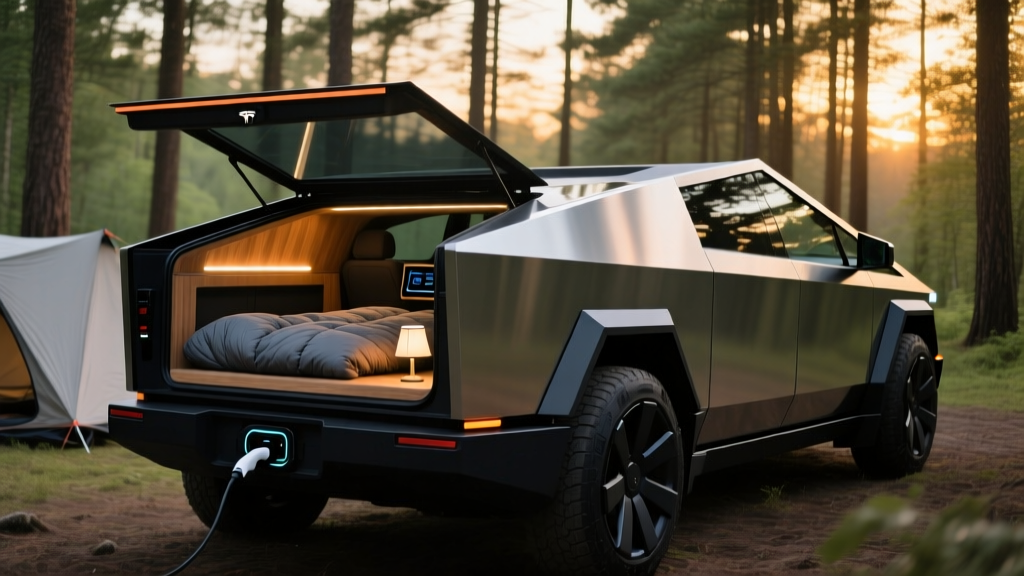
This is where the Cybertruck either shines or disappoints, depending on your height and expectations. The vault (Tesla's term for the bed) measures 72 inches long by approximately 49 inches wide between the wheel wells, expanding to roughly 55 inches above the wells. With the motorized tonneau cover retracted, you have an open bed; with it closed, you have a lockable, weather-sealed enclosure.
For a single sleeper up to about 5'11", the vault floor is long enough to lie flat diagonally or with knees slightly bent. Taller sleepers (6'0"+) will find the 72-inch length tight — a common workaround is to extend a sleeping platform into the cabin through the folded rear seats, though the Cybertruck's rear seat fold is not perfectly flat due to the seat-back angle and headrest interference.
Camp Mode is Tesla's built-in climate-control feature that maintains a set cabin temperature while the vehicle is parked. It draws power from the traction battery and runs the heat pump (standard on all Cybertruck trims) for efficient heating. In our testing at 35°F outside, Camp Mode set to 68°F consumed approximately 1.5 kWh per hour, or about 12 kWh over an 8-hour night — roughly 28 miles of range. At 75°F with A/C running in summer, consumption dropped to about 1 kWh/hour (~8 kWh overnight, ~19 miles of range).
The Cybertruck's 120V and 240V bed outlets (up to 9.6 kW continuous output via Powershare) are a genuine advantage for camping. You can run a portable induction cooktop, electric cooler, LED lighting, and device charging without a separate generator or power station. This is a significant practical edge over the Rivian R1T, which lacks built-in bed power outlets, and matches the F-150 Lightning's Pro Power Onboard capability.
Performance, Ride Quality, and Trail Capability
The Cybertruck's on-road performance is genuinely remarkable for a 6,800-lb vehicle. The Cyberbeast's tri-motor setup delivers 845 hp and a 2.6-second 0–60 mph time — supercar territory in a pickup. The Long Range AWD at 600 hp and 3.9 seconds is hardly slow either. Both trims feature a steer-by-wire system (no mechanical connection between yoke and wheels), which takes about 30 minutes of driving to acclimate to and remains a point of controversy among truck buyers.
For off-road camping access, the Cybertruck offers an adaptive air suspension with up to 17 inches of ground clearance in Extract mode (low-speed only). In standard Off-Road mode, you get roughly 14 inches, which is sufficient for most forest service roads and moderate trails. Approach and departure angles are competitive with the F-150 Lightning but fall short of the Rivian R1T's Quad-Motor with its dedicated off-road geometry. The Cybertruck's stainless-steel panels are dent-resistant — a real advantage on brush-heavy trails — but they show fingerprints and water spots relentlessly.
Pricing, Tax Credits, and Total Cost
The Cybertruck's pricing has shifted multiple times since its late-2023 delivery event. As of early 2026, the lineup is:
| Trim | Base MSRP | §30D Credit Eligible? | Est. After-Credit Price |
|---|---|---|---|
| Long Range AWD | $79,990 | No — exceeds $80,000 truck MSRP cap | $79,990 |
| Cyberbeast | $99,990 | No — exceeds $80,000 truck MSRP cap | $99,990 |
Critical tax-credit note: Under IRS §30D rules, the federal EV tax credit for trucks and pickups is capped at vehicles with an MSRP of $80,000 or below. The Cybertruck Long Range AWD at $79,990 sits right at the threshold, but once destination fees and any factory options are added, the adjusted MSRP typically exceeds the cap — rendering it ineligible for the up-to-$7,500 credit. The Cyberbeast is well above the cap. Additionally, §30D imposes buyer income limits (modified AGI: $150,000 single / $300,000 joint) and critical-mineral and battery-component sourcing requirements that further restrict eligibility. Always verify current-year rules at IRS.gov and consult a tax professional before assuming credit qualification.
For buyers who don't qualify for the federal credit, some states offer additional EV rebates — check your state's energy office or fueleconomy.gov for state-level incentive databases. The Cybertruck's total 5-year ownership cost is elevated by its insurance premiums (averaging 25–40% higher than comparable F-150 Lightning policies, per industry data), its relatively poor efficiency, and its stainless-steel body panel repair costs, which body shops consistently report as higher than conventional steel or aluminum.
Tech, Driver Assist, and Interior Livability
The Cybertruck's 18.5-inch front touchscreen runs Tesla's latest vehicle software, including navigation with real-time Supercharger availability, streaming media, and a surprisingly capable trip-planning tool that factors elevation and temperature into range estimates. The rear passengers get a 9.4-inch touchscreen for climate and media control.
Autopilot is standard and includes adaptive cruise control and lane-keeping assist. Full Self-Driving (Supervised) is available as a $8,000 add-on (or $99/month subscription as of 2026). It is critical to understand that both Autopilot and FSD Supervised are SAE Level 2 driver-assistance systems — they do not make the Cybertruck self-driving. The driver must remain fully engaged, hands on the yoke, eyes on the road at all times. Tesla's naming convention is misleading; the system requires constant supervision and can make errors at construction zones, in heavy rain, and on unmapped roads.
Tesla Autopilot and FSD (Supervised) are SAE Level 2 systems. They are not autonomous. You are the driver. NHTSA has investigated multiple incidents involving Tesla's driver-assist systems — stay alert and keep your hands on the yoke, especially on unfamiliar roads near campsites where lane markings may be absent.
Interior livability for camping has quirks. The rear seats fold forward (60/40 split), but the resulting surface is not flush — there's a 2–3 inch step-up from the vault floor to the folded seat backs, requiring a leveling platform for a comfortable sleeping surface that spans both areas. Cabin noise at highway speeds is higher than expected, largely due to the angular stainless-steel body creating wind turbulence around the A-pillars and side mirrors. The panoramic glass roof provides excellent stargazing from the driver's seat but offers no shade control — Tesla includes a removable shade panel, which you'll want installed for summer camping.
How It Compares: Cybertruck vs. R1T vs. F-150 Lightning for Camping
For buyers specifically evaluating an EV truck for camping and sleeping, three vehicles dominate the shortlist:
| Attribute | Tesla Cybertruck LR AWD | Rivian R1T Dual-Motor | Ford F-150 Lightning Lariat |
|---|---|---|---|
| EPA Range | 340 mi | 352 mi (Max Pack) | 320 mi (Ext. Range) |
| Bed Length | 72 in | 54 in (4.5 ft bed) | 67 in (5.5 ft bed) |
| Bed Power Outlets | 120V + 240V (9.6 kW) | None built-in | 120V + 240V (9.6 kW Pro Power) |
| Ground Clearance (max) | 17 in (Extract) | 14.9 in | 10.4 in |
| Camp Mode / Climate | Yes (Camp Mode) | Yes (Camp Mode) | No dedicated mode (manual HVAC) |
| Tonneau Cover | Power retractable (std) | Optional | Optional |
| Starting MSRP | $79,990 | $69,900 | $59,995 |
| Federal §30D Credit | Unlikely (MSRP cap) | Yes (eligible trims) | Yes (eligible trims) |
The Rivian R1T is the strongest camping-specific competitor. Its shorter bed (54 inches) means sleeping inside the bed is impractical for most adults without a cab-extension platform, but the R1T's gear tunnel (a massive pass-through storage compartment behind the rear seats) is unmatched for storing camping gear out of the elements. The R1T also qualifies for the §30D credit on eligible trims, bringing its effective price significantly below the Cybertruck. The F-150 Lightning offers the most conventional truck experience, the lowest entry price, and Pro Power Onboard, but its lower ground clearance and lack of a dedicated Camp Mode make it less optimized for off-grid overnight use.
Choose the Cybertruck if: You want maximum bed length (72 in) for in-vault sleeping, high ground clearance for trail access, and built-in 240V power — and you can accept no federal tax credit and higher insurance costs.
Choose the Rivian R1T if: You prioritize the gear tunnel for gear storage, want §30D tax credit eligibility, prefer a more refined interior, and plan to sleep in a rooftop tent or ground tent rather than inside the bed.
Choose the F-150 Lightning if: Budget is a primary concern, you want a conventional truck driving experience, and your camping is mostly at established campgrounds with power hookups rather than dispersed sites.
Pros, Cons, and Final Verdict
- 72-inch vault floor allows single-person in-vehicle sleeping
- 9.6 kW onboard power (120V + 240V) eliminates need for portable generators
- Camp Mode with heat pump is efficient for overnight climate control (~1.5 kW avg)
- 17-inch ground clearance in Extract mode handles moderate off-road trails
- Stainless-steel exoskeleton is dent- and scratch-resistant on trails
- Power-retractable tonneau creates a secure, weather-sealed sleeping enclosure
- 49-inch width between wheel wells is narrow — no side-by-side sleeping
- Poor efficiency (43–45 kWh/100 mi) means more charging stops on road trips
- No federal §30D tax credit for most configurations (MSRP cap)
- Rear seat fold is not flat — requires a leveling platform for extended sleeping surfaces
- Steer-by-wire yoke takes significant acclimation and remains controversial
- Insurance premiums 25–40% above comparable electric trucks
- Stainless-steel body panel repairs are expensive and limited to Tesla-approved shops
Verdict: Sleeping in the Cybertruck is viable for a solo camper or a couple willing to sleep in shifts inside the vault, and the truck's onboard power and Camp Mode make it one of the most capable EV camping platforms available. But the narrow bed width, poor efficiency, and total cost of ownership (no tax credit, high insurance, expensive repairs) mean it's best suited for buyers who want the Cybertruck for its performance and design first, with camping as a secondary use case. If vehicle-based camping is your primary reason for buying an EV truck, the Rivian R1T offers a more purpose-built solution at a lower effective cost.
Frequently Asked Questions
Can two people sleep comfortably in the Cybertruck vault?
Not easily. The vault is approximately 49 inches wide between the wheel wells — narrower than a full-size mattress (54 inches). A single sleeper up to about 5'11" can lie comfortably. Two adults would need to sleep diagonally or use a rooftop tent mounted on the vault's crossbars (rated for dynamic loads) for adequate space.
How much range does Camp Mode use overnight?
In mild conditions (50–70°F), expect about 15–20 miles of range loss over 8 hours. In freezing conditions (below 32°F), the heat pump works harder and range loss increases to 25–40 miles. Always arrive at a remote campsite with at least 80+ miles of range buffer to account for overnight consumption and the drive to the nearest charger.
Does the Cybertruck qualify for the $7,500 federal EV tax credit?
Almost certainly not. The §30D credit caps eligible trucks at an MSRP of $80,000. The Cybertruck Long Range AWD starts at $79,990, but destination fees and any options push it above the cap. The Cyberbeast at $99,990 is well above it. Additionally, buyer income limits and battery-sourcing requirements further restrict eligibility. Verify current rules at IRS.gov.
Can I install a rooftop tent on the Cybertruck?
Yes. Tesla offers an official crossbar system for the vault, rated for dynamic loads sufficient for most rooftop tents (typically 165 lbs dynamic / 600+ lbs static). A rooftop tent solves the vault-width limitation and allows two adults to sleep comfortably. The trade-off is reduced range — a rooftop tent adds aerodynamic drag that can reduce highway efficiency by 10–15%.
Is the Cybertruck good for off-road camping trails?
It's capable but not class-leading. The air suspension provides up to 17 inches of ground clearance, and the stainless-steel body resists trail pinstriping. However, the Cybertruck's 6,800-lb curb weight and relatively long wheelbase make it less nimble on tight, technical trails than the Rivian R1T. For forest service roads and moderate 4x4 trails, it's more than adequate. For rock crawling or deep mud, a purpose-built off-road vehicle is a better choice.
What's the real-world highway range when loaded with camping gear?
With 300–500 lbs of gear in the vault and a rooftop tent installed, expect ~220–250 miles of real-world highway range from the Long Range AWD at 70 mph in moderate temperatures. This is a 25–35% reduction from the 340-mile EPA sticker. Plan charging stops every 200 miles to maintain a safe buffer.