The Short Answer on Slate Auto's Electric Truck
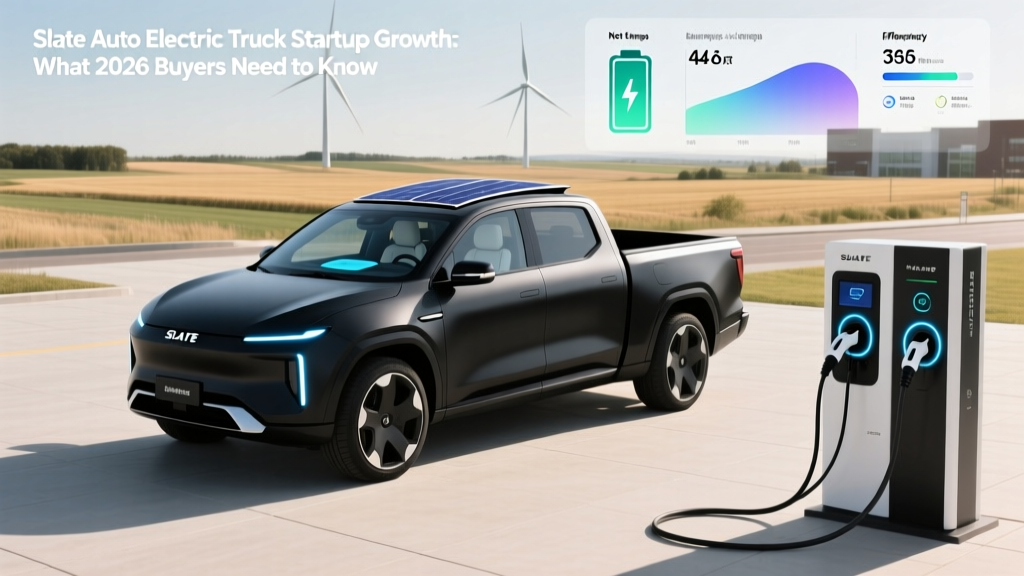
Slate Auto is a Michigan-based EV startup building a compact, lightweight electric pickup aimed at urban and suburban utility use — not heavy-duty towing. As of early 2026, the company has moved from concept to limited production intent, targeting a base MSRP near $25,000–$30,000 before incentives, with a projected EPA range of approximately 150–200 miles and a modular bed system. The truck has not yet received full EPA certification, and deliveries remain in a pre-order/reservation phase. If you need a proven, available electric truck today, the Rivian R1T, Ford F-150 Lightning, or Chevrolet Silverado EV are shipping now. Slate Auto is worth watching if you want an affordable, city-sized electric utility vehicle and can wait for production to scale.
What Is Slate Auto and Why Is It Growing?
Slate Auto emerged from the wave of EV startups that gained momentum after 2020, but with a different thesis: instead of competing on range, horsepower, or luxury, Slate is targeting the affordable utility segment — a space where electric trucks under $35,000 barely exist. The company's pitch centers on a compact pickup footprint (shorter than a Ford Maverick), a stripped-down interior with durable, washable surfaces, and a modular bed that can be configured for cargo, work, or lifestyle use.
The startup's growth trajectory follows a familiar pattern in the EV space: seed funding, concept reveal, media buzz, reservation openings, and then the hard part — scaling manufacturing. As of 2026, Slate Auto has reportedly secured venture funding and announced manufacturing partnerships, but has not yet delivered vehicles to retail customers at volume. This is a critical distinction. Growth in reservations and media attention is not the same as growth in deliveries.
For context, Rivian took roughly 7 years from founding to its first R1T delivery. Lordstown Motors, Canoo, and several other EV truck startups failed or restructured before reaching meaningful production. Slate Auto's growth should be evaluated on production milestones, not just announcements.
Announced Specs vs. What's Actually Available
Because Slate Auto's truck is not yet in full production, all specifications below are preliminary and subject to change. They are based on the company's public announcements and concept-stage disclosures.
| Specification | Slate Auto Truck (Announced/Estimated) | Rivian R1T Dual-Motor (2026) | Ford F-150 Lightning Std Range (2026) |
|---|---|---|---|
| Base MSRP | ~$25,000–$30,000 | $71,700 | $54,995 |
| EPA Range | ~150–200 mi (est.) | 270 mi | 240 mi |
| Battery Capacity | ~50–65 kWh (est., LFP likely) | 106 kWh (NMC) | 98 kWh (NMC) |
| Peak DC Fast Charge | ~100–150 kW (est.) | 220 kW | 150 kW |
| 10–80% Charge Time | ~30–40 min (est.) | ~21 min | ~38 min |
| 0–60 mph | ~7–8 sec (est.) | 4.5 sec | 4.5 sec |
| Horsepower | ~200–250 hp (est.) | 533 hp | 452 hp |
| Towing Capacity | ~2,000–3,500 lbs (est.) | 11,000 lbs | 7,700 lbs |
| Production Status | Pre-production / Reservations | Shipping | Shipping |
The comparison makes the trade-off clear: Slate Auto's truck would be dramatically cheaper but also significantly smaller, less powerful, shorter-ranged, and far less capable as a tow rig. It's a different vehicle category — closer to an electric utility cart with a bed than a full-size or mid-size pickup.
Startup Risk: What EV Truck Buyers Must Understand
Buying from an EV startup carries risks that buying from Ford, GM, or even Rivian (now a public company with an established factory) does not. Here is a factual breakdown of what can go wrong:
- Production delays are the norm, not the exception. Nearly every EV startup — Tesla included — has missed initial delivery timelines by 12–36 months.
- Specs change between concept and production. Battery suppliers, motor configurations, and software features often shift as cost engineering takes over from concept engineering.
- Service infrastructure may be limited. Established automakers have dealer networks for warranty work. Startups typically rely on mobile service or third-party shops, which can mean longer repair times and parts delays.
- Federal tax credit eligibility is not guaranteed. To qualify for the §30D clean vehicle credit (up to $7,500), the vehicle must meet IRS battery sourcing and critical mineral requirements, MSRP caps ($80,000 for trucks), and buyer income limits. A startup's supply chain may not meet these thresholds at launch.
- Resale value is uncertain. Vehicles from startups with limited production runs and unproven reliability records typically depreciate faster than comparable models from established brands.
Common Misconceptions About Slate Auto and EV Startups
| Myth | Fact |
|---|---|
| "A $25,000 electric truck means I'll pay $25,000 out the door." | Destination fees, dealer markups (if applicable), optional packages, and state registration add $1,500–$4,000+. The advertised base price rarely reflects real transaction price. |
| "I'll definitely get the $7,500 tax credit." | §30D eligibility requires the vehicle to meet battery-component and critical-mineral sourcing rules, the buyer's AGI must be under $150K (single) / $300K (joint), and the truck MSRP must be under $80,000. Check IRS.gov for current qualified-vehicle lists. |
| "150 miles of range is enough for a truck." | For city commuting under 40 miles round-trip, yes. For highway driving at 70+ mph, expect 15–20% range loss versus EPA. In cold weather (below 32°F), LFP and NMC batteries alike can lose 20–30% of rated range. A 150-mile EPA truck may deliver only 105–125 miles in winter highway conditions. |
| "Startups innovate faster so they'll catch up." | Manufacturing at scale is a fundamentally different challenge than prototyping. Tooling, supply chain, quality control, and safety certification (NHTSA compliance) take years and billions of dollars. |
Cost of Ownership: Slate Auto vs. Gas and Established EV Trucks
Let's model a realistic 5-year ownership comparison. Since Slate Auto's truck isn't shipping, we'll use its announced target pricing and compare it to a comparably affordable gas truck (Ford Maverick Hybrid) and the cheapest available full EV truck (Ford F-150 Lightning base).
| Cost Factor (5 Years) | Slate Auto (Est. at $28K MSRP) | Ford Maverick Hybrid ($28K MSRP) | F-150 Lightning ($55K MSRP) |
|---|---|---|---|
| Purchase Price (after est. incentives) | $20,500 (if $7,500 credit applies) | $28,000 (no EV credit; PHEV/HEV credit N/A for HEV) | $47,500 (if $7,500 credit applies) |
| Fuel / Electricity (60,000 mi) | ~$2,700 (home charging at $0.14/kWh, 3 mi/kWh) | ~$5,100 (42 MPG combined, $3.50/gal) | ~$2,800 (home charging at $0.14/kWh, 2 mi/kWh) |
| Maintenance | ~$800 (no oil, fewer moving parts) | ~$2,800 (oil, filters, brakes, transmission) | ~$900 (no oil, fewer moving parts) |
| Insurance (avg. national) | ~$7,500 (startup premium likely) | ~$6,500 | ~$8,500 |
| Estimated Depreciation | ~$12,000 (high startup risk) | ~$10,000 | ~$18,000 |
| 5-Year Total Cost | ~$43,500 | ~$52,400 | ~$77,700 |
Key takeaway: If Slate Auto delivers at its target price AND the buyer qualifies for the full §30D credit AND the truck depreciates moderately, it could be the cheapest vehicle to own in this comparison. But that's three big "ifs" — each carrying genuine risk. The Maverick Hybrid is the safe, proven, available alternative with excellent fuel economy and no charging requirement.
Real-World Ownership Considerations Before Reserving
Before placing a deposit on any startup EV truck — Slate Auto included — evaluate these practical factors:
Home Charging Access
A compact EV truck with a ~50–65 kWh battery is an excellent home-charging candidate. A Level 2 charger (7.7–11.5 kW) can fully replenish the battery overnight in 5–8 hours. However, if you live in an apartment, rent, or lack a garage or dedicated parking spot with electrical access, you'll rely entirely on public DC fast charging. At ~100–150 kW peak (estimated), a Slate Auto truck would add roughly 80–120 miles of range in a 30-minute session — adequate for city dwellers who charge weekly, but inconvenient for road trips.
Level 2 home installation typically costs $500–$2,000 if your electrical panel has capacity, or $2,000–$5,000+ if a panel upgrade (100A to 200A) is needed. Factor this into your purchase budget.
Climate and Range Reality
If you live in a region with harsh winters (Upper Midwest, Northeast, Mountain West), plan for 20–30% range loss in cold weather. A truck with an announced 150–200 mile EPA range may realistically deliver 105–160 miles in freezing temperatures, especially on highway trips. Battery preconditioning and a heat pump (if equipped) mitigate this, but physics cannot be eliminated.
Driving Patterns
Slate Auto's truck makes the most sense for drivers whose daily routine looks like this: commute under 40 miles, occasional cargo hauling, no towing, home charging available, and a second vehicle in the household for long road trips. If your truck is your only vehicle and you regularly drive 200+ miles between charges, this is not the right truck — look at the F-150 Lightning Extended Range (320 mi EPA) or Rivian R1T Max Pack (352 mi EPA).
Decision Framework: Should You Wait for Slate Auto or Buy Now?
Choose Based on Your Situation
Wait for Slate Auto if:
- Your budget is strictly under $30,000 and you want a new electric truck (not used)
- Your daily driving is under 50 miles round-trip
- You have reliable home Level 2 charging
- You don't need to tow more than 2,000 lbs
- You already have another vehicle for long trips
- You can tolerate a 12–24 month wait with possible delays
Buy an established EV truck now if:
- You need a truck for work, towing, or frequent long-distance driving
- You want proven reliability data, established service networks, and NHTSA crash-test ratings
- You need guaranteed §30D tax credit eligibility (check the DOE/EPA qualified vehicle list)
- You want financing from a mainstream lender (startups may have limited financing options)
Consider a hybrid truck instead if:
- You want truck utility with no range anxiety and no charging dependency
- The Ford Maverick Hybrid (42 MPG combined, ~$28K) or Toyota Tacoma i-FORCE MAX hybrid fits your needs
- You live in a charging desert or apartment without charging access
Frequently Asked Questions
Is Slate Auto's electric truck available to buy right now?
No. As of early 2026, Slate Auto is accepting reservations or expressions of interest but has not begun retail deliveries. The company is in a pre-production phase. Any vehicle you see is a prototype or concept — not a shipping product.
How does the Slate Auto truck compare to a Ford Maverick?
The Maverick is a compact gas/hybrid unibody truck that's available now, has established reliability, a full dealer network, and gets up to 42 MPG combined in hybrid form. The Slate Auto truck would be fully electric with lower running costs but shorter range, no towing capability to speak of, and startup risk. The Maverick is the pragmatic choice; the Slate is the speculative, potentially cheaper-to-operate choice — if it ships.
Will I qualify for the $7,500 federal EV tax credit on a Slate Auto truck?
Possibly, but it's not guaranteed. Under current IRS §30D rules, the truck must meet battery component and critical mineral sourcing requirements, the MSRP must be under $80,000 (trucks), and your adjusted gross income must be below $150,000 (single) or $300,000 (married filing jointly). Startups often have supply chains that don't initially meet sourcing thresholds. Verify eligibility on the IRS qualified-vehicle list before assuming the credit.
What happens if Slate Auto goes out of business before delivering my truck?
This is the core startup risk. If the company fails, reservation deposits may be partially or fully refundable depending on the terms you agreed to, but there is no guarantee. Unlike a Ford or GM purchase, there is no parent company with deep pockets backing the warranty. Only put down a deposit you can afford to lose, and read the reservation terms carefully.
Can I charge a Slate Auto truck at Tesla Superchargers?
This depends on which connector the production vehicle uses. Most new EVs sold in North America from 2025 onward are adopting the NACS (Tesla) connector standard. If Slate Auto equips its truck with NACS, it will have access to the Supercharger network (17,000+ stalls in the U.S.). If it ships with CCS, adapters will be needed. This specification has not been confirmed for the production vehicle.
What battery chemistry will Slate Auto use?
The company has not officially confirmed battery chemistry for production. Given the target price point and compact battery size (~50–65 kWh estimated), LFP (lithium iron phosphate) is the most likely choice. LFP cells are cheaper, have longer cycle life (3,000+ cycles vs. ~1,500 for NMC), and tolerate frequent 100% charging — ideal for a daily-driver truck. The trade-off is lower energy density (heavier for the same kWh) and slightly worse cold-weather performance versus NMC.