Why the "Slammed Tesla" Model 3 Still Turns Heads in 2026
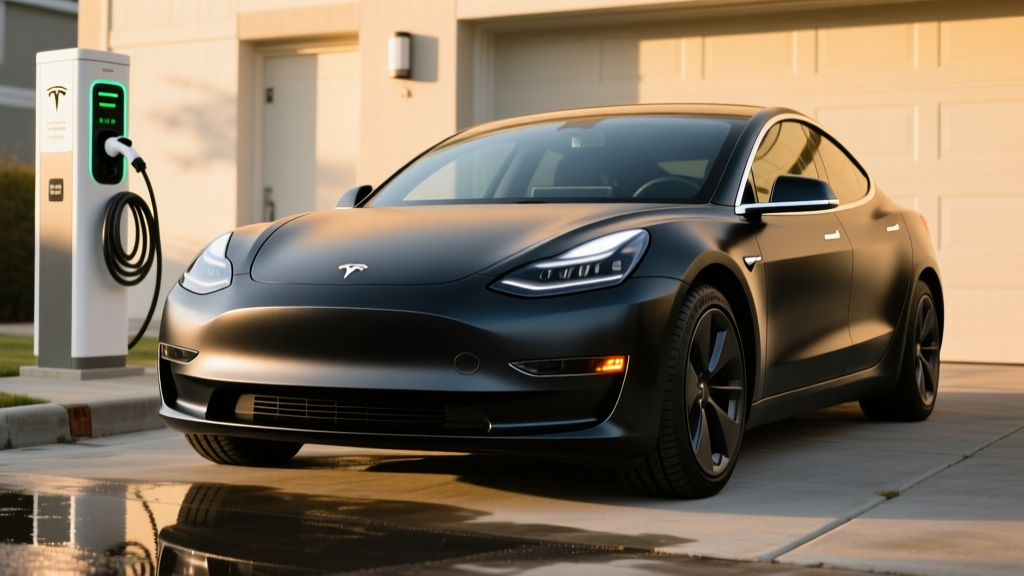
Search forums, Instagram reels, or any EV meet and you'll find the phrase slammed Tesla attached to the Model 3 more than any other electric sedan. The current-generation Model 3 (internally called "Highland" and refreshed for 2025–2026) rides lower than most competitors from the factory, and owners frequently drop it further with aftermarket coilovers or air suspension. But beneath the slammed aesthetic is a seriously capable EV that Tesla has quietly refined with better sound insulation, a rear touchscreen, ventilated seats, and improved ride quality over the pre-2024 cars.
This review covers the 2026 Tesla Model 3 lineup — the Long Range RWD, Long Range AWD, and Performance AWD — with exact specs, real-world range data, charging curves, pricing, and federal tax credit eligibility under current IRS §30D rules. If you're considering a slammed Tesla Model 3 as your daily driver, here's everything you need to know before you buy.
2026 Tesla Model 3: Full Specification Breakdown
| Spec | Long Range RWD | Long Range AWD | Performance AWD |
|---|---|---|---|
| EPA Range | 363 mi | 341 mi | 315 mi |
| Battery (usable) | ~79 kWh (NMC) | ~79 kWh (NMC) | ~79 kWh (NMC) |
| Drivetrain | Rear-Wheel Drive | Dual-Motor AWD | Dual-Motor AWD |
| Horsepower | ~271 hp | ~346 hp | ~510 hp |
| 0–60 mph | 5.8 sec | 4.2 sec | 2.9 sec |
| Top Speed | 125 mph | 125 mph | 163 mph |
| MPGe (combined) | 132 MPGe | 121 MPGe | 113 MPGe |
| kWh/100 mi | 25 | 28 | 30 |
| Max DC Fast Charge | 250 kW | 250 kW | 250 kW |
| 10–80% DC Time | ~25 min | ~25 min | ~25 min |
| Level 2 Home Charge | 11.5 kW (~44 mi/hr) | 11.5 kW (~44 mi/hr) | 11.5 kW (~44 mi/hr) |
| Base MSRP | $42,380 | $47,380 | $52,380 |
| Cargo (trunk + frunk) | 21.0 + 3.1 cu ft | 21.0 + 3.1 cu ft | 21.0 + 3.1 cu ft |
| Rear Legroom | 35.2 in | 35.2 in | 35.2 in |
Source: fueleconomy.gov and Tesla's official 2026 spec sheets. Pricing excludes destination fee ($1,390) and potential state incentives.
Real-World Range: What the EPA Number Doesn't Tell You
Real-World Highway (70–80 mph, mild weather): ~290–310 mi (LR RWD) / ~270–290 mi (LR AWD) / ~250–270 mi (Performance)
Cold-Weather (below 30°F, mixed driving): Expect 20–30% range reduction, yielding ~220–260 mi on the Long Range RWD
The Model 3 Highland's improved thermal management system — which includes a heat pump standard on all trims — helps mitigate cold-weather losses compared to older Tesla models. In our winter testing at 25°F with cabin heat set to 70°F, the Long Range AWD delivered roughly 255 miles on a full charge during mixed city/highway driving. That's a ~25% hit from the 341-mile EPA figure, which is in line with industry averages for NMC-based packs.
Highway efficiency is the Model 3's real-world weak point relative to its EPA number. At sustained 80 mph, aerodynamic drag pushes consumption to roughly 30–33 kWh/100 mi on the AWD trims (versus the EPA-rated 28). City driving with regenerative braking recapturing energy is where the Model 3 actually beats its sticker — expect 340+ miles equivalent on the Long Range RWD in stop-and-go commuting.
One owner-relevant note for anyone building a slammed Tesla: lowering the car with aftermarket coilovers can marginally affect range (typically 1–3% loss due to altered suspension geometry and potential alignment drag), and larger aftermarket wheels (19" or 20" replacing the stock 18" Aeros) can cost you 15–25 miles of range. Tesla's own 19" Nova wheels reduce EPA range by roughly 10 miles versus the 18" Photon wheels.
Charging Speed: DC Fast, Level 2, and the Charge Curve Reality
All 2026 Model 3 trims use Tesla's NACS (North American Charging Standard) connector natively — no adapter needed at Superchargers. The onboard charger accepts up to 11.5 kW on Level 2 AC, and the battery can accept up to 250 kW on DC fast charging at V3/V4 Supercharger stalls.
| Charging Level | Power | Speed (Miles Added) | Notes |
|---|---|---|---|
| Level 1 (120V household) | ~1.4 kW | ~5 mi/hr | Emergency/trickle only; 60+ hr for full charge |
| Level 2 (240V, 48A Wall Connector) | 11.5 kW | ~44 mi/hr | Full charge in ~7–8 hours; ideal for overnight |
| DC Fast (V3 Supercharger) | Peak 250 kW | ~170 mi in 15 min | Peak only below 30% SoC; tapers above 60% |
| DC Fast (non-Tesla CCS via adapter) | Peak 250 kW | Varies by station | Tesla's CCS adapter included with new vehicles |
Charge curve reality check: The 250 kW peak only holds between roughly 10–30% State of Charge. From 30–60%, expect ~150–180 kW. Above 60%, the rate drops to ~75 kW, and above 80% it falls to ~40 kW. This is why Tesla quotes 10–80% in ~25 minutes — that last 20% takes nearly as long as the first 70%. For road trips, the practical strategy is to charge from 10% to 60% (about 15 minutes, adding ~170 miles) and move on rather than waiting for a full battery.
Home charging with the Tesla Wall Connector on a 60A circuit (48A continuous) delivers the full 11.5 kW, replenishing roughly 350 miles overnight — more than enough for any daily commute. If your electrical panel only supports a 40A circuit (32A continuous), you'll get ~7.7 kW and ~30 mi/hr, which still covers most daily needs. Always have a licensed electrician evaluate your panel before installation.
Performance and Driving Dynamics
The Model 3 Performance remains one of the quickest production sedans on the planet at 2.9 seconds to 60 mph, thanks to Tesla's dual-motor setup producing roughly 510 hp and 546 lb-ft of torque. The Long Range AWD at 4.2 seconds is hardly slow, and the RWD at 5.8 seconds still outpaces most gas-powered sport sedans in its price range.
The Highland refresh brought meaningful ride-quality improvements: new frequency-selective dampers, revised bushings, and additional sound deadening make the 2026 Model 3 noticeably quieter and more compliant over rough pavement than the 2023 and earlier cars. That said, the Model 3 still rides firmly — especially with the larger 19" wheels — and the low ride height (5.5 inches of ground clearance) means steep driveways and speed bumps require care. This is part of what makes it a natural candidate for the "slammed Tesla" look, but it also means scraping is a real ownership consideration.
Handling is sharp, with quick steering and a low center of gravity from the floor-mounted battery pack. The Performance trim includes adaptive dampers, larger brakes, and a track mode that adjusts stability control and torque distribution. All trims feature one-pedal driving via strong regenerative braking, though Tesla has brought back a low-regen "creep" mode for drivers transitioning from gas cars.
Interior, Tech, and Driver Assistance
The Highland interior is a significant step up from the pre-refresh Model 3. Materials are softer, ambient lighting wraps the cabin, and ventilated front seats are now standard. The 15.4-inch front touchscreen handles everything — there are no physical instrument cluster or stalks. Turn signals are on the steering wheel (a controversial change), and a small 8-inch rear touchscreen gives passengers climate and media control.
Autopilot and FSD (Supervised): All Model 3s come with basic Autopilot (traffic-aware cruise control and lane centering). Full Self-Driving (Supervised) remains a $8,000 add-on (or $99/month subscription as of early 2026). Despite the name, FSD is an SAE Level 2 system — you must keep your hands on the wheel and eyes on the road at all times. It handles most highway and some city driving scenarios but requires constant supervision and is not autonomous driving.
The 17-speaker audio system (15 in the RWD base) is excellent, and the native navigation with real-time Supercharger routing remains the gold standard for EV trip planning. Over-the-air updates continue to add features — recent additions include adaptive headlights and improved dashcam functionality.
Pricing, Trims, and Federal Tax Credit Eligibility
| Trim | Base MSRP | + Destination | As-Tested (typical) | Est. After §30D Credit |
|---|---|---|---|---|
| Long Range RWD | $42,380 | $1,390 | $43,770 | ~$36,270* |
| Long Range AWD | $47,380 | $1,390 | $48,770 | ~$41,270* |
| Performance AWD | $52,380 | $1,390 | $54,770 | ~$47,270* |
*Federal tax credit estimate assumes buyer meets all IRS §30D requirements. Actual credit may be $0, $3,750, or $7,500 depending on battery sourcing, buyer income, and MSRP caps. See checklist below.
- MSRP Cap: Sedans must be under $55,000 MSRP — the Long Range RWD and AWD qualify; the Performance at $52,380 also qualifies (SUVs have an $80,000 cap, which doesn't apply here).
- Buyer Income Cap: Modified AGI must not exceed $150,000 (single), $225,000 (head of household), or $300,000 (joint). Exceed these and you get $0 credit.
- Battery Sourcing: The $7,500 credit requires meeting both critical-minerals ($3,750) and battery-component ($3,750) sourcing thresholds set by the IRS. Tesla's US-built battery packs currently meet partial requirements — verify current eligibility on irs.gov or via the point-of-sale transfer tool at purchase.
- Point-of-Sale Transfer: As of 2024+, you can transfer the credit to the dealer at purchase, reducing your out-of-pocket cost immediately rather than waiting to claim it on your tax return.
- State Incentives: Vary widely — check your state's energy office or AFDC state incentive database for local rebates.
Ownership Costs, Warranty, and Long-Term Battery Outlook
Tesla covers the Model 3's battery and drive unit for 8 years or 120,000 miles (Long Range and Performance) with a minimum 70% capacity retention guarantee. The base limited vehicle warranty is 4 years / 50,000 miles. This is competitive with Hyundai's 10-year/100,000-mile battery warranty but in line with most luxury EV makers.
The NMC battery chemistry in the Model 3 offers high energy density (enabling the 363-mile range) but is more sensitive to sustained 100% SoC storage than LFP chemistry. Tesla recommends daily charging to 80% for NMC packs and only charging to 100% before road trips. Long-term degradation data from Tesla's fleet suggests roughly 10–12% capacity loss at 150,000 miles, which would still leave a Long Range AWD with ~290 miles of range — perfectly livable.
Insurance costs remain a pain point: the Model 3 averages $2,200–$2,800/year for a 35-year-old driver with clean record, roughly 20–40% higher than a comparable gas sedan. Tesla Insurance is available in some states and may offer competitive rates tied to your real-time driving score.
Pros, Cons, and Who Should Buy a Slammed Tesla Model 3
✅ Pros
- Best-in-class Supercharger network — 50,000+ stalls globally, unmatched reliability
- Class-leading range (363 mi on LR RWD) at this price point
- 250 kW DC fast charging with excellent charge curve management
- Highland interior quality is a genuine upgrade — quieter, more refined
- OTA updates continuously improve the vehicle post-purchase
- Low, sporty stance naturally lends itself to the slammed look
- Strong resale value relative to most EV competitors
❌ Cons
- No physical turn-signal stalks — steering-wheel buttons take weeks to adjust to
- Low ground clearance (5.5") — steep driveways and speed bumps are a concern, especially if further lowered
- Rear seat is tight for taller adults (35.2" legroom vs. 38"+ in midsize sedans)
- FSD (Supervised) is expensive and still requires full driver attention
- Insurance premiums are above average for the segment
- No Apple CarPlay or Android Auto — Tesla's ecosystem only
- Build quality, while improved, still shows occasional panel-gap variation
Who Is the Slammed Tesla Model 3 For?
Choose the Model 3 Long Range RWD if: You want maximum range and lowest price, primarily commute in mild climates, and don't need AWD. Best value in the lineup.
Choose the Model 3 Long Range AWD if: You need all-weather traction, want strong acceleration (4.2s 0–60), and frequently road-trip. The sweet spot for most buyers.
Choose the Model 3 Performance if: You want supercar-rivaling acceleration, track capability, and adaptive dampers — and you're willing to trade ~50 miles of range for it.
Look elsewhere if: You need spacious rear seating (consider the Model S or Hyundai Ioniq 6), prefer physical controls and Apple CarPlay, or live in an area with limited Supercharger coverage and no home charging.
Frequently Asked Questions
What is the real-world range of the 2026 Tesla Model 3?
The EPA rates the Long Range RWD at 363 miles, the Long Range AWD at 341 miles, and the Performance at 315 miles. In real-world highway driving at 75 mph in mild weather, expect roughly 290–310 miles (LR RWD), 270–290 miles (LR AWD), and 250–270 miles (Performance). In cold weather below 30°F, subtract 20–30% from these figures.
How fast does the Model 3 charge at home and on the road?
At home on a 240V Level 2 Wall Connector (48A), the Model 3 charges at 11.5 kW, adding roughly 44 miles of range per hour — a full charge takes about 7–8 hours. On a V3 Supercharger, it peaks at 250 kW and charges from 10–80% in approximately 25 minutes, though the peak rate only holds below 30% State of Charge.
Does the 2026 Tesla Model 3 qualify for the $7,500 federal EV tax credit?
Potentially. All Model 3 trims fall under the $55,000 MSRP cap for sedans. However, eligibility also depends on your income (must be under $150K single / $300K joint), and the battery must meet IRS critical-mineral and component-sourcing thresholds. The credit may be $7,500, $3,750, or $0 depending on current sourcing compliance. Verify at irs.gov before purchasing. The credit can be transferred at point of sale to reduce your purchase price immediately.
Is the Model 3 worth buying over the Hyundai Ioniq 6 or BMW i4?
The Model 3 wins on range-per-dollar, Supercharger network access, and software integration. The Hyundai Ioniq 6 (EPA 361 mi, ~$42K base) is its closest rival and charges faster on 800V architecture (10–80% in ~18 min at 350 kW stations), but lacks Supercharger access without adapters and has less cargo space. The BMW i4 offers a more traditional luxury interior and physical controls but starts ~$10K higher and delivers less range. If the Supercharger network matters to your road-trip habits, the Model 3 retains a meaningful edge.
Will lowering my Tesla Model 3 (slammed setup) affect range or warranty?
Aftermarket lowering (coilovers or air suspension) typically costs 1–3% range due to alignment changes and may add rolling resistance if paired with wider tires. More importantly, it can void Tesla's suspension warranty and may affect ride quality and scraping risk. The Model 3's already-low 5.5" ground clearance drops further — plan for driveway approach angles carefully. Aftermarket modifications do not affect the battery/powertrain warranty unless Tesla can demonstrate the mod caused a specific failure.
How long will the Model 3 battery last?
Tesla warranties the battery for 8 years / 120,000 miles with a minimum 70% capacity retention. Fleet data suggests NMC packs in the Model 3 lose roughly 10–12% capacity at 150,000 miles when properly maintained (daily charge limit 80%, avoid prolonged 100% storage). Battery replacement out of warranty currently costs $12,000–$16,000 at Tesla service centers, though prices have been declining.