Quick Answer: Is a Skoda EV Right for You?
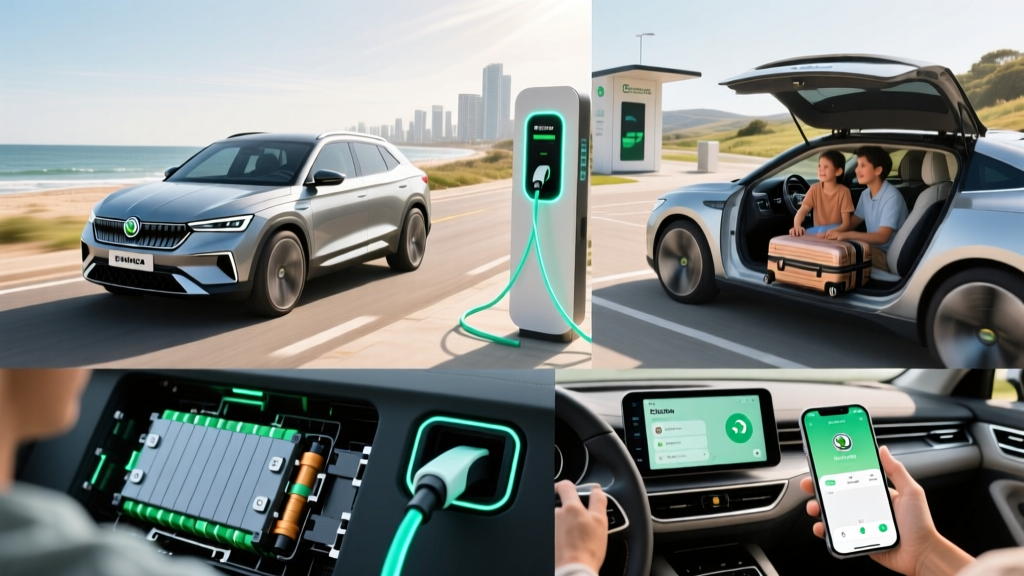
Skoda's 2026 EV lineup centers on two models: the Enyaq (mid-size SUV, up to 564 km WLTP range, ~€43,000 base) and the newer Elroq (compact SUV, up to 560 km WLTP, ~€36,000 base). Both ride on Volkswagen Group's MEB platform, offering competitive efficiency and practical cargo space. They're best suited to European buyers with home or workplace Level 2 charging access who need 400+ km of real-world range without paying premium-brand prices. If you lack reliable charging access or regularly drive 500+ km in cold climates, a Skoda PHEV or conventional vehicle may serve you better.
Skoda's Current EV Lineup: Enyaq and Elroq at a Glance
Skoda has positioned itself as the value-oriented EV brand within the Volkswagen Group. Rather than chasing headline-grabbing performance figures, the Czech automaker focuses on practicality, interior space, and real-world usability — much like it does with its ICE models. For 2026, two battery-electric models anchor the lineup, with the smaller Skoda Vision 7S concept hinting at a future large family SUV.
| Spec | Enyaq 85 | Enyaq 85x (AWD) | Elroq 60 | Elroq 85 |
|---|---|---|---|---|
| Battery (usable) | 77 kWh (NMC) | 77 kWh (NMC) | 59 kWh (NMC) | 77 kWh (NMC) |
| WLTP Range | 564 km | 536 km | 420 km | 560 km |
| Real-World Range (est.) | ~420–470 km | ~390–440 km | ~310–360 km | ~410–460 km |
| Peak DC Charge Rate | 175 kW | 175 kW | 145 kW | 175 kW |
| 10–80% DC Charge Time | ~28 min | ~28 min | ~25 min | ~28 min |
| AC Charging (Level 2) | 11 kW (3-phase) | 11 kW (3-phase) | 11 kW (3-phase) | 11 kW (3-phase) |
| Power Output | 210 kW (286 hp) | 220 kW (300 hp) | 150 kW (204 hp) | 210 kW (286 hp) |
| 0–100 km/h | 6.7 sec | 6.6 sec | 8.1 sec | 6.7 sec |
| Base Price (EU approx.) | €43,900 | €48,500 | €35,900 | €42,900 |
| Battery Warranty | 8 yr / 160,000 km (70% SoH) | 8 yr / 160,000 km | 8 yr / 160,000 km | 8 yr / 160,000 km |
kW vs kWh reminder: kW (kilowatts) measures power — how fast energy flows into the battery during charging. kWh (kilowatt-hours) measures energy capacity — how much the battery holds. A 77 kWh battery charged at 175 kW peak doesn't fill in 26 minutes; the charge curve tapers significantly above 80% SoC to protect cell longevity.
Real-World Range: What the WLTP Sticker Doesn't Tell You
WLTP testing produces optimistic figures compared to actual driving. Based on MEB-platform testing across the VW Group family (the Enyaq shares its powertrain architecture with the VW ID.4 and Audi Q4 e-tron), here's what to actually expect:
Enyaq 85 — WLTP 564 km / Real-world expectations:
- Moderate climate, mixed driving: ~440–470 km
- Highway at 120 km/h, summer: ~400–430 km
- Highway at 120 km/h, winter (0°C): ~330–370 km
- City driving with regen, mild weather: ~480–510 km
The Enyaq's heat pump (optional on some trims, standard on higher specs) reduces winter range loss by approximately 10–15% compared to resistive cabin heating. If you live in Scandinavia or the Alpine regions, this option is worth the investment.
The Elroq 85, despite a similar 560 km WLTP rating, achieves slightly less real-world range due to its less aerodynamic compact-SUV profile. Expect roughly 5–8% less than the Enyaq in equivalent highway conditions.
Charging Speeds and Infrastructure: CCS2 and the European Network
Both Skoda EVs use the CCS2 connector, the European standard for DC fast charging. This grants access to Ionity, Shell Recharge, Fastned, EnBW, and most major European networks — though not Tesla Superchargers (which remain NACS/Tesla-proprietary in most European locations, though some have opened to non-Tesla EVs via the Tesla app).
| Charging Level | Power | Connector | Miles/km Added per Hour | Typical Use Case |
|---|---|---|---|---|
| Level 1 (Domestic Socket) | ~2.3 kW | Schuko/Type 2 | ~12–15 km/hr | Emergency/overnight trickle |
| Level 2 (Wallbox) | 7.4–11 kW | Type 2 | ~40–65 km/hr | Home/workplace daily charging |
| DC Fast Charging | 50–175 kW | CCS2 | ~250–900 km/hr (peak) | Road trips, motorway stops |
The charge curve reality: The Enyaq's 175 kW peak rate only sustains between roughly 10–35% SoC. From 35–60%, it drops to ~130 kW. From 60–80%, it tapers further to ~90 kW. Above 80%, charging slows dramatically to protect battery health — a 10–80% charge takes ~28 minutes, but 80–100% adds another 25–30 minutes. Plan road-trip stops around the 10–80% window for maximum efficiency.
Skoda EV vs Gas and Hybrid: Total Cost of Ownership
Let's compare the Enyaq 85 against its closest internal-combustion sibling, the Skoda Kodiaq 2.0 TDI, and the Kodiaq PHEV, over a 5-year / 100,000 km ownership period. Costs reflect approximate European averages (Germany, 2026).
| Cost Factor | Enyaq 85 (BEV) | Kodiaq 2.0 TDI (Diesel) | Kodiaq PHEV |
|---|---|---|---|
| Purchase Price (approx.) | €43,900 | €39,500 | €44,200 |
| Govt. Incentive (DE Umweltbonus) | €0 (phased out 2024) | €0 | €0 |
| Fuel/Energy (100k km) | ~€3,600 (home charging €0.30/kWh) | ~€8,500 (diesel €1.70/L, 6.5 L/100km) | ~€5,200 (mixed EV/diesel) |
| Maintenance (5 yr) | ~€800 | ~€2,500 | ~€1,800 |
| Insurance (5 yr avg.) | ~€5,500 | ~€4,800 | ~€5,100 |
| Estimated Depreciation | ~€18,000 | ~€15,000 | ~€19,000 |
| Total 5-Year Cost | ~€71,800 | ~€70,300 | ~€75,300 |
| Cost per km | ~€0.72 | ~€0.70 | ~€0.75 |
Key takeaway: The Enyaq's energy cost advantage is substantial — roughly €4,900 less than diesel over 100,000 km when charging primarily at home. However, higher insurance premiums and steeper EV depreciation (still a market reality in 2026) narrow the gap. The break-even point arrives around year 4 if you charge at home. If you rely exclusively on public DC fast charging at €0.55–0.70/kWh, the fuel savings shrink to ~€1,500 over five years, making the diesel competitive.
Home Charging: The Make-or-Break Factor
Home charging access determines whether a Skoda EV saves you money or costs you more. A Level 2 wallbox (7.4–11 kW) fully replenishes the Enyaq's 77 kWh battery in 7–10 hours — perfect for overnight charging at off-peak electricity rates.
Installation costs vary dramatically:
- Simple wallbox install (existing circuit capacity): €800–1,500
- Panel upgrade or long cable run: €2,000–4,000+
- Apartment/condo shared garage: €1,500–5,000+ (requires building management approval)
If you live in an apartment without dedicated parking or in a building where electrical upgrades are cost-prohibitive, a Skoda EV becomes significantly less practical. In that scenario, the Kodiaq PHEV — which can run ~60 km on battery for daily commutes and falls back to diesel for longer trips — may be the smarter choice.
Common Misconceptions About Skoda EVs
| Myth | Fact |
|---|---|
| "The battery will need replacing within a few years" | VW Group's NMC cells degrade ~10–15% over 8 years based on fleet data. The 8-year/160,000 km warranty guarantees 70% State of Health. Full battery replacement costs €12,000–18,000 but is rarely needed within the vehicle's lifetime. |
| "It can't handle winter" | Cold weather reduces range by 20–30%, but preconditioning (warming the battery while plugged in) mitigates charging-speed loss. The Enyaq's heat pump preserves cabin comfort without devastating range. |
| "Charging takes too long on road trips" | 10–80% in ~28 minutes at a 175 kW charger. Combined with a 400+ km real-world range, most drivers need only one 30-minute stop on a 600 km trip — roughly the same time as a rest-stop lunch. |
| "Skoda EVs are just rebadged VWs with no advantage" | While the MEB platform is shared, Skoda tunes the suspension for comfort over sportiness, offers more cargo space in the Enyaq vs the ID.4, and prices 5–10% below equivalent VW and Audi models. |
| "I can charge from any socket at home" | A standard 2.3 kW Schuko outlet adds only ~12–15 km of range per hour. Fully charging the 77 kWh battery takes 33+ hours — impractical for daily use. A dedicated Level 2 wallbox is strongly recommended. |
Who Should Buy a Skoda EV? A Decision Framework
Choose the Enyaq 85 if:
- You have home or workplace Level 2 charging
- Your daily driving is under 350 km
- You take road trips 3–6 times per year and can plan around CCS2 fast-charging stations
- You want SUV cargo space (585 L boot) without paying Audi or BMW prices
- You live in a moderate-to-mild climate, or spec the heat pump for cold regions
Choose the Elroq 60 if:
- You're on a tighter budget (~€36,000) and mostly drive in urban/suburban settings
- Your daily commute is under 150 km round-trip
- You want a compact footprint for city parking
- You rarely drive more than 300 km in a single day
Choose a Skoda PHEV (Octavia iV or Kodiaq iV) instead if:
- You lack reliable home or workplace charging
- You regularly drive 500+ km in winter conditions
- You live in a region with sparse public charging infrastructure
- You want electric commuting (40–65 km EV range) with zero range anxiety for long trips
Wait or look elsewhere if:
- You need the upcoming seven-seat Vision 7S production model (expected 2027, specs preliminary)
- You require towing capacity above 1,400 kg (the Enyaq is rated for 1,200–1,400 kg braked depending on variant)
- You want access to Tesla's Supercharger network exclusively (consider the Model Y instead)
What First-Time Skoda EV Buyers Need to Know
Preconditioning is essential. Both the Enyaq and Elroq allow you to precondition the battery and cabin while plugged in — warming the cells to optimal temperature before a fast-charge stop or your morning commute. This preserves range in winter and enables peak DC charging speeds. Set departure times in the Skoda app to automate this.
One-pedal driving takes adjustment. The Enyaq's regenerative braking (activated via steering-wheel paddles or the B mode on the gear selector) can recover up to 0.3g of deceleration — enough for most city stops without touching the brake pedal. However, unlike some competitors, it doesn't come to a complete hold; you'll still need the brake pedal at stops.
Insurance is higher. EV insurance premiums in Europe run 10–20% above equivalent ICE models due to higher repair costs (battery protection, sensor recalibration after bodywork, specialized technician requirements). Get quotes before purchasing — the difference can be €100–200/year depending on your profile and country.
Software updates are ongoing. Skoda delivers over-the-air updates that can improve charging curves, add features, and refine the infotainment system. However, the MEB platform's software (now on version 4.x for 2026 models) has historically been less polished than Tesla's interface. Expect functional but not class-leading UX.
Frequently Asked Questions
Does Skoda qualify for any EV incentives in 2026?
Incentive availability depends entirely on your country. Germany's Umweltbonus ended in 2024. France's bonus écologique (up to €4,000 for income-qualifying buyers) may apply to lower-priced Elroq trims. The UK has no purchase grant but offers Benefit-in-Kind (BiK) tax advantages for company-car EV buyers at 2% through 2026. Always check your national environmental agency or transport ministry for current programs.
What happens if the battery degrades below 70%?
Under Skoda's 8-year/160,000 km warranty, if the battery's State of Health drops below 70% within the warranty period, Skoda will repair or replace modules to bring it above the threshold. In practice, VW Group MEB batteries have shown ~8–12% degradation over 5 years and 80,000–100,000 km based on fleet data — well within the warranty buffer.
Can I charge a Skoda EV at a Tesla Supercharger?
In most of Europe, Tesla Superchargers use the CCS2 connector and Tesla has opened select stations to non-Tesla EVs via the Tesla app. However, not all stations are open, and pricing for non-Tesla vehicles is typically 15–25% higher than for Tesla owners. Check the Tesla app for station availability in your area. Skoda EVs cannot access Superchargers that remain Tesla-exclusive.
How does the Enyaq compare to the VW ID.4?
Both share the MEB platform, battery options, and powertrain. The Enyaq offers slightly more boot space (585 L vs 543 L), a more comfort-oriented suspension tune, and typically undercuts the ID.4 on price by €1,000–2,500 in equivalent trims. The ID.4 offers a slightly more modern interior design and marginally better infotainment responsiveness. Real-world range and charging speeds are nearly identical.
Is the Skoda Enyaq good for towing?
The Enyaq 85 is rated to tow up to 1,200 kg (braked trailer); the 85x AWD variant is rated at 1,400 kg. Towing reduces range by approximately 30–45% depending on trailer weight and aerodynamics. For a 1,000 kg caravan on the motorway, expect real-world range to drop to ~260–300 km in the Enyaq 85. Plan charging stops accordingly.