Why Tesla Dropped SiriusXM — and What It Means for EV Audio
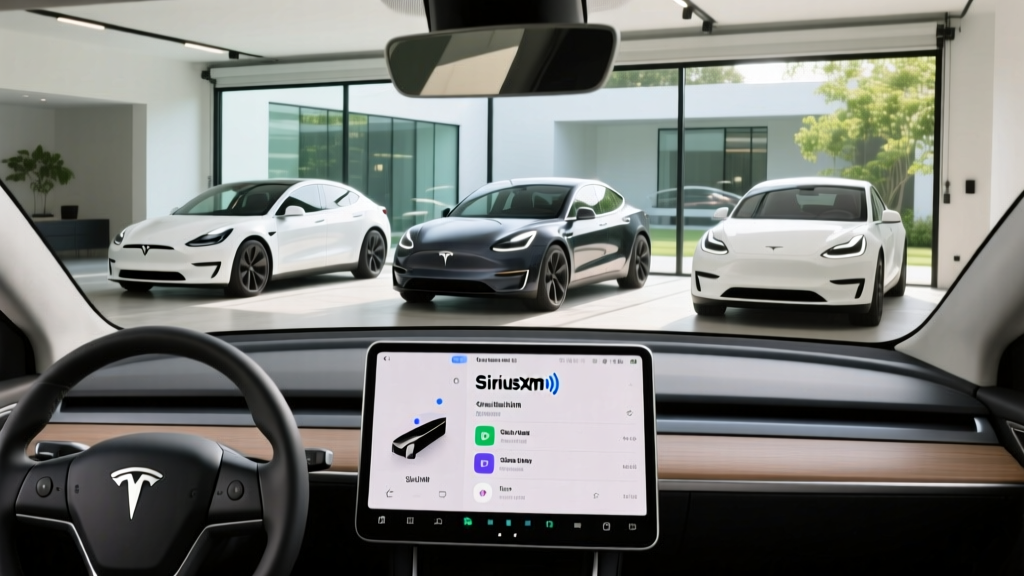
If you've shopped a new Tesla in 2026 expecting to find a SiriusXM satellite radio tuner built into the dashboard, you won't. Tesla has never included native SiriusXM hardware in any production vehicle — not the Model 3, Model Y, Model S, or Model X. That decision, rooted in Tesla's software-first infotainment philosophy, continues to frustrate longtime satellite radio subscribers who are transitioning from legacy automakers where SiriusXM has been a standard feature for over a decade.
The good news: there are multiple practical ways to get SiriusXM content into your Tesla cabin, ranging from free streaming tiers to dedicated hardware workarounds. This guide breaks down every option, ranks them by audio quality and convenience, and explains how Tesla's own audio ecosystem compares — including the 2026 Model Y's upgraded 17-speaker premium system and the refreshed Model S/X 22-speaker setups.
Your Options for Getting SiriusXM in a Tesla (Ranked)
Here's the complete landscape of SiriusXM access methods for Tesla owners, ranked from most seamless to most involved.
1. SiriusXM Streaming App via Bluetooth (Best for Most Owners)
The simplest path: download the SiriusXM app on your iOS or Android phone, pair your phone to your Tesla via Bluetooth, and stream. Tesla's Bluetooth audio integration in 2026 supports AAC codec streaming, which delivers acceptable quality for spoken-word and most music content, though it falls short of lossless. You'll control playback from your phone screen (mounted on a MagSafe or vent mount) or use Tesla's steering-wheel media buttons for skip/play/pause once the Bluetooth session is active.
Pros: Full SiriusXM catalog, personalized stations, on-demand replays, no extra hardware.
Cons: Phone-dependent (uses mobile data), slight Bluetooth compression, no native Tesla UI integration.
2. Tesla's Built-In TuneIn + Internet Radio (The Native Alternative)
Tesla's infotainment system includes TuneIn as a native app, which aggregates thousands of internet radio stations — including many that also broadcast on SiriusXM channels. While it's not a 1:1 replacement, stations like Howard Stern's SiriusXM channel, NFL Radio, and many music formats have TuneIn equivalents or direct internet streams. Tesla's built-in streaming uses the car's LTE/5G connection (Premium Connectivity subscription required, currently $9.99/month) or a Wi-Fi hotspot.
3. SiriusXM SmartStick or Dedicated Streaming Device via AUX/USB
Here's where Tesla ownership gets tricky. The Model 3 and Model Y (including the 2025+ Juniper refresh) have no auxiliary (AUX) input and no USB audio input for third-party devices. This eliminates the classic workaround of plugging in a SiriusXM Internet Radio or a dedicated streaming dongle. The Model S and Model X retain USB-C ports, but Tesla's firmware does not recognize USB audio class devices — meaning you can't simply plug in a USB DAC and stream from an external player.
The only hardware workaround for Model 3/Y owners who want a dedicated SiriusXM device is an FM transmitter — a small Bluetooth or AUX-to-FM unit that broadcasts to an unused FM frequency your Tesla radio can tune. Audio quality is noticeably degraded (FM bandwidth limits, potential interference), but it works for talk radio and podcasts where fidelity matters less.
4. Apple CarPlay / Android Auto (2026 Status)
As of early 2026, Tesla still does not support Apple CarPlay or Android Auto in any production vehicle. Despite years of owner petitions, Tesla maintains its proprietary infotainment stack. This means you can't mirror the SiriusXM app to the Tesla touchscreen — you're limited to phone-screen control over Bluetooth audio.
Tesla's Native Audio Ecosystem: What You Get Instead
If you're willing to explore alternatives to SiriusXM, Tesla's built-in audio options in 2026 are substantial:
- Spotify — fully integrated, supports your existing playlists, podcasts, and Premium streaming (included with Premium Connectivity).
- Tidal — available as a native app on 2024+ vehicles, supports hi-res audio on the Model S/X premium systems.
- Apple Music — added as a native Tesla app in late 2024, supports Apple Music Classical and spatial audio on compatible hardware.
- TuneIn — internet radio aggregation (noted above).
- Tesla Theater / YouTube — available while parked; not relevant for driving audio but useful for passengers.
For talk-radio and news subscribers, SiriusXM's biggest draws — Howard Stern, NFL Radio, CNBC, comedy channels — have partial equivalents across podcast platforms and TuneIn, but exclusive live content remains a SiriusXM differentiator.
How Tesla's Audio Hardware Compares Across the 2026 Lineup
| Model | Speaker Count | Subwoofers | Amplifier | Immersive Audio | Notable |
|---|---|---|---|---|---|
| Model 3 (Highland) | 17 | 2 | ~600W | Dolby Atmos (2025+) | Significantly improved over pre-2024 |
| Model Y (Juniper) | 17 | 2 | ~600W | Dolby Atmos (2025+) | Vented rear parcel shelf speakers |
| Model S (2026) | 22 | 2 | ~960W | Dolby Atmos | Active noise cancellation |
| Model X (2026) | 22 | 2 | ~960W | Dolby Atmos | Best-in-class cabin volume for bass |
Across the lineup, Tesla's audio quality has improved dramatically since the 2023-2024 refreshes. The Model S and X systems, in particular, rival premium audio packages from Mercedes (Burmester) and BMW (Bowers & Wilkins). Bluetooth audio from a SiriusXM stream will sound noticeably compressed compared to native Spotify or Tidal streaming over the car's LTE connection — a factor worth considering if audio fidelity is a priority.
Tesla Model Y (2026 Juniper): Full EV Specs for the SiriusXM-Curious Buyer
Many SiriusXM subscribers cross-shopping Tesla are evaluating the 2026 Model Y, the highest-volume Tesla and the most common "first EV" purchase. Here's the complete spec profile so you can weigh the audio trade-off against the vehicle's core strengths.
| Spec | Long Range AWD | Performance |
|---|---|---|
| EPA Range | 320 miles | 293 miles |
| Battery (usable) | ~75 kWh (NMC) | ~75 kWh (NMC) |
| Drivetrain | Dual Motor AWD | Dual Motor AWD |
| Horsepower | 384 hp | 456 hp |
| 0-60 mph | 4.8 sec | 3.5 sec |
| Peak DC Fast Charge | 250 kW (V3 Supercharger) | 250 kW |
| 10-80% DC Time | ~27 min | ~27 min |
| Level 2 Charge Rate | 11.5 kW (~44 mi/hr) | 11.5 kW (~44 mi/hr) |
| MPGe (combined) | 122 MPGe | 111 MPGe |
| Efficiency | 28 kWh/100mi | 30 kWh/100mi |
| Cargo (rear seats up) | 30.2 cu ft | 30.2 cu ft |
| Cargo (rear seats folded) | 72.1 cu ft | 72.1 cu ft |
| Base MSRP | $47,990 | $53,990 |
| Battery Warranty | 8 yr / 120,000 mi | 8 yr / 120,000 mi |
Charging Speed Deep Dive: What Model Y Owners Actually Experience
Charging speed is where Tesla's Supercharger network advantage becomes tangible. The 2026 Model Y supports the North American Charging Standard (NACS) connector natively — no adapter needed at any of Tesla's 7,000+ North American Supercharger stalls.
| Charge Level | Power | Miles Added per Hour | Use Case |
|---|---|---|---|
| Level 1 (120V household) | ~1.4 kW | ~5 mi/hr | Emergency / overnight trickle |
| Level 2 (240V home, 48A) | 11.5 kW | ~44 mi/hr | Daily home charging (full overnight) |
| DC Fast (V3 Supercharger) | Peak 250 kW | ~1,000 mi/hr (peak) | Road trips; 10-80% in ~27 min |
| DC Fast (V4 Supercharger) | Peak 250 kW* | ~1,000 mi/hr (peak) | Newer stalls; same vehicle-side limit |
*The Model Y's onboard charge architecture caps at 250 kW. V4 Supercharger stalls capable of 350+ kW (for Cybertruck and future platforms) will not charge the Model Y faster.
Pricing, Tax Credits, and Total Cost for the 2026 Model Y
| Trim | Base MSRP | Est. Destination | §30D Credit (if eligible) | Effective Price |
|---|---|---|---|---|
| Long Range AWD | $47,990 | $1,390 | Up to $7,500 | ~$41,880 |
| Performance | $53,990 | $1,390 | Up to $7,500 | ~$47,880 |
- MSRP Cap: SUVs (including Model Y) must have an MSRP at or below $80,000. Both Model Y trims qualify.
- Buyer Income Cap: Modified AGI must not exceed $150,000 (single), $225,000 (head of household), or $300,000 (joint).
- Battery Sourcing: A percentage of critical minerals and battery components must be sourced from the U.S. or FTA-partner countries. This requirement tightens annually. Tesla's Fremont and Austin-built Model Y batteries have historically met partial or full sourcing thresholds, but the exact dollar amount ($3,750 or $7,500) depends on the current-year mineral/component percentages.
- Point-of-Sale Transfer: As of 2024, eligible buyers can transfer the credit to the dealer at purchase, reducing the out-of-pocket price immediately rather than waiting for a tax refund.
Who Should Buy the 2026 Model Y (Even Without SiriusXM)?
- You want the lowest-friction EV ownership experience (Supercharger network, OTA updates, mobile app).
- You're a commuter covering 30-80 miles daily with home Level 2 charging.
- You need crossover cargo space (30.2 cu ft rear, 72.1 cu ft folded) for family gear or road-trip luggage.
- You're open to streaming audio alternatives and can adapt from satellite radio to Spotify/Apple Music/TuneIn.
- SiriusXM is a non-negotiable daily habit — all three competitors offer native SiriusXM tuners.
- You want Apple CarPlay / Android Auto integration.
- You prefer a traditional dealer service experience over Tesla's mobile-ranger-and-service-center model.
Pros and Cons: 2026 Tesla Model Y for the SiriusXM Subscriber
Pros
- 320-mile EPA range; real-world highway ~280 mi
- 250 kW DC fast charging on NACS — no adapter
- Supercharger network: most reliable public charging in North America
- 17-speaker Dolby Atmos audio (post-Highland/Juniper) is excellent
- Class-leading cargo space and frunk storage
- OTA updates continuously add features
- Strong resale value relative to EV market
Cons
- No native SiriusXM hardware — Bluetooth streaming is the only practical option
- No Apple CarPlay or Android Auto
- No AUX input or USB audio on Model 3/Y
- Bluetooth audio quality is compressed vs native streaming
- Phone-dependent SiriusXM control (no steering-wheel channel switching)
- Premium Connectivity ($9.99/mo) needed for in-car streaming without Wi-Fi
- Insurance costs tend to run 15-25% higher than comparable ICE crossovers
Frequently Asked Questions
Can I install SiriusXM hardware in my Tesla aftermarket?
Not practically. SiriusXM requires a proprietary satellite antenna and tuner module that integrate with a vehicle's head unit via CAN bus or dedicated wiring. Tesla's closed infotainment architecture doesn't support third-party tuner integration. The only viable aftermarket option is an FM transmitter paired with a SiriusXM Internet Radio device, which delivers poor audio quality compared to native streaming.
Does Tesla's Premium Connectivity include SiriusXM?
No. Tesla's Premium Connectivity ($9.99/month or $99/year) enables in-car streaming for Spotify, Apple Music, Tidal, TuneIn, and Tesla's navigation features (satellite maps, live traffic). It does not include any SiriusXM subscription or content. You'll need a separate SiriusXM streaming subscription (starting around $12.99/month for the streaming-only plan) to access SiriusXM content via your phone.
Will Tesla ever add native SiriusXM support?
There is no indication Tesla plans to add SiriusXM hardware or a native SiriusXM app. Tesla's infotainment strategy has consistently favored direct streaming-service integration (Spotify, Apple Music, Tidal) over third-party content aggregators. If SiriusXM were to offer an open API that Tesla chose to integrate — similar to how Tidal was added in 2024 — it could theoretically appear as a native app, but this remains speculative.
What's the best SiriusXM workaround for long road trips?
For road trips, the SiriusXM streaming app over Bluetooth is the most reliable option. Ensure your phone has a strong cellular data plan (SiriusXM streaming uses approximately 60-120 MB per hour at standard quality). Mount your phone where you can safely reach it, or have a passenger manage channel changes. If you're in a rural area with weak cell coverage — where satellite radio's advantage over streaming is most pronounced — you'll experience buffering. In those scenarios, pre-downloading SiriusXM on-demand content before the trip is a smart backup.
How does Tesla's audio quality compare to SiriusXM satellite?
Tesla's native streaming (Spotify Premium, Tidal, Apple Music) over the car's LTE connection delivers higher audio quality than SiriusXM's satellite signal, which is compressed to approximately 64-128 kbps depending on the channel. Bluetooth streaming of SiriusXM from your phone adds another layer of compression (Bluetooth AAC codec). If audio fidelity is your priority, Tesla's native apps with the Juniper/Highland 17-speaker system will outperform SiriusXM in most listening scenarios.
Does the 2026 Model Y qualify for the $7,500 federal tax credit?
The Model Y's MSRP falls well under the $80,000 SUV cap, so the vehicle qualifies on price. However, the actual credit amount ($3,750 or $7,500) depends on current-year battery sourcing requirements, and the buyer must meet IRS income thresholds. Check the latest eligibility details at fueleconomy.gov and confirm with your tax advisor before purchase.