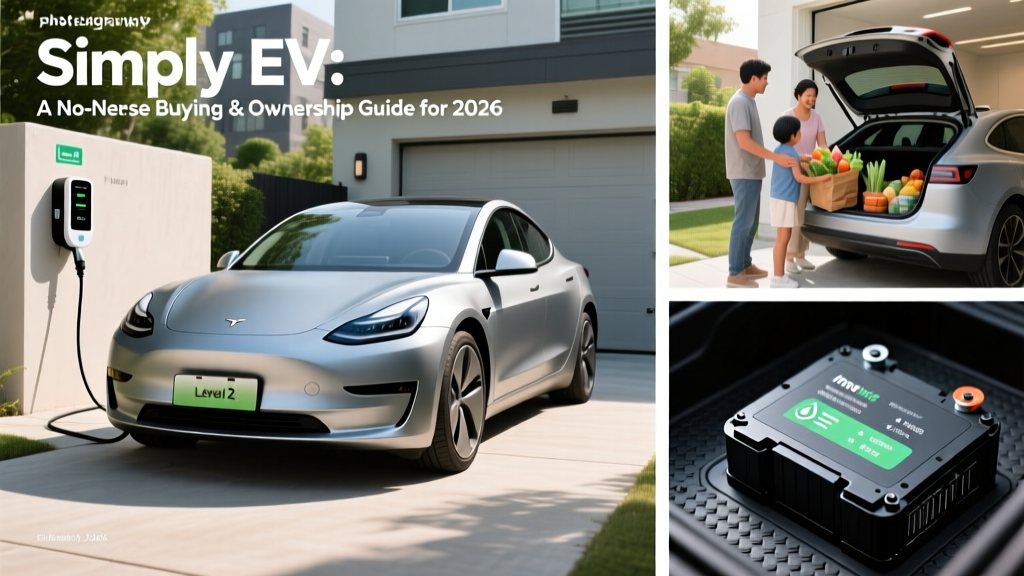
The Simply EV Answer: Should You Buy Electric in 2026?
Yes, if you can charge at home, drive under 300 miles a day, and qualify for the federal §30D tax credit. A typical 2026 EV like the Hyundai Ioniq 5 (EPA 318 miles, ~$42,900 base) costs roughly $0.04–$0.06 per mile to charge at home versus $0.12–$0.15 per mile for a 28-MPG gas car at $3.40/gallon. Over five years and 75,000 miles, that's $4,500–$6,750 in fuel savings alone — before factoring in lower maintenance (no oil changes, fewer brake replacements thanks to regenerative braking). If you lack reliable home or workplace charging, regularly drive in sub-20°F winters, or tow heavy loads long-distance, a plug-in hybrid (PHEV) or efficient HEV may serve you better today.
What "Simply EV" Actually Means for a First-Time Buyer
The phrase "simply EV" captures what most new buyers want: a clear, jargon-free path through the noise. The electric vehicle landscape in 2026 is mature enough that the core decision comes down to four measurable factors — range, charging access, total cost, and daily driving pattern — not abstract debates about the future of transportation.
Here's the practical vocabulary you need:
- kWh (kilowatt-hour): Energy capacity — think of it as your "tank size." A 77.4 kWh battery holds more energy than a 58 kWh one.
- kW (kilowatt): Power rate — how fast energy flows. A 150 kW DC fast charger delivers energy roughly 20× faster than a 7.2 kW Level 2 home unit.
- EPA range: The government-tested estimate. Real-world highway and cold-weather driving typically yields 75–90% of that number.
- MPGe: Miles-per-gallon-equivalent — a way to compare EV efficiency to gas cars. Higher is better. Per fueleconomy.gov, the 2026 Tesla Model Y RWD achieves 122 MPGe combined.
EV vs Gas vs Hybrid: The Numbers That Matter
Every purchase decision deserves a side-by-side. Below is a representative comparison using a popular compact crossover in each powertrain category — the Hyundai Ioniq 5 (BEV), Toyota RAV4 Hybrid (HEV), and Toyota RAV4 gas AWD — all 2026 models at comparable trim levels.
| Metric | Hyundai Ioniq 5 SE AWD (BEV) | Toyota RAV4 Hybrid XLE (HEV) | Toyota RAV4 LE AWD (Gas) |
|---|---|---|---|
| Base MSRP | $42,900 | $33,575 | $30,575 |
| EPA Range / Fuel Economy | 290 mi / 110 MPGe | 39 MPG combined | 28 MPG combined |
| Energy Cost per Mile | ~$0.05 (home L2) | ~$0.09 | ~$0.12 |
| Annual Fuel/Energy (15k mi) | ~$750 | ~$1,350 | ~$1,800 |
| 5-Year Fuel Cost | ~$3,750 | ~$6,750 | ~$9,000 |
| Federal Tax Credit (§30D) | Up to $7,500* | None (HEV) | None |
| Estimated 5-Yr Maintenance | ~$1,800 | ~$2,900 | ~$3,400 |
| 0-60 mph | 5.1 sec | 7.4 sec | 8.1 sec |
*§30D credit eligibility depends on MSRP caps, buyer income limits, and battery mineral/component sourcing. See the IRS §30D guidelines for current requirements. Point-of-sale transfer is available at participating dealers.
Real Costs of EV Ownership: A 5-Year Breakdown
Sticker price is only the opening move. Here's a realistic 5-year / 75,000-mile cost-of-ownership comparison for the Ioniq 5 SE AWD versus the RAV4 gas LE AWD, assuming $3.40/gallon gas and $0.14/kWh home electricity.
| Category | Hyundai Ioniq 5 (BEV) | Toyota RAV4 LE (Gas) |
|---|---|---|
| Purchase Price (after $7,500 credit*) | $35,400 | $30,575 |
| Home Level 2 Charger Install | $800–$1,500 | $0 |
| 5-Year Energy/Fuel | $3,750 | $9,000 |
| 5-Year Maintenance | $1,800 | $3,400 |
| 5-Year Insurance (est.) | $8,500 | $6,800 |
| Estimated Depreciation (5 yr) | $14,200 | $12,000 |
| Total 5-Year Cost | $64,450–$65,150 | $61,775 |
The EV's higher insurance premiums (typically 15–25% more for EVs due to battery repair costs and higher initial vehicle values) and steeper depreciation partially offset the fuel and maintenance savings. The break-even point typically arrives around year 4–6, depending on your electricity rate, mileage, and whether you qualify for the full tax credit. Higher annual mileage accelerates the EV payoff.
Charging Reality: What First-Time EV Buyers Must Know
Charging access is the single most important variable in EV satisfaction. Here's what the three charging tiers actually deliver:
| Level | Power (kW) | Miles Added per Hour | Typical Use Case |
|---|---|---|---|
| Level 1 (120V outlet) | 1.2–1.9 kW | 3–5 miles | Overnight top-up; PHEVs; low-mileage drivers |
| Level 2 (240V home/public) | 7.2–19.2 kW | 25–60 miles | Primary daily charging for most BEV owners |
| DC Fast Charging | 50–350 kW | 150–800+ miles/hr (peak) | Road trips; 10–80% in 18–40 minutes |
Home Level 2 installation typically costs $800–$1,500 for a 40-amp / 9.6 kW hardwired unit if your electrical panel has capacity. A panel upgrade from 100A to 200A adds $1,500–$3,500. Always get a licensed electrician's assessment before purchasing equipment.
Charging-curve reality check: When a manufacturer advertises "peak 240 kW DC fast charging," that rate applies only at low state-of-charge (SoC) and optimal battery temperature. Expect the Ioniq 5 (84 kWh battery, NMC chemistry) to charge from 10–80% in approximately 18 minutes at a 350 kW station under ideal conditions, but 25–30 minutes in cold weather or at a congested station sharing power. Above 80% SoC, charging slows dramatically to protect battery health — a 80–100% top-up can take as long as the 10–80% session.
EPA Range vs. Real-World Range
The Ioniq 5 SE AWD carries an EPA range of 290 miles. In real-world mixed driving, expect approximately 250–270 miles at highway speeds (70–80 mph). In sub-30°F winter conditions without preconditioning, range can drop to 180–220 miles. Preconditioning the battery while plugged in — a feature on most 2026 EVs — recovers 10–15% of that winter loss by warming the battery before departure.
Common EV Misconceptions vs. Facts
| Myth | Fact |
|---|---|
| "EV batteries need replacing every few years." | Most 2026 EV batteries are warranted for 8 years/100,000 miles at 70% capacity retention. NMC and LFP chemistries routinely retain 85–90% capacity at 100,000 miles based on fleet data. Full replacement costs $8,000–$18,000 but is rarely needed within typical ownership. |
| "The power grid can't handle EVs." | Most EV charging happens overnight at 3–7 kW when grid demand is lowest. A single EV adds roughly the same load as a central AC unit. Utility time-of-use rates reward off-peak charging with lower per-kWh costs. |
| "EVs are worse in cold weather." | Range loss of 20–30% in extreme cold is real, but EVs start instantly (no cold cranking), cabin heating via heat pump is efficient, and preconditioning while plugged in eliminates most cold-morning range penalty. |
| "Public charging is unreliable." | Networks like Tesla Supercharger and Electrify America report 95%+ uptime at maintained stations. Apps like PlugShare and A Better Routeplanner let you verify station status before a trip. CCS and NACS connector standardization in 2025–2026 has simplified access. |
| "EVs aren't actually cleaner." | Even on a coal-heavy grid, an EV produces fewer lifetime emissions than a comparable gas car. On the average US grid mix, EVs emit roughly 60–70% less CO₂ per mile over their lifetime, per EPA and EPA myth-busting data. |
Tax Credits and Incentives: What You Actually Qualify For
The federal §30D tax credit offers up to $7,500 for qualifying new EVs and $4,000 for qualifying used EVs (subject to a $25,000 price cap). However, eligibility is far from universal. As of 2026, key requirements include:
- MSRP caps: Vans, SUVs, and pickups must be under $80,000; sedans under $55,000.
- Buyer income limits: Modified adjusted gross income (MAGI) must not exceed $150,000 (single), $225,000 (head of household), or $300,000 (joint filers).
- Battery sourcing rules: A percentage of critical minerals and battery components must be sourced from the US or free-trade-agreement partners, with thresholds increasing annually. This has disqualified some previously eligible models.
- Point-of-sale transfer: You can transfer the credit to the dealer at purchase, reducing the sale price directly — you don't need to wait until tax filing.
- Final assembly: Vehicle must undergo final assembly in North America.
Always verify current eligibility on the IRS qualified vehicles list before committing to a purchase. State and local incentives vary widely — check your state energy office or DSIRE database for additional rebates.
Decision Framework: Which Powertrain Is Right for You?
If-Then EV Buyer's Guide
- IF you have a garage or dedicated parking with a 240V outlet (or can install one), drive under 250 miles daily, and qualify for the §30D credit → Choose a BEV like the Ioniq 5, Tesla Model Y, or Chevrolet Equinox EV for maximum fuel savings and lowest maintenance.
- IF you can charge at home but regularly take 400+ mile road trips, live in a region with sparse DC fast charging, or tow frequently → Choose a PHEV like the Toyota RAV4 Prime (42 mi electric range, 38 MPG after depletion) for electric daily commuting with gas-powered range flexibility.
- IF you cannot charge at home or work, live in an apartment without charging access, or drive in extreme cold (regularly below 0°F) with no garage → Choose an HEV like the Toyota RAV4 Hybrid for zero lifestyle change with meaningful fuel savings over a gas-only vehicle.
- IF your daily commute is under 40 miles round-trip and budget is the top priority → Consider a used EV under the §30D used-vehicle credit ($4,000 up to $25,000 sale price) — models like a 2022–2023 Chevrolet Bolt EV offer 259 miles of EPA range at under $20,000 after credit.
Frequently Asked Questions
How long do EV batteries actually last?
Most 2026 EV batteries carry an 8-year/100,000-mile warranty guaranteeing at least 70% capacity retention. Real-world fleet data from high-mileage Teslas and Hyundai/Kia EVs shows typical degradation of 8–12% over the first 100,000 miles. LFP (lithium iron phosphate) batteries, used in standard-range Teslas and some Rivian models, degrade even more slowly and tolerate daily 100% charging without harm.
Is it cheaper to charge at home or at public DC fast chargers?
Home Level 2 charging at $0.14/kWh costs roughly $0.04–$0.05 per mile. Public DC fast charging at $0.35–$0.50/kWh costs $0.10–$0.15 per mile — comparable to a fuel-efficient gas car. Most EV owners do 85–95% of their charging at home, using DC fast chargers only for road trips.
Do I need to upgrade my electrical panel for a home charger?
Not always. A 40-amp Level 2 charger draws about 9.6 kW (similar to an electric dryer). If your panel is 200 amps with available capacity, installation is straightforward. Homes with 100-amp panels or high existing loads (electric heat, EV + dryer + oven running simultaneously) may need a $1,500–$3,500 panel upgrade. A licensed electrician's load calculation is essential before buying equipment.
What's the real difference between NACS and CCS charging connectors?
NACS (North American Charging Standard, used by Tesla) is smaller and lighter than CCS1. As of 2025–2026, Ford, GM, Rivian, Volvo, and most major automakers have adopted NACS on new vehicles, with CCS-to-NACS adapters available for legacy CCS vehicles. Tesla Superchargers now welcome non-Tesla EVs at many locations via the built-in Magic Dock adapter or your vehicle's native NACS port. Per NHTSA and industry data, the transition is largely complete for new vehicles.
Will an EV save me money if I drive only 8,000 miles per year?
At low annual mileage, the fuel savings shrink. Driving 8,000 miles/year, you'd save roughly $600–$800 annually on fuel versus a 28-MPG gas car. Over five years, that's $3,000–$4,000 — which may not offset higher insurance premiums and potential depreciation. Low-mileage drivers should weigh whether the driving experience, instant torque, and environmental benefits justify the cost, or consider a less expensive used EV.
The Bottom Line
Going "simply EV" isn't about ideology — it's about arithmetic. If your home charging, daily mileage, and budget align, a 2026 battery-electric vehicle delivers lower per-mile operating costs, minimal scheduled maintenance, and a smoother, quieter driving experience than any gas alternative. If your situation doesn't fit, PHEVs and HEVs offer excellent bridge solutions without range compromise. Run your own numbers using the tables above, verify tax credit eligibility on the IRS site, and test-drive with your actual daily route in mind. The best EV is the one that fits your life, not someone else's.