Quick Answer: Is the Silverado RST EV Worth It?
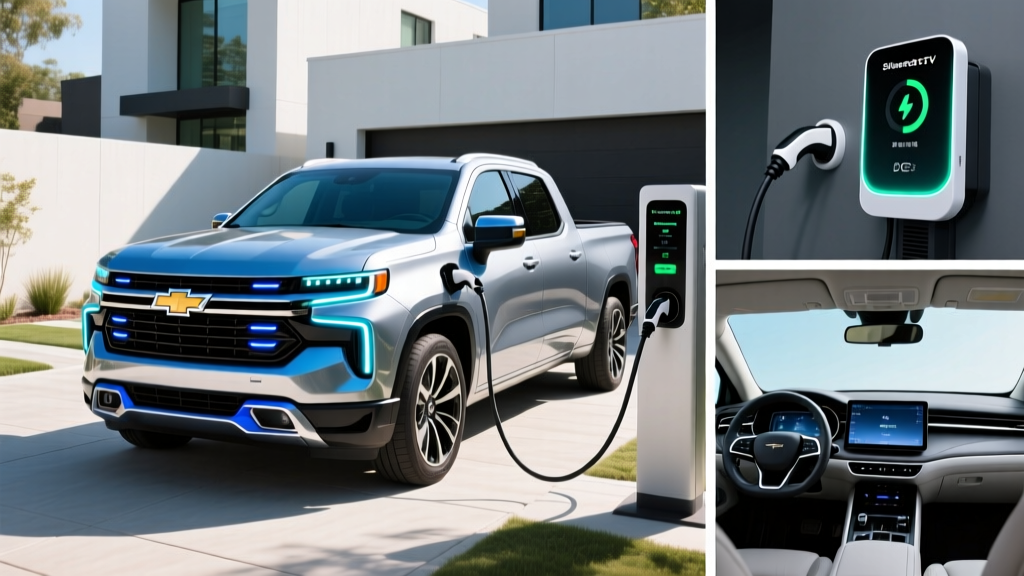
The 2026 Chevrolet Silverado RST EV pairs a massive 200+ kWh Ultium battery with up to 400 miles of EPA-estimated range and 350 kW DC fast charging. Starting around $74,800 before incentives, it costs roughly $15,000–$20,000 more than a comparably equipped gas Silverado RST, but home charging can cut per-mile fuel costs by 50–65% depending on your electricity rate. It makes financial sense if you can charge at home, drive under 350 miles daily, and qualify for partial or full federal tax credits. If you tow frequently in cold climates or rely solely on public charging, the gas or hybrid Silverado remains the more practical choice.
Range, Battery & Efficiency: The Numbers That Matter
The 2026 Silverado RST is built on GM's BT1 electric truck platform with a dual-motor AWD configuration producing 664 horsepower and 780 lb-ft of torque. The usable battery capacity sits at approximately 200 kWh using GM's Ultium NMC (nickel manganese cobalt) pouch cells — one of the largest packs in any production vehicle.
| Spec | Value |
|---|---|
| EPA Range (est.) | ~400 miles |
| Battery (usable) | ~200 kWh, NMC Ultium |
| Peak DC Fast Charge | 350 kW |
| 10–80% DC Charge Time | ~45 minutes |
| Level 2 Charge Rate | 19.2 kW (AC) |
| Level 2 Full Charge Time | ~10.5 hours |
| 0–60 mph | ~4.5 seconds |
| Horsepower | 664 hp |
| Torque | 780 lb-ft |
| Max Towing (est.) | 10,000 lbs |
| Base MSRP (RST trim) | ~$74,800 |
| Battery/Powertrain Warranty | 8 years / 100,000 miles |
Real-World Range Reality Check
The EPA sticker says ~400 miles, but plan for real-world variance. Highway driving at 70+ mph typically yields 280–320 miles. In cold weather (below 32°F), expect a 20–30% reduction, dropping effective range to roughly 220–280 miles. Towing a 7,000-lb trailer can halve that range entirely. The Silverado EV's thermal management system and available heat pump help mitigate losses, but physics is physics — a 6,000-lb truck pushing air at interstate speeds consumes serious energy.
Charging Speed & Infrastructure: What You'll Actually Experience
The Silverado RST EV supports up to 350 kW on DC fast chargers via the NACS (North American Charging Standard) connector, giving it native access to Tesla Supercharger V4 stalls and Electrify America's newest 350 kW stations. However, peak charge rate is not sustained rate. The charging curve tapers significantly above 80% State of Charge to protect the battery.
| Level | Power | Miles Added/Hour | Typical Cost |
|---|---|---|---|
| Level 1 (120V) | 1.4 kW | ~3–4 mi/hr | $0.12–$0.18/kWh (home) |
| Level 2 (240V, 48A) | 11.5 kW | ~28–32 mi/hr | $0.12–$0.18/kWh (home) |
| Level 2 (240V, 80A) | 19.2 kW | ~48–52 mi/hr | $0.12–$0.18/kWh (home) |
| DC Fast (peak) | 350 kW | ~800+ mi/hr (peak) | $0.35–$0.55/kWh (public) |
| DC Fast (avg session) | ~150 kW avg | ~350 mi/hr (avg) | $0.35–$0.55/kWh (public) |
For home charging, you'll want a hardwired Level 2 station delivering at least 11.5 kW (48 amps on a 60-amp circuit). An overnight charge from 20% to 80% takes roughly 6–7 hours at that rate — more than enough for daily use. The 19.2 kW option requires an 80-amp circuit and a panel that can support it; many homes need a 200-amp service upgrade, which adds $1,500–$3,500 to installation costs.
Professional Level 2 installation typically runs $800–$2,500 total (charger + electrician + permit), assuming your panel has spare capacity. According to Energy.gov's home charging guide, most EV owners spend $500–$1,500 on installation when no panel upgrade is needed.
Silverado RST EV vs Gas Silverado: The Cost Showdown
Let's compare the 2026 Silverado RST EV against the gas-powered 2026 Silverado 1500 RST (5.3L V8, 4WD) over a 5-year ownership period, assuming 15,000 miles per year.
| Category | Silverado RST EV | Gas Silverado RST (5.3L V8) |
|---|---|---|
| Purchase Price (MSRP) | ~$74,800 | ~$56,300 |
| Federal Tax Credit (§30D) | Up to $7,500* | $0 |
| Effective Purchase Price | ~$67,300 | ~$56,300 |
| Fuel/Energy (5 yrs, 75K mi) | $4,500–$6,800 | $11,250–$13,500 |
| Maintenance (5 yrs) | $1,200–$1,800 | $3,500–$4,500 |
| Insurance (5 yrs, est.) | $9,000–$11,000 | $7,000–$8,500 |
| 5-Year Depreciation (est.) | $28,000–$33,000 | $22,000–$26,000 |
| Total 5-Year Cost | $111,000–$120,000 | $100,000–$106,000 |
*Federal §30D credit eligibility depends on MSRP caps ($80,000 for trucks/vans/SUVs), buyer income limits ($300K joint / $150K single), and battery critical-mineral sourcing requirements. Check current rules at IRS.gov §30D. The credit can now be transferred to the dealer at point of sale as an upfront discount.
The EV saves $5,000–$8,000 in fuel and maintenance over five years, but the higher purchase price, steeper insurance premiums, and potentially larger depreciation hit keep the total cost of ownership roughly $5,000–$15,000 higher than the gas model. The gap narrows significantly if your state offers additional rebates, if electricity rates are low (under $0.14/kWh), or if you drive more than 15,000 miles annually.
Real-World Ownership: What First-Time EV Truck Buyers Should Know
Buying an electric truck is not the same as buying an electric sedan. The Silverado RST EV's size and weight introduce ownership considerations that gas truck buyers never think about.
Home Charging Is Nearly Mandatory
Public DC fast charging at $0.40–$0.55/kWh erases most of the EV cost advantage. A 200 kWh battery charged entirely on public fast chargers would cost $80–$110 per fill-up — comparable to gas. The economics only work if you charge at home 80%+ of the time. If you live in an apartment, park on the street, or lack a dedicated 240V circuit, solve the charging access problem before buying.
Cold Climate Range Loss Is Real
NMC batteries lose efficiency in freezing temperatures. If you live in Minnesota, Maine, or Montana, plan for 220–280 miles of effective winter range. Preconditioning the battery while plugged in helps, and the Silverado EV's thermal management is robust, but no chemistry is immune to cold. Garage parking mitigates this substantially.
Towing Cuts Range in Half
GM rates the Silverado EV at up to 10,000 lbs of towing capacity, but towing a 7,000-lb camper at 65 mph will drop range to roughly 180–220 miles. This is a hard physics limit shared by every electric truck on the market — the Rivian R1T and Ford F-150 Lightning face the same constraint. For frequent long-distance towing, a diesel or gas truck remains more practical.
Tire Costs Are Higher
EV trucks are heavy — the Silverado RST EV weighs over 8,500 lbs. Combined with instant torque, expect tire wear 20–30% faster than on a gas Silverado. Budget $1,200–$1,800 for a set of EV-rated tires every 30,000–40,000 miles.
Common Misconceptions About the Silverado RST EV
| Myth | Fact |
|---|---|
| "400 miles means I'll always get 400 miles." | EPA range is a lab estimate. Highway, cold, and towing reduce it 20–50%. Plan for 250–320 real-world miles in normal conditions. |
| "I can tow just as far on a charge as on a tank of gas." | Towing cuts range roughly in half. A gas Silverado tows 400+ miles on a tank; the EV manages ~200 under load. |
| "The battery will need replacing in a few years." | GM warranties the Ultium pack for 8 years/100,000 miles with a minimum 70% capacity retention threshold. Degradation data from GM's fleet shows NMC packs losing 8–12% capacity over 150,000 miles under normal use. |
| "Fast charging always charges at 350 kW." | 350 kW is a peak rate sustained only briefly at low SoC. Average rate across a 10–80% session is roughly 150–180 kW due to the charge curve taper. |
| "I'll save $7,500 no matter what." | §30D has income caps ($300K joint / $150K single), an $80K MSRP cap for trucks, and battery-sourcing requirements that change annually. Confirm eligibility on IRS.gov before purchasing. |
| "Super Cruise means the truck drives itself." | GM's Super Cruise is an SAE Level 2 system. You must remain attentive, keep your eyes on the road, and be ready to take over immediately. It works only on mapped divided highways. |
SAE Automation Level: Super Cruise = Level 2
Despite marketing language like "hands-free driving," Super Cruise is classified as SAE Level 2 — partial automation. The driver is the system. You are legally and practically responsible for the vehicle at all times. True driverless operation (Level 4) exists only in geofenced robotaxi services like Waymo, not in any consumer vehicle you can buy today.
Decision Framework: Should You Buy the Silverado RST EV?
Buy the Silverado RST EV If:
- You have access to home Level 2 charging (garage or driveway with 240V)
- Your daily driving is under 250 miles round-trip
- You want instant torque, near-silent operation, and a frunk for secure storage
- You can charge at home at rates under $0.18/kWh
- You qualify for the federal §30D credit or state incentives
- You rarely tow over long distances (under 200 miles one-way with a trailer)
- You value lower routine maintenance (no oil changes, fewer brake replacements due to regen)
Stick With the Gas or Hybrid Silverado If:
- You cannot install a home Level 2 charger
- You tow heavy trailers on long trips regularly
- You live in an extreme cold climate and need maximum range reliability year-round
- Your budget is firm below $60,000
- You drive in rural areas with sparse DC fast-charging infrastructure
- You plan to keep the truck 10+ years and want to avoid potential battery replacement costs ($15,000–$25,000 out of warranty)
Federal Tax Credit & Incentive Eligibility for 2026
The Silverado RST EV's ~$74,800 MSRP falls under the §30D truck MSRP cap of $80,000, making it potentially eligible. However, eligibility is not guaranteed for every buyer. Here's what you need to verify:
- Buyer Income Cap: Modified AGI must not exceed $300,000 (joint), $225,000 (head of household), or $150,000 (single).
- MSRP Cap: Trucks, vans, and SUVs must have an MSRP at or below $80,000. Loaded trims with options can push above — confirm the final sticker.
- Battery Sourcing: A percentage of critical minerals and battery components must be sourced from the US or free-trade-agreement countries. These thresholds increase annually. The credit amount may be reduced to $3,750 if only one of the two sourcing requirements is met.
- Point-of-Sale Transfer: As of 2024, you can transfer the credit to the dealer for an immediate price reduction rather than waiting to claim it on your tax return.
Always verify current-year rules at IRS.gov or consult a tax professional before finalizing your purchase. State incentives (California's CVRP, Colorado's Innovative Motor Vehicle Credit, etc.) may stack on top but vary by jurisdiction — check your state's energy office for current amounts.
Frequently Asked Questions
How long does it take to charge the Silverado RST EV at home?
On a standard 48-amp Level 2 charger (11.5 kW), a full charge from empty takes roughly 17–18 hours. A typical overnight session from 20% to 80% takes about 6–7 hours. The 19.2 kW option (80-amp circuit) cuts that to roughly 4–5 hours for the same 20–80% window.
Can the Silverado RST EV power my home during an outage?
GM has announced V2H (vehicle-to-home) capability for the Silverado EV via the GM Energy ecosystem, which requires a compatible bidirectional charger and home energy management system. When equipped, the 200 kWh battery could theoretically power an average home for 5–7 days. Hardware availability and installer support vary by region.
How does the Silverado RST EV compare to the Ford F-150 Lightning?
The Silverado RST EV offers a larger battery (~200 kWh vs. ~131 kWh extended range), longer EPA range (~400 mi vs. ~320 mi), and higher peak charge rate (350 kW vs. ~150 kW for the Lightning's standard onboard charger, though the Lightning's 2025+ models support higher rates). The Lightning starts significantly lower ($55,000–$65,000 range) and has broader dealer availability. The Silverado EV wins on range and charging speed; the Lightning wins on price and proven market presence.
What is the Silverado RST EV's insurance cost?
Expect insurance premiums 15–25% higher than a comparably priced gas Silverado, driven by higher repair costs for battery and structural components, specialized labor requirements, and the vehicle's $74,800+ replacement value. Average annual premiums run $1,800–$2,200 depending on your state, driving record, and coverage level. Get quotes from multiple carriers — some insurers now offer EV-specific discounts.
Will the battery need to be replaced, and what does it cost?
GM warranties the Ultium battery for 8 years or 100,000 miles against defects and excessive capacity loss (below 70% State of Health). Real-world degradation data from GM's commercial EV fleet suggests NMC packs retain 88–92% capacity at 150,000 miles. Out-of-warranty replacement is estimated at $15,000–$25,000, though module-level repairs may cost significantly less. Most owners will never need a full pack replacement within the vehicle's typical lifespan.