Quick Verdict: A Purpose-Built Electric Hauler
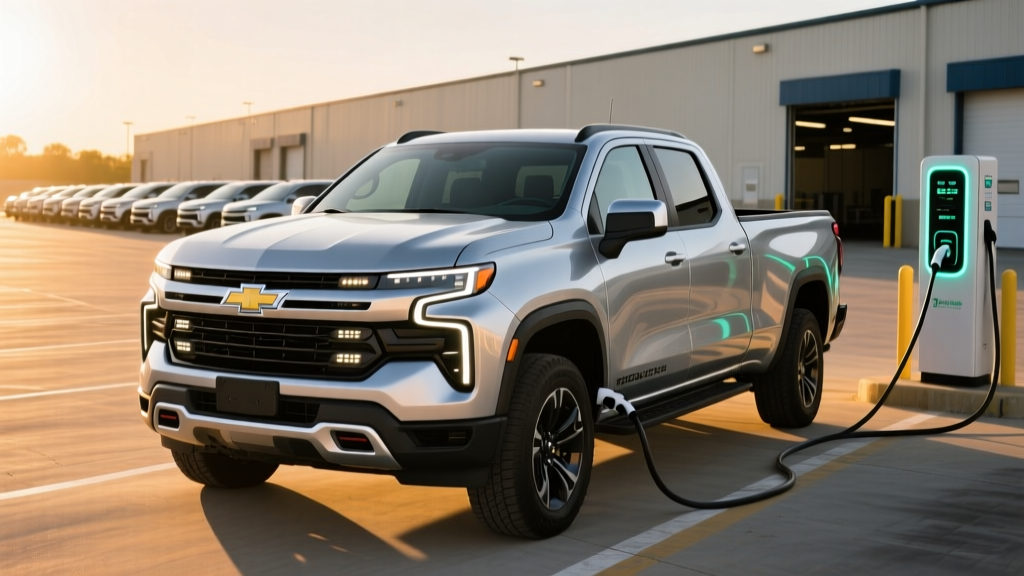
Chevrolet's Silverado EV Work Truck (WT) isn't trying to win beauty contests at the job site. It's engineered for one thing: moving heavy loads with minimal operating cost over a full workday. For the 2026 model year, the Silverado EV WT carries forward the Ultium platform's largest battery option, a spacious midgate cargo system, and DC fast-charging speeds that make depot top-ups practical. But with a starting MSRP pushing into the mid-$50,000s before incentives, fleet managers and owner-operators need to run the numbers carefully. Here's the full breakdown.
Range, Battery & Real-World Expectations
The 2026 Silverado EV 4WT trim — the volume work-truck configuration — uses a massive 200 kWh usable Ultium battery pack built on LG Energy Solution's NCMA (nickel-cobalt-manganese-aluminum) pouch cells. This is an NMC-derivative chemistry optimized for energy density and cycle life, not the LFP cells found in some lighter-duty EVs.
| Spec | Value |
|---|---|
| EPA Estimated Range | 393 miles (4WT) |
| Battery Capacity (Usable) | ~200 kWh |
| Cell Chemistry | NCMA (NMC variant) |
| Efficiency | 51 kWh/100 mi (combined) |
| MPGe (Combined) | 66 MPGe |
The EPA's 393-mile figure assumes mixed driving. On a sustained 70 mph highway run, expect ~310-330 miles before you're hunting for a charger. Towing a loaded 7,000-lb trailer cuts that to roughly 180-220 miles depending on terrain and headwind. In cold weather (below 30°F), plan for a 20-30% range reduction, bringing unladen highway range to around 240-260 miles. The Silverado EV's battery preconditioning system mitigates some of this loss when navigating to a DC fast charger, but physics is physics — a 200 kWh pack still needs thermal energy in winter.
Charging Speed: Depot and Home
For fleet operators, charging logistics determine whether an electric work truck is viable. The Silverado EV WT supports up to 200 kW peak DC fast charging via its CCS1 connector (with NACS adapter compatibility expanding access to Tesla Supercharger stations for the 2026 model year).
| Charging Level | Power | Speed |
|---|---|---|
| Level 1 (120V) | ~1.4 kW | ~3-4 miles/hr |
| Level 2 (240V, 48A) | 11.5 kW | ~28 miles/hr |
| Level 2 (240V, 80A) | 19.2 kW | ~47 miles/hr |
| DC Fast Charge (peak) | 200 kW | 10-80% in ~45 min |
The 10-80% DC charge time of approximately 45 minutes reflects the reality of charging a 200 kWh pack: even at 200 kW, you're moving a lot of electrons. The charge curve tapers significantly above 80% state of charge to protect cell longevity, so a full 0-100% session takes well over an hour. For fleet depots installing Level 2 chargers overnight, the 19.2 kW onboard charger option is a strong advantage — it can replenish roughly 350 miles of range in an 8-hour shift, which covers most daily duty cycles.
Performance, Towing & Drivetrain
The Silverado EV 4WT runs a dual-motor all-wheel-drive layout producing 510 horsepower and 615 lb-ft of torque in its standard WT tune. That's enough for a 0-60 mph time of approximately 5.8 seconds — brisk for a truck with an 8,500+ lb curb weight, and meaningfully quicker than any comparable diesel work truck off the line.
| Performance Spec | Value |
|---|---|
| Horsepower | 510 hp |
| Torque | 615 lb-ft |
| 0-60 mph | ~5.8 seconds |
| Drivetrain | Dual-motor AWD |
| Max Towing Capacity | 10,000 lbs (4WT) |
| Max Payload | ~1,800 lbs |
The 10,000-lb towing rating is competitive with half-ton gas trucks, but there's an important caveat: towing at or near max capacity will slash range by 40-50%. If your fleet regularly tows heavy loads over long distances, route planning around DC fast chargers becomes essential. For lighter-duty work — tools, materials, job-site shuttling under 3,000 lbs — the range impact is far more manageable.
Pricing, Trims & Federal Tax Credit
The 2026 Silverado EV lineup for work-truck buyers centers on two configurations:
| Trim | Base MSRP | Est. After §30D Credit |
|---|---|---|
| 4WT (Standard Range) | ~$55,000 | ~$47,500* |
| 4WT (Max Range / 200 kWh) | ~$63,000 | ~$55,500* |
*Tax credit estimates assume eligibility. See details below.
Under the IRS §30D clean vehicle credit, the Silverado EV may qualify for up to $7,500, but eligibility is not automatic. The truck must meet critical-mineral and battery-component sourcing requirements that have tightened significantly since the Inflation Reduction Act. Additionally:
- MSRP Cap: Trucks/vans/SUVs must have an MSRP at or below $80,000 — the Silverado EV WT clears this.
- Income Cap: Buyer AGI must not exceed $150,000 (single), $225,000 (head of household), or $300,000 (joint).
- Point-of-Sale Transfer: Eligible buyers can transfer the credit to the dealer at purchase, reducing the out-of-pocket price immediately.
- Commercial Clean Vehicle Credit (§45W): Fleet buyers who don't owe federal income tax may instead claim up to $7,500 (vehicles under 14,000 lbs GVWR) under the commercial credit — consult a tax professional.
Always verify current-year eligibility on fueleconomy.gov and with your tax advisor, as sourcing rules update annually.
Cargo, Interior & Work-Site Tech
The Silverado EV's architecture — with no engine bay — creates a massive front trunk (~10.7 cu ft) that locks securely, ideal for tools or gear you don't want rattling in the bed. The bed itself offers ~57 cu ft of volume (with the Multi-Flex Midgate closed), expanding to over 100 cu ft when the midgate is folded down and the rear seats are tipped forward, creating a near-flat load floor stretching nearly 11 feet from tailgate to cab wall.
Interior space is generous: 43.1 inches of front legroom and 42.8 inches rear, with a flat rear floor thanks to the skateboard platform. The WT trim keeps things utilitarian — cloth seats, rubberized floor covering, and a 17.7-inch diagonal infotainment screen running Google Built-In with native Google Maps navigation (critical for EV route planning with charging stops).
Notable tech includes:
- Super Cruise (available): GM's hands-free Level 2 driver-assist system for mapped highways — the driver must remain attentive, and this is not autonomous driving.
- ProGrade Trailering System with trailer light test, hitch guidance, and trailer tire-temperature monitoring.
- Vehicle-to-Load (V2L): Up to 10.2 kW of offboard power through the bed and cabin outlets — enough to run job-site power tools, lighting rigs, or even back up a home panel during an outage.
- OnStar telematics with fleet-management integration for route optimization and charge-status monitoring.
Super Cruise is SAE Level 2 — you must keep your eyes on the road and hands available to take over. It operates only on pre-mapped divided highways (~750,000+ miles in North America). It will not navigate construction zones, unmapped roads, or severe weather autonomously.
Warranty & Ownership Costs
Chevrolet backs the Silverado EV with:
- Battery & Drive Unit Warranty: 8 years / 100,000 miles (whichever comes first), with a capacity retention threshold of 70% or greater during the warranty period.
- Limited Vehicle Warranty: 3 years / 36,000 miles bumper-to-bumper.
- Roadside Assistance: 5 years / 60,000 miles.
For fleet buyers, the 8-year battery warranty provides meaningful protection, though high-mileage fleets that exceed 100,000 miles within 4-5 years should budget for potential out-of-warranty battery service. GM has not published a replacement cost for the 200 kWh pack, but industry estimates for packs of this size range from $25,000 to $40,000+ depending on future cell pricing — a risk factor worth modeling into total cost of ownership.
On the operating-cost side, electricity at commercial depot rates (~$0.12-$0.18/kWh) translates to roughly $0.06-$0.09 per mile, compared to $0.18-$0.25/mile for a comparable gas Silverado 1500 at current fuel prices. Over 100,000 miles, that's a potential fuel savings of $9,000-$16,000, partially offsetting the higher purchase price. Maintenance savings (no oil changes, fewer brake replacements thanks to regen) add another $2,000-$4,000 over the same period.
Pros, Cons & Who Should Buy
- Class-leading 393-mile EPA range (Max Range battery)
- 10.2 kW V2L for job-site power
- 19.2 kW Level 2 onboard charger — best-in-class overnight replenishment
- Multi-Flex Midgate extends bed to ~11 ft load floor
- Strong towing tech suite with trailer integration
- Low per-mile energy cost vs gas equivalents
- Heavy: 8,500+ lb curb weight hurts efficiency when unloaded
- Towing at max capacity slashes range to ~200 mi
- 45-min 10-80% DC charge is slower than lighter EVs
- MSRP still high for a work truck before incentives
- Public DC charging reliability remains inconsistent
- Wide body (86+ in) can be tight in urban job sites
Buy the Silverado EV WT if: Your daily routes are under 250 miles, you can charge at a depot overnight, you value V2L job-site power, and you want to lock in lower per-mile fuel costs for a fleet or sole-proprietor operation.
Look elsewhere if: You regularly tow over 5,000 lbs on routes exceeding 200 miles between chargers, you lack reliable overnight charging access, or your budget can't absorb the upfront premium even after tax credits. For lighter-duty commuting with occasional hauling, a smaller EV SUV or a PHEV truck like the Silverado PHEV (when available) may be more practical.
Frequently Asked Questions
What is the real-world range of the Silverado EV Work Truck?
The EPA rates the 4WT Max Range at 393 miles. In real-world highway driving at 70 mph, expect 310-330 miles. With a loaded trailer, that drops to 180-220 miles. Cold weather further reduces range by 20-30%.
How fast does the Silverado EV charge at home and on the road?
On a DC fast charger, it peaks at 200 kW, reaching 10-80% in about 45 minutes. At home on a 240V/80A Level 2 charger, it adds roughly 47 miles of range per hour — a full overnight session can replenish most of the 200 kWh pack.
Does the Silverado EV qualify for the $7,500 federal tax credit?
It may, depending on battery-sourcing compliance for the current model year, your income (AGI caps apply), and the vehicle's MSRP (must be ≤$80,000 for trucks). Fleet buyers may qualify under the §45W commercial credit instead. Always verify on irs.gov and with a tax professional.
Is the Silverado EV WT worth it vs. the Ford F-150 Lightning or Rivian R1T?
The Silverado EV WT offers more range (393 vs. ~320 miles for the F-150 Lightning Extended Range) and a more versatile midgate cargo system. The F-150 Lightning is generally less expensive and has a more established dealer/service network. The Rivian R1T is more refined but significantly pricier and positioned as a lifestyle truck rather than a fleet work vehicle. For pure work-truck duty with depot charging, the Silverado EV WT's range and V2L make it compelling.
Can the Silverado EV power my tools or home?
Yes. The V2L system provides up to 10.2 kW of offboard power through bed-mounted and cabin outlets — enough for most job-site power tools, lighting, and compressors. With the optional Energy Transfer Pro system, it can also back up a home electrical panel during outages (requires professional installation of a transfer switch).
What's the battery replacement cost?
GM has not published an official replacement cost for the 200 kWh Ultium pack. Industry estimates for packs of this capacity range from $25,000 to $40,000+ depending on future cell economics. The 8-year/100,000-mile warranty covers defects and capacity loss below 70%, providing substantial protection during the typical first-ownership period.