The Short Answer: Yes, the Silverado EV Is Significantly Longer
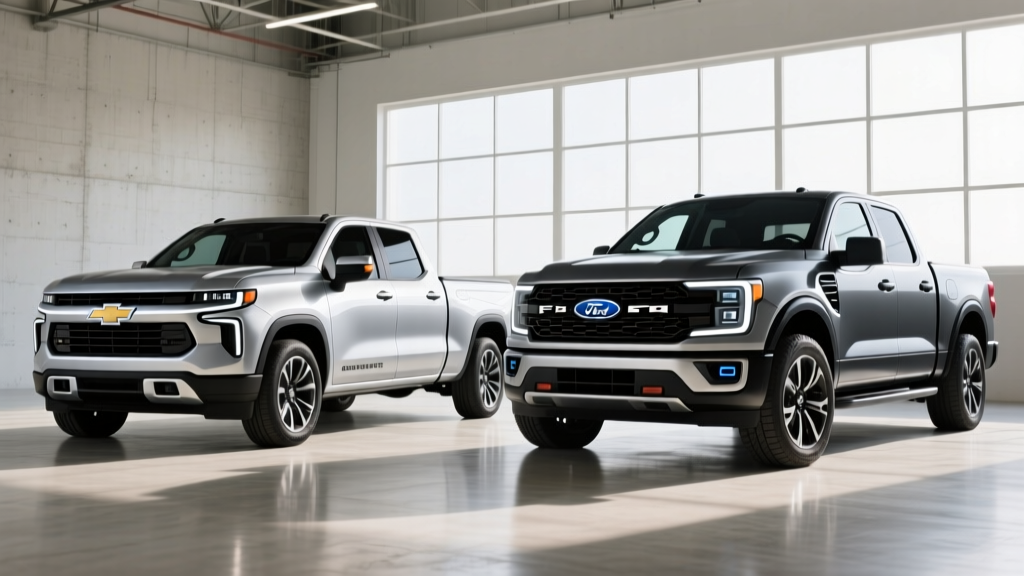
If you've been searching whether the Chevy Silverado EV is longer than the Ford F-150 Lightning, the answer is a definitive yes — and the gap is wider than most shoppers expect. The 2026 Silverado EV rides on a wheelbase roughly 14 inches longer than the Lightning and stretches nearly 20 inches bumper-to-bumper past Ford's electric truck. That extra length translates directly into cargo volume, rear-seat legroom, and a notably different driving character.
But length alone doesn't decide a truck purchase. Below, we break down every spec that matters — EPA range, real-world efficiency, DC fast-charging curves, battery chemistry, pricing after the §30D federal tax credit, and who each truck actually serves best.
Dimension-by-Dimension: Silverado EV vs F-150 Lightning
| Measurement | Chevy Silverado EV | Ford F-150 Lightning |
|---|---|---|
| Overall Length | ~233.1 in | ~232.7 in (std bed) / ~228.5 in (short bed) |
| Wheelbase | ~145.7 in | ~131.8 in |
| Width (excl. mirrors) | ~81.7 in | ~80.0 in |
| Height | ~78.3 in | ~79.0 in |
| Bed Length | ~69.9 in (5 ft 9 in) | ~67.1 in (5 ft 6 in) |
| Rear Legroom | ~43.1 in | ~41.8 in |
| Frunk Volume | ~10.7 cu ft (eTrunk) | ~14.1 cu ft (Mega Power Frunk) |
| Curb Weight (AWD) | ~8,500–9,000 lbs | ~6,000–6,500 lbs |
The Silverado EV's GM BT1 skateboard platform was engineered from the ground up for a long wheelbase, which gives it a limousine-like rear seat but also makes it substantially heavier. The F-150 Lightning, adapted from Ford's existing F-150 architecture, is more compact and roughly 2,000–2,500 lbs lighter depending on trim — an advantage you'll notice in efficiency and garage fitment.
Range, Battery & Efficiency: Which Goes Farther?
| Spec | Silverado EV (4WT / RST) | F-150 Lightning (Extended Range) |
|---|---|---|
| Usable Battery Capacity | ~200+ kWh (Ultium NMC) | ~131 kWh (NMC) |
| EPA Estimated Range | Up to 440 mi (4WT Max) | Up to 320 mi (XLT Extended Range) |
| Efficiency (kWh/100 mi) | ~48–53 kWh/100 mi | ~48–52 kWh/100 mi |
| MPGe (Combined) | ~63–68 MPGe | ~66–70 MPGe |
| Battery Chemistry | NMC (nickel manganese cobalt) | NMC (nickel manganese cobalt) |
| Drivetrain | Dual-motor AWD (e4WD) | Dual-motor AWD |
Neither truck uses LFP chemistry — both rely on NMC packs optimized for energy density. This means you'll see typical NMC degradation patterns: roughly 5–8% capacity loss over the first 100,000 miles, stabilizing afterward. Both manufacturers recommend keeping daily charge limits at 80–90% to maximize long-term battery health.
For the latest official EPA figures, cross-reference fueleconomy.gov's EV side-by-side tool, which updates as new model-year certifications are published.
Charging Speed: DC Fast-Charge & Home Level 2
| Charging Metric | Silverado EV | F-150 Lightning |
|---|---|---|
| Max DC Fast-Charge Rate | 350 kW (peak) | 150 kW (peak) |
| 10–80% DC Fast-Charge Time | ~30 min (est., 350 kW station) | ~41 min (150 kW station) |
| Level 2 Home Charge Rate | 19.2 kW (max, 80A circuit) | 19.2 kW (max, 80A circuit) |
| Level 2 Miles Added per Hour | ~34–38 mi/hr | ~30–34 mi/hr |
| Charge Port / Connector | NACS (native, 2025+) | NACS (native, 2025+) |
| Charge Curve Taper | Holds ~250 kW to ~55% SoC, tapers sharply above 80% | Holds ~130 kW to ~60% SoC, gradual taper above 75% |
The Silverado EV's 350 kW peak charge rate is a headline number, but real-world charging depends on station availability. You'll need a CCS-to-NACS adapter at older Electrify America or EVgo stations still running CCS connectors, though most major networks are transitioning to native NACS by 2026. At a true 350 kW-capable charger, the Silverado EV's enormous battery can absorb energy far longer before tapering, which means the 10–80% time advantage is meaningful on road trips.
For home charging, both trucks support up to 19.2 kW on a hardwired 100-amp circuit (80 amps continuous). This requires a panel upgrade in many homes — expect $1,500–$3,500 for a 200-amp service upgrade plus $800–$1,500 for the charger unit and electrician labor. Budget $2,500–$5,000 total for a full Level 2 home installation. If your panel already has capacity, a 48-amp circuit (11.5 kW) is a more economical option and still adds roughly 20–25 miles of range per hour of charging.
Performance: 0–60, Towing & Payload
| Metric | Silverado EV (RST / 4WT) | F-150 Lightning (Platinum / Lariat) |
|---|---|---|
| Horsepower | Up to 754 hp (RST) | Up to 580 hp (Extended Range) |
| Torque (lb-ft) | Up to 785 lb-ft | Up to 775 lb-ft |
| 0–60 mph | ~4.5 sec (RST) | ~3.8 sec (Extended Range) |
| Max Towing Capacity | Up to 12,500 lbs (w/ Max Trailering) | Up to 10,000 lbs (w/ Max Trailer Tow) |
| Max Payload | ~1,800 lbs | ~2,235 lbs |
The Silverado EV RST's 754 hp is a party trick, but the Lightning's lighter chassis gives it a quicker 0–60 time. For towing, the Silverado EV's heavier frame and longer wheelbase provide more stability with large trailers, and its 12,500-lb rating edges out the Lightning. However, towing at max capacity will slash range by 40–50% on both trucks — expect roughly 200–220 miles from the Silverado EV and 150–170 miles from the Lightning when pulling near their limits.
Pricing, Trims & Federal Tax Credit Eligibility
| Trim | Silverado EV MSRP | F-150 Lightning MSRP |
|---|---|---|
| Base / Work Truck | ~$39,900 (3WT, fleet-oriented) | ~$54,995 (Pro, standard range) |
| Mid-Tier | ~$54,500 (LT) | ~$62,995 (Lariat, Extended Range) |
| Premium / Performance | ~$87,300 (RST) | ~$84,995 (Platinum, Extended Range) |
- MSRP Cap: Trucks/vans/SUVs must have an MSRP at or below $80,000 to qualify. This eliminates the Silverado EV RST and Lightning Platinum from the credit.
- Income Cap: Buyer AGI must not exceed $150,000 (single), $225,000 (head of household), or $300,000 (joint).
- Battery Sourcing: Critical minerals and battery components must meet escalating domestic-sourcing thresholds. As of 2026, both GM and Ford have restructured supply chains to maximize eligibility, but always verify current-year compliance on the specific VIN before purchase.
- Point-of-Sale Transfer: Eligible buyers can transfer the credit to the dealer at purchase, reducing the sale price by up to $7,500 on the spot.
Source: IRS §30D Clean Vehicle Credit. Consult a tax professional for your specific situation.
In practice, the Silverado EV LT (~$54,500) and the F-150 Lightning Lariat (~$62,995) are the trims most likely to qualify for the full $7,500 credit, bringing effective prices to roughly $47,000 and $55,495 respectively — before any state incentives. The Silverado EV 3WT at ~$39,900 is aimed at commercial fleets and may qualify under the separate §45W commercial credit instead.
Tech, Driver Assistance & Interior
Silverado EV highlights: The RST and LT trims feature a 17.7-inch diagonal infotainment screen, an 11-inch driver display, GM's Super Cruise (hands-on-wheel Level 2 driver assistance on 750,000+ mapped miles of highway), a Multi-Flex Midgate that extends bed length into the cabin, and available 4-wheel steering (crabwalk mode on select trims). The eTrunk (front trunk) holds 10.7 cu ft but is shallower than Ford's offering.
F-150 Lightning highlights: The Lightning offers a 15.5-inch portrait touchscreen (SYNC 4A), Ford BlueCruise (hands-off Level 2 on 130,000+ miles of divided highway), the class-leading 14.1 cu ft Mega Power Frunk with drain plug and 400W outlet, Pro Power Onboard (up to 9.6 kW of vehicle-to-load power for job sites or tailgating), and an available interior work surface. Rear-seat room is tighter than the Silverado EV but competitive with gas F-150 SuperCrew models.
Warranty, Ownership Costs & Long-Term Outlook
| Coverage | Silverado EV | F-150 Lightning |
|---|---|---|
| Battery & Powertrain | 8 years / 100,000 miles | 8 years / 100,000 miles |
| Battery Retention Guarantee | ≥70% capacity during warranty | ≥70% capacity during warranty |
| Bumper-to-Bumper | 3 years / 36,000 miles | 3 years / 36,000 miles |
| Estimated Battery Replacement | $20,000–$30,000+ (out of warranty, est.) | $18,000–$28,000 (out of warranty, est.) |
Both trucks carry the federally mandated 8-year/100,000-mile battery warranty with a 70% capacity retention floor. The Silverado EV's larger battery means replacement will likely cost more out of warranty. Insurance premiums for both trucks run 15–25% higher than their gas counterparts due to repair costs and parts pricing — get quotes before committing.
Pros, Cons & Who Should Buy Which
Silverado EV — Pros
- Class-leading 440-mile EPA range (4WT Max)
- Longest wheelbase in the segment — exceptional rear legroom
- 350 kW peak DC fast-charging
- Multi-Flex Midgate extends usable bed length
- Super Cruise highway assist on 750K+ miles
Silverado EV — Cons
- 8,500+ lb curb weight hurts efficiency and tire wear
- May not fit standard-depth garages
- RST trim exceeds $80K tax-credit MSRP cap
- Smaller frunk than Lightning
- Limited real-world range data (newer platform)
F-150 Lightning — Pros
- Lighter, quicker, more garage-friendly footprint
- 14.1 cu ft Mega Power Frunk with outlet
- 9.6 kW Pro Power Onboard (V2L)
- More real-world range data (on sale since 2022)
- BlueCruise hands-off highway driving
F-150 Lightning — Cons
- 320-mile max EPA range trails Silverado EV by 120 mi
- 150 kW max DC charge rate is slower on road trips
- Platinum trim exceeds $80K tax-credit MSRP cap
- Tighter rear legroom than Silverado EV
- Towing range drop-off is steep
- Choose the Silverado EV if: You need maximum range for long-distance driving, prioritize rear-seat comfort, want the fastest DC charging available, and have garage space for a 233-inch truck.
- Choose the F-150 Lightning if: You want a more maneuverable daily driver, value the massive frunk and onboard power for worksite or tailgate use, prefer a proven platform with years of real-world data, and want quicker acceleration in a lighter package.
Frequently Asked Questions
Is the Silverado EV longer than the F-150 Lightning?
Yes. The 2026 Silverado EV measures approximately 233.1 inches overall with a 145.7-inch wheelbase, compared to the Lightning's ~232.7 inches (standard bed) and 131.8-inch wheelbase. The wheelbase difference — nearly 14 inches — is where you feel it most, in rear-seat room and ride quality.
What is the real-world range of the Silverado EV and F-150 Lightning?
The Silverado EV 4WT Max posts an EPA-estimated 440 miles, but expect roughly 350–380 miles in real-world highway driving and 300–330 miles in cold weather. The Lightning Extended Range is EPA-rated at 320 miles, with real-world highway returns of 260–285 miles and cold-weather figures around 220–250 miles.
Does either truck qualify for the $7,500 federal EV tax credit?
Mid-tier trims like the Silverado EV LT (~$54,500) and Lightning Lariat (~$62,995) are eligible if you meet IRS income caps ($150K single / $300K joint) and the vehicle's battery sourcing meets 2026 thresholds. Top trims (RST at ~$87,300, Platinum at ~$84,995) exceed the $80,000 MSRP cap for trucks and do not qualify. Always verify on the IRS website and with your dealer before purchase.
Which truck charges faster?
The Silverado EV, decisively. Its 350 kW peak DC rate versus the Lightning's 150 kW means faster stops on road trips — roughly 30 minutes from 10–80% versus 41 minutes, provided you're at a capable 350 kW station. Both charge at up to 19.2 kW at home on Level 2.
Which is better for towing?
The Silverado EV tows up to 12,500 lbs versus the Lightning's 10,000 lbs, and its heavier, longer-wheelbase platform is more stable with large trailers. However, both trucks lose 40–50% of range at max tow, so plan charging stops accordingly.
Will either truck fit in a standard garage?
Measure carefully. The Silverado EV at 233 inches long and 81.7 inches wide is a tight fit or a no-fit in many single-car garages built before 2010. The Lightning at ~228–233 inches (depending on bed) is slightly more accommodating but still requires a 22-foot-deep garage minimum for comfortable clearance.