The Chevrolet Silverado EV has spent its first two model years proving that a full-size electric pickup can deliver serious range and utility without the compromises that plagued early electric trucks. For 2026, Chevy expands the lineup with new trims, refined software, and a cabin that finally feels worthy of its premium price tags on upper trims. This review breaks down every number that matters — from real-world range and charging curves to interior dimensions and tax-credit math — so you can decide whether the Silverado EV earns a spot in your driveway.
Quick Verdict: Who Should Buy the 2026 Silverado EV
The 2026 Silverado EV targets truck buyers who need genuine utility — a 5-foot bed, 10,000-lb max towing, and a Multi-Flex Midgate — but want to eliminate fuel costs and enjoy instant torque. The Work Truck (WT) fleet model starts at an approachable $39,900, while the fully loaded RST First Edition pushes past $97,000. If you tow frequently over 200 miles, need a crew-cab bed combo for job sites, or simply want the longest-range electric pickup on the market, the Silverado EV deserves serious consideration. If you primarily need a compact daily driver or rarely use a bed, a smaller EV will serve you better at lower cost.
Range, Battery, and Real-World Efficiency
Chevrolet offers the 2026 Silverado EV with two Ultium battery configurations across its trim lineup. The standard pack is a 200 kWh (gross) lithium-ion NMC (nickel manganese cobalt) battery, while the Extended Range variant pushes to approximately 240 kWh gross — among the largest battery packs in any production vehicle.
| Specification | Standard Range (WT) | Extended Range (LT/RST) |
|---|---|---|
| Battery Capacity (gross) | ~200 kWh | ~240 kWh |
| Usable Capacity | ~190 kWh | ~228 kWh |
| Chemistry | NMC (Ultium) | NMC (Ultium) |
| EPA Est. Range | ~280 miles | ~400 miles (RST) |
| Efficiency (MPGe) | ~62 MPGe combined | ~65 MPGe combined |
| Efficiency (kWh/100mi) | ~54 kWh/100mi | ~52 kWh/100mi |
The 400-mile EPA figure on the Extended Range RST is impressive on paper, but real-world results depend heavily on how you drive. In highway testing at 70-75 mph, expect approximately 320-350 miles before needing a charge. Cold weather (below 32°F) can reduce range by 15-25%, bringing the Extended Range down to roughly 280-310 miles in winter highway conditions. City driving with frequent regenerative braking can actually exceed the EPA estimate, with some owners reporting 410-430 miles in mild-weather urban use. Towing a 7,000-lb trailer cuts range roughly in half — plan for 160-200 miles between charges when hauling.
Charging Speed: DC Fast Charging and Home Level 2
The Silverado EV's Ultium platform supports up to 350 kW peak DC fast charging on properly equipped trims (RST and above with the available charge package). However, peak rate and sustained rate are very different things, and understanding the charge curve is essential for road-trip planning.
| Charging Level | Max Rate | Speed / Time |
|---|---|---|
| Level 1 (120V household) | 1.4 kW | ~3-4 miles per hour |
| Level 2 (240V home, 48A) | 11.5 kW | ~23 miles per hour; full charge in ~17-20 hrs |
| Level 2 (240V, 80A capable) | 19.2 kW | ~38 miles per hour; full charge in ~10-12 hrs |
| DC Fast Charge (CCS/NACS) | 350 kW peak | 10-80% in ~25-30 min (350 kW station) |
| DC Fast Charge (150 kW station) | ~150 kW sustained | 10-80% in ~45-50 min |
Charge curve reality: The Silverado EV peaks near 350 kW only between roughly 10-25% state of charge, then tapers progressively. From 25-50%, expect ~250-280 kW; from 50-80%, the rate drops to approximately 150-180 kW. This is typical for large NMC packs but means the advertised 10-80% time is heavily dependent on starting at a low SoC and using a functioning 350 kW charger. At a more common 150 kW Electrify America or EVgo station, plan for 45-50 minutes for a 10-80% session.
For home charging, the Silverado EV comes with a dual-level portable charge cord. For optimal daily use, we recommend installing a hardwired 48-amp Level 2 station on a 60-amp circuit. If your electrical panel supports it, the available 19.2 kW onboard charger (standard on RST, optional on LT) dramatically cuts overnight charge times. According to fueleconomy.gov, a 19.2 kW Level 2 setup adds roughly 38 miles of range per hour of charging.
The 2026 Silverado EV Interior: Space, Tech, and Livability
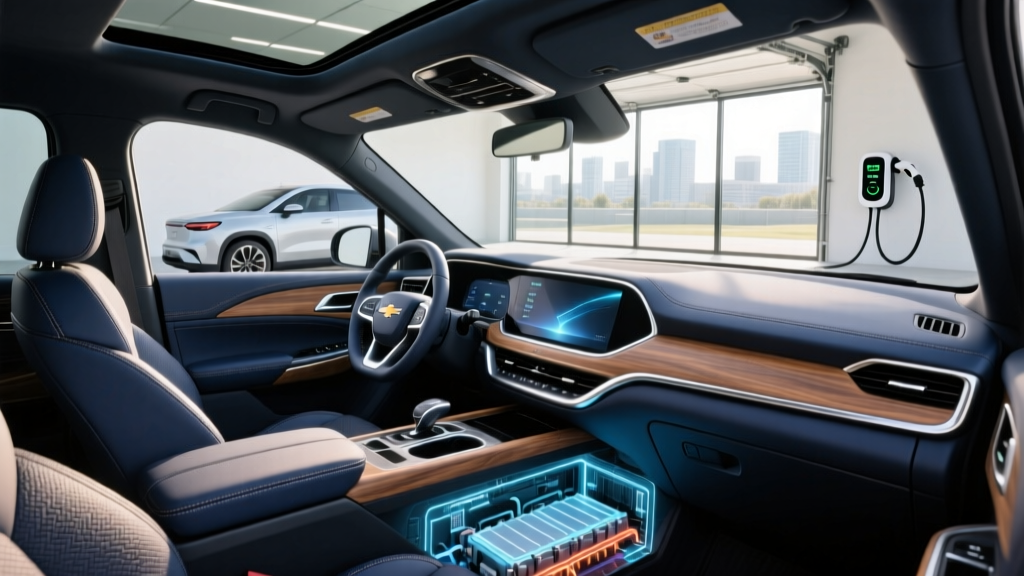
Searches for "Silverado EV interior" spike for good reason: this cabin is where Chevy has made the most visible year-over-year improvements. The 2026 model year brings updated materials on upper trims, revised center-console ergonomics, and a faster infotainment processor.
Interior Dimensions and Cargo
| Measurement | Specification |
|---|---|
| Seating Capacity | 5 passengers (crew cab) |
| Front Headroom | ~40.5 in |
| Front Legroom | ~44.2 in |
| Rear Headroom | ~39.8 in |
| Rear Legroom | ~43.4 in |
| Bed Length | ~63.7 in (standard); up to 109 in with Midgate open |
| Bed Volume | ~54.7 cu ft (standard bed) |
| Front Trunk (Frunk) | ~10.7 cu ft |
| Max Payload | ~1,800 lbs (varies by trim) |
| Max Towing | 10,000 lbs (RST); 8,000 lbs (WT standard) |
The cabin layout uses a portrait-oriented 17.7-inch infotainment touchscreen on LT and RST trims (11-inch on WT), paired with an 11-inch digital driver display. The flat floor — a benefit of the dedicated Ultium skateboard platform — creates genuine three-across rear seating comfort that beats many body-on-frame competitors. The available Multi-Flex Midgate lets you fold the rear cabin wall down to extend the bed through the cab, accommodating items up to 109 inches long while still protecting them from weather with the tonneau cover.
Material quality varies sharply by trim. The WT uses durable but hard plastics appropriate for fleet use. The LT adds soft-touch surfaces and available leather. The RST First Edition delivers premium Nappa leather, open-pore wood trim, and a Bose 14-speaker audio system. One persistent complaint from 2024-2025 owners — a lack of physical volume and climate knobs — has been partially addressed for 2026 with a revised center stack that adds capacitive-touch shortcut buttons, though some drivers will still miss tactile dials.
Driver Assistance and Technology
Every 2026 Silverado EV includes Chevy's Super Cruise hands-free driving system on mapped highways — approximately 750,000 miles of compatible roads in the US and Canada. Super Cruise is an SAE Level 2 driver-assistance system, meaning the driver must remain attentive and ready to take over at all times, even though hands can leave the wheel on compatible roads. The system uses a driver-monitoring camera to verify attention.
Super Cruise and the available Trailering Super Cruise are Level 2 systems — the driver is always responsible. This is not autonomous or "self-driving" capability. Level 4 robotaxi services like Waymo operate without any driver; the Silverado EV requires your full engagement even when the system is active.
Additional tech highlights include:
- Google built-in (Google Maps, Google Assistant, Play Store apps)
- Available Trailering Super Cruise with trailer-geometry compensation
- ProGrade Trailering system with up to 10 camera views
- Vehicle-to-load (V2L) power: up to 9.6 kW available through bed and cabin outlets
- Over-the-air software updates via Ultifi platform
- Available Head-Up Display (RST)
Performance: Acceleration, Powertrain, and Drivetrain
| Trim | Drivetrain | Horsepower | Torque (lb-ft) | 0-60 mph |
|---|---|---|---|---|
| WT Standard Range | Dual-Motor AWD | ~510 hp | ~615 | ~5.8 sec |
| LT Extended Range | Dual-Motor AWD | ~645 hp | ~785 | ~4.5 sec |
| RST Extended Range | Dual-Motor AWD | ~754 hp | ~785 | ~4.2 sec |
Every 2026 Silverado EV uses a dual-motor all-wheel-drive layout with one motor on each axle. The RST's 754 hp output delivers genuinely startling acceleration for a vehicle weighing over 8,500 lbs. In real-world driving, the instant torque makes merging and passing effortless, and the low center of gravity (batteries mounted in the floor) keeps body roll surprisingly controlled for a full-size truck. The four-wheel steering system (standard on RST, available on LT) shrinks the turning circle to roughly 42 feet — tighter than many midsize SUVs — making parking-lot maneuvering far less stressful than the truck's size suggests.
Pricing, Trims, and Federal Tax Credit Eligibility
| Trim | Base MSRP | As-Tested (Typical) | Est. After §30D Credit |
|---|---|---|---|
| WT (Fleet/Standard Range) | $39,900 | $44,000 | Varies (fleet rules differ) |
| LT (Extended Range) | $63,400 | $68,500 | ~$55,900* |
| RST First Edition | $87,300 | $97,800 | $89,800* |
*After-tax-credit prices assume full $7,500 §30D credit eligibility. See checklist below.
- MSRP Cap: Vans/pickups must be under $80,000 MSRP — the RST First Edition exceeds this cap and does NOT qualify. The LT qualifies if optioned below $80,000.
- Buyer Income Cap: Modified AGI must not exceed $150,000 (single), $225,000 (head of household), or $300,000 (joint filers).
- Battery Sourcing: Critical minerals and battery components must meet phased-in domestic/free-trade sourcing thresholds. Verify current-year compliance at irs.gov.
- Point-of-Sale Transfer: Eligible buyers can transfer the credit to the dealer for an immediate price reduction at purchase.
- Commercial Entity Exception: Fleet purchases (WT trim) may qualify under §45W commercial clean vehicle credit instead — consult a tax professional.
The WT trim at $39,900 is a standout value for fleet operators and qualifying individual buyers, though retail availability has been limited — Chevy prioritizes commercial sales for this trim. The LT Extended Range at ~$63,400 (potentially ~$55,900 after the credit) is the sweet spot for most retail buyers seeking the 400-mile range. The RST is a technology showcase but crosses the MSRP cap, eliminating federal credit eligibility.
Warranty, Ownership Costs, and Longevity
| Coverage | Term |
|---|---|
| Battery (capacity retention ≥70%) | 8 years / 100,000 miles |
| Powertrain (motors, power electronics) | 5 years / 60,000 miles |
| Bumper-to-Bumper | 3 years / 36,000 miles |
| Roadside Assistance | 5 years / 60,000 miles |
| Corrosion Perforation | 6 years / 100,000 miles |
Chevrolet's 8-year/100,000-mile battery warranty guarantees at least 70% capacity retention — consistent with industry norms. Ultium NMC batteries in GM's existing EV fleet (Lyriq, Blazer EV) have shown modest degradation of approximately 3-5% over the first 30,000 miles based on owner-reported data, though long-term data beyond 5 years is still accumulating. The Silverado EV's massive battery pack provides a built-in longevity advantage: even with 10% degradation over a decade, the Extended Range model would still deliver ~360 miles of EPA range.
For a deeper understanding of how NMC chemistry ages versus LFP alternatives, see our battery chemistry and degradation guide.
- Class-leading 400-mile EPA range (Extended Range)
- 350 kW DC fast-charge capability
- Multi-Flex Midgate for extended cargo flexibility
- 10,000-lb towing capacity with Trailering Super Cruise
- 9.6 kW V2L for job-site or campsite power
- Four-wheel steering for tight maneuverability
- Spacious, flat-floor crew cab interior
- RST First Edition exceeds $80K MSRP cap — no federal tax credit
- Very large footprint — challenging in tight urban environments
- Towing cuts range by ~50%
- 17.7-inch screen lacks physical knobs (improved but not solved for 2026)
- Full charge on Level 2 takes 10-20 hours due to massive battery
- WT trim primarily allocated to fleets, limited retail availability
Silverado EV vs. Key Competitors
| Spec | Chevy Silverado EV (LT) | Ford F-150 Lightning | Rivian R1T (Dual-Motor Max) |
|---|---|---|---|
| EPA Range | ~400 mi | ~320 mi (Ext. Range) | ~410 mi (Max Pack) |
| Max DC Charge | 350 kW | 150 kW | 220 kW |
| 0-60 mph | ~4.5 sec | ~3.8 sec | ~3.5 sec |
| Max Towing | 10,000 lbs | 10,000 lbs | 11,000 lbs |
| Bed Length | ~63.7 in (Midgate extends) | ~67.1 in | ~54.2 in (Gear Tunnel adds space) |
| Base Price | $63,400 | $59,995 | $79,900 |
- Maximum range (400 miles) is your top priority for long-haul road trips
- You need the Midgate for hauling long items through the cab
- 350 kW DC charging speed matters for minimizing road-trip stops
- You value Super Cruise for hands-free highway driving
- You want the lowest entry price in a full-size electric truck
- You prefer a traditional truck layout and familiar F-150 ergonomics
- Your daily driving stays under 250 miles and you charge at home
- Performance (0-60, off-road) is more important than cargo space
- You want the most adventure-oriented design with the Gear Tunnel
- Budget allows for a $80K+ starting price with premium positioning
Frequently Asked Questions
What is the real-world range of the 2026 Silverado EV?
The Extended Range model is EPA-rated at approximately 400 miles. In real-world highway driving at 70-75 mph, expect 320-350 miles. In cold weather (below freezing), plan for 280-310 miles. City driving with regenerative braking can exceed the EPA estimate, reaching 410+ miles in mild conditions. Towing cuts range roughly in half.
How fast does the Silverado EV charge at home and on the road?
On a 350 kW DC fast charger, the Silverado EV charges from 10-80% in approximately 25-30 minutes (starting at low SoC). At a 150 kW station, expect 45-50 minutes. At home on a 48-amp Level 2 (11.5 kW), it adds ~23 miles per hour. With the available 19.2 kW onboard charger, home charging speeds increase to ~38 miles per hour.
Does the 2026 Silverado EV qualify for the $7,500 federal tax credit?
It depends on the trim and your income. The LT Extended Range qualifies if optioned under the $80,000 MSRP cap for trucks and your income is within §30D limits ($150K single / $300K joint). The RST First Edition exceeds the $80K cap and does not qualify. The WT may qualify under commercial credit rules (§45W). Always verify current sourcing requirements and eligibility at irs.gov before purchasing.
Is the Silverado EV worth buying vs. the F-150 Lightning or Rivian R1T?
The Silverado EV wins on range (400 miles) and DC charging speed (350 kW). The F-150 Lightning wins on price and traditional truck familiarity. The Rivian R1T wins on performance and adventure features. Your choice depends on whether range, price, or performance is your top priority.
Can the Silverado EV power my home or job site?
Yes. The available V2L (Vehicle-to-Load) system provides up to 9.6 kW of power through outlets in the bed and cabin. This is enough to run power tools on a job site, power a campsite, or provide emergency backup power to essential home circuits (with a professionally installed transfer switch).
How long will the Silverado EV battery last?
Chevrolet warrants the battery for 8 years or 100,000 miles with a minimum 70% capacity retention guarantee. Based on early Ultium fleet data, NMC degradation is tracking at roughly 3-5% over the first 30,000 miles. With the Silverado EV's oversized battery pack, even 10-15% degradation over 10+ years leaves substantial usable range.