The Tesla Model 3 remains the default benchmark in the electric sedan segment, and the refreshed "Highland" generation — now in its third model year for 2026 — has only sharpened that position. If you've been searching for a silver Tesla Model 3, you're looking at one of the most popular exterior colorways Tesla offers (badged "Quicksilver" in the current palette, replacing the older Midnight Silver Metallic). But paint is just the wrapper. What matters is what's underneath: a 60 kWh LFP pack in the base trim, a 79 kWh NMC pack in the Long Range, class-leading efficiency, and access to the largest DC fast-charging network in North America.
This review breaks down every number a buyer needs — EPA range versus what you'll actually see on a cold highway morning, sustained versus peak charging speeds, total cost after the §30D federal credit, and where the Model 3 wins and loses against the Hyundai Ioniq 6, BMW i4, and Polestar 2.
Quick Verdict: Who Should Buy the Silver Tesla Model 3?
The 2026 Model 3 is best suited for daily commuters and tech-forward drivers who prioritize efficiency, software polish, and Supercharger access over plush interiors or traditional luxury branding. The RWD trim at $38,990 MSRP is the value play; the Long Range AWD at $45,990 is the road-trip pick. It is not the best choice for buyers needing maximum rear-seat room (look at the Ioniq 6), a physical button interface, or a luxury badge. Towing is not a use case here — the Model 3 is not rated for towing.
Choose the silver Model 3 Long Range AWD if: you take regular road trips over 250 miles, live in a cold climate, or want dual-motor traction and sub-4.5-second 0-60 performance.
Look elsewhere if: you need a large rear seat for adults, physical climate controls, or a luxury-marque badge.
2026 Tesla Model 3 Specifications at a Glance
| Spec | RWD (Base) | Long Range AWD | Performance |
|---|---|---|---|
| EPA Range | 272 mi | 363 mi | 315 mi |
| Battery (usable) | ~60 kWh (LFP) | ~79 kWh (NMC) | ~79 kWh (NMC) |
| Drivetrain | Rear-Wheel Drive | Dual-Motor AWD | Dual-Motor AWD |
| Horsepower | 271 hp | 346 hp | 510 hp |
| 0–60 mph | 5.8 sec | 4.2 sec | 2.9 sec |
| MPGe (combined) | 132 MPGe | 131 MPGe | 118 MPGe |
| Efficiency | 25 kWh/100 mi | 26 kWh/100 mi | 29 kWh/100 mi |
| Peak DC Charge | 170 kW | 250 kW | 250 kW |
| 10–80% DC Time | ~30 min | ~25 min | ~25 min |
| Level 2 Rate | 11.5 kW (~44 mi/hr) | 11.5 kW (~44 mi/hr) | 11.5 kW (~44 mi/hr) |
| Cargo (trunk + frunk) | 23 cu ft total | 23 cu ft total | 23 cu ft total |
| Rear Legroom | 35.3 in | 35.3 in | 35.3 in |
| Base MSRP | $38,990 | $45,990 | $52,990 |
| Battery Warranty | 8 yr / 100,000 mi | 8 yr / 120,000 mi | 8 yr / 120,000 mi |
Source: EPA fueleconomy.gov, Tesla specifications. Prices exclude $1,390 destination.
Real-World Range: What You'll Actually Drive
Real-World Highway (70 mph, mild weather): ~230–245 mi (RWD) / ~305–325 mi (Long Range)
Real-World Cold Weather (30°F, highway): ~190–210 mi (RWD) / ~250–280 mi (Long Range)
City / Stop-and-Go: Close to or slightly above EPA thanks to regenerative braking.
The EPA cycle is generous to EVs that recover energy in stop-and-go traffic, and the Model 3 is no exception. On a flat 70-mph highway loop in 65°F weather, independent testers consistently log 230–245 miles in the RWD and 305–325 miles in the Long Range before hitting 10% state of charge.
Cold weather is the real equalizer. At 30°F with the heat pump running, expect a 25–30% range reduction versus EPA. The Model 3's standard heat pump (introduced in the refresh) mitigates this better than resistive cabin heaters in older EVs, but physics still wins. If your commute is under 80 miles round-trip, even a cold-weather RWD will handle it comfortably. For road trips exceeding 250 miles in winter, the Long Range is strongly recommended — not because you'll run out, but because charging stops become shorter and less frequent.
One often-overlooked factor: the LFP battery in the RWD trim can (and should) be charged to 100% daily without degradation concerns, unlike the NMC packs in the Long Range and Performance, which Tesla recommends keeping at 80% for daily use. This effectively narrows the usable range gap between trims in everyday commuting.
Charging Speed: DC Fast, Level 2, and Home Setup
| Charging Level | Power / Rate | Miles Added per Hour | Best For |
|---|---|---|---|
| Level 1 (120V outlet) | ~1.4 kW | ~5 mi/hr | Emergency / overnight trickle |
| Level 2 (240V, 48A) | 11.5 kW | ~44 mi/hr | Daily home charging |
| DC Fast (RWD peak) | 170 kW | ~145 mi in 15 min | Road trips |
| DC Fast (LR/Perf peak) | 250 kW | ~200 mi in 15 min | Road trips |
The Model 3 Long Range and Performance peak at 250 kW on V3 Superchargers, but this is a peak, not a sustained rate. The charge curve tapers meaningfully above 55% SoC, and by 80% you're pulling closer to 70–90 kW. A realistic 10–80% session takes roughly 25 minutes on a V3 stall. On the newer V4 Superchargers rolling out across the network, sustained rates improve slightly in the mid-SoC range, shaving 2–3 minutes off that figure.
The RWD's LFP pack tops out at 170 kW. The 10–80% time stretches to about 30 minutes — still competitive, but noticeably slower on long highway stretches. For home charging, the onboard 11.5 kW charger fills either pack overnight. A full 0–100% on the RWD takes roughly 5.5 hours; the Long Range takes about 7 hours on a hardwired 48A Level 2 wall connector.
Home installation for a Tesla Wall Connector typically runs $500–$1,500 for the electrician's labor and materials if your panel has capacity. Older homes with 100A service may need a panel upgrade ($1,500–$3,000). Always get a quote from a licensed electrician before budgeting.
Performance and Driving Dynamics
Even the base RWD Model 3 hits 60 mph in 5.8 seconds — quicker than most gas-powered sport sedans from a decade ago. The Long Range drops that to 4.2 seconds with dual-motor AWD, and the Performance trim delivers a supercar-rivaling 2.9 seconds with 510 hp.
The Highland refresh brought a retuned suspension with frequency-selective dampers, new acoustic glass, and improved isolation bushings. The result is a noticeably quieter, more compliant ride than pre-2024 Model 3s. Road noise at 70 mph has dropped measurably, and the car now absorbs sharp impacts rather than crashing over them. It's still a firm, sport-oriented tune — not a luxury float — but the gap to the BMW i4 has closed.
Regenerative braking remains strong and enables one-pedal driving in most scenarios. Tesla removed the driver-selectable regen level in the refresh (it's now always "Standard"), which frustrates some buyers transitioning from EVs with adjustable regen.
Interior, Tech, and the Screen-Only Interface
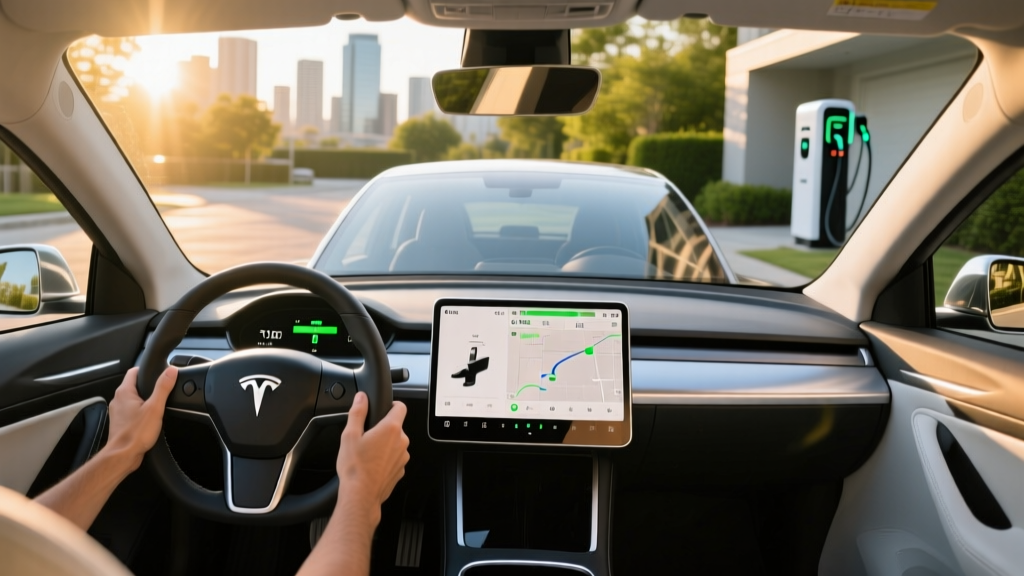
The 2026 Model 3 interior is minimalist by design: a 15.4-inch central touchscreen handles every function — climate, mirrors, glovebox, speedometer. A secondary 8-inch rear touchscreen controls rear climate and media. There are no physical instrument clusters, no stalks (turn signals are steering-wheel buttons), and no traditional gear selector (drive/reverse is via the touchscreen swipe or backup roof buttons).
Standout tech:
- Tesla's infotainment OS remains the fastest and most responsive in the industry, with native Netflix/YouTube/arcade while parked.
- Over-the-air updates regularly add features — recent additions include adaptive high beams, improved trip planning, and battery preconditioning refinements.
- The premium audio system (17 speakers in Long Range/Performance) is genuinely excellent, rivaling $1,000+ home setups.
- Ambient lighting, ventilated front seats, and power-folding mirrors are now standard on all trims.
Notable drawbacks:
- Turn-signal buttons on the steering wheel are polarizing; many drivers find them unintuitive in roundabouts.
- No physical climate knobs — adjusting fan speed requires tapping through menus.
- Rear-seat headroom is tight for passengers over 6'1" due to the sloping roofline.
- No Apple CarPlay or Android Auto — Tesla's ecosystem is closed.
Pricing, Trims, and Federal Tax Credit Eligibility
| Trim | MSRP (excl. dest.) | Destination | Est. §30D Credit | Effective Price |
|---|---|---|---|---|
| RWD | $38,990 | $1,390 | Up to $7,500* | ~$32,880 |
| Long Range AWD | $45,990 | $1,390 | Up to $7,500* | ~$39,880 |
| Performance | $52,990 | $1,390 | Up to $7,500* | ~$46,880 |
*The §30D federal EV tax credit is subject to multiple requirements. As of 2026, per IRS guidelines:
- MSRP cap: Sedans must be under $55,000 — all three Model 3 trims qualify.
- Buyer income cap: AGI must not exceed $150,000 (single), $225,000 (head of household), or $300,000 (joint).
- Battery sourcing: Critical minerals and battery components must meet phased-in domestic/free-trade sourcing thresholds that tighten annually. Tesla's North American battery supply chain currently qualifies, but always verify at the point of sale.
- Point-of-sale transfer: You can transfer the credit to the dealer at purchase to reduce the purchase price directly, rather than waiting for a tax refund.
The Quicksilver (silver) paint adds $0–$1,500 depending on the current palette rotation — Tesla occasionally makes it a no-cost option. Full Self-Driving (Supervised) remains a $8,000 add-on or $99/month subscription. We recommend skipping it unless you have a specific use case; the included Basic Autopilot handles highway lane-keeping and traffic-aware cruise competently.
Driver Assistance: Autopilot and FSD (Supervised)
Tesla Autopilot and FSD (Supervised) are driver-assistance systems, not self-driving. The driver must remain attentive, keep hands on the wheel, and be prepared to take over at any moment. Only Level 4 robotaxi services (Waymo, Zoox) operate without a human driver.
Basic Autopilot — standard on every Model 3 — includes traffic-aware cruise control and lane-centering on divided highways. It's smooth, predictable, and handles 90% of interstate driving. FSD (Supervised) adds automatic lane changes, traffic-light and stop-sign recognition, and city-street navigation, but its performance varies significantly by geography and road-marking quality. In 2026, FSD remains a compelling tech demo with real utility on familiar routes, but it is not a replacement for an attentive driver.
• Navigate construction zones reliably
• Handle unmapped or poorly marked rural roads
• Replace driver judgment in adverse weather (heavy rain, snow, fog)
• Operate without a licensed, attentive driver in the seat
Tesla Model 3 vs. Key Competitors
| Attribute | Tesla Model 3 LR | Hyundai Ioniq 6 SEL | BMW i4 eDrive40 | Polestar 2 LR DM |
|---|---|---|---|---|
| EPA Range | 363 mi | 361 mi | 307 mi | 315 mi |
| Base MSRP | $45,990 | $42,600 | $57,900 | $51,300 |
| Peak DC Charge | 250 kW | 240 kW | 205 kW | 205 kW |
| 10–80% Time | ~25 min | ~18 min | ~31 min | ~28 min |
| Charging Network | Supercharger (NACS) | NACS (adapters 2025+) | NACS (adapters 2025+) | NACS (adapters 2025+) |
| 0–60 mph | 4.2 sec | 5.1 sec | 5.5 sec | 4.3 sec |
| Infotainment | Tesla OS (no CarPlay) | Hyundai + CarPlay | BMW iDrive + CarPlay | Android Automotive |
The Ioniq 6 charges faster (18-minute 10–80%) and costs less, but lacks the Supercharger network's reliability. The BMW i4 is more luxurious but $12,000 pricier with less range. The Polestar 2 is stylish but trails on efficiency and charging speed. The Model 3's combination of range, Supercharger access, OTA updates, and software integration keeps it at the top of this segment for most buyers.
Warranty and Long-Term Ownership
Tesla covers the Model 3 with a 4-year/50,000-mile basic warranty and an 8-year battery and drive unit warranty — 100,000 miles on the RWD, 120,000 miles on Long Range and Performance. The battery warranty guarantees the pack will retain at least 70% of its original capacity during the coverage period.
Real-world degradation data from high-mileage Model 3 fleets shows LFP packs (RWD) losing roughly 5–8% capacity over the first 100,000 miles, while NMC packs (Long Range) typically lose 8–12% over the same distance. Both comfortably stay above the 70% threshold. A replacement battery pack, if needed out of warranty, currently costs between $12,000 and $16,000 depending on the chemistry and labor — though this price continues to decline as battery manufacturing scales.
Insurance is a real cost factor: Model 3 premiums average 15–25% higher than comparable gas sedans due to repair costs and parts pricing. Get quotes before purchasing. Tesla's own insurance product, available in most states, can sometimes undercut traditional carriers for drivers with clean records.
Pros and Cons of the Silver Tesla Model 3
- Class-leading efficiency (25 kWh/100 mi RWD)
- Supercharger network — most reliable DC charging in North America
- Strong real-world range, especially Long Range (305+ mi highway)
- Excellent OTA updates continuously add features
- Quicksilver paint is durable and hides minor swirl marks well
- One of the lowest total-cost-of-ownership EVs in the segment
- LFP battery (RWD) can charge to 100% daily without degradation worry
- Screen-only controls frustrate some drivers (no physical knobs)
- Steering-wheel turn-signal buttons are a learning curve
- Rear seat is tighter than Ioniq 6 and BMW i4
- No Apple CarPlay or Android Auto
- Insurance premiums are above segment average
- FSD (Supervised) remains expensive and is not autonomous
- RWD DC charging (170 kW) is slower than Ioniq 6's 240 kW
Frequently Asked Questions
What is the real-world range of the silver Tesla Model 3?
The RWD delivers approximately 230–245 highway miles in mild weather and 190–210 in cold weather (30°F). The Long Range AWD achieves 305–325 highway miles in mild weather and 250–280 in cold weather. City driving often matches or slightly exceeds EPA ratings thanks to regenerative braking.
How fast does the Model 3 charge at home and on the road?
At home on a 240V Level 2 charger (48A), the Model 3 charges at 11.5 kW, adding roughly 44 miles of range per hour — enough to fully recharge overnight. On DC fast chargers, the Long Range and Performance peak at 250 kW (10–80% in ~25 minutes), while the RWD peaks at 170 kW (10–80% in ~30 minutes). Charging speed tapers significantly above 80% SoC.
How much does the silver Tesla Model 3 cost after tax credits?
The RWD starts at $38,990 plus $1,390 destination. With the full $7,500 §30D federal credit (if you meet income, sourcing, and MSRP requirements), the effective price drops to approximately $32,880. The Long Range falls to roughly $39,880 after credit. State incentives may reduce this further — check your local program.
Does the 2026 Tesla Model 3 qualify for the federal EV tax credit?
All three trims fall under the $55,000 sedan MSRP cap. Eligibility also depends on your adjusted gross income (≤$150K single / ≤$300K joint), and on battery component and critical mineral sourcing requirements that tighten each year. As of early 2026, Tesla's North American battery supply qualifies, but always confirm at the point of sale. Consult a tax professional for your specific situation, and reference IRS §30D guidelines.
Is the silver Tesla Model 3 worth buying over competitors?
For most buyers prioritizing range, charging infrastructure, and software, yes. The Supercharger network remains a decisive advantage for road-trippers. The Hyundai Ioniq 6 is a strong alternative if you want faster DC charging, physical buttons, and Apple CarPlay at a lower price. The BMW i4 appeals to luxury seekers willing to pay a premium. Test-drive all three before committing.
Is Quicksilver paint worth it on the Model 3?
Quicksilver (the current silver option) is a multi-coat finish that shows off the Highland body lines well and hides light dirt and swirl marks better than black or white. It typically costs $0–$1,500 extra depending on Tesla's current pricing rotation. Resale data suggests silver Model 3s hold value comparably to white and gray — they don't command a premium but don't suffer a penalty either.
Is Autopilot or FSD self-driving?
No. Both are SAE Level 2 driver-assistance systems requiring constant driver supervision. FSD (Supervised) can navigate city streets and highways with less input than Basic Autopilot, but it makes errors and requires an attentive driver at all times. True self-driving (Level 4) is currently only available in limited robotaxi services like Waymo in select cities.