The Quick Answer
Siemens does not manufacture electric vehicles, but it is one of the most established brands in EV charging hardware. The Siemens VersiCharge line offers Level 2 home chargers rated at 7.2 kW to 11.5 kW (adding roughly 25–45 miles of range per hour of charging). Equipment costs $350–$700, while professional installation typically runs $500–$2,000 depending on your electrical panel. For most EV owners with a 240V circuit, a Siemens Level 2 charger delivers a full overnight charge at roughly $0.04–$0.06 per mile — about one-third the fuel cost of a comparable gasoline car.
What Siemens Actually Makes for EV Owners
A common search for "Siemens EV" stems from confusion: Siemens AG is a global industrial and electrification conglomerate, not an automaker. You won't find a Siemens-badged car on any dealer lot. What you will find is a mature lineup of EV supply equipment (EVSE) — the technical term for charging hardware — along with the broader electrical infrastructure (panels, breakers, smart-home integration) that supports home charging.
The Siemens VersiCharge family has been a staple in residential and commercial Level 2 charging for over a decade. In 2026, the lineup includes Wi-Fi-enabled smart chargers compatible with both J1772 (standard for non-Tesla EVs) and NACS (the North American Charging Standard adopted by Ford, GM, Rivian, Hyundai, and others starting in 2025). Siemens also supplies the circuit breakers, load-management panels, and energy-monitoring hardware that licensed electricians use during installation.
Siemens' broader role in the EV ecosystem extends to public charging infrastructure, fleet depot electrification, and grid-scale power management — but for individual buyers, the VersiCharge home unit is the primary product worth evaluating.
VersiCharge Specs: kW, Connector, and Charge Times
Understanding charger specs requires one critical distinction: kW (kilowatts) measures power — the rate of charging, while kWh (kilowatt-hours) measures energy — the battery capacity. A 48-amp Siemens VersiCharge on a 60-amp circuit delivers up to 11.5 kW of power. How fast that fills your battery depends on your vehicle's onboard charger and battery size.
| Model | Max Output | Amps | Circuit Required | Connector | Mi/Hour Added* | Smart Features | MSRP |
|---|---|---|---|---|---|---|---|
| VersiCharge 32A | 7.7 kW | 32A | 40A breaker | J1772 / NACS | ~25–30 | Wi-Fi, app scheduling | $399 |
| VersiCharge 48A | 11.5 kW | 48A | 60A breaker | J1772 / NACS | ~35–45 | Wi-Fi, load mgmt, energy tracking | $599 |
| VersiCharge HC (Commercial) | 19.2 kW | 80A | 100A breaker | NACS / J1772 | ~55–70 | Networked, RFID, OCPP | $1,200+ |
*Miles per hour added varies by vehicle efficiency. A 3.5 mi/kWh EV (e.g., Hyundai Ioniq 6) gains more miles per hour than a 2.5 mi/kWh truck (e.g., Ford F-150 Lightning).
For context, most 2026 EVs have onboard chargers rated between 7.7 kW and 11.5 kW. If your vehicle's onboard charger caps at 7.7 kW (common in base-trim crossovers), a 48A VersiCharge won't charge it any faster than the 32A model — the vehicle is the bottleneck, not the charger. Check your EV's spec sheet before overspending on amperage you can't use.
Installation Cost Breakdown: What You'll Actually Pay
The charger unit is only part of the equation. Professional installation by a licensed electrician is where costs vary most — and where surprises happen. Here's a realistic 2026 breakdown based on national averages:
| Component | Simple Install (panel nearby) | Complex Install (panel upgrade / long run) |
|---|---|---|
| VersiCharge 48A unit | $599 | $599 |
| 240V circuit wiring (6 AWG) | $200–$400 | $600–$1,200 |
| Electrician labor (2–6 hrs) | $300–$500 | $800–$1,500 |
| Permit & inspection | $50–$150 | $50–$200 |
| Electrical panel upgrade (if needed) | $0 | $1,500–$3,000 |
| Total | $1,150–$1,650 | $3,550–$6,500 |
The biggest variable is your existing electrical panel. A modern 200-amp panel with spare breaker slots can usually accommodate a 60A circuit for the 48A VersiCharge without issue. Older homes with 100-amp service or fully loaded panels may need a panel upgrade to 200 amps, adding $1,500–$3,000. Always get a quote from a licensed electrician before purchasing hardware — they'll assess your panel capacity, wire-run distance, and local code requirements.
Some utilities and states offer rebates of $250–$1,000 for home charger installation. Check your utility's EV program page and the IRS Residential Clean Energy Credit (which can cover 30% of installation costs up to $1,000 for qualifying equipment through 2032).
Charging Cost: Siemens Home Charger vs Gas Station
The financial case for home Level 2 charging is straightforward when you compare per-mile costs. Here's how a Siemens VersiCharge at home stacks up against gasoline for a typical 2026 EV and a comparable gas vehicle:
| Metric | EV (Home Level 2) | Gas Vehicle (28 MPG Combined) |
|---|---|---|
| Energy source | Electricity ($0.16/kWh avg) | Gasoline ($3.40/gal avg) |
| Efficiency | 3.0 mi/kWh (112 MPGe) | 28 MPG |
| Cost per mile | $0.053 | $0.121 |
| Annual cost (12,000 mi) | $640 | $1,457 |
| 5-year fuel savings | ~$4,085 | |
At a national average residential electricity rate of $0.16/kWh (U.S. EIA data), charging at home costs roughly half to one-third what gasoline costs per mile. Over five years and 60,000 miles, that's approximately $4,000 in fuel savings — enough to offset the charger purchase and installation multiple times over.
If you have time-of-use (TOU) rates and schedule charging overnight at $0.08–$0.10/kWh, the per-mile cost drops to around $0.03, widening the savings gap further. The Siemens app supports scheduled charging to take advantage of off-peak rates automatically.
Real-World Ownership: Climate, Driving Patterns, and Access
A Siemens VersiCharge works well for most EV owners — but real-world conditions matter. Here's what to consider before buying:
Home Charging Access
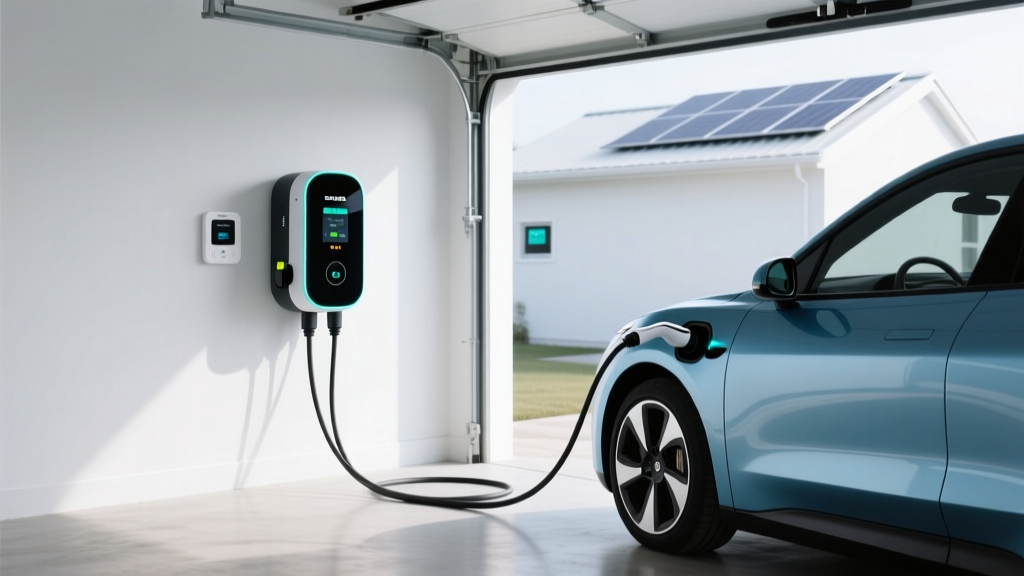
Level 2 home charging requires a garage, carport, or driveway with proximity to your electrical panel. If you park on the street or in a detached garage far from the panel, wire-run costs escalate quickly. Apartment and condo dwellers should check whether their building supports shared EVSE or whether a right-to-charge law applies in their state.
Cold-Weather Range Loss
In sub-freezing temperatures, EV batteries lose 15–30% of their EPA-rated range due to increased cabin heating demand and reduced chemical efficiency. A vehicle rated at 300 miles EPA may deliver 210–255 miles in winter conditions. A home Siemens charger mitigates this: you can precondition the battery and cabin while plugged in, warming the vehicle using grid power instead of battery power — preserving range for your commute.
Driving Patterns
If your daily driving is under 60 miles (the U.S. average is roughly 37 miles, per the FHWA), even the 32A VersiCharge replenishes a full day's driving in under two hours. For road-trip-heavy drivers, home charging handles daily needs while DC fast charging covers long-distance travel. The VersiCharge is not a DC fast charger — it's designed for overnight replenishment, not highway pit stops.
Common Misconceptions About Siemens EV Chargers
| Myth | Fact |
|---|---|
| "Siemens makes electric cars" | Siemens manufactures charging hardware and electrical components, not vehicles. |
| "I need the highest-amp charger for fastest charging" | Your EV's onboard charger is the bottleneck. A 7.7 kW onboard charger won't charge faster on a 48A/11.5 kW circuit. |
| "Any outlet works for EV charging" | Level 1 (120V) adds only 3–5 mi/hr. Level 2 requires a dedicated 240V circuit installed by an electrician. |
| "Home charging is more expensive than gas" | At $0.16/kWh, home charging costs ~$0.05/mi vs $0.12/mi for a 28 MPG gas car. |
| "The charger needs a Tesla connector" | As of 2025–2026, NACS is the standard for most new EVs. Siemens offers both J1772 and NACS options. |
Decision Framework: Which Siemens Charger (or Alternative) Is Right for You?
If → Then
- If your EV has a 7.7 kW onboard charger (e.g., base Chevy Equinox EV, some PHEVs) → the 32A VersiCharge is sufficient. Don't overspend on 48A.
- If your EV supports 11.5 kW AC charging (e.g., Ford F-150 Lightning, BMW iX, Tesla Model Y) → the 48A VersiCharge maximizes your charge speed.
- If your panel is 100A or fully loaded → budget for a panel upgrade ($1,500–$3,000) or consider a lower-amp charger on a smaller circuit.
- If you lack home charging access → a Siemens home unit isn't practical. Evaluate workplace charging, public Level 2 networks (ChargePoint, EVgo), or DC fast-charging proximity instead.
- If you want energy monitoring and load management → the 48A smart model with the Siemens app provides real-time kWh tracking and can coordinate with solar or TOU rate schedules.
- If you drive a Tesla → you can use a NACS-equipped VersiCharge directly, or use a J1772-to-NACS adapter. Tesla's Wall Connector remains a strong alternative at similar pricing.
Federal Tax Credits and Rebates for Home Charger Installation
The IRS §30D Clean Vehicle Credit applies to EV purchases, not chargers directly. However, the Alternative Fuel Vehicle Refueling Property Credit (IRS §30C) covers 30% of home charging equipment and installation costs — up to $1,000 — for qualifying taxpayers in eligible census tracts. As of 2026, eligibility depends on whether your residence is in a designated low-income or non-urban area. Consult the IRS §30C guidance or a tax professional before assuming eligibility.
Separately, many utilities offer instant rebates of $250–$500 for purchasing a smart Level 2 charger and enrolling in a demand-response or TOU program. Check your local utility's EV page before buying — some require pre-approval to qualify.
Frequently Asked Questions
Does Siemens make electric vehicles?
No. Siemens AG is an industrial technology company that produces EV charging hardware (the VersiCharge line), electrical panels, breakers, and grid infrastructure — but it does not manufacture cars. If you're shopping for an EV, look at automakers like Tesla, Hyundai, Ford, BMW, or Rivian.
What's the difference between kW and kWh on a charger?
kW (kilowatts) is the rate of charging — like the flow rate of a water hose. kWh (kilowatt-hours) is the amount of energy stored in your battery — like the size of the tank. A 11.5 kW charger delivers energy at that rate; a 75 kWh battery stores that total amount. Divide battery kWh by charger kW to estimate a full charge time (e.g., 75 kWh ÷ 11.5 kW ≈ 6.5 hours from empty).
Can I install a Siemens VersiCharge myself?
Hardwired Level 2 chargers require a dedicated 240V circuit, which must be installed by a licensed electrician to meet local electrical code and pass inspection. Plug-in models (NEMA 14-50) can be plugged into an existing 240V outlet if one is already installed — but the outlet and circuit must still be rated for continuous EV loads (typically 80% of breaker capacity). DIY electrical work on 240V circuits carries fire and insurance-liability risks.
Will a Siemens charger work with my Tesla?
Yes, if you select the NACS connector version or use a J1772-to-Tesla adapter (Tesla includes one with most vehicles). Since 2025, NACS has become the dominant connector standard in North America, and new Siemens VersiCharge models support it natively.
How long does it take to fully charge an EV on a Siemens Level 2 charger?
For a typical 75 kWh battery on the 48A/11.5 kW VersiCharge, a full 0–100% charge takes approximately 6.5–7 hours. Most owners arrive home with 30–50% remaining and wake up to a full charge in 4–5 hours. DC fast charging (150–350 kW) handles road trips, adding 10–80% in 18–30 minutes depending on the vehicle.