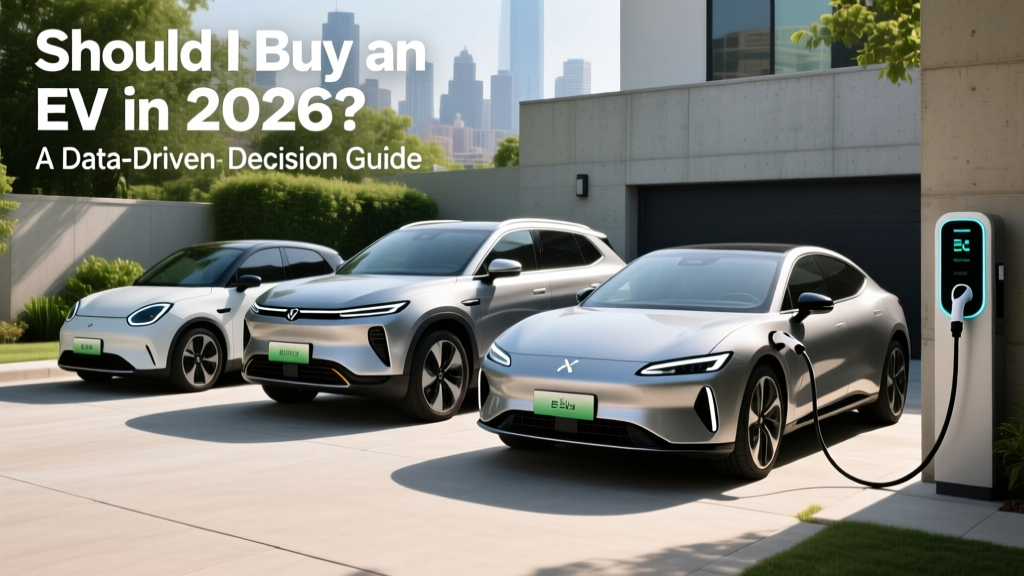
The Short Answer: Should I Buy an EV?
Yes, if you can charge at home (or work), drive under 300 miles daily, and qualify for the federal §30D tax credit — you'll likely save $4,000–$9,000 over five years vs. a comparable gas car. No, if you rely solely on public charging in a sparse network area, regularly tow heavy loads in winter, or need a sub-$25,000 vehicle today. Consider a PHEV instead if you want electric commuting without range limitations on road trips.
The decision to go electric isn't ideological — it's mathematical. This guide strips away the marketing hype and runs the real numbers on range, charging infrastructure, ownership costs, and tax incentives as they stand in 2026. Whether you're cross-shopping a Tesla Model 3 against a Toyota Camry or weighing a Hyundai Ioniq 5 against a RAV4 Hybrid, the data below will tell you which path saves money and which creates friction.
EV vs. Gas vs. Hybrid: The Efficiency Numbers
The most common comparison shoppers want is straightforward: how does the cost per mile stack up? Let's look at three representative 2026 vehicles across the powertrain spectrum — an EV, a conventional hybrid, and a gas-only baseline.
| Metric | 2026 Tesla Model 3 RWD | 2026 Toyota Camry Hybrid LE | 2026 Honda Accord 1.5T (Gas) |
|---|---|---|---|
| EPA Efficiency | 132 MPGe / 25 kWh/100mi | 51 MPG combined | 30 MPG combined |
| Energy Cost per Mile (home avg.) | $0.035–$0.045 | $0.055 | $0.115 |
| Annual Fuel/Energy (12,000 mi) | $420–$540 | $660 | $1,380 |
| 5-Year Energy Cost | $2,100–$2,700 | $3,300 | $6,900 |
| Base MSRP | $38,990 | $29,495 | $28,290 |
Energy costs based on U.S. average residential electricity at $0.16/kWh and regular gasoline at $3.45/gallon (early 2026). Source: fueleconomy.gov and EIA.
The EV's per-mile energy cost is roughly one-third that of a gas car — but only when charging at home on a standard utility rate. Public DC fast charging at $0.35–$0.55/kWh pushes EV energy costs to $0.07–$0.10 per mile, narrowing the advantage substantially. This is why home charging access is the single biggest variable in the buy/no-buy equation.
The Real Costs: Purchase, Charging, Maintenance, and Insurance
Sticker price is only the entry point. Here's a five-year total cost of ownership (TCO) comparison for the same three vehicles, assuming 12,000 miles annually, 60% home / 40% public charging for the EV, and the current federal tax credit landscape.
| Cost Category (5-Year) | Tesla Model 3 RWD | Camry Hybrid LE | Accord 1.5T Gas |
|---|---|---|---|
| Purchase Price (after incentives) | $31,490* | $29,495 | $28,290 |
| Energy/Fuel | $2,400 | $3,300 | $6,900 |
| Maintenance | $1,200 | $2,800 | $3,400 |
| Insurance (avg.) | $8,500 | $6,200 | $6,000 |
| Depreciation (est.) | $14,500 | $10,200 | $11,800 |
| 5-Year Total | $58,090 | $51,995 | $56,390 |
*Assumes $7,500 point-of-sale §30D credit applied. Eligibility requires buyer income ≤$150K single / $300K joint, vehicle MSRP ≤$55K (sedans), and compliant battery sourcing. Verify at irs.gov.
Three things jump off this table:
- Maintenance savings are real but modest. EVs skip oil changes, transmission fluid, and spark plugs. But tires wear faster (heavier vehicle, instant torque), and cabin filters still need replacement. Expect roughly $240/year in EV maintenance vs. $560–$680 for gas.
- Insurance is the hidden EV tax. Collision repairs on EVs cost more due to battery proximity, high-voltage safety protocols, and specialized parts. Expect premiums 20–35% higher than equivalent gas models. Shop quotes before buying.
- Depreciation is the wildcard. EV resale values have been volatile. The Tesla price wars of 2023–2024 cratered used values, but prices have stabilized. Hybrids currently hold value exceptionally well due to sustained demand.
Home Charging: The Make-or-Break Factor
Over 80% of EV charging happens at home. If you have a garage or driveway with access to a 240V outlet (or the ability to install one), an EV integrates seamlessly into daily life. If you're apartment-dwelling or street-parking, the calculus changes dramatically.
| Charging Level | Power (kW) | Miles Added/Hour | Typical Use Case | Install Cost |
|---|---|---|---|---|
| Level 1 (120V) | 1.2–1.9 kW | 3–5 mi/hr | Overnight top-up, PHEVs | $0 (standard outlet) |
| Level 2 (240V) | 7.2–11.5 kW | 25–44 mi/hr | Daily home charging | $500–$2,200 |
| DC Fast Charge | 50–350 kW | 150–1,000+ mi/hr | Road trips, quick stops | N/A (pay per kWh) |
A Level 2 home charger installation typically runs $500–$2,200 depending on panel proximity. If your electrical panel needs a 200-amp upgrade, add $1,500–$3,500. A licensed electrician should assess your panel capacity before purchase — don't assume your 100-amp service has headroom for a 48-amp charger.
Real-world charging math: A Tesla Model 3 with a ~60 kWh usable battery charging on an 11.5 kW Level 2 home charger (like a Tesla Wall Connector on a 60-amp circuit) will go from 20% to 100% in roughly 4.5 hours — easily overnight. At $0.16/kWh, a full charge costs about $9.60 for an EPA-estimated 363 miles of range.
Range Reality: EPA Stickers vs. What You'll Actually Get
The EPA range estimate is a useful baseline, but real-world range depends on speed, temperature, terrain, and climate control use. Here's what to expect from popular 2026 models:
| Vehicle | EPA Range | Highway (70 mph) | Cold Weather (30°F) | Battery (kWh / Chemistry) |
|---|---|---|---|---|
| Tesla Model 3 Long Range AWD | 363 mi | ~290–310 mi | ~250–280 mi | 79 kWh / NMC |
| Hyundai Ioniq 5 SEL AWD | 290 mi | ~235–255 mi | ~195–225 mi | 77.4 kWh / NMC |
| Chevrolet Equinox EV RS | 319 mi | ~260–280 mi | ~215–250 mi | 85 kWh / NMC |
| Ford F-150 Lightning Lariat | 320 mi | ~255–275 mi | ~210–245 mi | 131 kWh / NMC |
The cold-weather penalty is real and non-negotiable. Lithium-ion batteries lose efficiency in low temperatures, and cabin heating draws significant power (EVs lack waste heat from an engine). Expect 15–30% range loss in sustained freezing conditions. A heat pump — standard on most 2026 EVs — mitigates this by 5–10% compared to resistive heating.
For context, the average American drives 37 miles per day (FHWA data). Even with cold-weather degradation, nearly every current EV covers a week of commuting before needing a charge. Range anxiety is primarily a road-trip concern, not a daily one.
Federal Tax Credits and Incentives: The 2026 Rules
The §30D Clean Vehicle Credit offers up to $7,500 for qualifying new EVs and $4,000 for qualifying used EVs (up to 30% of sale price). But eligibility is a multi-layer filter:
- Buyer income cap: Modified AGI ≤$150,000 (single), $225,000 (head of household), or $300,000 (joint) — per IRS §30D guidelines.
- Vehicle MSRP cap: ≤$55,000 for sedans; ≤$80,000 for SUVs, vans, and trucks.
- Battery sourcing requirements: Increasing percentages of critical minerals and battery components must be sourced from the U.S. or free-trade-agreement partners. This disqualifies some models year to year.
- Point-of-sale transfer: As of 2024, you can transfer the credit to the dealer at purchase, reducing your out-of-pocket cost immediately rather than waiting for a tax refund.
- Commercial vehicle loophole (IRC §45W): Some buyers use a business entity to purchase vehicles that don't qualify under §30D — consult a tax professional.
Critical caveat: Battery sourcing rules tighten periodically. A model that qualifies in January may not qualify by July if its supply chain shifts. Always verify current eligibility on fueleconomy.gov's tax credit page before committing to a purchase.
Common EV Myths vs. Facts
| Myth | Fact (with Data) |
|---|---|
| "EV batteries need replacing every few years." | Federal law mandates 8-year/100,000-mile battery warranties. Real-world degradation data shows most EVs retain 85–92% of original capacity after 100,000 miles. Full replacements cost $8,000–$18,000 but are rarely needed within the first decade. |
| "The grid can't handle mass EV adoption." | Most EV charging occurs overnight during off-peak hours. A single EV adds roughly the equivalent of one central AC unit to household load. Managed charging and V2G are scaling to handle growth. |
| "EVs are worse for the environment because of mining." | Lifecycle analyses consistently show EVs produce 50–70% fewer emissions over their lifetime than gas cars, even accounting for battery manufacturing. The gap widens as grids decarbonize (EPA lifecycle data). |
| "Charging takes too long on road trips." | Modern EVs with 250+ kW peak charge rates add 150–200 miles in 15 minutes (10–80%). Combined with rest stops and meals, the time penalty on a 400-mile trip is roughly 25–40 minutes total. |
| "I can't take an EV on a road trip." | Tesla's Supercharger network has 6,000+ U.S. stations. Electrify America, EVgo, and ChargePoint collectively cover major interstates. Route planners like A Better Routeplanner auto-calculate stops. |
Your Decision Framework: Which Path Fits Your Life?
Choose a Battery EV (BEV) if:
- You have reliable Level 2 home or workplace charging
- Your daily driving is under 80 miles round-trip
- You qualify for the §30D tax credit (reducing effective purchase price by up to $7,500)
- You want the lowest per-mile energy cost and minimal maintenance
- You take road trips 2–4 times a year and can plan charging stops
Choose a Plug-in Hybrid (PHEV) if:
- You want electric-only commuting (25–45 miles) but gas flexibility for longer trips
- Home charging is possible but you lack reliable public charging for road trips
- You live in a region with extreme cold where EV range loss is punishing
- You regularly tow or haul heavy loads
- You want to avoid range planning entirely
Choose a Standard Hybrid (HEV) if:
- You have zero charging access (apartment, street parking, no workplace charger)
- You want better fuel economy with no behavior change
- Your budget is under $30,000 and you can't wait for incentives
- You drive high annual miles (20,000+) where hybrid MPG savings compound quickly
Stick with Gas (for now) if:
- You drive fewer than 5,000 miles per year (savings won't offset higher EV purchase price)
- You're buying a specialty/enthusiast vehicle with no electrified equivalent
- Your local electricity rates exceed $0.30/kWh with no off-peak discount
What First-Time EV Buyers Must Know Before Signing
- Test the actual charging ecosystem, not just the car. Download the Electrify America, EVgo, and ChargePoint apps. Map your regular routes and check charger density. A 350-kW charger is useless if it's always broken or occupied.
- Understand the charge curve. Peak charge rates (e.g., "250 kW") are sustained only between roughly 10–40% State of Charge. Above 80%, charging slows dramatically to protect the battery. Plan road-trip stops around the 10–80% window for the fastest sessions.
- Precondition before fast charging. Most EVs let you set a navigation destination to a charger, which warms the battery for faster charging. Skip this step in cold weather and your 250-kW charger might deliver only 80 kW.
- Get insurance quotes before purchasing. EV insurance varies wildly by model and insurer. A Model Y might cost $1,800/year with one carrier and $3,100 with another. Always compare before signing a purchase agreement.
- Check your electrical panel before ordering a home charger. A 200-amp panel with existing heavy loads (electric oven, dryer, HVAC) may not support a 48-amp EV charger without an upgrade. Budget $1,500–$3,500 for a panel upgrade if needed.
- Verify tax credit eligibility for the exact VIN. The dealer should confirm §30D eligibility at point of sale. Get it in writing. If the IRS later determines the vehicle didn't qualify, the credit may be recaptured from you.
Frequently Asked Questions
Is an EV cheaper than a gas car over 5 years?
It depends on the model, your electricity rate, and tax credit eligibility. A Tesla Model 3 with the $7,500 credit and home charging can break even or beat a comparable gas sedan within 3–4 years. Without the credit or with expensive public-only charging, the EV may cost $3,000–$5,000 more over five years due to higher purchase price and insurance.
What happens if I run out of charge on the road?
The same thing that happens if you run out of gas — you're stranded until help arrives. But EVs give extensive low-battery warnings, and navigation systems route you through chargers. Roadside assistance (often included for 3–5 years) can provide a tow to the nearest charger. Running out is almost always a planning failure, not a technology failure.
How long do EV batteries actually last?
Data from Tesla's 2024 impact report shows Model 3/Y batteries retain approximately 85% of original capacity after 150,000 miles. Hyundai, GM, and Ford all warranty their EV batteries for 8 years/100,000 miles with a capacity retention threshold of 70%. LFP-chemistry batteries (used in base Model 3 and some others) show even slower degradation. Expect 15–20 years of usable life for most EV batteries.
Can I charge an EV with solar panels?
Yes, and this is one of the most cost-effective EV ownership models. A 10-kW residential solar system producing ~14,000 kWh/year can power roughly 50,000+ miles of EV driving annually at an effective cost of $0.02–$0.04/kWh after the system pays for itself.
Should I wait for solid-state batteries?
Solid-state batteries promise higher energy density and faster charging, but they remain in limited production for 2026 and won't reach mainstream affordability until approximately 2029–2031. If you need a vehicle now, current lithium-ion technology is mature, well-warrantied, and proven. Waiting for the next breakthrough is a moving target that never arrives.