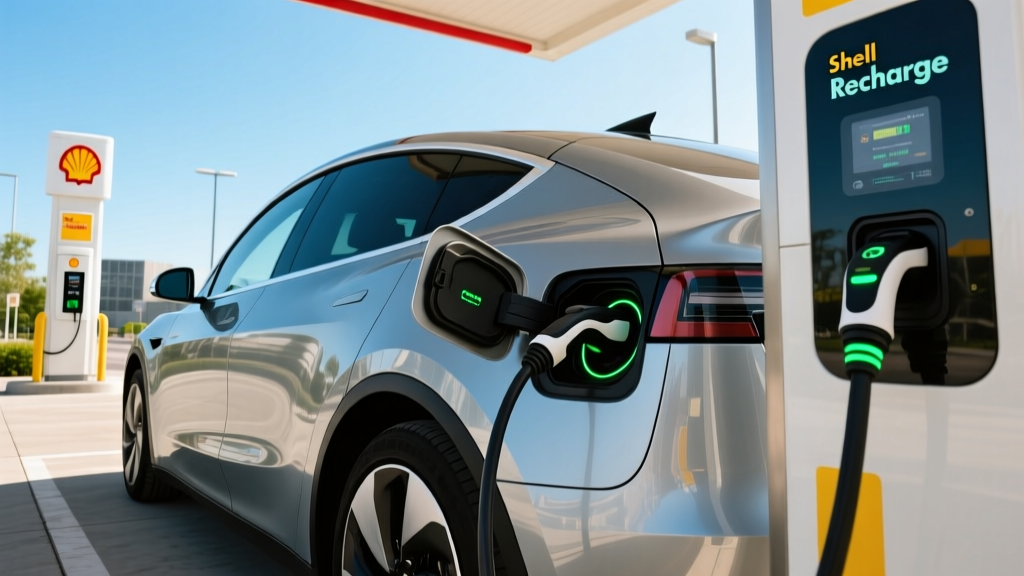
Quick Answer: Shell EV charging — branded as Shell Recharge — operates roughly 120+ DC fast-charging stations and thousands of Level 2 destination chargers across the U.S. as of early 2026. DC fast chargers peak between 50 kW and 180 kW depending on location, with pricing averaging $0.39–$0.55 per kWh in most markets. Shell Recharge is a viable supplemental public charging option, especially along highway corridors and at Shell gas station conversions, but it does not yet rival Electrify America or Tesla Supercharger in station density or peak charge speeds. For daily use, home Level 2 charging remains far cheaper at roughly $0.12–$0.18/kWh depending on your utility.
What Is Shell Recharge and How Does It Work?
Shell has been steadily converting portions of its legacy gas station footprint and building new dedicated EV charging plazas under the Shell Recharge brand. The network includes a mix of:
- DC fast chargers (DCFC): Typically 50 kW to 180 kW units, with a growing number of 350 kW-capable stalls at newer plaza locations
- Level 2 chargers: 7.2 kW to 19.2 kW units at retail locations, parking garages, and fleet depots
- Shell Fleet Solutions: Dedicated commercial charging for delivery and ride-hail fleets
Shell entered the U.S. charging market largely through its acquisition of Greenlots (rebranded to Shell Recharge Solutions) and has since expanded through partnerships with automakers and site hosts. The chargers use the standard CCS1 connector for DC fast charging and J1772 for Level 2. As of 2026, Shell Recharge locations with NACS (Tesla-compatible) connectors remain limited — Tesla owners should verify connector availability in the Shell Recharge app before routing to a station.
Access is handled through the Shell Recharge app, an RFID card, or contactless credit card payment at the terminal. Pricing is displayed per-kWh in states that allow it, or per-minute in states where per-kWh retail electricity sales are restricted (a shrinking but still relevant list that includes parts of the Southeast and Midwest).
Shell Recharge Pricing: What You'll Actually Pay
Public DC fast charging is significantly more expensive than home charging — this is true across every network, and Shell Recharge is no exception. Here's what the numbers look like in practice:
| Charging Method | Typical Cost/kWh | Cost to Add 200 Miles* | Time Required |
|---|---|---|---|
| Home Level 2 (utility rate avg.) | $0.13–$0.18 | $7.80–$10.80 | 6–10 hours (overnight) |
| Shell Recharge DCFC (avg.) | $0.39–$0.55 | $23.40–$33.00 | 20–45 minutes |
| Electrify America DCFC (avg.) | $0.43–$0.56 | $25.80–$33.60 | 18–40 minutes |
| Tesla Supercharger V3/V4 (avg.) | $0.28–$0.40 | $16.80–$24.00 | 15–30 minutes |
| Gas car (28 MPG, $3.20/gal) | $0.11/mile equiv. | $22.86 | 5–8 minutes |
*Based on a vehicle averaging 3.0 mi/kWh (roughly 100 MPGe combined), such as a Hyundai Ioniq 5 or Tesla Model Y. Actual costs vary by vehicle efficiency, state electricity rates, and idle fees.
A few important pricing notes from real-world use:
- Idle fees: Shell Recharge imposes idle fees (typically $0.20–$0.40/minute) if your vehicle remains plugged in after reaching its charge limit or 80% SoC. Move your car promptly.
- Membership plans: Shell occasionally offers subscription pricing (e.g., $4.99/month for a reduced per-kWh rate). If you use Shell Recharge more than twice a month, the math usually favors the subscription.
- Per-minute billing states: In states that prohibit per-kWh retail electricity sales, you're billed by the minute. This penalizes vehicles with slower charge acceptance — a 50 kW session on a vehicle that can accept 150 kW means you're paying for time without getting full power.
Charging Speeds: Peak kW vs. Sustained Reality
This is where understanding the difference between kW (power — the rate of charging) and kWh (energy — the battery capacity) matters enormously. A charger rated for 180 kW peak does not deliver 180 kW for your entire session. The charge curve tapers as your battery's state of charge (SoC) rises, and thermal management plays a major role.
At Shell Recharge DCFC locations, here's what to expect in practice:
- 50 kW stations (older/legacy): Expect roughly 25–35 miles of range added per 10 minutes in a midsize crossover. A 10–80% charge on a 77 kWh battery (e.g., VW ID.4) takes approximately 55–70 minutes.
- 150–180 kW stations (most common current Shell Recharge DCFC): A vehicle capable of accepting this rate (like the Ioniq 5 or Kia EV6 with 800V architecture) can add 10–80% in roughly 20–28 minutes. Vehicles limited to ~100–120 kW peak (older Bolt EV, base Model 3 RWD) will see 10–80% in 30–40 minutes.
- 350 kW stations (newer plazas, limited availability): Only vehicles with 800V+ architectures and high charge acceptance (Lucid Air, Porsche Taycan, Ioniq 5 N) will meaningfully benefit. Most mainstream EVs will still peak at their vehicle-side limit regardless of charger capacity.
Real-world tip: Always precondition your battery before arriving at a DC fast charger. Most EVs do this automatically when you navigate to a charging station in the built-in nav system. Cold batteries (below ~50°F / 10°C) can see charge acceptance cut by 30–50% without preconditioning, turning a 25-minute stop into a 45-minute stop.
Shell Recharge vs. Competitors: Network Comparison
| Feature | Shell Recharge | Electrify America | Tesla Supercharger | EVgo |
|---|---|---|---|---|
| U.S. DCFC Stations (approx.) | 120+ | 900+ | 2,000+ | 1,100+ |
| Peak DCFC Speed | Up to 350 kW | Up to 350 kW | Up to 350 kW (V4) | Up to 350 kW |
| Typical Avg. Price/kWh | $0.39–$0.55 | $0.43–$0.56 | $0.28–$0.40 | $0.35–$0.50 |
| Connector Types | CCS1, limited NACS | CCS1, CHAdeMO, NACS | NACS (CCS via adapter) | CCS1, CHAdeMO, NACS |
| Reliability (user-reported uptime) | Moderate (~85–90%) | Improved (~88–92%) | High (~95–98%) | Moderate (~85–90%) |
| App Quality | Functional, basic | Good, real-time status | Excellent | Good |
Station counts and uptime figures are approximate as of Q1 2026 based on network disclosures and third-party aggregators. Actual availability varies by region.
The honest assessment: Shell Recharge is a secondary or supplemental network for most EV owners. It works best when a Shell Recharge station happens to be on your route or near your regular stops (especially if you already frequent Shell gas stations for convenience store access). It does not have the density to serve as a primary road-trip network the way Tesla Superchargers or Electrify America can in most regions.
Real-World Ownership: Should You Rely on Shell Recharge?
Whether Shell Recharge fits into your EV ownership experience depends heavily on your specific situation:
If you have reliable home Level 2 charging: Shell Recharge is a convenient backup for occasional road trips or when you need a quick top-up away from home. You'll do 85–95% of your charging at home for $0.13–$0.18/kWh, making public charging costs largely irrelevant to your daily budget.
If you rely primarily on public charging (apartment/condo living): You need a network-dense strategy. Shell Recharge alone won't suffice — combine it with Electrify America, EVgo, and any local utility or municipal chargers. Your effective per-kWh cost will be $0.35–$0.55, which can erode or eliminate the fuel-cost advantage over a gas car or hybrid. In this scenario, a PHEV like the Toyota RAV4 Prime (42 miles electric-only, 38 MPG combined on gas) may be a more practical choice than a full BEV.
If you road-trip frequently (300+ mile trips monthly): Prioritize vehicles with Tesla Supercharger access (all new Tesla models, plus Ford, GM, Rivian, and others via NACS adapter in 2026). Use Shell Recharge as a supplementary option when it aligns with your route, but don't plan trips around it exclusively.
If you live in a region with extreme cold (sub-20°F winters): Expect 20–35% EPA range loss and significantly slower DC fast charging unless your vehicle has an active battery thermal management system with preconditioning. Shell Recharge's 50 kW legacy stations will feel painfully slow in winter — seek out 150 kW+ stations and precondition aggressively.
Common Misconceptions About Shell EV Charging
| Myth | Fact |
|---|---|
| "Shell chargers are as fast as Tesla Superchargers" | Most Shell Recharge DCFC stations peak at 50–180 kW. Tesla V3 Superchargers consistently deliver 250 kW peak, and V4 sites reach 350 kW. Your vehicle's charge acceptance also determines actual speed. |
| "Public charging is always cheaper than gas" | At $0.45/kWh and 3.0 mi/kWh efficiency, you're paying ~$0.15/mile — comparable to a 22 MPG gas car at $3.30/gallon. Home charging is where the real savings live. |
| "I can use any Shell charger with my Tesla" | Most Shell Recharge DCFC stations use CCS1 connectors. Tesla vehicles need a NACS-to-CCS adapter (or a station with native NACS cables). Verify connector type in the app before driving there. |
| "The charger will automatically stop at 80%" | Some Shell Recharge stations allow you to set a charge limit in the app, but not all. Set your vehicle's internal charge limit to 80% to avoid idle fees and preserve battery health on DCFC. |
| "Shell Recharge is free because Shell is an oil company" | Shell Recharge is a paid, for-profit network. Pricing is competitive with Electrify America and EVgo, though generally higher than Tesla Superchargers. |
The Bottom Line: Where Shell Recharge Fits in 2026
Shell Recharge is a legitimate and growing public charging network, but it occupies a specific niche. It's best understood as a convenience-layer supplement to the larger Tesla Supercharger and Electrify America networks — useful when a Shell station is already on your route or when you want to combine charging with a gas station convenience stop.
For EV buyers evaluating whether Shell Recharge's presence should influence a purchase decision: it shouldn't, at least not significantly. The factors that matter far more are your home charging access, your vehicle's charge acceptance rate, and whether you have access to the Tesla Supercharger network (now open to most major brands via NACS adoption). Shell Recharge is one tool in a broader public-charging toolkit, not a deciding factor.
If Shell continues to deploy 350 kW hardware at scale and expand NACS connector availability through 2026 and 2027, its utility for mainstream EV owners will grow. Until then, download the Shell Recharge app, check coverage along your common routes, and keep it as a backup option alongside your primary charging apps.
Is Shell Recharge cheaper than Electrify America?
Pricing is comparable and varies by location. In most markets, Shell Recharge averages $0.39–$0.55/kWh while Electrify America averages $0.43–$0.56/kWh. Neither consistently undercuts the other — check the app for the specific station you plan to visit. Both are typically more expensive than Tesla Superchargers.
Can I charge my Tesla at a Shell Recharge station?
It depends on the connector. Most Shell Recharge DCFC stations have CCS1 connectors. If your Tesla has a NACS charge port (all Tesla vehicles), you'll need a CCS-to-NACS adapter unless that specific Shell location offers native NACS cables. Check the Shell Recharge app for connector details before routing there.
Does Shell Recharge offer Level 2 charging?
Yes. Shell Recharge operates Level 2 stations (7.2–19.2 kW) at various retail, workplace, and parking locations. Level 2 adds roughly 20–50 miles of range per hour depending on your vehicle's onboard charger. These are useful for destination charging but too slow for road-trip use.
Is public DC fast charging bad for my EV battery?
Occasional DC fast charging is fine — modern battery management systems handle it well. However, exclusive reliance on DCFC (never using Level 2) can accelerate degradation by a few percentage points over the battery's lifetime. Most manufacturers warranty their batteries for 8 years/100,000 miles with a minimum 70% capacity retention threshold. For long-term battery health, favor home Level 2 charging and limit DCFC to road trips or when needed.
How do I find Shell Recharge stations?
Download the Shell Recharge app (iOS/Android), which shows real-time station status, pricing, and connector types. Shell Recharge stations also appear in aggregator apps like PlugShare, ChargeHub, and most vehicle built-in navigation systems. You can also visit the Shell Recharge website for a station locator.
Sources: Shell Recharge official site, fueleconomy.gov for vehicle efficiency data, Alternative Fuels Data Center (AFDC) for station counts.