Families shopping for a seven seater Tesla in 2026 face a choice between two very different vehicles: the flagship Tesla Model X with its standard three-row layout and falcon-wing rear doors, and the Tesla Model Y with its optional third-row seat. Both seat up to seven, but they diverge sharply on price, range, charging speed, and everyday practicality. This review breaks down the exact specs, real-world range expectations, charging curves, and total ownership costs to help you decide which Tesla SUV actually fits your household.
Which Tesla Offers a Seven-Seat Configuration?
Tesla sells two production models with seven-passenger seating as of the 2026 model year:
- Tesla Model X — Standard 5-seat, optional 6-seat, and optional 7-seat configurations across Long Range and Plaid trims. The third row is included with the 7-seat option at no additional charge on current order pages.
- Tesla Model Y — Standard 5-seat layout; 7-seat option available exclusively on the Long Range AWD trim for an additional $2,500. Not offered on the base RWD or Performance trims.
The Model X is a large, purpose-built three-row SUV. The Model Y is a compact/midsize crossover with a small, best-for-kids third row. That distinction drives everything from cargo room to highway efficiency.
Spec-by-Spec: Model X vs Model Y Seven Seater
| Spec | Model X Long Range (7-seat) | Model X Plaid (7-seat) | Model Y LR AWD (7-seat) |
|---|---|---|---|
| EPA Range | 335 mi | 311 mi | 303 mi |
| Battery (usable, est.) | ~100 kWh (NMC) | ~100 kWh (NMC) | ~75 kWh (NMC) |
| Drivetrain | Dual-Motor AWD | Tri-Motor AWD | Dual-Motor AWD |
| Horsepower | 670 hp | 1,020 hp | 384 hp |
| 0–60 mph | 3.8 sec | 2.5 sec | 4.8 sec |
| Peak DC Fast Charge | 250 kW | 250 kW | 250 kW |
| 10–80% DC Time | ~30 min | ~30 min | ~27 min |
| Level 2 Home Charge | 11.5 kW (~34 mi/hr) | 11.5 kW (~34 mi/hr) | 11.5 kW (~37 mi/hr) |
| MPGe (combined) | 98 MPGe | 95 MPGe | 117 MPGe |
| Efficiency (kWh/100 mi) | 34 | 35 | 29 |
| Cargo (behind 3rd row) | ~15 cu ft | ~15 cu ft | ~10.6 cu ft |
| Cargo (3rd row folded) | ~44 cu ft | ~44 cu ft | ~30.2 cu ft |
| Cargo (max, all rows folded) | ~85 cu ft | ~85 cu ft | ~72.1 cu ft |
| 3rd-Row Legroom | ~32.7 in | ~32.7 in | ~26.5 in |
| Towing Capacity | 5,000 lbs | 5,000 lbs | 3,500 lbs |
| Base MSRP | $81,630 | $96,630 | $50,130 (+$2,500 7-seat) |
| Battery/Drive Unit Warranty | 8 yr / 150,000 mi | 8 yr / 150,000 mi | 8 yr / 120,000 mi |
Sources: fueleconomy.gov, Tesla.com order configurator (2026 model year). Range and efficiency figures are EPA estimates for 7-seat equipped vehicles.
Real-World Range: What to Expect Beyond the EPA Sticker
Model X Long Range: EPA 335 mi. Expect ~280–300 mi on highway road trips at 70–75 mph; ~230–260 mi in freezing temperatures with cabin heat.
Model X Plaid: EPA 311 mi. Expect ~255–280 mi highway; ~210–240 mi in cold weather.
Model Y Long Range AWD (7-seat): EPA 303 mi. Expect ~255–275 mi highway; ~215–240 mi in cold weather.
All figures assume a full seven-passenger load with cargo, which increases energy consumption by roughly 5–8% compared to a solo driver.
Tesla's large 100-class kWh battery in the Model X gives it a meaningful highway buffer over the Model Y. However, the Model X's heavier curb weight (~5,100–5,400 lbs depending on trim) and taller frontal area hurt efficiency. The Model Y's lower mass and more aerodynamic crossover profile translate into better kWh/100mi numbers, even though its smaller battery limits total range.
Cold weather hits both models hard. Tesla's heat pump (standard on all current models) mitigates some cabin-heating energy draw, but battery chemistry limits still reduce usable capacity by 15–25% in sub-freezing conditions. Preconditioning the battery while plugged in helps preserve range and enables faster DC charging.
Charging Speed: DC Fast Charging and Home Level 2
Both seven seater Tesla models peak at 250 kW on DC fast chargers using the native NACS (North American Charging Standard) connector. That gives them access to the full Tesla Supercharger network — over 25,000 stalls in North America — without an adapter. Through 2026, Tesla has also begun opening select Superchargers to other brands, but Tesla owners still benefit from seamless plug-and-charge integration and built-in route preconditioning.
| Charging Level | Model X Long Range | Model Y LR AWD (7-seat) |
|---|---|---|
| Level 1 (120V / 12A) | ~3 mi/hr | ~3 mi/hr |
| Level 2 (240V / 48A) | 11.5 kW / ~34 mi/hr | 11.5 kW / ~37 mi/hr |
| DC Fast (peak kW) | 250 kW | 250 kW |
| DC 10–80% time | ~30 min | ~27 min |
| DC 10–80% miles added | ~235 mi | ~212 mi |
Charging-curve reality: Neither vehicle sustains 250 kW for the full session. Peak rates occur between roughly 10–30% state of charge (SoC), then taper progressively. By 60% SoC, expect ~120–150 kW; above 80%, speeds drop sharply to protect battery longevity. This is why the 10–80% metric matters more than peak kW alone.
For home Level 2 charging, both models support up to 48 amps on a 60-amp dedicated circuit using the Tesla Wall Connector. That delivers roughly 34–37 miles of range per hour of charging — enough to fully replenish either vehicle overnight. Installation typically costs $800–$2,000 depending on panel proximity and whether a 200-amp service upgrade is needed (see our Level 2 install cost guide for a full breakdown).
Pricing, Trims, and Federal Tax Credit Eligibility
Here is where the two seven seater Tesla options diverge most dramatically:
| Model X Long Range | Model X Plaid | Model Y LR AWD (7-seat) | |
|---|---|---|---|
| Base MSRP (7-seat) | $81,630 | $96,630 | $52,630 |
| As-tested (typical options) | $85,000–$90,000 | $100,000–$108,000 | $54,000–$57,000 |
| Federal §30D Credit | $0 (exceeds MSRP cap) | $0 (exceeds MSRP cap) | Up to $7,500* |
| Effective price after credit | $81,630+ | $96,630+ | From ~$45,130* |
*Federal tax credit caveats: Under IRS §30D rules current for 2026, the Model Y Long Range AWD may qualify for up to $7,500 in federal tax credits, but eligibility depends on multiple conditions:
- MSRP cap: SUVs must have an MSRP at or below $80,000 — the Model Y easily clears this.
- Buyer income cap: Modified adjusted gross income (MAGI) must not exceed $150,000 (single), $225,000 (head of household), or $300,000 (married filing jointly).
- Battery sourcing: A portion of the credit depends on critical-mineral and battery-component sourcing requirements that phase in progressively. The exact credit amount ($3,750 or $7,500) depends on whether the vehicle meets both sourcing thresholds for the given model year.
- Point-of-sale transfer: Buyers can elect to transfer the credit to the dealer at purchase, reducing the purchase price directly rather than waiting for a tax refund.
The Model X in any trim exceeds the $80,000 SUV MSRP cap and is ineligible for the §30D new-vehicle credit. Always verify current eligibility on IRS.gov and consult a tax professional before relying on credit amounts.
Interior Space, Cargo, and Family Practicality
The seven-seat experience differs enormously between these two vehicles.
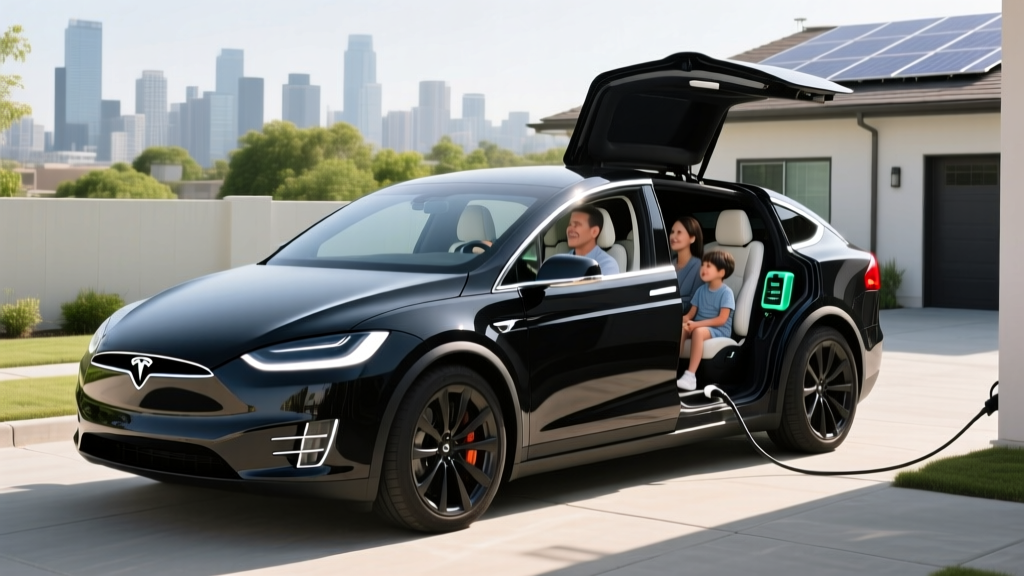
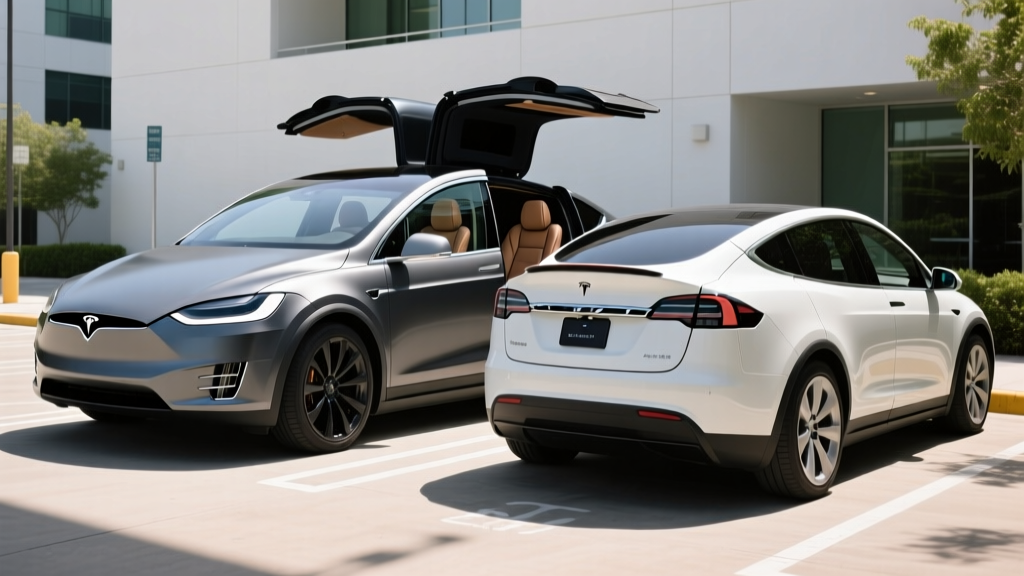
Model X: The third row accommodates adults for short trips and older children comfortably on longer drives, with ~32.7 inches of legroom. The falcon-wing rear doors open upward, making it dramatically easier to load car seats and buckle children in tight parking spaces. With all three rows in use, you still get roughly 15 cubic feet of rear cargo — enough for a week's groceries or a couple of carry-on bags. Fold the third row and cargo expands to ~44 cu ft; fold everything for up to ~85 cu ft.
Model Y (7-seat): The third row is strictly for small children — legroom is approximately 26.5 inches, and the seat cushion sits low to the floor. Teenagers and adults will not tolerate it beyond a short errand. With all rows up, cargo space shrinks to just ~10.6 cu ft, which is tight for a family road trip. Fold the third row and you recover ~30.2 cu ft; maximum cargo with both rear rows flat is ~72.1 cu ft.
The bottom line on space: If your third row will carry children regularly and you need cargo room simultaneously, the Model X is the only Tesla that genuinely delivers. The Model Y 7-seat option works best as an occasional-use jump seat for young kids on short drives.
Performance, Ride Quality, and Driver Assistance
Both Teslas deliver instant electric torque and smooth single-speed acceleration, but their performance envelopes are worlds apart.
The Model X Plaid with its tri-motor powertrain produces 1,020 horsepower and hits 60 mph in 2.5 seconds — absurdly quick for a 5,400-pound family SUV. The Long Range dual-motor variant still manages 3.8 seconds. Air suspension is standard, providing a comfortable ride and adjustable ground clearance (useful for steep driveways and light off-pavement). Towing capacity reaches 5,000 pounds.
The Model Y Long Range produces 384 horsepower and reaches 60 mph in 4.8 seconds — plenty quick for daily driving. It uses conventional coil springs, and the ride is firmer than the Model X, especially over rough pavement. Towing is limited to 3,500 pounds.
All Tesla vehicles equipped with Autopilot or Full Self-Driving (Supervised) operate at SAE Level 2. The driver must remain fully attentive, hands on or near the wheel, and ready to take over at any moment. This is not self-driving. FSD (Supervised) adds capabilities like city-street navigation and traffic-light recognition, but it does not eliminate the driver's legal and practical responsibility. Only Level 4 robotaxi services (e.g., Waymo) operate without a human driver in defined zones.
Tesla's infotainment system remains one of the strongest in the EV space — a responsive 17-inch (Model X) or 15-inch (Model Y) center touchscreen handles navigation, media, vehicle settings, and gaming. Over-the-air updates add features regularly. Notable drawbacks: no Apple CarPlay or Android Auto, no physical instrument cluster (speed and navigation appear on the center screen or, in the Model X, a small secondary driver display), and Tesla's reliance on touchscreen controls for nearly every function.
Pros and Cons at a Glance
Pros
- Access to the Tesla Supercharger network — the most reliable DC fast-charging infrastructure in North America
- Strong EPA range (303–335 mi) across both models
- Class-leading performance, especially Model X Plaid
- Over-the-air software updates continuously add features
- Falcon-wing doors on Model X genuinely improve child-seat loading
- Model Y 7-seat starts under $53,000 before potential credits
Cons
- Model Y third row is too small for adults and eats cargo space
- Model X is ineligible for the federal §30D tax credit (MSRP cap)
- No Apple CarPlay or Android Auto in either model
- Model X pricing starts above $81,000 — steep for a family hauler
- Both models peak at 250 kW DC — some newer competitors charge at 350 kW
- Insurance premiums tend to run higher than comparable non-Tesla SUVs
Who Should Buy a Seven Seater Tesla?
Choose the Model X Long Range if: You need a genuine three-row SUV with adult-usable rear seats, meaningful cargo space with all rows up, air suspension comfort, 5,000-lb towing, and budget is not the primary constraint. Best for larger families, frequent road trippers, and those who regularly carry more than five passengers.
Choose the Model Y Long Range AWD (7-seat) if: You primarily need a five-seat crossover with an occasional emergency third row for small children, you want the lowest entry price in a Tesla SUV, and you want to potentially capture the $7,500 federal tax credit. Best for smaller families, commuters, and buyers who only need the extra seats a few times a month.
Look at competitors if: You need 350+ kW charging (Hyundai Ioniq 9, Kia EV9), a usable third row under $50K (Kia EV9), or Apple CarPlay integration (nearly every non-Tesla rival).
How Does It Compare to Non-Tesla 7-Seat EVs?
The Tesla duopoly on seven-seat EVs is ending. The Kia EV9 (EPA ~279–304 mi, starting ~$56,000) offers a genuinely usable third row with more cargo room than the Model Y, 350 kW peak DC charging capability, and a lower starting price than the Model X. The Hyundai Ioniq 9 (2026 model year) targets a similar space with an expected ~300+ mi range and 800V architecture for faster charging.
Where Tesla retains an edge: the Supercharger network remains unmatched for cross-country reliability, Tesla's software and OTA update cadence lead the industry, and the Model X Plaid has no performance rival in the three-row EV segment. But if charging speed and third-row comfort are your top priorities, the competition is now credible.
Frequently Asked Questions
What is the real-world range of a seven seater Tesla?
The Model X Long Range delivers an EPA-estimated 335 miles, but real-world highway driving with a full passenger load typically yields 280–300 miles. The Model Y 7-seat achieves 303 miles EPA, with ~255–275 miles in real-world highway use. Cold weather (below freezing) reduces both figures by 15–25%.
How fast does a seven seater Tesla charge?
Both models peak at 250 kW on DC fast chargers, adding 10–80% in roughly 27–30 minutes. On a home Level 2 charger (48A / 11.5 kW), expect ~34–37 miles of range per hour, fully replenishing the battery overnight in 8–10 hours.
Does the seven seater Tesla qualify for the federal EV tax credit?
The Model Y Long Range AWD (7-seat, ~$52,630 MSRP) may qualify for up to $7,500 under IRS §30D, subject to buyer income limits, battery-sourcing requirements, and the $80,000 SUV MSRP cap. The Model X exceeds the MSRP cap in all trims and does not qualify for the new-vehicle credit. Always verify on IRS.gov.
Is the Model Y third row worth it?
Only if your third-row passengers are small children and the seat will be used occasionally. With ~26.5 inches of legroom and a low seat cushion, it is not comfortable for adults or teens. Cargo space with all rows up is just ~10.6 cu ft. For regular seven-passenger duty, the Model X or a competitor like the Kia EV9 is a far better choice.
Is a seven seater Tesla worth buying vs. competitors?
The Model X is worth it if you value Supercharger access, air suspension, 5,000-lb towing, and falcon-wing door convenience — and can absorb the $80,000+ price without a tax credit. The Model Y 7-seat is worth it if you want an efficient, well-priced Tesla with occasional extra seating. However, if third-row comfort and faster charging matter more than the Tesla ecosystem, the Kia EV9 and Hyundai Ioniq 9 are strong alternatives.
What is the battery warranty on a seven seater Tesla?
The Model X carries an 8-year/150,000-mile battery and drive unit warranty. The Model Y carries an 8-year/120,000-mile battery and drive unit warranty. Both warranties guarantee a minimum of 70% battery capacity retention over the coverage period. See Tesla's warranty documentation for full terms.