The Short Answer on the Scout Terra EV
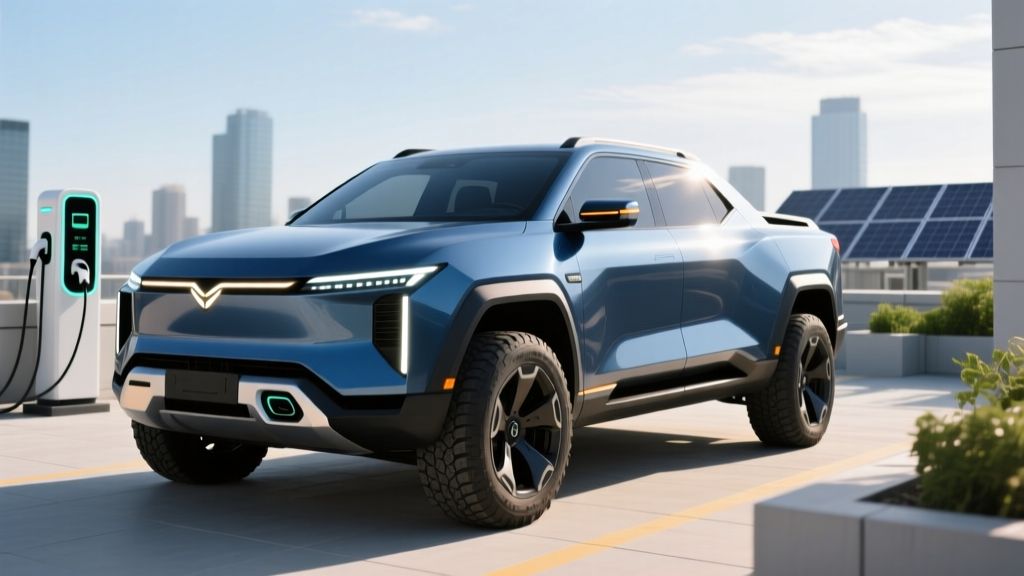
The Scout Terra is an all-electric pickup built by Volkswagen Group's revived Scout Motors brand, entering production in late 2027 as a 2028 model-year vehicle. Target specs include a 350+ mile EPA-estimated range, a ~150 kWh battery pack, 800-volt architecture supporting DC fast charging above 300 kW, and a starting MSRP near $60,000 before incentives. It is designed as a body-on-frame truck with off-road capability, a 10,000-lb towing target, and a range-extender (EREV) variant planned for later. If you need a truck today, the Rivian R1T, Ford F-150 Lightning, or Chevrolet Silverado EV are available now; if you can wait and want a rugged, long-range electric workhorse from a new brand, the Terra is worth tracking.
What Is the Scout Terra and Who Is It For?
Scout Motors, backed by Volkswagen Group, announced two vehicles in October 2024: the Traveler SUV and the Terra pickup truck. The Terra targets the full-size electric truck segment — think F-150 Lightning and Rivian R1T territory — but leans harder into traditional truck architecture. Scout confirmed a separate body-on-frame chassis (not a unibody skateboard), solid rear axle, and mechanical 4WD system with locking differentials. This is a deliberate contrast to the R1T's independent suspension and skateboard platform.
The Terra is aimed at buyers who:
- Want a traditional truck layout with serious off-road and towing capability
- Need 300+ miles of range for job-site commutes or rural driving
- Are open to a new brand with VW Group backing and parts infrastructure
- Prefer the option of a range-extender powertrain for remote work or towing
Scout is taking fully refundable $100 reservations, with production slated for its new Blythewood, South Carolina factory. First deliveries are expected in 2028.
Scout Terra EV Specs: Range, Battery, Charging & Performance
Scout has released preliminary specifications. Final EPA-certified numbers will come closer to production. Here is what we know and what the engineering targets suggest:
| Specification | Target / Announced |
|---|---|
| EPA Range (BEV) | 350+ miles (estimated) |
| Battery Capacity | ~150 kWh usable (NMC chemistry expected) |
| Battery Architecture | 800V nominal |
| DC Fast Charge (Peak) | 300+ kW |
| 10–80% Charge Time | ~20–25 minutes (estimated at 350 kW station) |
| Level 2 AC Charging | 11.5 kW onboard charger (estimated) |
| Horsepower | TBD — dual-motor AWD standard |
| 0–60 mph | TBD — expect 5–7 sec range |
| Towing Capacity | 10,000 lbs (target) |
| Payload | TBD — expect 1,500–1,800 lbs |
| Charging Port | NACS (Tesla Supercharger compatible) |
| Starting MSRP | ~$60,000 (before incentives) |
| Battery Warranty | TBD — expect 8 yr / 100,000 mi minimum per federal requirement |
Real-World Range Reality Check
A 350-mile EPA target is strong, but real-world results depend heavily on conditions. For a body-on-frame truck with a solid rear axle and all-terrain tires, expect:
- Highway (70 mph, 75°F): ~280–310 miles
- Cold weather (30°F, mixed driving): ~240–270 miles
- Towing (5,000+ lb trailer, 60 mph): ~150–190 miles
Towing with any electric truck cuts range roughly in half. The planned EREV (extended-range electric vehicle) variant, which adds a small gasoline engine to charge the battery on the go, could address this for buyers who tow frequently in remote areas.
How the Scout Terra Compares to Gas Trucks and Current EVs
The Terra enters a segment with established gas pickups and a growing EV field. Here is how it stacks up on paper against what you can buy today:
| Metric | Scout Terra (BEV) | Ford F-150 Lightning | Rivian R1T | Ford F-150 (3.5L EcoBoost Gas) |
|---|---|---|---|---|
| Base MSRP | ~$60,000 | $54,995 | $69,900 | $43,970 |
| EPA Range | 350+ mi (est.) | 240–320 mi | 270–410 mi | ~550 mi (18 gal tank, 20/26 mpg) |
| Battery / Tank | ~150 kWh | 98–131 kWh | 95–149 kWh | 18–36 gal |
| Max DC Charge | 300+ kW | 150 kW | 200 kW | N/A |
| Towing | 10,000 lbs | 7,700–10,000 lbs | 11,000 lbs | 8,200–13,000 lbs |
| Drivetrain | Dual-motor AWD | Dual-motor AWD | Dual or Quad-motor AWD | RWD/4WD |
| Body Style | Body-on-frame | Body-on-frame | Unibody (skateboard) | Body-on-frame |
Key takeaways from this comparison:
- Range: The Terra's 350+ mile target beats the F-150 Lightning's standard range pack and sits between the R1T's Standard and Max packs. Rivian's Max pack (410 mi) still leads.
- Charging speed: Scout's 800V architecture and 300+ kW target significantly outpace the Lightning (limited to 150 kW) and match or beat the R1T (200 kW). This means shorter stops on road trips.
- Price: At ~$60,000, the Terra undercuts the R1T but sits above the Lightning's base price. If federal tax credits apply, the effective price drops further (see below).
- Towing range penalty: All EV trucks lose roughly 40–50% of range when towing. The gas F-150 still wins on towing distance without stopping, which is why Scout's EREV variant matters for this use case.
Ownership Costs: Purchase, Charging, Fuel, Maintenance & Insurance
Buying an electric truck involves higher upfront cost but lower operating expenses. Here is a realistic 5-year cost projection for the Scout Terra BEV vs. a comparably equipped gas F-150:
| Cost Category | Scout Terra BEV | Ford F-150 4WD Gas |
|---|---|---|
| Purchase Price (MSRP) | $60,000 | $50,000 |
| Federal Tax Credit (§30D) | Up to $7,500 (if eligible) | $0 |
| Effective Purchase | $52,500 | $50,000 |
| Fuel / Electricity (5 yr, 75,000 mi) | $5,250 (home L2 at $0.14/kWh, ~3 mi/kWh) | $13,500 (gas at $3.60/gal, 20 mpg combined) |
| Maintenance (5 yr) | $1,200 (cabin filter, tire rotation, fluid checks) | $4,500 (oil changes, brakes, transmission fluid, filters) |
| Insurance (5 yr avg.) | $12,000 ($2,400/yr — EV truck premium) | $9,000 ($1,800/yr) |
| Estimated Depreciation (5 yr) | $22,000 (~42% — new brand uncertainty) | $18,000 (~36%) |
| Total 5-Year Cost | $92,950 | $95,000 |
Key assumptions: 15,000 miles/year, home Level 2 charging at national average electricity rates, no public DC fast charging costs included (which would raise the Terra's fuel cost to ~$7,500 if heavily reliant on public chargers at $0.35–0.50/kWh). Gas prices and electricity rates vary significantly by state. See fueleconomy.gov for state-specific energy cost data.
Home Charging: The Cost That Matters Most
The Terra's ~150 kWh battery means home charging is a significant consideration:
- Level 1 (120V, 1.4 kW): Adds ~4 miles per hour. A full charge takes over 100 hours — impractical for daily use.
- Level 2 (240V, 11.5 kW): Adds ~30–35 miles per hour. A full 10–100% charge takes roughly 13 hours. An overnight top-up from 30% to 80% takes about 6–7 hours.
- Level 2 installation: Expect $1,200–$3,500 for a 48A hardwired charger and circuit, or $4,000–$8,000+ if your home needs a 200A panel upgrade. Always get a quote from a licensed electrician.
Federal Tax Credit Eligibility: Will the Terra Qualify?
The §30D Clean Vehicle Credit offers up to $7,500 for new EVs, but eligibility depends on multiple requirements that change frequently. As of current IRS rules, the Terra must meet:
- MSRP cap: Trucks must be priced at or below $80,000 MSRP. The Terra's ~$60,000 starting price clears this.
- Buyer income cap: Adjusted gross income must not exceed $150,000 (single), $225,000 (head of household), or $300,000 (married filing jointly).
- Final assembly: Vehicle must be assembled in North America. Scout's Blythewood, SC factory satisfies this.
- Battery sourcing: Critical minerals and battery components must meet phased-in percentage thresholds from US or free-trade-agreement countries. Volkswagen Group's supply chain will determine this closer to production.
- Point-of-sale transfer: Eligible buyers can transfer the credit to the dealer at purchase, reducing the out-of-pocket price immediately.
Critical caveat: Battery component and critical mineral sourcing rules tighten each year. By the 2028 model year, the thresholds will be stricter than today. Scout has not yet confirmed whether the Terra's battery supply chain will meet these requirements. Check IRS.gov §30D guidance closer to the on-sale date for the definitive answer. Never assume the full $7,500 — plan your budget on the full MSRP and treat any credit as a bonus.
First-Time EV Truck Buyer: What You Must Know
If the Scout Terra is your first electric vehicle, several ownership realities differ from gas trucks:
| Myth | Fact |
|---|---|
| "The battery will need replacing in 5 years." | NMC and LFP batteries are designed for 1,500–3,000+ full charge cycles. At 350 miles per cycle, that's 525,000–1,050,000 miles before reaching 70–80% capacity. Federal law mandates an 8-year / 100,000-mile battery warranty minimum. |
| "I can tow just as far on electric." | Towing cuts EV range by 40–50%. A 350-mile truck becomes a 150–190-mile truck under a heavy trailer. Plan routes around charging or wait for the EREV variant. |
| "Charging takes too long." | At a 350 kW DC fast charger with 800V architecture, 10–80% takes roughly 20–25 minutes. However, charging slows significantly above 80% (the charge curve tapers to protect the battery). Plan stops to 80%, not 100%. |
| "EVs don't work in cold weather." | Cold reduces range by 15–30% due to battery chemistry and cabin heating demands. Preconditioning the battery while plugged in recovers much of this loss. A heat pump (expected on the Terra) improves cold efficiency significantly. |
| "I don't need home charging." | Public DC fast charging costs 2–4× more per mile than home Level 2. Relying solely on public charging erases most fuel savings and adds time. Home charging access is the single biggest factor in EV satisfaction. |
Charging Deserts and Route Planning
While the US charging network has expanded rapidly — particularly with the Tesla Supercharger network opening to NACS-equipped vehicles — rural routes in the Mountain West, Great Plains, and parts of the Southeast still have gaps. Scout's NACS port means Terra owners will have access to over 20,000 Superchargers, which is a significant advantage. However, for job-site work in remote areas, the EREV variant (gasoline range extender) may be the more practical choice.
Decision Framework: Should You Wait for the Scout Terra?
Wait for the Scout Terra if:
- You don't need a new truck until 2028 or later
- You want a body-on-frame EV truck with solid-axle durability and locking differentials
- 350+ miles of range and 300+ kW charging speed are priorities for your commute or road trips
- You want the EREV option for frequent towing in areas with sparse charging
- You're comfortable being an early adopter of a new brand (with VW Group backing)
Buy Now Instead if:
- You need a truck in the next 12–18 months — the Rivian R1T, Ford F-150 Lightning, and Chevrolet Silverado EV are available today
- You want a proven brand with established service centers and parts availability
- Your budget is under $55,000 — the Lightning's base price is lower and it's in production now
- You need maximum towing range today — a gas or diesel F-250/F-350 still wins for long-haul heavy towing
- You cannot install home Level 2 charging — without home charging, EV truck ownership is significantly more expensive and inconvenient
Frequently Asked Questions
Is the Scout Terra available to buy now?
No. The Scout Terra is in pre-production. Scout Motors is accepting $100 refundable reservations, with production expected to begin at the Blytheword, SC factory in late 2027 for the 2028 model year. First deliveries are anticipated in 2028.
Will the Scout Terra qualify for the $7,500 federal tax credit?
It has a strong chance based on MSRP (under $80,000 truck cap) and North American assembly (South Carolina factory). However, battery component and critical mineral sourcing requirements must also be met, and these thresholds tighten annually. Final eligibility will be confirmed by the IRS closer to the on-sale date. Check IRS.gov for current rules.
What is the Scout Terra's real-world range?
Scout targets 350+ miles EPA. In real-world conditions, expect approximately 280–310 miles on the highway in mild weather, 240–270 miles in cold weather, and 150–190 miles when towing a 5,000+ lb trailer. These estimates are based on comparable EV trucks and will be confirmed after EPA testing.
Does the Scout Terra have a gas engine option?
Scout has confirmed that an EREV (extended-range electric vehicle) variant is planned. The EREV uses a small gasoline engine as a generator to charge the battery, extending range without directly driving the wheels. This variant is expected after the initial BEV launch, likely for the 2029 model year.
Can I charge the Scout Terra at Tesla Superchargers?
Yes. Scout has confirmed the Terra will use the NACS (North American Charging Standard) connector, which is compatible with the Tesla Supercharger network. This gives access to over 20,000 Supercharger stalls across North America.
How much will it cost to charge the Scout Terra at home?
With a ~150 kWh battery and national average electricity rates of $0.14/kWh, a full charge from 0–100% costs approximately $21. At roughly 3 miles per kWh, that's about $0.047 per mile — compared to $0.18 per mile for a gas F-150 at 20 mpg and $3.60/gallon. Your actual cost depends on your utility rate; some areas offer off-peak EV rates as low as $0.06–0.08/kWh.