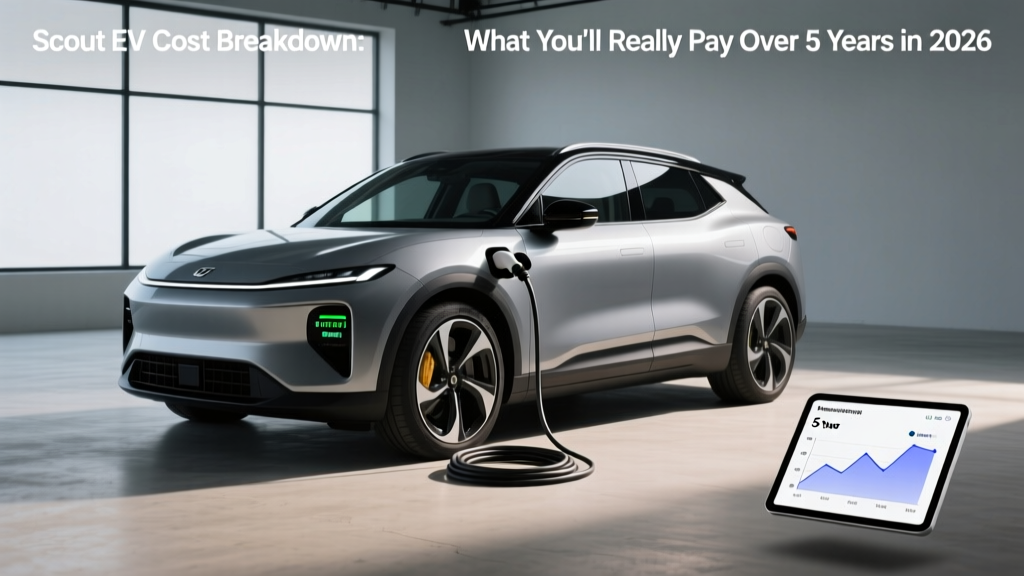
The Scout EV Cost Question: Beyond the Sticker Price
Scout Motors, the Volkswagen Group-backed revival of the International Harvester nameplate, began delivering its first electric vehicles — the Scout Traveler (SUV) and Scout Terra (truck) — in late 2027 after years of anticipation. With a starting MSRP hovering around $50,000–$60,000 depending on trim and configuration, the Scout EV cost proposition sits squarely in the premium-but-accessible electric truck and SUV segment, competing directly with the Rivian R1T/R1S, Ford F-150 Lightning, and Chevrolet Silverado EV.
But the window sticker is only the beginning. Real ownership cost involves federal tax credit eligibility, state rebates, home charging infrastructure, electricity rates, insurance premiums, and long-term depreciation — all of which behave differently for EVs than for gas vehicles. This guide breaks down the complete 5-year Scout EV cost picture with concrete numbers, so you can decide whether the math works for your household.
| Spec | Scout Traveler (SUV) | Scout Terra (Truck) |
|---|---|---|
| Base MSRP | ~$50,000 | ~$55,000 |
| EPA Range (est.) | ~350 miles | ~340 miles |
| Battery Capacity | ~100 kWh (NMC est.) | ~100 kWh (NMC est.) |
| Peak DC Fast Charge | ~200+ kW (est.) | ~200+ kW (est.) |
| 10–80% DC Charge Time | ~28 min (est.) | ~28 min (est.) |
| Horsepower | ~400 hp (dual motor AWD) | ~400 hp (dual motor AWD) |
| 0–60 mph | ~5.5 sec (est.) | ~6.0 sec (est.) |
| Towing Capacity | ~7,500 lbs (est.) | ~10,000 lbs (est.) |
| Battery Warranty | 8 yr / 100,000 mi (est.) | 8 yr / 100,000 mi (est.) |
Note: Scout Motors has released preliminary specifications; final EPA-certified figures may differ at delivery. Specs above reflect announced targets and industry estimates as of early 2026.
5-Year Total Cost of Ownership: Scout EV vs. Gas Truck
Total cost of ownership (TCO) is where the Scout EV cost story gets interesting — and where it gets complicated. Below is a 5-year / 75,000-mile TCO estimate comparing a Scout Traveler (base ~$50,000) against a comparably priced gas SUV/truck (e.g., Toyota 4Runner or Ford Explorer, ~$48,000 MSRP).
| Category | Scout Traveler (EV) | Gas SUV (~$48k) | Notes |
|---|---|---|---|
| Purchase Price (MSRP) | $50,000 | $48,000 | Base trims, before incentives |
| Federal Tax Credit (§30D) | −$3,750 to −$7,500 | $0 | See eligibility below |
| State/Utility Rebates | −$500 to −$2,000 | $0 | Varies widely by region |
| Home Charger Install (L2) | $800–$2,000 | $0 | One-time cost |
| Fuel / Electricity (5 yr) | $4,500–$6,000 | $9,000–$11,500 | See per-mile math below |
| Maintenance (5 yr) | $1,500–$2,200 | $3,500–$4,500 | No oil, fewer wear items |
| Insurance (5 yr) | $10,500–$13,500 | $7,500–$9,500 | EV premiums typically 20–35% higher |
| Depreciation (5 yr) | $22,000–$27,000 | $18,000–$22,000 | EV depreciation remains elevated |
| Estimated 5-Yr Net Cost | $35,000–$46,000 | $37,000–$46,000 | Highly dependent on credit & rates |
The takeaway: the Scout EV cost advantage is real but conditional. If you qualify for the full $7,500 federal credit, charge mostly at home on cheap electricity, and live in a state with additional rebates, the Scout can break even or beat a gas truck over 5 years. If you miss the credit, rely on expensive public DC fast charging, and face high insurance premiums, the gas vehicle may come out ahead.
Federal Tax Credit: Does the Scout Qualify for §30D?
The IRS §30D Clean Vehicle Credit offers up to $7,500 for qualifying new EVs, but the rules are layered and have tightened significantly since the Inflation Reduction Act reshaped them. Here is what you need to know for the Scout Traveler and Terra:
§30D Eligibility Checklist (2026 Rules)
- MSRP Cap: SUVs, vans, and trucks must have an MSRP ≤ $80,000; sedans ≤ $55,000. Scout Traveler and Terra, as SUV/truck classifications, fall under the $80,000 cap — base trims clear this easily, but fully loaded configurations may approach the limit.
- Buyer Income Cap: Modified adjusted gross income (MAGI) must not exceed $150,000 (single), $225,000 (head of household), or $300,000 (joint).
- Battery Sourcing — Critical Minerals ($3,750): A percentage of critical minerals in the battery must be extracted or processed in the U.S. or a free-trade-agreement country, or recycled in North America. The required percentage increases annually.
- Battery Sourcing — Components ($3,750): A percentage of battery components must be manufactured or assembled in North America. This threshold also increases annually.
- FEOC Restriction: Vehicles with battery components or critical minerals from a "foreign entity of concern" (primarily China) may be disqualified entirely.
- Point-of-Sale Transfer: As of 2024, you can transfer the credit to the dealer at purchase, reducing your out-of-pocket cost immediately rather than waiting to claim it on your tax return.
- North American Final Assembly: Required. Scout vehicles are assembled in a new facility in South Carolina, satisfying this requirement.
The critical unknown for Scout: Because Scout Motors is a new entrant, the specific battery cell supplier and critical-mineral sourcing chain will determine whether the Traveler and Terra qualify for the full $7,500, a partial $3,750, or no credit at all. Volkswagen Group has been building North American battery supply chains, but final certification rests with the IRS and Treasury Department. Always verify eligibility on fueleconomy.gov before purchasing.
Charging vs. Gas: The Per-Mile Cost Math
This is where Scout EV cost ownership delivers its clearest advantage — but only if you charge strategically.
| Scenario | $/kWh or $/gal | Efficiency | Cost per Mile |
|---|---|---|---|
| Scout — Home L2 (national avg electricity) | $0.16/kWh | 2.0 kWh/mi (est.) | $0.032/mi |
| Scout — Home L2 (cheap utility, off-peak) | $0.10/kWh | 2.0 kWh/mi | $0.020/mi |
| Scout — Public DC Fast Charger | $0.40/kWh | 2.0 kWh/mi | $0.080/mi |
| Scout — Tesla Supercharger / Electrify America (peak) | $0.55/kWh | 2.0 kWh/mi | $0.110/mi |
| Gas Truck (22 MPG combined) | $3.50/gal | 22 MPG | $0.159/mi |
| Gas Truck (18 MPG, towing/city) | $3.50/gal | 18 MPG | $0.194/mi |
At 15,000 miles per year, the annual fuel cost spread looks like this:
- Home-charged Scout: $300–$480/year
- Mostly public-charged Scout: $1,200–$1,650/year
- Gas truck: $2,385–$2,910/year
Home charging is the linchpin. Over 5 years and 75,000 miles, a Scout owner charging primarily at home saves $8,000–$12,000 versus a gas truck. But if you live in an apartment without charging access and rely entirely on public DC fast chargers at $0.40–$0.55/kWh, your savings shrink to $2,000–$4,000 — and may disappear entirely when you factor in higher insurance.
Efficiency note: Full-size electric trucks and SUVs typically consume 1.8–2.5 kWh per mile depending on speed, temperature, and payload. In cold weather (below 32°F), expect 20–30% higher consumption due to cabin heating and battery resistance, which increases your effective $/mile. A heat pump (if equipped on the Scout) mitigates this somewhat.
Maintenance Savings: Where EVs Genuinely Win
EVs have far fewer moving parts than internal combustion vehicles, and the maintenance savings are measurable and consistent.
| Service Item | Scout EV | Gas Truck |
|---|---|---|
| Oil Changes | $0 (none required) | $600–$1,000 |
| Transmission Fluid | $0 (single-speed reducer) | $150–$300 |
| Brake Pads/Rotors | $200–$400 (regen extends life 2–3×) | $800–$1,500 |
| Air Filters / Spark Plugs | $0 | $200–$400 |
| Coolant / Misc. Fluids | $100–$200 | $200–$400 |
| Tire Rotation / Replacement | $1,200–$1,800 (EV tires wear faster due to weight/torque) | $1,000–$1,400 |
| Cabin Air Filter / Wipers / Misc. | $200–$400 | $200–$400 |
| Total (5 yr) | $1,700–$3,000 | $3,150–$5,400 |
The net maintenance savings for the Scout over 5 years: approximately $1,500–$2,500. The one area where EVs can cost more is tires — the combination of heavy battery packs (likely 5,500+ lbs for the Scout) and instant torque accelerates tread wear. Budget for premium all-season or all-terrain tires at ~$300–$400 per corner.
Insurance Reality: The Hidden EV Cost Premium
Insurance is the category most EV cost analyses undercount. According to industry data, EV insurance premiums run 20–35% higher than comparable gas vehicles, and the Scout will likely follow this pattern.
Why?
- Higher repair costs: EV-specific components (battery packs, power electronics, heat pump systems) require specialized technicians and OEM parts. Even minor collision damage near the battery enclosure can trigger a total-loss declaration.
- Higher vehicle values: The Scout's $50,000+ MSRP means higher comprehensive and collision payouts.
- Limited actuarial data: As a brand-new model from a startup, insurers have zero claims history for the Scout specifically, so they price conservatively.
- Weight: Heavier vehicles cause more damage in multi-vehicle collisions, raising liability premiums.
Expect annual premiums of $2,100–$2,700 for the Scout Traveler or Terra (depending on your state, driving record, and coverage level), versus $1,500–$1,900 for a comparably priced gas SUV. Over 5 years, that's an additional $3,000–$4,500 in insurance costs — enough to erase a meaningful chunk of your fuel and maintenance savings.
Mitigation: Shop quotes from multiple carriers before purchasing. Some insurers (Geico, Progressive, State Farm) offer EV-specific discounts. Bundling home and auto, maintaining a clean record, and choosing a higher deductible can narrow the gap.
Depreciation and Resale Value: The Wildcard
Depreciation is the single largest ownership cost for any vehicle, and EVs have experienced turbulent resale values in recent years.
From 2022–2025, EV depreciation accelerated due to aggressive price cuts by Tesla, rapid improvements in range and charging speed making older models less desirable, and consumer uncertainty about battery longevity. According to iSeeCars analysis, average 5-year EV depreciation reached 45–55% in some model years, compared to 38–45% for gas trucks.
For the Scout specifically, several factors could influence resale:
- Brand cachet: The International Harvester heritage and rugged design could generate enthusiast demand that supports values, similar to early Ford Bronco or Jeep Wrangler residuals.
- Supply constraints: Scout is ramping production slowly at its South Carolina plant. Limited initial supply could support used values in the first 3–5 years.
- Battery health perception: If Scout's battery demonstrates strong state-of-health retention (90%+ at 100,000 miles), resale values will benefit. A robust warranty (8 yr / 100,000 mi minimum, per industry standard) also helps.
- Technology obsolescence: If solid-state batteries or 350+ kW charging arrive by 2030, the Scout's NMC pack and ~200 kW charging could look dated — a risk all current EVs face.
Conservative 5-year depreciation estimate for the Scout: 45–55%, or $22,500–$27,500 on a $50,000 purchase. This is the biggest variable in your TCO calculation and the hardest to control.
State, Local, and Utility Incentives
Your location dramatically affects the real Scout EV cost. Beyond the federal §30D credit, many states, municipalities, and electric utilities offer additional rebates and incentives. These vary enormously and change frequently, so always verify current programs. Examples include:
- California (CVRP): Up to $7,000 for income-qualified buyers (funding-limited, first-come basis)
- Colorado: State tax credit up to $5,000 for EVs under certain MSRP thresholds
- New York (Drive Clean Rebate): Up to $2,000 point-of-sale rebate
- Utility rebates: Many utilities (e.g., PG&E, ConEdison, Xcel Energy) offer $500–$1,500 for EV purchase and/or $300–$800 for home Level 2 charger installation
- HOV lane access: Several states grant single-occupant HOV lane access for EVs — a non-monetary but high-value perk in congested metro areas
Check the U.S. Department of Energy's AFDC database for current incentives in your state.
Home Charging Setup: The Upfront Cost Most Buyers Overlook
To capture the lowest per-mile electricity costs, you need a Level 2 home charger. Here's what that investment looks like:
| Component | Cost Range | Notes |
|---|---|---|
| Level 2 Charger (hardware) | $350–$700 | 32A–48A units (7.7–11.5 kW); ChargePoint, Wallbox, Emporia, Tesla Wall Connector |
| Electrician Labor | $400–$1,500 | Depends on panel proximity, conduit run length, local rates |
| Permit & Inspection | $50–$300 | Required in most jurisdictions |
| Electrical Panel Upgrade (if needed) | $1,500–$3,500 | Older homes with 100A service may need 200A upgrade |
| Total (no panel upgrade) | $800–$2,500 | Typical scenario for modern homes |
| Total (with panel upgrade) | $2,300–$6,000 | Older homes or high-draw setups |
At 48 amps (11.5 kW), a Level 2 charger adds roughly 35–45 miles of range per hour of charging — enough to fully replenish the Scout's ~100 kWh battery overnight in 9–10 hours. This is the setup that makes the $0.02–$0.03/mile fuel cost possible.
Important: Always hire a licensed electrician for a final assessment of your panel capacity and wiring. The figures above are estimates; your actual cost depends on your home's electrical infrastructure and local code requirements.
Frequently Asked Questions
How much does it really cost to own a Scout EV over 5 years?
Based on our analysis, the 5-year net cost of owning a Scout Traveler or Terra ranges from approximately $35,000 to $46,000 over 75,000 miles, depending on tax credit eligibility, electricity rates, insurance premiums, and depreciation. This is roughly comparable to — or slightly better than — a gas truck in the same price range, provided you qualify for incentives and charge primarily at home.
Do I qualify for the $7,500 federal tax credit on a Scout?
Maybe. You must meet income caps ($150k single / $300k joint), the Scout must stay under the $80,000 MSRP cap for trucks/SUVs, and its battery must meet critical-mineral and component-sourcing thresholds set by the IRS. Scout's South Carolina assembly satisfies the final-assembly requirement, but battery sourcing certification is model-specific. Check fueleconomy.gov for the definitive answer before purchasing. Remember: the credit is non-refundable unless you use the point-of-sale transfer option.
How much do I save on fuel and maintenance with the Scout?
Charging at home on average U.S. electricity ($0.16/kWh), the Scout costs roughly $0.03/mile to "fuel" versus $0.16/mile for a gas truck getting 22 MPG. Over 75,000 miles, that's $9,750 in fuel savings. Maintenance savings add another $1,500–$2,500 over 5 years thanks to eliminated oil changes, reduced brake wear from regenerative braking, and fewer mechanical components. Combined savings: $11,000–$12,000+ — but only if you charge at home.
Are Scout EVs more expensive to insure?
Yes, expect to pay 20–35% more for insurance compared to a similarly priced gas SUV or truck. This translates to roughly $600–$900 more per year, or $3,000–$4,500 over 5 years. The higher cost reflects expensive EV-specific repairs, limited claims data for a new brand, and the Scout's heavy curb weight. Shop multiple carriers and ask about EV-specific discounts.
How well will the Scout hold its value?
This is uncertain. EV depreciation has been volatile, averaging 45–55% over 5 years in recent model years — worse than gas trucks at 38–45%. However, the Scout's limited initial production, heritage branding, and rugged positioning could support stronger-than-average residuals. Conservative estimate: 45–55% depreciation over 5 years, meaning a $50,000 Scout could be worth $22,500–$27,500 at the 5-year mark. Battery health data and brand reputation will be the decisive factors.
What happens if the Scout doesn't qualify for the federal credit?
If battery sourcing rules disqualify the Scout from the full or partial §30D credit, your 5-year TCO increases by $3,750–$7,500. In this scenario, state and utility incentives become more important, and the fuel/maintenance savings must work harder to offset the higher effective purchase price. Run the numbers for your specific state and electricity rate before committing.
Can I use the Scout for towing without destroying my range?
Towing is the kryptonite of electric truck efficiency. Expect range to drop 40–60% when towing near the Scout's maximum capacity (7,500–10,000 lbs est.). A 350-mile range could shrink to 140–210 miles with a heavy trailer. This makes long-distance towing impractical without careful route planning around DC fast chargers. For occasional light towing (small boat, utility trailer), the impact is manageable; for frequent heavy towing, a diesel truck may still be the pragmatic choice.
Bottom Line: Who Should Buy the Scout?
Choose the Scout Traveler or Terra if:
- You qualify for the §30D federal tax credit (income + sourcing requirements)
- You can install a Level 2 home charger and access cheap electricity ($0.10–$0.18/kWh)
- You want a distinctive, rugged electric SUV/truck with heritage design
- Your daily driving is under 200 miles with occasional longer road trips
- You value the maintenance and fuel savings of an EV powertrain
Consider a gas or hybrid truck instead if:
- You cannot charge at home and must rely on public DC fast chargers
- You regularly tow heavy loads over long distances
- You exceed the income caps for the §30D credit
- Insurance quotes for the Scout come in significantly above your budget
- You plan to keep the vehicle 8–10+ years and worry about out-of-warranty battery replacement costs
The Scout EV cost equation isn't simple, but it's solvable. With the right combination of incentives, home charging, and realistic expectations about insurance and depreciation, the Traveler and Terra can deliver genuine 5-year savings over a gas equivalent — while offering a driving experience, instant torque, and quiet refinement that no combustion truck can match. Just do the math for your specific situation before signing the order agreement.