Quick Verdict: Is the Schumacher Electric Level 2 EV Wall Charger Worth It?
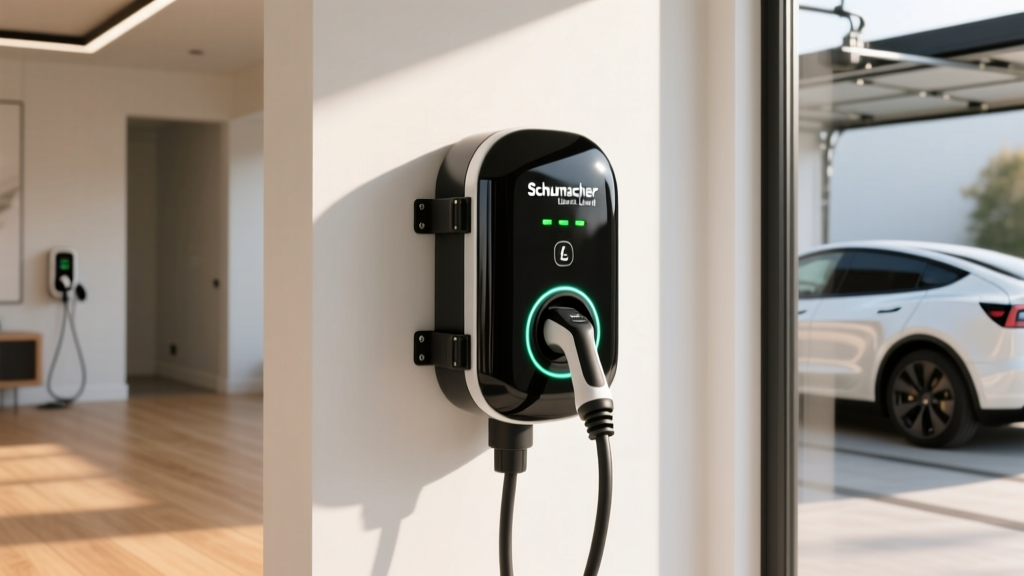
The Schumacher Electric Level 2 EV wall charger (model SC-SCMH08A02) delivers up to 11.5 kW of power on a 240-volt, 48-amp circuit — enough to add roughly 35–44 miles of range per hour to most mainstream EVs. At a street price around $399, it undercuts premium competitors like the ChargePoint Home Flex and Emporia Vue while still offering Wi-Fi connectivity, a 25-foot cable, and a NEMA 4 outdoor rating. For EV owners with a 60-amp or larger dedicated circuit available in their panel, the Schumacher is a strong value pick for daily home charging.
But hardware cost is only part of the equation. Installation — including a dedicated 240V circuit, permit, and potential panel upgrade — can add $500 to $2,500+ depending on your home's electrical infrastructure. This guide breaks down the real numbers: charging speeds, install costs, connector compatibility, and per-mile charging costs versus gasoline.
Charging Levels Explained: How Fast Will You Add Range?
Before evaluating any wall charger, understand the three charging tiers available to EV owners. Power is measured in kilowatts (kW), which represents the rate of energy delivery — think of it as how fast water flows through a hose. Energy is measured in kilowatt-hours (kWh), which represents the total amount stored in your battery — the size of the bucket.
| Level | Voltage | Max Power (kW) | Miles of Range Added per Hour | Typical Use Case |
|---|---|---|---|---|
| Level 1 | 120V AC | 1.4–1.9 kW | 3–5 mi/hr | Overnight trickle; PHEVs with small batteries |
| Level 2 | 240V AC | 3.3–19.2 kW | 12–70 mi/hr | Daily home and workplace charging |
| DC Fast Charging | 400–800V DC | 50–350 kW | 150–1,000+ mi/hr (peak) | Road trips; 10–80% in 15–40 minutes |
The Schumacher Electric Level 2 EV wall charger operates at Level 2, delivering up to 11.5 kW (48 amps × 240 volts). For context, here's how that translates to real charging times for common EV battery sizes:
- Hyundai Ioniq 5 (84 kWh usable, NMC): 10–80% in approximately 7.5–8.5 hours on the Schumacher at full 11.5 kW. That's a full overnight charge.
- Tesla Model Y Long Range (~75 kWh usable): 10–80% in roughly 6.5–7.5 hours.
- Ford F-150 Lightning Extended Range (131 kWh usable): 10–80% takes about 12–13 hours at 11.5 kW — you'll need to plug in by early evening for a full morning charge.
- Toyota RAV4 Prime PHEV (18.1 kWh battery): 0–100% in under 2 hours.
Compare that to a standard 120V Level 1 outlet at ~1.4 kW, where that same Ioniq 5 would take over 48 hours for a 10–80% charge. Level 2 is the practical baseline for BEV ownership.
Home Installation: Electrical Requirements and Real Costs
The Schumacher SC-SCMH08A02 requires a dedicated 240-volt, 60-amp circuit to deliver its full 48-amp output. Per the National Electrical Code (NEC), continuous loads like EV charging must not exceed 80% of a circuit's rated capacity — hence 48A on a 60A breaker. If your panel only supports a 50-amp circuit, the charger can be software-limited to 40A (9.6 kW), which still provides roughly 30–36 miles of range per hour.
What Your Electrician Will Evaluate
A licensed electrician will assess three critical factors before installation:
- Panel capacity: Most modern homes have a 200-amp main panel. Adding a 60-amp EV circuit consumes a significant portion of available capacity. If your panel is already near load limits (common in older homes with electric heat, A/C, and appliances), you may need a panel upgrade to 200A or even 400A service.
- Wire run distance: The charger must be hardwired or connected via a NEMA 14-50 receptacle. Longer wire runs from the panel to the garage or driveway require thicker-gauge copper (typically 6 AWG for 60A, 4 AWG for runs over 100 feet), which increases material cost.
- Permitting and inspection: Most jurisdictions require an electrical permit for a new 240V circuit. Your electrician pulls the permit, and a local inspector verifies the work meets NEC Article 625 (EV charging system requirements). Skipping the permit risks insurance claim denials and code violations.
| Component | Simple Install (panel nearby, no upgrade) | Complex Install (long run, panel at capacity) |
|---|---|---|
| Schumacher charger unit | $399 | $399 |
| Electrical permit | $50–$150 | $100–$250 |
| Electrician labor (2–4 hrs simple; 6–10 hrs complex) | $300–$600 | $900–$1,800 |
| Wire, conduit, breaker, hardware | $100–$300 | $400–$800 |
| Panel upgrade (if needed) | $0 | $1,500–$3,500 |
| Total estimated range | $849–$1,449 | $3,299–$6,749 |
The wide range reflects real-world variability. A homeowner with a modern 200A panel and a garage wall adjacent to the electrical room might pay under $1,000 total. A 1970s home with a 100A panel, a detached garage, and a 120-foot wire run could easily spend $5,000+. Always get at least two quotes from licensed electricians before committing.
Federal incentive note: The IRS §30D credit applies to new EV purchases, not standalone charger hardware. However, the Alternative Fuel Vehicle Refueling Property Credit (Form 8911) may cover up to 30% of home charger equipment and installation costs (capped at $1,000) if you live in an eligible census tract. Consult a tax professional for current-year eligibility.
Connector Compatibility: Will It Plug Into Your EV?
The North American EV charging landscape has shifted dramatically since Tesla opened its Supercharger network and the NACS (North American Charging Standard, SAE J3400) connector became the industry standard. As of the 2025–2026 model years, most new EVs ship with a NACS charge port natively, including Tesla, Ford, GM, Rivian, Hyundai/Kia (select models), and others. Some 2024–2025 models still use CCS1 and require an adapter.
| Connector | Brands Using It (Native) | Adapter Needed for Schumacher? |
|---|---|---|
| NACS (J3400) | Tesla (all), Ford (2025+), GM (2025+), Rivian (2025+), Hyundai Ioniq 5/9 (2026+) | No — if you buy the NACS-terminated Schumacher model |
| CCS1 | VW ID.4 (through 2025), BMW iX, some 2024 Hyundai/Kia | Yes — NACS-to-CCS adapter (~$150–$200) |
| CHAdeMO | Nissan Leaf (legacy, discontinued 2025) | Yes — CHAdeMO adapter required; increasingly rare |
The Schumacher Electric Level 2 EV wall charger is available with a J1772 connector (universal for non-Tesla EVs through 2024) or a NACS connector for newer vehicles. If your EV has a CCS1 port and you purchase the NACS version, a NACS-to-CCS adapter from a reputable supplier like Lectron or A2Z will bridge the gap. Confirm your vehicle's charge port type before ordering.
Cost Per Mile: Home Charging vs. Gasoline
One of the strongest arguments for home Level 2 charging is cost. Electricity rates vary by utility and time-of-use (TOU) plans, but the math consistently favors electrons over gasoline for daily driving.
| Scenario | Rate / Price | Vehicle Efficiency | Cost Per Mile |
|---|---|---|---|
| Home charging (off-peak TOU rate) | $0.09/kWh | 3.0 mi/kWh (100 MPGe) | $0.030 |
| Home charging (standard residential avg.) | $0.16/kWh | 3.0 mi/kWh | $0.053 |
| Public Level 2 (network rate) | $0.30/kWh | 3.0 mi/kWh | $0.100 |
| DC Fast Charging ( Electrify America, EVgo) | $0.48/kWh | 3.0 mi/kWh (adjusted for charging losses) | $0.170 |
| Gasoline (28 MPG combined avg.) | $3.30/gallon | 28 MPG | $0.118 |
| Gasoline (truck, 19 MPG) | $3.30/gallon | 19 MPG | $0.174 |
At off-peak residential rates, home charging costs roughly 3 cents per mile — about one-quarter the cost of gasoline at $3.30/gallon in a 28 MPG vehicle. Even at standard residential rates (~$0.16/kWh), you're paying 5.3 cents per mile, still less than half the gas cost. The savings compound: a driver covering 12,000 miles per year saves approximately $700–$1,050 annually by charging at home versus fueling a 28 MPG gas car, based on EPA efficiency data.
Public DC fast charging, however, narrows or eliminates that gap. At $0.48/kWh, DC fast charging can cost more per mile than gasoline in an efficient car. This is why home Level 2 charging — with the Schumacher or any quality wall unit — is the economic foundation of EV ownership.
Safety, Code, and Smart Features
The Schumacher SC-SCMH08A02 carries a NEMA 4 enclosure rating, meaning it's sealed against splashing water and suitable for outdoor installation — important for homes without a garage. Key safety and feature specifications:
- UL listing: The unit is UL-certified (UL 2594 for EV charging equipment), which your electrical inspector will verify and most utilities require for any rebate eligibility.
- GFCI protection: NEC 2023 and later require GFCI protection for all receptacles used for EV charging in garages and outdoors. Hardwired installations (recommended for 48A+) use the charger's internal ground-fault protection rather than a GFCI breaker, which avoids nuisance tripping.
- Dedicated circuit: The charger must be on its own dedicated 60A circuit — you cannot share it with a dryer, welder, or other appliance.
- Wi-Fi and app control: The Schumacher app allows scheduling (useful for TOU rate optimization), energy monitoring, and firmware updates. Unlike ChargePoint or Emporia, it does not currently integrate with utility demand-response programs or offer granular per-session cost tracking.
- Cable length: 25 feet, sufficient for most single-car garage and driveway configurations. If your charge port is on the driver's side and the unit mounts on the far wall, measure carefully before installation.
Equipment Comparison: Schumacher vs. Competing Level 2 Chargers
The Schumacher Electric Level 2 EV wall charger competes in a crowded market. Here's how it stacks up against other popular 40–48A home chargers available in 2026:
| Feature | Schumacher SC-SCMH08A02 | ChargePoint Home Flex | Emporia Vue Smart | Wallbox Pulsar Plus |
|---|---|---|---|---|
| Max power output | 11.5 kW (48A) | 12 kW (50A) | 11.5 kW (48A) | 11.5 kW (48A) |
| Circuit required | 60A | 60A | 60A | 60A |
| Cable length | 25 ft | 23 ft | 24 ft | 25 ft |
| Connector options | J1772 or NACS | J1772 (NACS adapter sold separately) | J1772 or NACS | J1772 or NACS |
| Wi-Fi / App | Yes | Yes | Yes | Yes |
| Energy monitoring | Basic | Detailed (per-session cost) | Detailed (whole-home integration) | Basic |
| Outdoor rating | NEMA 4 | NEMA 4 | NEMA 4 | NEMA 4X |
| Street price (2026) | ~$399 | ~$549 | ~$399 | ~$449 |
| Warranty | 2 years | 3 years | 3 years | 3 years |
The Schumacher's primary advantage is price — it matches the Emporia on cost while offering NACS availability. Its main weakness is a shorter warranty (2 years vs. 3 years for competitors) and less mature app functionality. If you value detailed energy dashboards, utility demand-response integration, or a longer warranty, the ChargePoint Home Flex or Emporia Vue justify their modest premiums. If you want the most affordable 48A NACS-native charger with solid hardware, the Schumacher delivers.
Frequently Asked Questions
How much does it cost to install a home EV charger with the Schumacher Level 2?
Total installed cost ranges from roughly $850 to $1,500 for a straightforward installation (panel nearby, no upgrade needed) and $3,300 to $6,700+ for complex installs requiring a panel upgrade or long wire run. The charger unit itself costs about $399; the remainder is electrician labor, permit, wire, and hardware.
How fast will each charging level add range to my EV?
Level 1 (120V) adds 3–5 miles per hour. Level 2 at 11.5 kW (the Schumacher's output) adds approximately 35–44 miles per hour depending on your vehicle's efficiency. DC fast charging at 150–350 kW can add 150–1,000+ miles per hour at peak, though the charge curve tapers significantly above 80% state of charge.
Which connector do I need for the Schumacher charger?
Check your EV's charge port. If your vehicle has a native NACS port (Tesla, 2025+ Ford/GM/Rivian, 2026+ Hyundai/Kia), order the NACS version. If your EV uses CCS1 (most 2022–2025 non-Tesla models), order the J1772 version and use a CCS adapter, or order NACS with a NACS-to-CCS adapter. CHAdeMO vehicles (Nissan Leaf) require a specific CHAdeMO adapter.
How much does EV charging cost per mile compared to gas?
Home charging at off-peak rates (~$0.09/kWh) costs about $0.03 per mile in a typical EV. Standard residential rates (~$0.16/kWh) bring it to ~$0.05/mile. A comparable 28 MPG gas car at $3.30/gallon costs $0.12/mile. Home charging saves $700–$1,050 per year at 12,000 miles driven. Public DC fast charging at $0.48/kWh costs ~$0.17/mile, which can exceed gasoline costs.
What electrical upgrades might I need for a 48A Level 2 charger?
The Schumacher requires a dedicated 60-amp, 240-volt circuit. If your electrical panel is 100A or already heavily loaded, you may need a panel upgrade to 200A ($1,500–$3,500). Homes with 200A panels and available breaker slots typically need no upgrade. An electrician's load calculation will determine your specific needs. Some homeowners opt for a 50A circuit instead, limiting the charger to 40A (9.6 kW) — still adequate for overnight charging of most vehicles.
Is the Schumacher charger eligible for utility rebates?
Many utilities offer rebates of $250–$500 for smart Level 2 chargers, but eligibility typically requires the charger to be on the utility's approved list and to support demand-response programs. Check with your local utility before purchasing. The Schumacher's limited smart-grid integration may disqualify it from some demand-response rebate programs, even though it meets UL safety certification requirements.
Sources: EPA Fuel Economy — EV Battery & Range Data, IRS Alternative Fuel Vehicle Refueling Property Credit, National Electrical Code (NEC) Article 625 — EV Charging Systems.