Quick Answer: Is a Scania Electric Truck Right for Your Fleet?
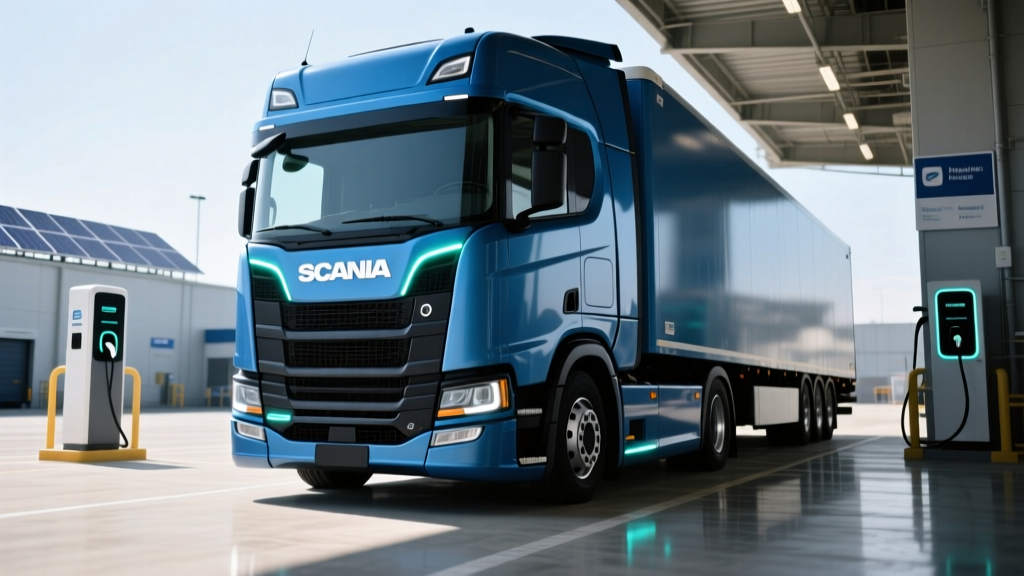
Scania's current battery-electric truck lineup — anchored by the Scania 45 R (regional) and Scania 25 P (distribution) — targets medium- and heavy-duty operators running predictable routes under 350 km (≈217 miles) per shift. Expect 220–350 km of real-world range depending on payload, terrain, and climate, with battery packs ranging from 187 kWh to 559 kWh usable capacity (LFP chemistry on select trims, NMC on high-capacity builds). DC fast charging peaks at up to 375 kW, achieving a 10–80% top-up in roughly 40–55 minutes on larger packs. Purchase prices run roughly 2–3× a comparable diesel Scania, but per-km energy costs drop 50–70% and maintenance savings are substantial. The math works best for depot-based fleets with overnight Level 2 charging and daytime opportunity DC fast charging.
Scania Electric Truck Lineup: Key Specs at a Glance
Scania offers several battery-electric configurations across its P, G, R, and S cab series. Below are the most common 2025–2026 model-year specifications for the core electric models. Note that Scania builds these trucks modularly — battery count, motor output, and axle configuration are configurable to application.
| Specification | Scania 25 P (Distribution) | Scania 45 R (Regional) |
|---|---|---|
| Gross Vehicle Weight (GVW) | Up to 28 tonnes (rigid) | Up to 44+ tonnes (tractor + trailer) |
| Battery Options | 187 / 281 / 375 kWh (usable) | 281 / 416 / 559 kWh (usable) |
| Battery Chemistry | NMC (nickel manganese cobalt) | NMC / LFP (application-dependent) |
| E-Stated Range (Full Load) | ~150–250 km | ~220–350 km |
| Electric Motor Output | Up to 300 kW (400 hp) | Up to 410 kW (550 hp) |
| Peak DC Fast Charge Rate | Up to 270 kW | Up to 375 kW |
| 10–80% DC Charge Time (Largest Pack) | ~50 min | ~55 min (559 kWh pack) |
| AC Charging (Depot / Level 2 equivalent) | 22–43 kW | 22–43 kW |
| Estimated Base Price (EUR) | €250,000–€320,000 | €350,000–€450,000+ |
| Battery Warranty | 8 years / 800,000 km (~70% SoH) | 8 years / 800,000 km (~70% SoH) |
Sources: Scania Electric Trucks, Scania BEV Range Documentation.
Real-World Range vs. Stated Range: What Fleets Actually See
Like passenger EVs, heavy-duty electric trucks lose range under real-world conditions. Scania publishes range estimates based on specific drive cycles, but fleet operators should plan conservatively:
Scania 45 R (559 kWh, 44-tonne GCW):
- Stated / favorable conditions: Up to 350 km (217 mi) — flat terrain, moderate speed, 15°C ambient, partial payload.
- Real-world highway (loaded, 85 km/h avg): ~270–310 km (168–193 mi).
- Cold weather (−10°C / 14°F, cabin + battery heating): ~200–240 km (124–149 mi) — a 25–40% reduction.
- Hilly terrain (loaded): Expect 15–25% range reduction vs. flat routes. Regenerative braking on descents partially offsets this.
Cold-weather losses are significant for electric trucks because cabin heating, battery thermal management, and reduced regenerative braking efficiency all draw from the traction battery. Fleets operating in northern climates should spec the largest available battery pack and plan routes with a 20–30% range buffer.
Total Cost of Ownership: Scania Electric Truck vs. Diesel
The upfront price premium for a Scania BEV is steep — typically 2–3× the cost of an equivalent diesel truck. However, operating costs tilt heavily in the electric truck's favor over a 5–8 year ownership cycle. Below is a simplified 5-year TCO comparison for a regional-haul Scania 45 R operating 80,000 km/year in a European market.
| Cost Category (5-Year) | Scania 45 R (Electric) | Scania 45 R (Diesel) |
|---|---|---|
| Purchase Price (approx.) | €400,000 | €150,000 |
| Fuel / Energy (400,000 km total) | €72,000 (€0.18/kWh depot avg) | €180,000 (€1.50/L diesel avg) |
| Maintenance & Service | €18,000 | €40,000 |
| AdBlue / DEF Fluid | €0 | €8,000 |
| Insurance (est.) | €22,000 | €18,000 |
| Depot Charging Infrastructure (amortized) | €35,000 | €0 |
| Estimated Residual Value (Year 5) | −€80,000 | −€50,000 |
| Net 5-Year Cost | ~€467,000 | ~€346,000 |
| Cost per km | ~€1.17 | ~€0.87 |
Key insight: On a pure 5-year TCO, the diesel still wins in most scenarios — but the gap narrows rapidly with higher annual mileage, lower electricity rates (especially off-peak depot charging at €0.10–0.12/kWh), government subsidies for BEV trucks, and carbon pricing or urban zero-emission zone mandates. By year 7–8, the electric truck typically reaches cost parity, and by year 10 it becomes cheaper per-km. Fleets with subsidized electricity, grant funding, or regulatory pressure (e.g., EU urban ZE zones) may see parity in 3–5 years.
Charging Infrastructure: What Depot Setup Actually Costs
Unlike passenger EVs, you can't simply plug a Scania electric truck into a standard outlet. Depot charging infrastructure is a capital project requiring electrical engineering, utility coordination, and permits.
| Charging Type | Power (kW) | Approx. km Added per Hour | Use Case |
|---|---|---|---|
| AC Depot (overnight) | 22–43 kW | ~15–30 km/hr | Full overnight charge (8–12 hrs) |
| DC Fast (opportunity) | 150–250 kW | ~100–170 km/hr | Mid-shift top-up (30–45 min) |
| DC Ultra-Fast (megawatt-class) | 300–375 kW | ~200–250 km/hr | Rapid turnaround at depot or hub |
Typical depot installation costs (per charger point):
- AC 22–43 kW wallbox: €3,000–€8,000 (equipment) + €5,000–€15,000 (electrical work, panel upgrades, trenching).
- DC 150 kW charger: €50,000–€80,000 (equipment) + €20,000–€60,000 (utility upgrade, transformer, installation).
- DC 350 kW charger: €100,000–€150,000 (equipment) + €40,000–€120,000 (high-voltage utility connection, switchgear, civil works).
Utility lead times for high-power DC installations can run 6–18 months. Fleet buyers should begin infrastructure planning before ordering trucks.
Common Misconceptions About Electric Trucks
| Myth | Fact |
|---|---|
| "Electric trucks can't haul heavy loads." | The Scania 45 R handles up to 44+ tonnes GCW in markets that allow it. Torque delivery is instant and superior to diesel at low RPM. |
| "Batteries won't last the life of the truck." | Scania warranties batteries for 8 years / 800,000 km at ≥70% state of health. Real-world degradation data from early fleet operators shows ~10–15% capacity loss at 500,000 km with proper thermal management. |
| "Charging takes too long for commercial operations." | At 375 kW DC, a 559 kWh pack charges 10–80% in ~55 minutes. Combined with overnight depot AC charging, most single-shift operations never wait for a charge during working hours. |
| "Electric trucks are only for last-mile delivery." | Scania's regional-haul 45 R covers 270–310 km real-world highway range at full load — sufficient for inter-city routes with mid-shift opportunity charging. |
| "The grid can't handle fleet charging." | Managed/smart charging (off-peak scheduling, load balancing) reduces peak demand by 40–60%. Many utilities offer commercial EV rate plans specifically for fleet depots. |
Decision Framework: Should Your Fleet Go Electric?
Choose a Scania electric truck if:
- Your daily routes are under 300 km (or under 200 km in cold climates) and return to a home depot nightly.
- You operate in or near cities with zero-emission zone mandates (current or planned).
- Your depot has access to 3-phase power or can secure a utility upgrade within your truck delivery timeline.
- You can access government purchase incentives or green fleet grants (EU member states, Norway, Netherlands, and others offer €50,000–€150,000+ per BEV truck).
- Your fleet's annual km per truck exceeds 60,000 km — higher utilization accelerates the fuel-savings payback.
- Driver comfort and retention matter — electric trucks are quieter, smoother, and produce no diesel fumes at the depot.
Stick with diesel (or consider a hybrid) if:
- Your routes regularly exceed 400 km per day without reliable en-route DC fast charging.
- You operate in extreme cold (below −20°C / −4°F) for extended periods with no depot pre-conditioning.
- Your depot lacks grid capacity and utility upgrades are cost-prohibitive or have multi-year lead times.
- You run long-haul, cross-border routes where charging infrastructure is sparse or unreliable.
- Your trucks are on a 3–4 year replacement cycle — you won't capture enough operating savings to offset the purchase premium.
What First-Time Electric Truck Buyers Must Know
Transitioning a fleet from diesel to battery-electric is a systems project, not just a vehicle swap. Key considerations:
- Route analysis first, trucks second. Use Scania's fleet planning tools (or third-party telematics) to map daily km, elevation profiles, payload weights, and ambient temperatures across your routes. This determines battery pack sizing and charging strategy.
- Engage your utility early.High-power depot charging (multiple 150–350 kW DC units) may require a new medium-voltage connection. Lead times of 12–18 months are common in some regions.
- Budget for infrastructure, not just vehicles. A fleet of 10 electric trucks may require €500,000–€1.5M in depot charging upgrades. Factor this into your TCO model.
- Train your drivers. Regenerative braking, pre-conditioning routines, and energy-efficient driving techniques (speed management, minimizing HVAC load) can extend real-world range by 10–20%.
- Plan for battery end-of-life. At 70% state of health, a pack may not serve its original route but can be repurposed for stationary storage. Scania offers battery recycling and second-life programs — confirm these terms in your purchase agreement.
- Monitor state of health (SoH) continuously. Modern fleet management systems track battery degradation in real time. Set alerts for unexpected capacity drops that may indicate a warranty claim.
Frequently Asked Questions
What is the real-world range of a Scania electric truck?
Under typical loaded conditions, expect 220–310 km (137–193 mi) for the Scania 45 R regional tractor with the 559 kWh pack. Cold weather reduces this by 25–40%. The distribution-oriented Scania 25 P delivers 150–250 km depending on battery spec and stop-start urban driving patterns (which favor range via regenerative braking).
How long does it take to charge a Scania electric truck?
On a 375 kW DC fast charger, the 559 kWh pack charges from 10–80% in approximately 55 minutes. Overnight AC charging at 43 kW fully replenishes the same pack in roughly 12–14 hours. Note that charge speed tapers significantly above 80% SoC — fleets should plan charging stops around the 10–80% window for maximum efficiency.
How does a Scania electric truck compare to a diesel Scania on cost?
Purchase price is 2–3× higher for the electric model. However, energy cost per km is 50–70% lower (electricity vs. diesel), maintenance costs are roughly 50% lower (no oil changes, no exhaust aftertreatment, fewer brake replacements due to regen), and AdBlue/DEF costs are eliminated. Total cost of ownership typically reaches parity between years 5–8 depending on mileage, electricity rates, and available subsidies.
Are Scania electric trucks available in the US?
As of 2026, Scania's battery-electric trucks are primarily sold in European markets and select regions (Latin America, parts of Asia). Scania does not sell trucks in the United States or Canada — North American buyers should look to the Volvo VNR Electric, Tesla Semi, Freightliner eCascadia, or Peterbilt/Kenworth electric models instead. Scania and Volvo Group share a parent company (Traton Group / Volvo Group relationship varies by division), but the product lineups and markets are distinct.
What battery chemistry does Scania use?
Scania uses NMC (nickel manganese cobalt) lithium-ion cells for most high-energy-density applications, with LFP (lithium iron phosphate) available on select configurations where cycle life and cost are prioritized over maximum range. LFP cells are heavier per kWh but offer longer cycle life and better thermal stability — a reasonable trade-off for depot-based distribution trucks that charge nightly and don't need maximum range.
What incentives exist for buying electric trucks?
Incentive programs vary significantly by country and region. In the EU, many member states offer purchase grants of €50,000–€150,000+ per heavy-duty BEV, plus reduced road tolls and tax benefits. In the US (where Scania doesn't sell), the IRS §45W Commercial Clean Vehicle Credit offers up to $40,000 for qualifying heavy-duty electric trucks (15% of basis for tax-exempt entities via direct pay). Always consult a tax professional and check current-year program rules before relying on incentive amounts.