The Short Answer: Safe EV Home Charging Starts Before You Plug In
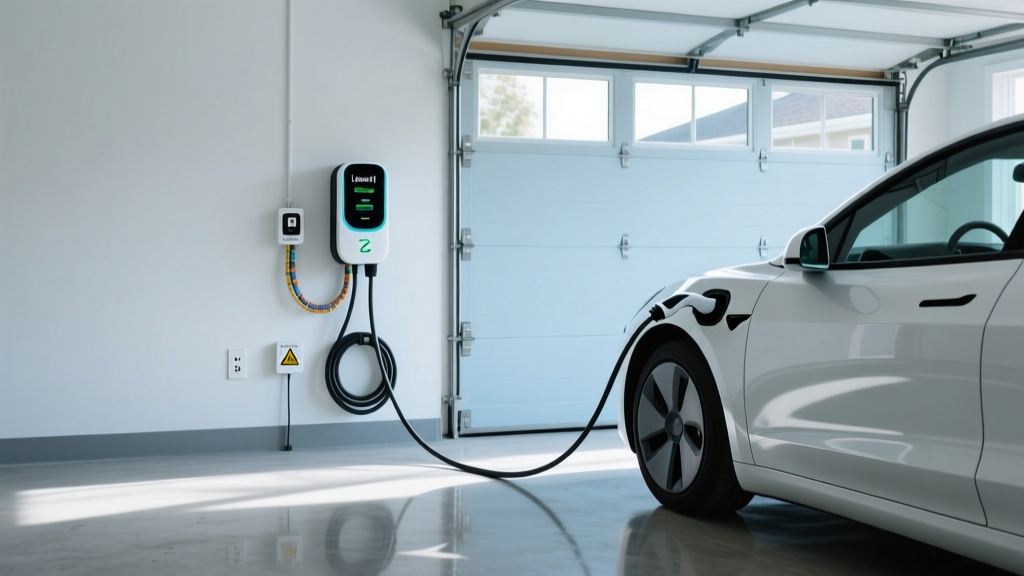
A "safety first EV plug" approach means ensuring your home electrical system can handle continuous high-draw loads before buying a charger. Most Level 2 home chargers pull 32–48 amps continuously (7.7–11.5 kW), which requires a dedicated 40–60 amp circuit on a panel with sufficient spare capacity. A licensed electrician should perform a load calculation per NEC Article 220 before any installation. Typical safe-install costs range from $800 (simple outlet near panel) to $3,500+ (panel upgrade + long conduit run). Never use extension cords, adapter daisy-chains, or undersized circuits — thermal events and breaker trips are real risks when corners are cut.
Why EV Charging Safety Is Different From Plugging In a Phone
When you plug in a phone, you're drawing roughly 10–20 watts. A Level 2 EV charger pulls 7,700–11,500 watts — continuously — for 4 to 10 hours at a stretch. That's closer to running an electric oven or clothes dryer, except it runs every night, sometimes in a hot garage, sometimes in freezing cold, and a fault can involve a $40,000+ vehicle battery.
This isn't fear-mongering. According to NFPA (National Fire Protection Association) data, electrical failures and malfunctions account for a small but measurable percentage of residential fires, and adding a continuous high-draw load to an older or already-loaded panel increases risk if the installation isn't done to code. The good news: when installed correctly by a licensed professional, home EV charging is extremely safe — arguably safer than fueling with gasoline stored in your garage.
The key distinction every EV owner must understand:
- kW (kilowatts) = power, or the rate at which energy flows (like water pressure in a hose)
- kWh (kilowatt-hours) = energy, or the total amount delivered over time (like gallons of water in a bucket)
- A 48-amp Level 2 charger delivers ~11.5 kW of power. Charging a 75 kWh battery from 20% to 80% takes roughly 4–5 hours at that rate.
Before You Buy a Charger: The Home Electrical Audit
The safety-first approach starts with a panel inspection — not a charger purchase. Here's what an electrician evaluates:
Panel Capacity and Load Calculation
Your main service panel is rated for a maximum amperage — typically 100A, 150A, or 200A in US homes. A NEC Article 220 load calculation determines whether adding a 40A or 60A EV circuit pushes you over the safe limit. If your panel is already running near capacity (electric range, dryer, HVAC, water heater all on one 150A panel), you may need:
- A panel upgrade from 100A to 200A ($1,500–$3,500)
- A load-management device that throttles charger amperage when other appliances draw heavy current ($200–$500 for hardware, plus installation)
- A lower-amperage charger — a 16A (3.8 kW) unit adds ~15 miles of range per hour, adequate for drivers covering under 40 miles daily
Wiring, Conduit, and Circuit Length
The distance from your panel to the charging location determines wire gauge and cost. A 50-foot run of 6 AWG copper wire costs significantly less than a 100-foot run requiring 4 AWG or even 3 AWG. Longer runs also mean more voltage drop, which can reduce charging efficiency and increase heat in the conductors — a safety concern if wire is undersized.
Home Level 2 Charger Installation: Cost Breakdown (2025–2026)
| Component | Budget Install | Standard Install | Complex Install |
|---|---|---|---|
| Level 2 Charger (hardware) | $300–$500 | $400–$700 | $500–$800 |
| Electrician labor (2–4 hrs) | $300–$500 | $500–$1,000 | $1,000–$2,000 |
| Wire, conduit, breaker | $100–$200 | $200–$500 | $500–$1,200 |
| Permit and inspection | $50–$150 | $100–$250 | $150–$350 |
| Panel upgrade (if needed) | — | — | $1,500–$3,500 |
| Total estimated cost | $750–$1,350 | $1,200–$2,450 | $3,650–$7,850 |
Sources: Electrician surveys via HomeAdvisor/Angi; hardware pricing from ChargePoint, Emporia, Tesla. Actual costs vary by region, panel location, and local code.
Charger Hardware: What Makes a Plug Safe?
Not all EV chargers (technically called EVSE — Electric Vehicle Supply Equipment) are built equally. A safety-first EV plug selection means looking for these features:
UL Listing or ETL Certification
Every charger should carry a UL (Underwriters Laboratories) or ETL (Intertek) mark, confirming independent safety testing. Budget chargers from unknown brands on marketplace sites sometimes skip this — avoid them. The certification ensures overcurrent protection, ground-fault detection, and thermal cutoffs are functional.
NEMA 14-50 vs. Hardwired: Which Is Safer?
Both are safe when installed correctly, but they differ:
- NEMA 14-50 outlet (plug-in): Allows you to unplug and take the charger if you move. Requires a 50A circuit. NEC 2017+ code in many jurisdictions now requires a GFCI breaker for 14-50 receptacles in garages — these cost $80–$150 and can occasionally nuisance-trip. Some EV owners report repeated GFCI trips with certain charger-outlet combinations.
- Hardwired: Charger is directly wired to the panel with no plug. Eliminates the receptacle as a failure point, allows up to 60A circuits (48A continuous charging), and doesn't require a GFCI breaker (the EVSE has built-in ground-fault protection). Preferred for high-amperage setups.
If you choose a NEMA 14-50 outlet, have your electrician use an industrial-grade receptacle (Hubbell, Bryant, or Cooper — not the $12 big-box store version). Cheap receptacles have been documented overheating under sustained EV charging loads, which can run 8+ hours nightly.
Connector Standards: NACS vs. CCS
As of 2025–2026, the North American charging landscape has consolidated around NACS (North American Charging Standard), originally Tesla's connector. Ford, GM, Rivian, Hyundai, Kia, and most other manufacturers have adopted or are transitioning to NACS. CCS1 (Combined Charging System) remains on older models and some current stock. CHAdeMO is effectively discontinued for new vehicles in the US.
For home Level 2 charging, the connector doesn't affect safety — both NACS and CCS use the same J1772 protocol at Level 2. The connector difference matters primarily for DC fast charging on road trips. If you buy a CCS-equipped vehicle, a CCS-to-NACS adapter ($150–$250) provides access to Tesla Superchargers.
EV Charging Costs: Home vs. Gas vs. Public DC
Understanding the economics helps justify the upfront safety investment. Here's how Level 2 home charging compares to alternatives for a typical EV driver covering 12,000 miles annually:
| Fueling Method | Cost per Unit | Efficiency | Annual Cost (12k mi) | Cost per Mile |
|---|---|---|---|---|
| Home Level 2 (US avg electricity) | $0.16/kWh | 3.5 mi/kWh (120 MPGe) | $549 | $0.046 |
| Home Level 2 (off-peak TOU rate) | $0.09/kWh | 3.5 mi/kWh | $309 | $0.026 |
| Public DC fast charging | $0.35–$0.55/kWh | 3.5 mi/kWh | $1,200–$1,886 | $0.10–$0.16 |
| Gas vehicle (27 MPG combined) | $3.20/gallon | 27 MPG | $1,422 | $0.119 |
| Hybrid (50 MPG combined) | $3.20/gallon | 50 MPG | $768 | $0.064 |
Electricity rates from EIA 2025 data; gas prices from AAA national average estimates. Actual costs vary by utility, state, and driving patterns.
The safety investment in a proper Level 2 installation pays for itself within 1–3 years through fuel savings versus gasoline, and the convenience of waking to a full "tank" every morning is difficult to overstate.
Common EV Charging Safety Myths — Fact-Checked
| Myth | Fact |
|---|---|
| "I can use a heavy-duty extension cord with my Level 1 charger." | Extension cords add resistance, heat, and failure points. Manufacturers explicitly void warranties when extension cords are used. Run a dedicated circuit to where you park. |
| "Charging in the rain is dangerous." | EVSE connectors are weather-rated (IP55 or higher). The plug and vehicle inlet are designed to be water-resistant during connection and charging. Rain is not a hazard with properly installed equipment. |
| "My EV will overload my home's electrical system." | A properly permitted installation with a correct load calculation will not overload your panel. Load-management devices can automatically throttle charging when other appliances are running. |
| "I don't need a permit — it's just a plug." | Most jurisdictions require an electrical permit for a new 240V circuit. Unpermitted work can void homeowner's insurance coverage in the event of a fire and create issues at resale. |
| "All chargers are basically the same." | Quality varies significantly. UL-listed chargers from established brands (ChargePoint, Emporia, Tesla, Grizzl-E, Enel X) include thermal monitoring, ground-fault protection, and firmware updates. Uncertified imports may lack critical safety components. |
Real-World Ownership: What First-Time EV Buyers Should Know
Home Charging Access Is the Single Biggest Factor
If you can install a Level 2 charger at home (garage, carport, or driveway with panel access), EV ownership is dramatically more convenient and cheaper than gas. You'll do 90%+ of your charging at home, waking to 200–350 miles of range every morning depending on your vehicle. If you live in an apartment or lack dedicated parking with electrical access, public charging becomes your primary source — and costs 3–5x more per mile while being less convenient.
Cold Weather Reduces Range and Charging Speed
In sub-freezing temperatures, expect 20–35% range reduction depending on the vehicle and whether it has a heat pump. Battery chemistry slows in cold, meaning DC fast charging also takes longer unless you precondition the battery (most EVs do this automatically when you navigate to a charger). A garage-mounted Level 2 charger mitigates some of this — the vehicle can maintain battery temperature while plugged in.
The §30D Federal Tax Credit and Charger Credits
The federal EV tax credit under IRS §30D offers up to $7,500 for qualifying new EVs, subject to MSRP caps ($55,000 for cars, $80,000 for SUVs/trucks/vans), buyer income limits ($150K single / $300K joint AGI), and battery critical-mineral sourcing requirements that tighten annually. A separate credit (IRC §30C) offers up to $1,000 for home charger installation, though it has its own eligibility requirements including placement in qualifying census tracts. Always verify current-year rules at IRS.gov and consult a tax professional — these rules change frequently.
Decision Framework: What Kind of EV Charging Setup Do You Need?
If you drive under 40 miles/day AND have a standard 120V outlet near parking:
→ Level 1 charging (1.4 kW, ~4–5 miles/hour) may suffice. No electrician needed. Fully safe with the OEM cordset. Expect 8–12 hours for a full charge on most EVs.
If you drive 40–150 miles/day AND have a garage/driveway with panel access:
→ Level 2 (7.7–11.5 kW) is the standard recommendation. Budget $1,200–$2,500 for a professional install with permit. This covers 95%+ of daily driving with overnight charging.
If your panel is maxed out (100A service with electric appliances):
→ Choose either a panel upgrade ($1,500–$3,500) or a load-managing charger like the Emporia Vue + charger system that dynamically adjusts amperage. A lower-amp 16A or 24A charger is also a safe, budget-friendly option.
If you live in an apartment/condo without dedicated parking electrical access:
→ Prioritize EVs with fast DC charging capability (200+ kW peak). Plan around public networks (Electrify America, EVgo, Tesla Supercharger). Factor $100–$200/month in public charging costs. Some states and utilities offer incentives for workplace or multi-unit dwelling charger installation.
If you frequently road-trip 300+ miles:
→ Vehicle selection matters more than home setup. Choose an EV with 300+ EPA miles and 200+ kW DC fast charging (e.g., Hyundai Ioniq 5, Tesla Model 3/Y, Chevrolet Silverado EV). Your home Level 2 handles daily use; DC fast chargers handle road trips at 10–80% in 18–25 minutes.
Charger Recommendations by Safety and Value (2025–2026)
- Emporia Level 2 EV Charger (48A, hardwired): ~$400. UL-listed, energy monitoring, load management capable with Emporia Vue panel sensor. Best value for safety-conscious owners.
- ChargePoint Home Flex (up to 50A, NEMA 14-50 or hardwired): ~$550–$700. UL-listed, flexible amperage settings, robust app, 25-foot cable option.
- Tesla Wall Connector (48A, hardwired): ~$450. Excellent build quality, NACS connector native (CCS vehicles need adapter), Wi-Fi updates. Best for Tesla owners or those committed to NACS ecosystem.
- Grizzl-E Smart (40A, NEMA 14-50 or hardwired): ~$500–$600. Canadian-built, extreme cold-rated (-40°F), aluminum case. Ideal for unheated garage or outdoor mounting in cold climates.
Frequently Asked Questions
Can I install an EV charger myself?
If you're a qualified electrician, yes. If not, absolutely not. A 240V circuit at 40–60 amps carries lethal current and must comply with NEC code, local amendments, and permit requirements. DIY electrical work on EV circuits has caused documented fires and insurance claim denials. The $500–$1,000 in professional labor is non-negotiable for safety.
Is it safe to charge my EV every night to 100%?
For NMC (nickel-manganese-cobalt) battery chemistry, daily charging to 80% is recommended for longevity — most EVs let you set a charge limit in the app or vehicle settings. For LFP (lithium iron phosphate) batteries, found in standard-range Tesla Model 3/Y and some other models, manufacturers actually recommend periodic 100% charges for accurate state-of-charge calibration. Check your specific vehicle's owner's manual.
What happens during a power outage while charging?
The EVSE and vehicle handle this gracefully — charging simply stops and resumes when power returns. There is no safety hazard. Some smart chargers can be set to resume automatically or wait for off-peak rates to restart.
Do I need a GFCI breaker for my EV charger?
NEC 2017 and later requires GFCI protection for 14-50 and 6-50 receptacles in garages. However, GFCI breakers can nuisance-trip with some EV chargers due to normal ground-leakage currents. If you experience repeated trips, consider switching to a hardwired charger (which doesn't require a GFCI breaker because the EVSE includes its own ground-fault protection) or consult your electrician about compatible breaker-charger pairings. Reference the National Electrical Code for current requirements in your jurisdiction.
How do I verify my charger installation is safe?
After installation, your local electrical inspector should verify the work as part of the permit process. Additionally: confirm the breaker amperage matches the circuit rating, check that wire gauge is appropriate for the run length, ensure the receptacle (if plug-in) is an industrial-grade unit, and verify the EVSE is UL/ETL listed. Many smart chargers include self-test routines that verify ground continuity and proper voltage on first power-up.
Is charging an EV at home safer than pumping gas?
From a fire-risk perspective, properly installed home EV charging involves no flammable vapors, no static-discharge ignition risk, and no fuel storage. Gasoline vapor is explosive at concentrations as low as 1.4% in air. A UL-listed EVSE on a permitted circuit is an extremely low-risk electrical appliance. The NHTSA and fire-safety data consistently show that EV battery fires are far less frequent per vehicle than internal-combustion engine fires.