Quick Answer: Is an RV EV Setup Practical in 2026?
If you're asking whether you can use an electric vehicle to tow a travel trailer or replace a gas motorhome with an EV, the honest answer is: it depends heavily on your trip type. For weekend camping within 120-150 miles of home with Level 2 charging at your campsite, EVs like the Ford F-150 Lightning or Rivian R1T work well. For cross-country RV trips or boondocking, an EV setup introduces serious range, charging, and weight challenges that make gas or diesel RVs more practical today.
An EV towing a 5,000-lb travel trailer typically sees its EPA range cut by 40-55%. A truck rated for 320 miles solo may deliver only 140-180 real-world miles while towing — meaning 2-3 charging stops on a 400-mile trip, each lasting 30-45 minutes.
What Does "RV EV" Actually Mean?
The term "RV EV" covers three distinct scenarios, and conflating them leads to bad purchasing decisions:
- EV as a tow vehicle: Using an electric truck or SUV to pull a conventional travel trailer, fifth wheel, or pop-up camper.
- Electric motorhome or camper van: A self-propelled RV with an electric powertrain (still extremely limited in availability as of 2026).
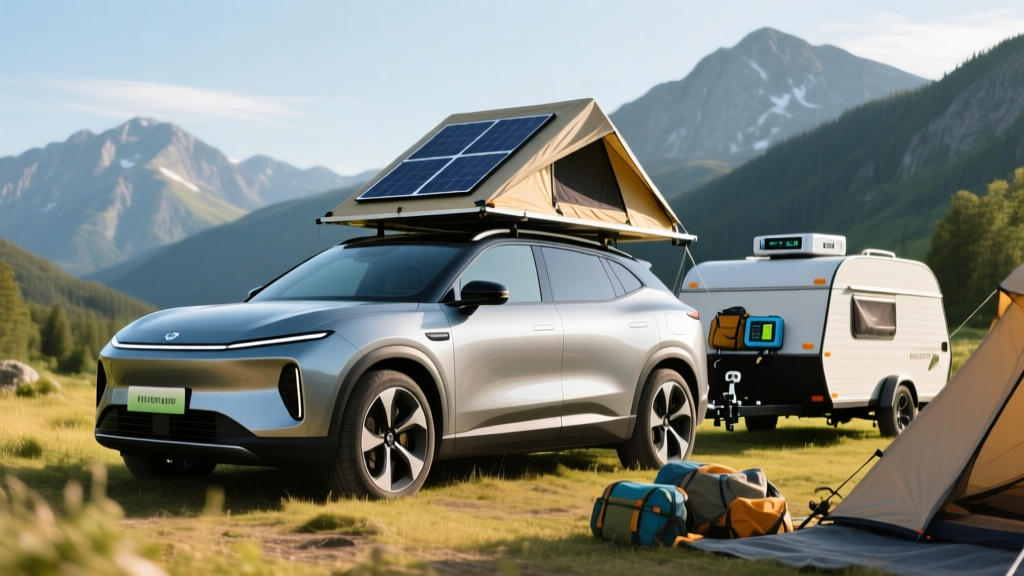
- EV camping: Using an EV's battery for campsite power (via V2L/V2H features) instead of a gas generator, without towing.
Each scenario has very different feasibility profiles. Let's address them with real numbers.
EV Towing Range: The Numbers Don't Lie
Towing is the single biggest range killer for any vehicle, but it hits EVs harder than gas vehicles because EVs are already heavier and because regenerative braking recovers less energy when pulling a loaded trailer downhill (the trailer pushes the truck).
| Vehicle | Solo EPA Range | Towing Range (Est.) | Fuel/Energy Cost per 400-mi Trip | Refuel/Recharge Stops |
|---|---|---|---|---|
| Ford F-150 Lightning (Ext. Range, 131 kWh) | 320 mi | 150-175 mi | $38-$62 (DC fast charging) | 2-3 stops, ~90 min total |
| Rivian R1T Dual Max (149 kWh) | 352 mi | 170-200 mi | $42-$68 | 2 stops, ~70 min total |
| Chevrolet Silverado EV 4WT (200+ kWh) | 440 mi | 210-250 mi | $50-$80 | 1-2 stops, ~60 min total |
| Ford F-150 Gas 3.5L EcoBoost (36-gal tank) | ~540 mi | ~280-320 mi | $105-$130 (gas at $3.40/gal) | 1 stop, ~10 min |
| Ram 1500 5.7L HEMI (33-gal tank) | ~495 mi | ~250-290 mi | $95-$120 | 1 stop, ~10 min |
Key takeaway: EVs cost roughly 40-60% less per mile to "fuel" while towing, but you'll spend 6-9x longer at charging stations compared to gas pumps. On a 400-mile trip, that's 70-90 extra minutes of downtime — which may or may not matter depending on your travel style.
Which 2026 EVs Can Actually Tow an RV?
Not every EV is rated for towing, and among those that are, tow ratings vary widely. Here's the current landscape for the most relevant models:
| Vehicle | Max Tow Rating | Battery (kWh Usable) | EPA Range (Solo) | Peak DC Charge (kW) | 10-80% Time | V2L/V2H | Base MSRP |
|---|---|---|---|---|---|---|---|
| Ford F-150 Lightning | 10,000 lbs | 131 (Ext. Range, NMC) | 320 mi | 150 kW | ~41 min | Yes (Pro Power Onboard, 9.6 kW) | $59,990 |
| Rivian R1T Dual Max | 11,000 lbs | 149 (NMC) | 352 mi | 200+ kW | ~30 min | Yes (camp kitchen, gear tunnel) | $87,600 |
| Chevrolet Silverado EV 4WT | 12,500 lbs | 200+ (NMC) | 440 mi | 350 kW (capable) | ~20 min | Yes (V2L, 10.2 kW) | $74,800 |
| Tesla Cybertruck AWD | 11,000 lbs | 123 (NMC) | 340 mi | 250 kW | ~28 min | Yes (Powershare, 11.5 kW) | $79,990 |
| Hyundai Ioniq 5 (no tow rating for RV) | Not rated / 1,650 lbs (EU) | 84 (NMC) | 310 mi | 240 kW | ~18 min | V2L (3.6 kW) | $46,650 |
Critical note: Max tow ratings assume a properly equipped truck with weight-distribution hitches and specific trim configurations. Real-world towing with a loaded travel trailer (propane, water, gear) often pushes tongue weights near or above limits. Always check your specific trailer's GVWR and loaded tongue weight before purchasing.
Campground Charging: The Infrastructure Reality
This is where most RV EV plans succeed or fail. Here's the hierarchy of campsite charging access:
Best Case: Campsites with 50-Amp or 30-Amp Hookups
A standard 50-amp RV pedestal delivers up to 12 kW (240V × 50A). A 30-amp pedestal delivers up to 3.6 kW (120V × 30A). With a mobile Level 2 EVSE (like the ChargePoint Home Flex or the EV's included mobile connector with appropriate adapter), you can charge overnight:
- 50-amp hookup: ~10-11 kW to the vehicle (accounting for overhead) = roughly 30-35 miles of solo range per hour, or a full overnight replenishment of 150-200 miles in 12-14 hours.
- 30-amp hookup: ~2.8-3.2 kW = roughly 8-10 miles per hour. A 12-hour overnight session adds only ~100-120 miles. This is marginal if you drove 150+ miles to get there.
Worst Case: Boondocking and State Parks Without Hookups
If you're dry camping or boondocking, you're relying entirely on your vehicle's battery. The F-150 Lightning's Pro Power Onboard (9.6 kW output) can run campsite appliances, lights, and a small microwave for days — but every kWh you use for camping is a kWh you don't have for driving home. A typical camping load (LED lights, fridge, phone charging, laptop, small electric heater) draws 1-3 kWh per day, which is manageable from a 131 kWh battery.
DC Fast Charging Near Campgrounds
Before committing to a campsite, check PlugShare or the EV's native navigation for DC fast chargers within 20-30 miles. Many rural campgrounds in the Mountain West, Great Plains, and parts of the Southeast remain charging deserts. If the nearest 150+ kW charger is 45 minutes from your campsite, the EV RV setup becomes impractical for that trip.
EV RV Cost Breakdown: Purchase, Fueling, and Ownership
| Cost Category | F-150 Lightning Lariat + 5,000-lb Trailer | F-150 Gas 3.5L Lariat + 5,000-lb Trailer |
|---|---|---|
| Vehicle Purchase (MSRP) | $74,990 | $59,470 |
| Federal §30D Tax Credit | -$7,500 (if eligible*) | $0 |
| Net Vehicle Cost | $67,490 | $59,470 |
| Travel Trailer (same model) | $35,000 | $35,000 |
| Home Level 2 Charger Install | $1,200-$2,500 | $0 |
| Fuel/Energy (5 yrs, 12,000 mi/yr, 20% towing) | $5,800-$8,200 | $12,500-$16,000 |
| Maintenance (5 yrs) | $1,500-$2,200 | $3,500-$5,000 |
| Insurance (5 yrs, avg.) | $11,000-$14,000 | $8,500-$11,000 |
| 5-Year Total (approx.) | $87,000-$94,400 | $83,970-$91,470 |
*The IRS §30D tax credit has income caps ($150K single / $300K joint), MSRP caps ($80K for trucks/vans/SUVs), and battery critical-mineral sourcing requirements that change annually. Verify your eligibility with a tax professional before purchasing. The credit can be transferred at point of sale as of 2024+.
Bottom line: Over five years, the EV setup costs roughly the same or slightly more than gas, even with fuel savings, because of the higher purchase price and insurance premiums. The EV wins if you drive mostly solo (not towing) during the week and use the truck as a daily driver — the fuel savings compound on 10,000+ non-towing miles annually.
Electric Motorhomes: What's Actually Available?
As of 2026, the all-electric motorhome market remains extremely limited:
- Winnebago e-RV: Announced concept based on the Ford E-Transit chassis. 126-mile EPA range, ~68 kWh battery. Suitable only for short hops between campgrounds with charging. Not yet in full production for consumers.
- Thor Industries / Airstream e-stream concept: A trailer with its own battery and motors to extend range and enable self-propulsion in campsites. Still in development/testing phases.
- Lightship L1: An aerodynamic all-electric travel trailer designed to minimize range loss when towed. Features solar panels and its own battery to power campsite needs without draining the tow vehicle. Announced for late 2025/2026 delivery, starting around $125,000.
For now, the practical "electric RV" for most buyers means an EV tow vehicle paired with a conventional or next-gen low-drag trailer.
Common RV EV Misconceptions
| Myth | Fact |
|---|---|
| "EVs can't tow anything heavy." | Modern EV trucks tow 10,000-12,500 lbs — comparable to gas half-tons. The issue isn't capability; it's range loss while towing. |
| "You'll get stuck at a campsite with no way to charge." | Most private RV parks offer 50-amp hookups. With a mobile Level 2 EVSE and a NEMA 14-50 adapter, you can charge overnight. Plan ahead for public land and boondocking. |
| "Towing will destroy the EV battery." | Towing increases charge cycles and thermal load, but modern thermal management systems handle it. Ford and Rivian's battery warranties cover 8 years / 100,000 miles regardless of towing use. |
| "I can use Tesla Superchargers while towing." | Most Supercharger stalls aren't designed for pull-through towing. You'll need to unhitch the trailer or find Supercharger locations with dedicated pull-through stalls (increasingly common but not universal). CCS and NACS networks vary. |
| "An EV replaces my gas generator at camp." | Yes — V2L systems like Ford's Pro Power Onboard (9.6 kW) or Hyundai's V2L (3.6 kW) can run appliances silently with zero emissions. But monitor your SoC carefully: running a 1,500W heater for 8 hours consumes 12 kWh, roughly 30-40 miles of driving range. |
Decision Framework: Should You Go RV EV?
Choose an EV Tow Vehicle If:
- Your typical camping trips are within 150 miles of home (one-way)
- You camp at RV parks with 50-amp electrical hookups
- You use the truck as a daily driver Monday-Friday (maximizing fuel savings)
- You have home Level 2 charging (240V / 40-48A circuit)
- You value silent, emission-free campsite power over maximum highway range
- You're willing to plan trips around DC fast-charging corridors
Stick With Gas or Diesel If:
- You regularly tow 300+ miles one way to remote campgrounds
- You boondock frequently with no electrical hookups
- You travel in regions with sparse DC fast-charging infrastructure (rural Mountain West, parts of the Southeast)
- You tow in extreme cold (below 20°F), where EV range loss compounds: towing + cold = 55-65% range reduction
- You need spontaneous, unplanned road trips without route-planning for chargers
- Your budget doesn't absorb the $10K-$25K premium of an EV truck over a comparable gas model
Consider a Hybrid Truck (F-150 PowerBoost) If:
- You want onboard generator power (the PowerBoost offers 7.2 kW Pro Power) without range anxiety
- You tow long distances but still want some fuel-economy benefit in daily driving (~22 MPG combined vs 18-20 for non-hybrid gas trucks)
First-Time EV RV Buyer Checklist
- Verify your home electrical panel: A Level 2 home charger requires a dedicated 240V circuit (40-60A). Older homes may need a panel upgrade ($1,500-$3,500). Get a quote from a licensed electrician before purchasing the EV.
- Calculate your real towing range: Take the EPA solo range, multiply by 0.45-0.55 for highway towing, then reduce another 15-25% for cold weather or mountain terrain. That's your realistic planning number.
- Map your most common campground routes: Use PlugShare or A Better Routeplanner to verify DC fast-charging availability along your regular routes. If there's a 100+ mile gap between chargers, reconsider.
- Check trailer tongue weight: EV trucks are heavy (6,000-8,500 lbs curb weight), and payload capacity is consumed by tongue weight (typically 10-15% of trailer weight). A 5,000-lb trailer = 500-750 lbs on the tongue, leaving less payload for passengers and gear.
- Understand charge-curve taper: DC fast charging peaks only between ~10-50% SoC. Above 80%, charge speed drops dramatically. Plan to charge to 80% and go rather than waiting for 100% at every stop.
- Budget for a mobile EVSE: A portable Level 2 charger ($300-$600) with NEMA 14-50 and TT-30 adapters is essential for campground charging. Don't rely solely on the OEM-included cord.
Frequently Asked Questions
Can I charge my EV at a standard RV campsite outlet?
Yes, but slowly. A 30-amp TT-30 outlet (common at campsites) provides 120V / 30A = 3.6 kW max. With a mobile EVSE and TT-30 adapter, you'll add roughly 8-10 miles of range per hour. A 50-amp 240V pedestal is far better: ~10-11 kW, adding 30-35 miles per hour. Always carry adapters.
How much range do I lose towing a travel trailer with an EV?
Expect 40-55% range reduction with a typical 4,000-6,000 lb travel trailer at highway speeds (65-70 mph). Aerodynamic trailers (like the upcoming Lightship L1) may reduce this penalty to 25-35%. Cold weather and mountain grades worsen the loss. Plan conservatively: if your EV's solo EPA range is 320 miles, plan trips assuming 150 miles between charges while towing.
Is it safe to leave my EV plugged in at a campsite overnight?
Yes. Modern EVs manage charge automatically and will stop drawing current when the battery reaches your set limit (set it to 80-90% for overnight charging to preserve battery health). Use a locking cable or a cable lock to deter theft at public campgrounds.
Can I use my EV battery to power my campsite instead of a generator?
Absolutely — this is one of the strongest arguments for an EV RV setup. Ford's Pro Power Onboard delivers up to 9.6 kW through bed outlets, enough to run lights, a microwave, a small fridge, and electronics simultaneously. Rivian's R1T offers camp kitchen accessories and gear-tunnel outlets. Tesla's Cybertruck Powershare provides 11.5 kW. Just monitor your State of Charge to ensure you have enough battery for the drive home.
Do electric trucks qualify for the $7,500 federal tax credit?
Some do, but eligibility depends on multiple factors under IRS §30D rules: the truck's MSRP must be under $80,000, your household income must be below $300,000 (joint) or $150,000 (single), and the battery must meet critical-mineral and component-sourcing thresholds that tighten each year. The credit can be transferred to the dealer at point of sale, effectively reducing your purchase price. Always verify current-year eligibility with the IRS or a tax professional before relying on the credit in your budget.
What about electric Class A or Class C motorhomes?
Production electric motorhomes are not realistically available to consumers as of 2026. The Winnebago e-RV (126-mile range) and similar concepts exist but face severe range limitations for full-size motorhome use. For now, the EV tow vehicle + trailer combination is the only practical electric RV approach.