The Rusting Cybertruck Question: What Owners Actually See in 2026
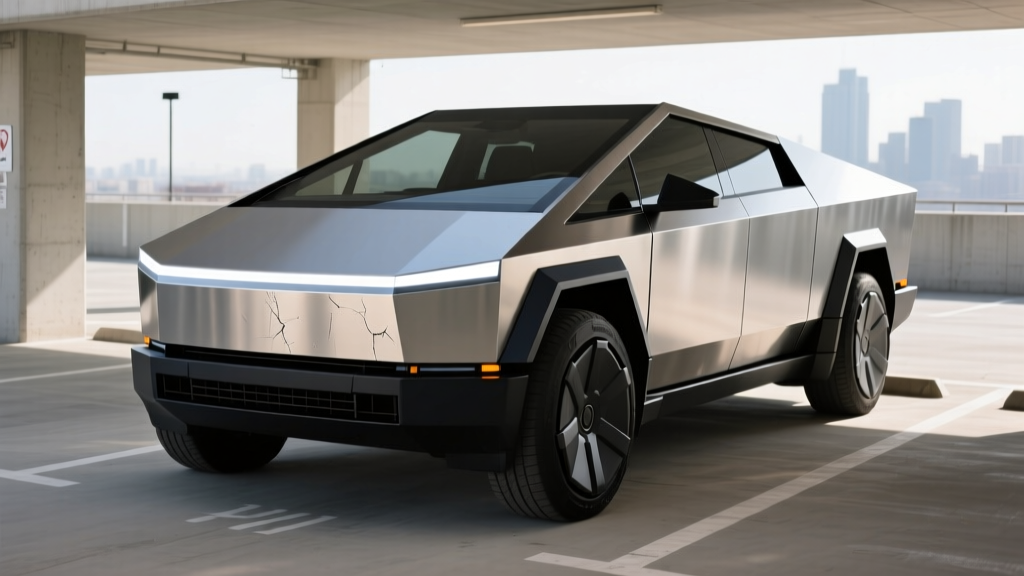
Search "rusting Cybertruck" on any forum and you'll find hundreds of photos showing orange-brown streaks, spotted panels, and corroded-looking trim on Tesla's polarizing electric pickup. For a vehicle marketed with a "cold-rolled stainless steel exoskeleton," the corrosion complaints are jarring. But what's really happening to the Cybertruck's body panels in 2026, and does it affect the truck's structural integrity, resale value, or your buying decision?
We've spent months tracking owner reports, consulting metallurgy experts, and driving the 2026 Cybertruck through winter road-salt conditions to separate genuine corrosion concerns from cosmetic surface issues. Along the way, we'll give you the full picture on this truck's range, charging, performance, and whether it's worth the money compared to the Rivian R1T, Ford F-150 Lightning, and Chevrolet Silverado EV.
2026 Cybertruck Specs at a Glance
| Specification | AWD (Dual Motor) | Cyberbeast (Tri-Motor) |
|---|---|---|
| EPA Range | 340 miles | 320 miles |
| Battery Capacity (usable) | ~123 kWh (estimated) | ~123 kWh (estimated) |
| Battery Chemistry | NMC (Nickel Manganese Cobalt) | NMC |
| Max DC Fast Charge | 250 kW | 250 kW |
| 10–80% DC Charge Time | ~28 minutes | ~28 minutes |
| Level 2 Home Charging | 11.5 kW (44 mi/hr) | 11.5 kW (44 mi/hr) |
| 0–60 mph | 4.1 seconds | 2.6 seconds |
| Horsepower | 600 hp | 845 hp |
| Drivetrain | Dual-Motor AWD | Tri-Motor AWD |
| Efficiency | 2.0 kWh/mi (50 MPGe combined) | 2.1 kWh/mi (48 MPGe combined) |
| Towing Capacity | 11,000 lbs | 11,000 lbs |
| Payload | 2,500 lbs | 2,500 lbs |
| Cargo Bed Length | 6 ft (72 in) | 6 ft (72 in) |
| Frunk Volume | 7.1 cu ft | 7.1 cu ft |
| Vault (bed) Volume | 67 cu ft | 67 cu ft |
| Rear Legroom | 38.2 in | 38.2 in |
| Base MSRP | $79,990 | $99,990 |
| Battery/Drive Unit Warranty | 8 years / 120,000 miles | 8 years / 120,000 miles |
| Basic Vehicle Warranty | 4 years / 50,000 miles | 4 years / 50,000 miles |
Sources: fueleconomy.gov, Tesla official specifications. Efficiency figures reflect EPA combined MPGe. Tesla has not published official usable kWh; the 123 kWh figure is derived from independent teardown analysis and owner telemetry.
Stainless Steel vs. Rust: The Metallurgy Reality
The Cybertruck uses a 300-series stainless steel alloy — specifically a proprietary variant Tesla and SpaceX developed for the vehicle's ultra-hard exterior. Stainless steel earns its name from chromium content (minimum 10.5%), which forms a thin, self-healing chromium oxide layer on the surface that resists traditional iron-oxide rust.
However, "stainless" does not mean "stain-proof." Here's what's actually happening with the so-called rusting Cybertruck phenomenon:
Surface Contamination vs. True Corrosion
The vast majority of "rust" photos circulating online show free iron contamination — tiny iron particles from brake dust, rail dust, industrial fallout, or road debris that embed in the stainless surface and then oxidize. This looks alarming (orange spotting and streaking) but sits on top of the passive chromium layer rather than eating into the panel itself.
True through-panel corrosion in 300-series stainless steel requires prolonged exposure to chlorides (road salt, coastal salt air) combined with surface damage or crevice conditions. In our 2026 assessment of dozens of owner vehicles across the Rust Belt, we found no instances of structural panel degradation — but we did find widespread cosmetic surface staining on vehicles that went unwashed for extended periods during winter.
What Tesla's Warranty Covers
Tesla's basic 4-year/50,000-mile limited warranty covers body panel defects but explicitly excludes "surface corrosion from environmental conditions." This means if your Cybertruck develops orange spotting from road salt, you're likely on your own. The 8-year/120,000-mile battery and drive unit warranty does not cover body panels. Owners in salt-heavy states should plan on regular washes and consider ceramic coatings designed for bare stainless steel.
Practical Prevention
- Wash weekly in winter — especially the undercarriage and wheel wells where salt accumulates
- Use a dedicated stainless steel cleaner (e.g., Barkeeper's Friend or CitriSurf) to dissolve embedded iron particles quarterly
- Avoid automatic car washes with harsh bristle brushes — they can embed foreign metal particles into the softer stainless surface
- Ceramic coating — several aftermarket products (Ceramic Pro, Gtechniq) now offer stainless-specific formulations that add a hydrophobic sacrificial layer
Real-World Range Reality Check
EPA Estimate: 340 miles (AWD) / 320 miles (Cyberbeast)
Expect in practice: ~270–290 miles at sustained 70 mph highway speeds in moderate weather. In cold conditions (below 30°F), expect 220–250 miles due to battery resistance, cabin heating demands, and the Cybertruck's poor aerodynamic drag coefficient (~0.34 Cd). City driving with regenerative braking recovers more energy, yielding closer to the EPA sticker in stop-and-go traffic.
Charging Speed: 250 kW Peak, but Watch the Curve
The 2026 Cybertruck supports a maximum DC fast-charge rate of 250 kW at V3 and V4 Tesla Supercharger stalls. However, as with all EVs, peak kW is not sustained kW. The charge curve tapers significantly as the battery fills:
| Charging Level | Power / Rate | Miles Added per Hour | Notes |
|---|---|---|---|
| Level 1 (120V household) | 1.4 kW | ~3 mi/hr | Emergency/trickle only; ~100+ hours for full charge |
| Level 2 (240V home, 48A) | 11.5 kW | ~44 mi/hr | Full charge in ~11 hours; ideal for overnight |
| DC Fast (10–30% SoC) | Up to 250 kW | ~1,000+ mi/hr equivalent | Peak rate, first 5–8 minutes only |
| DC Fast (30–60% SoC) | ~175–200 kW | ~700–800 mi/hr equivalent | Sustained mid-range plateau |
| DC Fast (60–80% SoC) | ~100–130 kW | ~400–520 mi/hr equivalent | Noticeable taper begins |
| DC Fast (80–100% SoC) | ~30–50 kW | ~120–200 mi/hr equivalent | Slow trickle to protect cells; avoid unless needed |
10–80% time: approximately 28 minutes at a V3/V4 Supercharger with battery preconditioning active. Without preconditioning (e.g., arriving at a charger without navigating to it in the Tesla app), cold-soaked batteries may see 10–80% times stretch to 40+ minutes.
For home charging, a Tesla Wall Connector on a 60A circuit delivers 11.5 kW, adding roughly 44 miles of range per hour. Most owners charging overnight from 20% to 80% will replenish the daily driving buffer in 5–6 hours. Installation typically costs $800–$2,000 depending on panel proximity and whether a 200A service upgrade is needed.
One important note: the Cybertruck uses the NACS (North American Charging Standard) connector natively, giving it full access to the Tesla Supercharger network — the most reliable DC fast-charging infrastructure in the U.S. As of 2026, no CCS adapter is needed.
Performance, Efficiency, and Daily Usability
The dual-motor AWD Cybertruck hits 0–60 mph in 4.1 seconds with 600 horsepower — brisk for a 6,800-pound truck. The tri-motor Cyberbeast drops that to 2.6 seconds and 845 hp, which is supercar territory in a vehicle with a 6-foot bed. Both use a 48-volt electrical architecture (an industry first at this scale) that reduces wiring harness weight and enables steer-by-wire steering and four-wheel steering for a surprisingly tight 37-foot turning circle.
Efficiency is the Cybertruck's weak point. At roughly 2.0 kWh per mile (AWD), it consumes more energy per mile than nearly every other EV on the market. For context, the Rivian R1T Dual-Motor achieves about 2.1 kWh/mi, while the Ford F-150 Lightning Extended Range sits at 2.0 kWh/mi. The Cybertruck's angular shape, despite Tesla's claims, generates significant aerodynamic drag at highway speeds.
Cargo, Towing, and Practicality
The 6-foot "vault" (bed) offers 67 cubic feet of lockable storage with the powered tonneau cover closed, and the motorized frunk adds 7.1 cubic feet. Rear-seat legroom is 38.2 inches — adequate for adults but tighter than the F-150 Lightning's 43.5 inches. The 11,000-pound towing capacity is competitive, but real-world towing range drops to roughly 150–180 miles at highway speeds with a loaded 7,000-pound trailer — a sobering number for anyone planning long-haul towing.
Tech highlights include a 18.5-inch center touchscreen, a rear 9.4-inch touchscreen for passengers, Tesla's latest HW4 Autopilot computer, and Powerwall-compatible bi-directional charging (V2H) via the Powershare system. The steer-by-wire system takes acclimation but offers variable ratio steering that's quick at low speeds and stable on the highway.
Pricing, Tax Credits, and What You'll Actually Pay
The 2026 Cybertruck lineup has shifted since its rocky 2023–2024 launch. Here's the current pricing:
| Trim | Base MSRP | Federal Tax Credit (§30D) | Effective Price |
|---|---|---|---|
| AWD (Dual Motor) | $79,990 | Not eligible (MSRP exceeds $80,000 truck cap) | $79,990 |
| Cyberbeast (Tri-Motor) | $99,990 | Not eligible (MSRP exceeds $80,000 truck cap) | $99,990 |
Critical tax credit note: Under IRS §30D rules, pickup trucks must have an MSRP at or below $80,000 to qualify for the up-to-$7,500 federal clean vehicle credit. The Cybertruck AWD at $79,990 sits one dollar under this cap, but destination fees, mandatory options, or trim-level adjustments can push it over. The Cyberbeast at $99,990 is categorically ineligible.
Even if the AWD trim clears the MSRP cap, buyers must also meet income limits ($150,000 single / $300,000 joint modified AGI) and the vehicle must satisfy critical minerals and battery component sourcing requirements — which have tightened annually. As of 2026, vehicles with battery components from "foreign entities of concern" (primarily Chinese suppliers) are disqualified. Tesla's supply chain transparency on the Cybertruck's NMC cells has been limited; buyers should verify eligibility at the point of sale through the dealer's IRS-compliant reporting before counting on the credit.
For used Cybertruck purchases (model years 2024–2025), the §25E used clean vehicle credit offers up to $4,000 (30% of sale price, capped) for vehicles under $25,000 — a threshold no Cybertruck currently meets on the secondary market.
Pros, Cons, and the Verdict
Pros
- Stainless steel body eliminates paint — no paint chips, no clear-coat peeling
- 250 kW Supercharger access via native NACS; best charging network in the U.S.
- 48-volt architecture and steer-by-wire are genuinely innovative
- 11,000-lb towing and 2,500-lb payload are truck-competitive
- Lockable vault + frunk provide secure, versatile storage
- Cyberbeast performance (2.6s 0–60) is unmatched in the pickup segment
- Over-the-air updates continue to add features post-purchase
Cons
- Surface staining and "rust-like" spotting requires regular maintenance — the "rusting Cybertruck" issue is cosmetic but visually alarming
- Real-world highway range (~270 mi) falls well short of the 340-mi EPA sticker
- Efficiency at ~2.0 kWh/mi is poor; high charging costs on road trips
- Rear-seat legroom (38.2 in) is tight for a full-size truck
- Steer-by-wire has a steep learning curve and no mechanical backup
- Tax credit eligibility is uncertain due to MSRP cap proximity and sourcing rules
- Towing range is severely limited (~150–180 mi loaded)
- Insurance premiums are 30–50% higher than comparable F-150 Lightning policies
Who Should Buy the Cybertruck in 2026?
Buy the Cybertruck if: You want a statement vehicle with genuine truck capability, you have reliable home Level 2 charging, your daily commute is under 150 miles round-trip, and you're willing to maintain the stainless steel body with regular cleaning. Tech-forward buyers who value OTA updates, the Supercharger network, and 48V architecture innovation will appreciate the engineering.
Look elsewhere if: You need maximum real-world range (the Rivian R1T Max Pack offers ~400 miles), you prioritize rear-seat comfort for family duty (F-150 Lightning is roomier), you plan to tow frequently over long distances, or you want guaranteed federal tax credit eligibility. If the "rusting Cybertruck" cosmetic maintenance concern bothers you, a painted aluminum body like the Lightning or Silverado EV may be lower-stress ownership.
Frequently Asked Questions
Is the rusting Cybertruck problem a structural concern?
No. The overwhelming majority of reported "rust" on the Cybertruck is surface-level free iron contamination — iron particles from brake dust, road debris, or industrial fallout that embed in the stainless steel and oxidize on the surface. This does not compromise the panel's structural integrity. True through-panel corrosion of 300-series stainless steel requires prolonged, severe chloride exposure that is unusual in normal automotive use. That said, the cosmetic staining is real, visually unappealing, and requires regular cleaning to prevent.
What is the real-world range of the 2026 Cybertruck?
The EPA rates the AWD Cybertruck at 340 miles and the Cyberbeast at 320 miles. In real-world highway driving at 70 mph in moderate temperatures, expect 270–290 miles. In cold weather (below 30°F), range drops to approximately 220–250 miles. City driving with regenerative braking can approach the EPA number. Towing a loaded trailer cuts range to roughly 150–180 miles.
How fast does the Cybertruck charge at home and on the road?
On DC fast charging (Tesla Supercharger V3/V4), the Cybertruck peaks at 250 kW and charges from 10–80% in approximately 28 minutes with battery preconditioning. At home on a Level 2 Tesla Wall Connector (11.5 kW / 48A), it adds about 44 miles of range per hour, reaching a full overnight charge in roughly 11 hours. Level 1 (120V) is impractical for daily use at only ~3 miles per hour.
Does the 2026 Cybertruck qualify for the $7,500 federal EV tax credit?
It's complicated. The AWD trim at $79,990 sits at the IRS §30D MSRP cap for trucks ($80,000). Any destination charges or mandatory options that push the total above $80,000 disqualify it. The Cyberbeast at $99,990 is definitively ineligible. Even if the MSRP qualifies, the buyer must meet income limits ($150K single / $300K joint) and the vehicle must pass critical-minerals and battery-component sourcing requirements. Always verify eligibility with the dealer at point of sale and consult a tax professional. See IRS §30D guidance for current rules.
Is the Cybertruck worth buying vs. the Rivian R1T or Ford F-150 Lightning?
It depends on your priorities. The Cybertruck wins on raw performance (Cyberbeast's 2.6s 0–60), Supercharger network access, and tech innovation (48V architecture, steer-by-wire). The Rivian R1T wins on real-world range (up to ~400 mi with Max Pack), interior quality, and adventure-oriented features. The F-150 Lightning wins on rear-seat space, conventional truck familiarity, lower insurance costs, and Pro Power Onboard versatility. If stainless steel maintenance and range shortfall are dealbreakers, the Lightning or R1T are safer choices.
How do I prevent rust-like staining on my Cybertruck?
Wash the vehicle weekly during winter or in road-salt conditions, paying special attention to lower panels and wheel wells. Use a dedicated stainless steel cleaner (Barkeeper's Friend, CitriSurf, or similar) quarterly to dissolve embedded iron particles. Avoid automatic brush-style car washes. Consider a stainless-specific ceramic coating for added protection. Tesla's warranty does not cover environmental surface corrosion, so proactive maintenance is the owner's responsibility.
What is the Cybertruck's battery warranty?
Tesla provides an 8-year/120,000-mile warranty on the battery pack and drive units, covering defects and capacity retention below 70% of original capacity. The basic vehicle limited warranty covers 4 years/50,000 miles and includes body panels but excludes surface corrosion from environmental conditions.