The "Rusted Cybertruck" Phenomenon: What Owners Are Actually Seeing
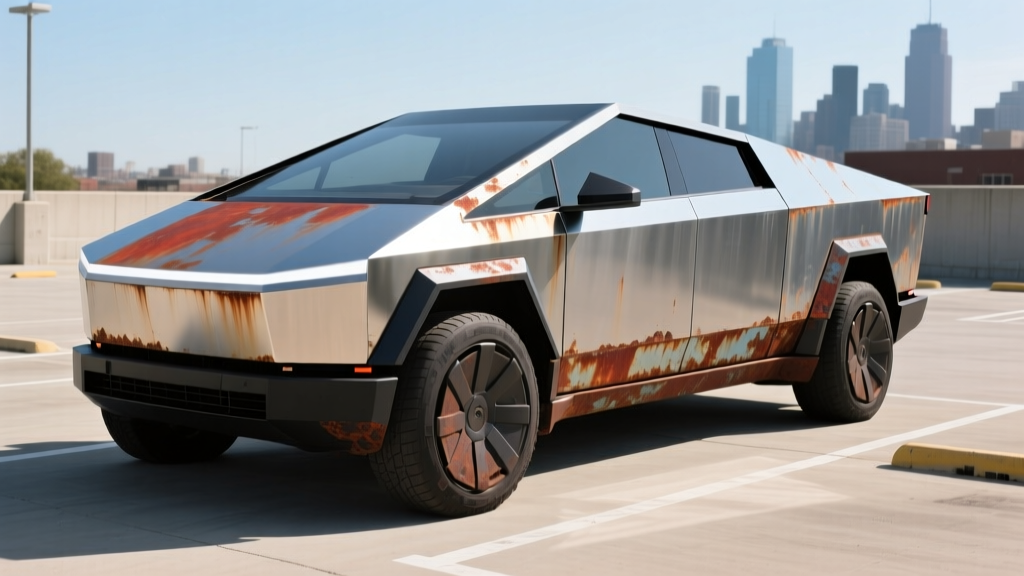
Search social media or EV forums long enough and you'll encounter photos labeled "rusted Cybertruck" — orange-brown streaks running down the angular stainless steel panels of Tesla's polarizing electric pickup. For a vehicle marketed with an exoskeleton of ultra-hard 30X cold-rolled stainless steel, the sight of any corrosion-like discoloration raises immediate questions about long-term durability and build quality.
As of early 2026, the Tesla Cybertruck has been in customer hands for roughly two years. Enough real-world data now exists to separate genuine material concerns from surface-level misunderstandings about stainless steel behavior. This review examines the corrosion reports in context, then delivers a complete ownership profile — range, charging, pricing, tax credits, and how the Cybertruck stacks up against the Ford F-150 Lightning and Rivian R1T.
The short verdict: what most people call "rust" on a Cybertruck is not structural corrosion of the stainless steel itself. It's typically one of three things — surface contamination from rail dust or brake dust, iron particle embedment from manufacturing or transport, or tea-staining from hard water and environmental deposits. That doesn't mean the truck is flawless. Panel gaps, seam sealing, and early-build quality remain legitimate concerns. Let's get into the data.
Stainless Steel vs. Rust: The Materials Science
Tesla's Cybertruck uses an alloy similar to 301-grade stainless steel for its exterior panels. Stainless steel earns its name from a passive chromium oxide layer that forms on the surface, preventing the iron in the alloy from oxidizing into iron oxide (rust). In controlled environments, this layer is self-repairing when exposed to oxygen.
However, several real-world factors can compromise that passive layer or create the appearance of rust without actual base-metal corrosion:
- Rail dust and iron particle embedment: During rail transport or manufacturing, microscopic iron particles from brakes, tracks, or tooling can embed in the stainless surface. These particles — not the panel itself — rust, creating orange spotting.
- Chloride exposure: Road salt (sodium chloride, calcium chloride) can attack the chromium oxide layer over time, particularly in crevices, seams, and around fasteners where the passive layer may be less robust.
- Galvanic interaction: Where stainless steel contacts dissimilar metals (aluminum trim, carbon steel fasteners), galvanic corrosion can occur at the junction points.
- Tea staining: A well-documented phenomenon in architectural stainless steel, this is a superficial brownish discoloration that doesn't affect structural integrity.
The takeaway: the Cybertruck's stainless panels are highly resistant to traditional body-panel rust-through. But the truck is not a monolith of stainless — it has conventional steel structural members underneath, aluminum components, various fasteners, and seam sealants that may behave differently over a 10-15 year ownership cycle. Long-term corrosion data on the Cybertruck specifically is still limited to roughly two years of field exposure.
2026 Cybertruck Specs: Range, Battery, and Efficiency
| Specification | AWD (Dual Motor) | Cyberbeast (Tri-Motor) |
|---|---|---|
| EPA Est. Range | 340 miles | 320 miles |
| Battery Capacity (usable) | ~123 kWh | ~123 kWh |
| Battery Chemistry | NMC (Nickel Manganese Cobalt) | NMC |
| Efficiency | ~48 kWh/100 mi (70 MPGe) | ~52 kWh/100 mi (65 MPGe) |
| 0-60 mph | 4.1 seconds | 2.6 seconds |
| Horsepower | 600 hp | 845 hp |
| Drivetrain | Dual-Motor AWD | Tri-Motor AWD |
| Towing Capacity | 11,000 lbs | 11,000 lbs |
| Payload | 2,500 lbs | 2,500 lbs |
| Cargo Bed Length | 6 ft (72 in) | 6 ft (72 in) |
| Cargo Volume (bed + frunk) | ~67 cu ft bed + ~7 cu ft frunk | ~67 cu ft bed + ~7 cu ft frunk |
| Wheelbase | 143.5 in | 143.5 in |
| Curb Weight | ~6,600 lbs | ~6,800 lbs |
Charging Speed and Infrastructure
| Charging Level | Power / Rate | Speed |
|---|---|---|
| Level 1 (120V household) | ~1.4 kW | ~3-4 miles per hour |
| Level 2 (240V home/public) | 11.5 kW (48A) | ~30-34 miles per hour |
| DC Fast Charge (peak) | 250 kW (CCS via adapter) / NACS native | 10-80% in ~30-35 min |
| DC Sustained (typical curve) | ~180-200 kW average 10-80% | ~200 mi added in 15 min |
The Cybertruck uses the NACS (North American Charging Standard) connector natively, giving it full access to Tesla's Supercharger network — the most reliable DC fast-charging infrastructure in North America as of 2026, with over 25,000 stalls. At a V3 or V4 Supercharger, the truck peaks at approximately 250 kW, though the large ~123 kWh battery and heavy vehicle mass mean the charge curve tapers significantly above 60% state of charge.
Expect a 10-80% session to take roughly 30-35 minutes under optimal conditions (battery preconditioned via navigation to a Supercharger). From 80-100%, charging slows dramatically — plan for an additional 25-30 minutes if you need a full charge. For CCS-equipped public chargers (Electrify America, EVgo), Tesla provides a NACS-to-CCS adapter, though charge speeds on non-Tesla networks may vary.
Home charging on a Level 2 Wall Connector at 11.5 kW will replenish the full battery in approximately 10-11 hours — practical for overnight charging if you drive under 250 miles daily. A full Level 2 installation typically costs $800-$2,000 depending on panel capacity and conduit run, assuming your home electrical panel has sufficient headroom (a 60A circuit is recommended for 48A continuous charging).
Pricing, Trims, and Federal Tax Credit Eligibility
| Trim | Base MSRP | As-Tested (typical options) | §30D Credit Eligibility |
|---|---|---|---|
| AWD (Dual Motor) | $79,990 | $82,000-$85,000 | Not eligible (MSRP exceeds $80,000 truck cap) |
| Cyberbeast (Tri-Motor) | $99,990 | $102,000-$105,000 | Not eligible (MSRP exceeds $80,000 truck cap) |
Here's a critical point many buyers miss: under current IRS §30D rules, the federal EV tax credit has an MSRP cap of $80,000 for trucks, vans, and SUVs (and $55,000 for sedans). The Cybertruck AWD starts at $79,990 — technically $10 under the cap — but once destination charges and any factory options push the vehicle above $80,000, it loses eligibility. In practice, most Cybertruck configurations ordered with common options (FSD, premium wheels, accessories) exceed the threshold.
Additional §30D requirements that further complicate eligibility:
- Buyer income caps: Modified AGI must not exceed $300,000 (joint), $225,000 (head of household), or $150,000 (individual).
- Battery sourcing: A percentage of critical minerals and battery components must be sourced from the US or free-trade-agreement countries. Tesla's supply chain has been shifting, but specific Cybertruck battery pack sourcing compliance varies by production batch.
- Point-of-sale transfer: If eligible, the credit can be applied at purchase rather than claimed on your tax return, reducing the effective purchase price immediately.
For the latest eligibility details, always check the IRS §30D guidance and the DOE's fueleconomy.gov tax credit lookup before purchasing. Tax professionals can confirm your specific eligibility.
Tech, Interior, and Driver Assistance
The Cybertruck's interior is minimalist even by Tesla standards — a single 18.5-inch front touchscreen handles virtually all vehicle functions, with a smaller 9.4-inch rear screen for passengers. There are no physical stalks for turn signals or wipers; these are integrated into the steering wheel and touchscreen, a design choice that continues to divide owners.
Notable tech features:
- Steer-by-wire with variable ratio (no mechanical linkage between wheel and rack)
- 48-volt electrical architecture (a first for a production vehicle at this scale)
- Armor glass (laminated composite, though early-build units had documented fitment issues)
- Bioweapon Defense Mode (HEPA cabin filtration)
- Powered tonneau cover with integrated bed lighting
- Air suspension with ~12 inches of travel and adaptive damping
- Autopilot standard; FSD (Supervised) available as a $8,000 option or $99/month subscription
Notable drawbacks:
- Steer-by-wire and yoke steering require a significant adaptation period; some owners report fatigue on long drives
- Wiper and turn-signal controls on the wheel/touchscreen are unintuitive for many drivers
- Rear visibility is limited; the tonneau cover blocks the rear window entirely when closed
- Panel gap inconsistency remains a documented issue, particularly on early-build units
- Stainless steel fingerprint magnet — the uncoated exterior shows every smudge and requires specific cleaning products
Cybertruck vs. F-150 Lightning vs. Rivian R1T
| Attribute | Tesla Cybertruck AWD | Ford F-150 Lightning Ext. Range | Rivian R1T Dual-Motor Max |
|---|---|---|---|
| EPA Range | 340 mi | 320 mi | 352 mi |
| Battery (usable) | ~123 kWh | ~131 kWh | ~149 kWh |
| 0-60 mph | 4.1 sec | ~5.0 sec | ~3.5 sec (Max Pack) |
| Towing | 11,000 lbs | 10,000 lbs | 11,000 lbs |
| DC Fast Charge Peak | 250 kW | 150 kW | 220 kW |
| 10-80% Time | ~30-35 min | ~41 min | ~30 min |
| Bed Length | 6 ft | 5.5 ft | 4.5 ft (standard bed) |
| Base MSRP | $79,990 | $69,995 | $83,900 |
| §30D Eligible | Borderline (see above) | Yes (select configs) | Borderline (MSRP cap) |
| Battery Warranty | 8 yr / 120,000 mi | 8 yr / 100,000 mi | 8 yr / 175,000 mi |
The Cybertruck wins on DC charging speed (thanks to Supercharger access and 250 kW peak) and bed length, while the R1T leads in battery warranty coverage and off-road capability. The F-150 Lightning offers the lowest entry price and the most conventional truck ergonomics. For corrosion concerns specifically, the F-150 Lightning uses a traditional steel body with conventional paint — susceptible to standard rock-chip rust over years, but well-understood and easily repaired. The Rivian R1T uses aluminum body panels, which don't rust but can corrode galvanically if damaged.
Warranty and Long-Term Ownership
Tesla provides the following warranty coverage for the 2026 Cybertruck:
- Basic Vehicle: 4 years / 50,000 miles
- Battery & Drive Unit: 8 years / 120,000 miles (minimum 70% capacity retention)
- Corrosion (perforation): Coverage details vary; Tesla's warranty historically covers body panel perforation (rust-through), not surface discoloration or cosmetic staining
For the "rusted Cybertruck" concern specifically, this matters. If you see orange spotting on the stainless panels, it is almost certainly surface contamination — not perforation — and would not be covered under a corrosion warranty regardless of manufacturer. Tesla has acknowledged iron particle embedment issues on early builds and, in some cases, offered detailing or pickling paste treatments to remove embedded particles. If you're buying in 2026, inspect the panels carefully at delivery and document any discoloration before signing off.
Battery longevity projections based on Tesla's NMC cell data suggest approximately 10-15% degradation over 150,000-200,000 miles under normal use patterns. The 8-year/120,000-mile battery warranty with a 70% retention floor provides a reasonable safety net. Replacement cost for the full battery pack, if out of warranty, is estimated at $15,000-$25,000 based on current NMC cell pricing and pack architecture.
Pros
- Class-leading DC fast charging (250 kW + Supercharger network)
- 6-foot bed with powered tonneau and 11,000-lb towing
- Stainless steel body panels resist traditional rust-through
- Tri-motor Cyberbeast delivers supercar-level acceleration (2.6 sec 0-60)
- 48V architecture and steer-by-wire are engineering milestones
- Air suspension with significant ground clearance adjustability
Cons
- Surface staining and iron embedment create "rust" appearance
- Touchscreen-only wiper/turn signal controls are distracting
- Real-world highway range significantly below EPA (260-290 mi vs 340 mi)
- Panel gaps and build consistency remain concerns
- Tax credit eligibility is borderline or unavailable for most configs
- Yoke steering and steer-by-wire polarize drivers
- Fingerprint-prone stainless exterior requires frequent maintenance
Who Should Buy the Cybertruck in 2026?
Choose the Cybertruck if: You need a full-size electric truck with best-in-class DC charging speed, want maximum Supercharger network access for road trips, value the 6-foot bed and 11,000-lb towing capacity, and are comfortable with unconventional ergonomics. The stainless steel body, despite the surface staining issue, offers genuine corrosion resistance for the panels themselves — relevant if you live in the Rust Belt or coastal salt-air environments.
Choose the F-150 Lightning if: You want a more conventional truck experience, need a lower entry price (starting ~$70K), prefer physical controls and traditional visibility, and value a dealership service network for body and mechanical work.
Choose the Rivian R1T if: You prioritize off-road capability, want the longest battery warranty (8yr/175,000 mi), prefer a more premium interior, and don't need the longest bed.
Frequently Asked Questions
Does the Cybertruck actually rust?
The stainless steel body panels themselves are highly resistant to traditional rust-through. What owners report as "rust" is typically iron particle embedment from manufacturing or transport, rail dust contamination, or tea staining — superficial discoloration that can be removed with stainless steel pickling paste or iron-remover detailing products. The underlying structural steel frame and non-stainless components are conventionally treated but long-term data is limited.
What is the real-world range of the Cybertruck?
The EPA rates the AWD at 340 miles and the Cyberbeast at 320 miles. Real-world highway driving at 70-75 mph yields approximately 260-290 miles (AWD) or 240-270 miles (Cyberbeast). Cold weather below 30°F can reduce range by an additional 15-25%. Towing at or near the 11,000-lb maximum will cut range roughly in half.
How fast does the Cybertruck charge at home and on the road?
At home on a Level 2 (240V/48A) charger, the Cybertruck adds approximately 30-34 miles of range per hour, fully charging in 10-11 hours. On a Tesla Supercharger, it peaks at 250 kW DC, achieving a 10-80% charge in approximately 30-35 minutes with a preconditioned battery.
Does the Cybertruck qualify for the $7,500 federal EV tax credit?
Eligibility is borderline. The AWD base MSRP of $79,990 is technically under the $80,000 truck cap, but destination charges and options typically push it over. The Cyberbeast at $99,990 does not qualify. Additionally, buyer income caps ($300K joint / $150K individual) and battery critical-mineral sourcing requirements apply. Always verify current eligibility at fueleconomy.gov and consult a tax professional.
Is the Cybertruck worth buying vs. the F-150 Lightning and Rivian R1T?
It depends on your priorities. The Cybertruck leads in DC charging speed and Supercharger access, making it the strongest road-trip truck. The F-150 Lightning is more affordable and conventional. The Rivian R1T offers better off-road capability and battery warranty. For corrosion specifically, none of these trucks are immune — but the Cybertruck's stainless panels resist perforation better than painted steel, even if surface staining is a cosmetic nuisance.
How should I maintain the Cybertruck's stainless steel exterior?
Tesla recommends regular washing with mild automotive soap and microfiber cloths. Avoid abrasive pads or steel wool. For iron particle removal, use a dedicated iron-decontamination spray (like CarPro IronX or similar). For stubborn staining, a stainless steel pickling paste can restore the passive chromium oxide layer. Applying a ceramic coating designed for bare stainless can reduce fingerprint accumulation and environmental staining. Wash frequently in winter if exposed to road salt.