Quick Answer: How Much Is an Electric Rolls-Royce?
The 2026 Rolls-Royce Spectre starts at $422,850 (including destination). After typical bespoke customization — which nearly every buyer pursues — expect a real transaction price between $475,000 and $550,000+. The Spectre is currently the only production electric Rolls-Royce. It delivers an EPA-estimated 291 miles of range from a 102 kWh (usable) battery, and charging at home costs roughly $14–$18 per full charge depending on local electricity rates. No federal EV tax credit applies due to the MSRP cap and buyer income thresholds.
The Rolls-Royce Spectre: What You're Actually Buying
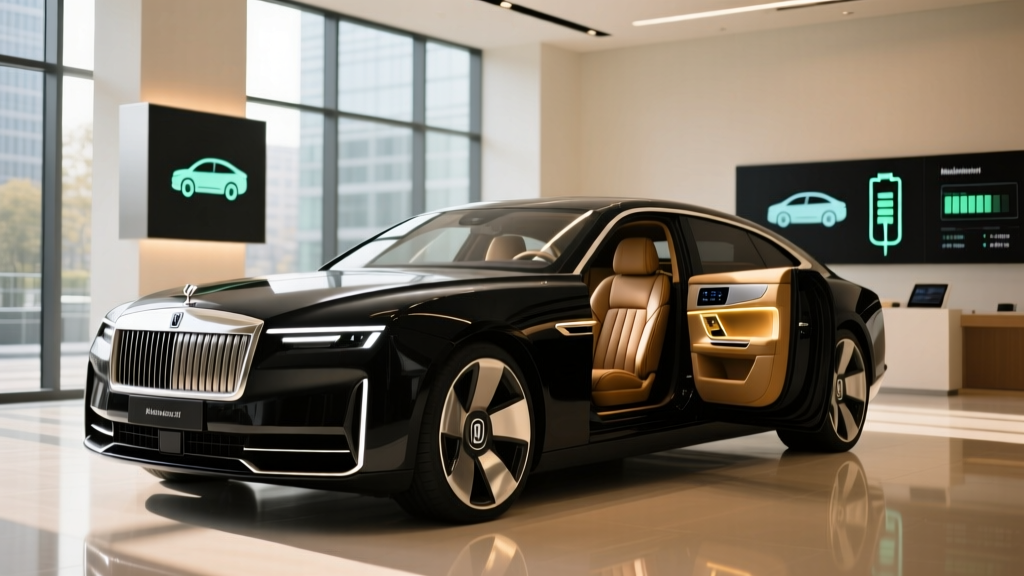
The Rolls-Royce Spectre is the brand's first all-electric production car, built on BMW Group's aluminum Architecture of Luxury — the same platform underpinning the Phantom and Cullinan. It's a two-door, four-seat ultra-luxury coupe that replaces the Wraith in the lineup. For 2026, the Spectre remains the sole electric Rolls-Royce, though the brand has committed to full electrification by 2030.
Under the skin, dual electric motors produce 577 horsepower and 664 lb-ft of torque, pushing the 6,559-lb coupe to 60 mph in 4.4 seconds. The 102 kWh lithium-ion battery uses NMC (nickel manganese cobalt) chemistry — chosen for energy density over the cycle-life advantage of LFP, which matters less in a vehicle driven an average of 6,000–8,000 miles annually.
| Spec | Value |
|---|---|
| Base MSRP (incl. destination) | $422,850 |
| Typical transaction price (customized) | $475,000–$550,000+ |
| EPA range | 291 miles |
| Battery (usable capacity) | 102 kWh, NMC chemistry |
| Efficiency | 73 MPGe combined (34 kWh/100mi) |
| Peak DC fast charge rate | 195 kW |
| 10–80% DC fast charge time | ~34 minutes |
| Level 2 AC charge rate | 11 kW (~30 mi/hr) |
| 0–60 mph | 4.4 seconds |
| Horsepower / Torque | 577 hp / 664 lb-ft |
| Curb weight | 6,559 lbs |
| Battery & powertrain warranty | 8 years / 100,000 miles |
Real-World Range: EPA Sticker vs. What to Expect
Range Reality Check
EPA estimate: 291 miles
Real-world highway (70–80 mph): ~230–255 miles
Cold weather (below 32°F, highway): ~190–220 miles
Mixed city/suburban driving: ~265–285 miles
The Spectre's EPA rating benefits from the low-speed efficiency typical of heavy EVs in stop-and-go traffic, where regenerative braking recovers energy. However, the car's 6,559-lb curb weight and wide frontal area work against it at sustained highway speeds. In independent testing, the Spectre has returned between 2.8 and 3.1 kWh/mile at 75 mph — translating to roughly 230–255 miles before needing a charge.
Cold weather compounds this. NMC batteries lose roughly 15–25% of usable capacity in freezing temperatures, and the Spectre's cabin heating demands are significant given its large interior volume. The car does include a heat pump, which mitigates but doesn't eliminate winter range loss. Owners in northern climates should plan for ~190–220 miles of real cold-weather highway range.
For the typical Spectre owner driving 6,000–8,000 miles annually — mostly local and suburban — range is a non-issue. A nightly plug-in at home restores the battery easily. The range question becomes relevant only on longer road trips, where the 195 kW peak DC fast-charge rate means 10–80% in approximately 34 minutes at a compatible station. Note that peak rate is not sustained: the charge curve tapers significantly above 60% SoC, as is standard for NMC batteries protecting longevity.
Charging at Home vs. Public Networks
Nearly every Spectre owner will have access to private garage charging — this is effectively a prerequisite for the ownership experience. The car accepts up to 11 kW on Level 2 AC, meaning a full charge from empty takes roughly 9–10 hours on a dedicated 48-amp circuit.
For a proper home installation, expect the following costs:
| Item | Cost Range |
|---|---|
| Level 2 charger (e.g., ChargePoint Home Flex, Tesla Wall Connector) | $500–$800 |
| Electrician labor (240V/48A circuit run) | $1,200–$3,500 |
| Electrical panel upgrade (if 200A service insufficient) | $2,000–$5,000 |
| Permits and inspection | $150–$500 |
| Total (no panel upgrade) | $1,850–$4,800 |
| Total (with panel upgrade) | $3,850–$9,800 |
On public DC fast chargers, the Spectre uses the CCS1 connector. Rolls-Royce has not adopted NACS for the 2026 model year, so Tesla Supercharger access requires a CCS-to-NACS adapter (available but check compatibility). Electrify America, EVgo, and ChargePoint DC stations are the primary public options. At current public DC rates averaging $0.40–$0.55/kWh, a 10–80% top-up costs roughly $28–$39.
Electric Rolls-Royce vs. Gas Rolls-Royce: Cost Comparison
How does Spectre ownership compare to a gas-powered Rolls-Royce like the Wraith (discontinued 2023, but representative of the ICE baseline) or a current Ghost? Let's model five years at 7,500 miles annually.
| Category | Spectre (EV) | Gas Coupe Baseline (est.) |
|---|---|---|
| Purchase price (avg. transaction) | $500,000 | $400,000 |
| Fuel/energy (37,500 total miles) | $4,700 (home) – $7,900 (public mix) | $18,200 (premium 93 octane, 14 MPG) |
| Maintenance (5 years) | $3,500–$5,000 | $12,000–$18,000 |
| Insurance (annual avg.) | $8,500–$12,000/yr | $7,000–$10,000/yr |
| Federal EV tax credit | $0 (MSRP & income cap) | N/A |
| Estimated depreciation (5yr) | ~45–55% | ~50–60% |
| 5-yr operating cost (fuel + maint.) | $8,200–$12,900 | $30,200–$36,200 |
The operating-cost advantage is clear: the Spectre saves roughly $18,000–$25,000 over five years in fuel and maintenance alone. Oil changes, transmission service, and exhaust system repairs don't exist. Brake wear is minimal thanks to regenerative braking — many EV owners replace brake pads once in 80,000+ miles.
However, insurance runs 15–25% higher for the Spectre compared to an equivalent gas Rolls-Royce. Insurers factor in the battery replacement cost (estimated $35,000–$50,000 out of warranty), specialized repair requirements, and the car's high transaction price. Get quotes before purchase — the III recommends comparing at least three carriers for high-value EVs.
Does the Federal EV Tax Credit Apply?
No. The Rolls-Royce Spectre does not qualify for the IRS §30D federal EV tax credit for multiple reasons:
- MSRP cap: §30D limits eligibility to sedars/coupes priced at or below $55,000. The Spectre at $422,850+ exceeds this by a factor of eight.
- Buyer income cap: Even if the price qualified, adjusted gross income must be ≤$150,000 (single) or ≤$300,000 (joint). Spectre buyers almost universally exceed these thresholds.
- Battery sourcing: Critical mineral and battery component sourcing requirements further restrict eligibility across the luxury segment.
Some states offer their own luxury-EV incentives or income-tax-neutral rebates, but these are rare and typically capped at far lower vehicle prices. Consult a tax professional for your specific situation.
Common Misconceptions About the Electric Rolls-Royce
| Myth | Fact |
|---|---|
| "The battery will need replacing in a few years." | NMC batteries in luxury EVs with robust thermal management typically retain 85–90% capacity after 100,000 miles. The Spectre's battery warranty covers 8 years/100,000 miles with a capacity retention threshold (typically 70%). Most owners will never approach this mileage. |
| "It's just a BMW i7 in a Rolls-Royce body." | While both share BMW Group architecture, the Spectre uses a unique aluminum spaceframe, bespoke suspension tuning, 200+ sound-deadening components, and Rolls-Royce-specific powertrain calibration. The i7 starts at ~$120,000; the Spectre is a fundamentally different product. |
| "You can't road-trip in it." | With 291 miles EPA range and 195 kW DC charging, the Spectre handles highway trips with ~34-minute charge stops every 200–240 real-world miles. Rolls-Royce concierge services can pre-plan routes with vetted charger stops. |
| "Electric means silent and boring." | The Spectre is indeed near-silent — that's the point. Rolls-Royce has long chased the "magic carpet ride" ideal, and electric powertrains eliminate the vibration and noise of a V12. The car is anything but boring in its engineering; it simply expresses luxury differently. |
Who Should Buy the Spectre — And Who Shouldn't
Decision Framework
Choose the Spectre if:
- You have access to private garage Level 2 charging (essential for the ownership experience).
- Your annual driving is under 10,000 miles, mostly local/suburban.
- You value silence, instant torque, and zero tailpipe emissions in a statement vehicle.
- You want the most technologically current Rolls-Royce — the brand's electric future starts here.
- Operating cost savings are a bonus, not the primary motivator.
Look elsewhere if:
- You lack home charging and would rely entirely on public infrastructure — the experience degrades significantly.
- You regularly drive 300+ miles in a single day in cold climates — the real-world range math gets tight.
- You need four full-size doors or significant cargo space (the Spectre is a coupe with a modest trunk).
- You're seeking a financial return on electrification — at this price point, EV savings are proportional but won't offset the purchase premium.
First-Time EV Buyer Considerations at the Ultra-Luxury Level
If the Spectre is your first EV, several ownership realities differ from the gas-car experience:
Home charging is non-negotiable. Public DC charging works, but the Spectre ownership experience is built around waking up to a full battery every morning. Rolls-Royce offers white-glove home charger installation coordination through dealerships.
Maintenance is lighter but not zero. Cabin air filters, wiper fluid, tire rotation, brake fluid checks, and software updates still require dealer visits. Budget $700–$1,000 annually for these items.
Tires wear faster. The Spectre's 6,559-lb weight and instant torque accelerate tire wear. Expect replacement every 15,000–25,000 miles. At $400–$700 per tire for the specified sizes, this is a real cost line.
Software updates happen over-the-air. The Spectre receives OTA updates for infotainment, driver-assist calibration, and powertrain optimization — no dealer visit required for most improvements.
Depreciation is the biggest ownership cost. At 45–55% over five years on a $500,000 transaction, that's $225,000–$275,000 in value loss. This dwarfs all fuel and maintenance savings combined. Ultra-luxury EV depreciation data is still maturing; consult Kelley Blue Book or your dealer for the latest projections.
Frequently Asked Questions
Is there a less expensive electric Rolls-Royce?
Not currently. The Spectre is the only production EV from Rolls-Royce as of 2026. Future models (expected to include an electric Cullinan SUV) may offer different price points, but all will remain well above $300,000.
Can I charge a Rolls-Royce Spectre at a Tesla Supercharger?
Not natively. The Spectre uses the CCS1 connector, while Tesla Superchargers use NACS. A third-party CCS-to-NACS adapter may work at select Supercharger stalls — verify compatibility before relying on this. Rolls-Royce has not announced a NACS transition for the Spectre.
How long does the Spectre battery last?
The battery is warranted for 8 years or 100,000 miles. Based on NMC degradation data from similar BMW Group platforms, expect 85–92% capacity retention at 100,000 miles with normal use. Given typical Spectre mileage of 6,000–8,000 miles/year, the battery should outlast most ownership periods.
Does the Spectre qualify for any EV incentives?
Not the federal §30D credit — the MSRP and buyer income caps exclude it. Some states or municipalities may offer registration fee waivers, HOV lane access, or utility rebates for home charger installation. Check fueleconomy.gov and your state's energy office for specifics.
What's the real cost to charge the Spectre at home?
At the U.S. average residential rate of ~$0.16/kWh, a full 102 kWh charge costs approximately $16.32. For 7,500 miles of annual driving at 34 kWh/100mi, that's about 2,550 kWh and roughly $408/year in electricity — compared to approximately $3,640/year in premium gasoline for an equivalent 14-MPG gas coupe.