Is the Rolls-Royce Spectre Electric? The Quick Answer
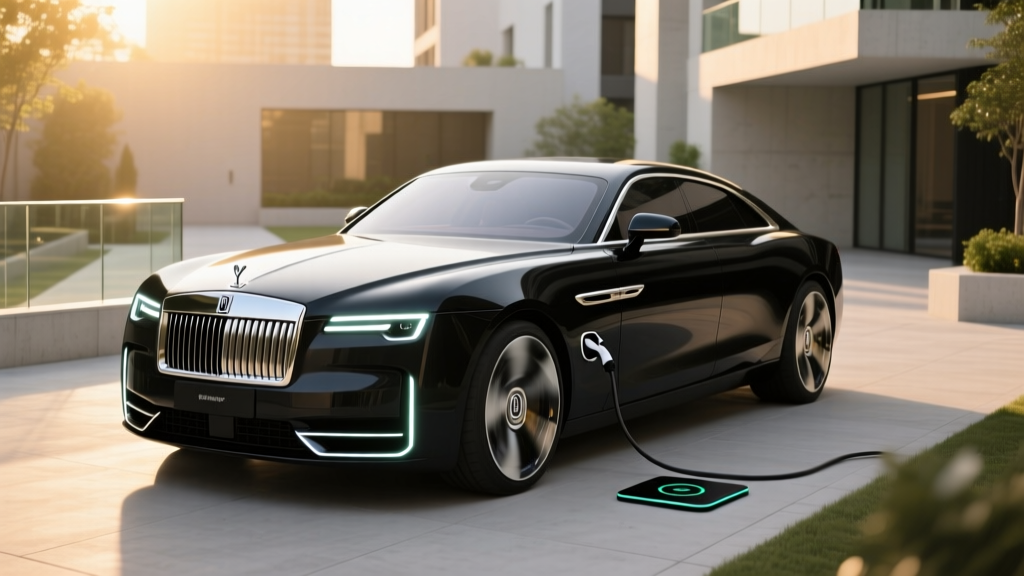
Yes — the Rolls-Royce Spectre is fully electric. It is a battery-electric vehicle (BEV) with no internal combustion engine, no hybrid system, and no range extender. The Spectre uses a 102 kWh (usable) lithium-ion battery pack with NMC (nickel manganese cobalt) chemistry, dual electric motors producing 577 horsepower, and carries an EPA-estimated range of 260 miles. The starting MSRP for the 2026 model year is approximately $420,000. It charges via a CCS1 connector at up to 195 kW DC fast charging, reaching 10–80% in roughly 34 minutes under ideal conditions.
Spectre EV Specs: Battery, Range, and Performance by the Numbers
The Spectre sits on Rolls-Royce's all-aluminum Architecture of Luxury platform, which was designed from the outset to accommodate battery-electric powertrains. Here are the core specifications every prospective buyer should know:
| Specification | 2026 Rolls-Royce Spectre |
|---|---|
| Powertrain | Dual-motor AWD, fully electric (BEV) |
| Horsepower | 577 hp |
| Torque | 664 lb-ft |
| 0–60 mph | 4.4 seconds |
| Battery Capacity (usable) | 102 kWh, NMC chemistry |
| EPA Range | 260 miles |
| Efficiency | 73 MPGe combined |
| Max DC Fast Charge Rate | 195 kW (CCS1) |
| 10–80% DC Fast Charge | ~34 minutes |
| Level 2 AC Charging | 22 kW onboard charger (~5.5 hours 0–100%) |
| Base MSRP | ~$420,000 |
| Battery Warranty | 8 years / 100,000 miles |
Real-World Range vs. EPA Estimate
The EPA rates the Spectre at 260 miles. In real-world highway driving at 75 mph with moderate temperatures, expect approximately 220–240 miles before needing to charge. In cold weather (below 30°F), range can drop to 180–200 miles due to battery heating demands and cabin climate load. The Spectre does include a heat pump, which mitigates some cold-weather loss compared to resistive heating systems, but the large cabin volume and heavy vehicle weight (over 6,500 lbs) work against efficiency. Plan road trips around 180–200 miles of usable range to maintain a comfortable buffer.
Charging the Spectre: Home, Public, and What You Actually Need
Owning a 6,500-pound electric luxury coupe requires a deliberate charging strategy. The Spectre's 102 kWh battery is one of the largest in any production passenger vehicle, meaning charging times are longer than smaller-battery EVs even at the same power levels.
| Charging Level | Power | Miles Added per Hour | Full Charge Time (0–100%) |
|---|---|---|---|
| Level 1 (120V household) | ~1.4 kW | ~3 mi/hr | ~73 hours (impractical) |
| Level 2 (240V, 48A home charger) | ~11.5 kW | ~25 mi/hr | ~10 hours |
| Level 2 (240V, 80A / 22 kW onboard) | ~19.2 kW | ~42 mi/hr | ~5.5 hours |
| DC Fast Charge (peak 195 kW) | 195 kW | ~430 mi/hr (peak) | 10–80% in ~34 min |
Home charging is essential for Spectre ownership. Level 1 charging on a standard 120V outlet adds only about 3 miles of range per hour — completely inadequate for a 102 kWh battery. You will need a Level 2 home charger. The Spectre supports up to a 22 kW onboard AC charger, which is among the fastest in any EV. To take full advantage, you need an 80-amp hardwired Level 2 station on a 100-amp circuit. Most homes will require an electrical panel upgrade (200-amp service minimum) and professional installation.
DC fast charging reality check: The Spectre peaks at 195 kW, but like all EVs, it does not sustain that rate for the entire session. The charge curve tapers significantly above 80% State of Charge (SoC) to protect the battery. A typical 10–80% session takes about 34 minutes, but charging from 80–100% can add another 30+ minutes. For road trips, plan stops at 150+ kW CCS1 stations (Electrify America, EVgo) and charge to 80% to minimize time spent plugged in.
The Spectre uses a CCS1 connector for DC fast charging. Rolls-Royce has not adopted the Tesla NACS standard for this model. If you rely on Tesla Superchargers, you would need an approved CCS-to-NACS adapter, and compatibility at Supercharger stalls is not guaranteed for non-Tesla vehicles — check the Tesla app for real-time availability.
Spectre vs. Gas Luxury Coupes: Cost and Experience Comparison
The most direct comparison for the Spectre is the now-discontinued Rolls-Royce Wraith (the brand's previous V12 grand coupe) or a Bentley Continental GT. Here's how the Spectre stacks up against a comparable V12 luxury coupe on key ownership metrics:
| Metric | Rolls-Royce Spectre (BEV) | V12 Luxury Coupe (Gas Baseline) |
|---|---|---|
| Powertrain | Dual electric motor, 577 hp | 6.0L twin-turbo V12, ~624 hp |
| 0–60 mph | 4.4 sec | ~3.9 sec |
| Range | 260 mi (EPA) | ~330 mi (16 gal × 21 mpg) |
| Fuel/Energy Cost per Mile | ~$0.06–$0.12 (home/public charging) | ~$0.22–$0.30 (premium fuel) |
| Annual "Fuel" Cost (12,000 mi) | ~$720–$1,440 | ~$2,640–$3,600 |
| Oil Changes | None | 2–3× per year (~$600–$1,200/yr) |
| Drivetrain Maintenance | Minimal (no transmission, no exhaust) | $2,000–$5,000+ annually |
| Noise, Vibration, Harshness | Near-silent (a Rolls-Royce hallmark) | V12 refinement, but audible |
| Federal EV Tax Credit (§30D) | Not eligible (MSRP exceeds $55,000 cap) | N/A |
Tax credit note: The Spectre does not qualify for the IRS §30D federal EV tax credit. The credit has an MSRP cap of $55,000 for sedans and $80,000 for SUVs/vans/pickups. At $420,000+, the Spectre far exceeds these limits. Additionally, buyer income caps ($150,000 single / $300,000 joint AGI) would disqualify most buyers regardless. Do not factor any federal incentive into your purchase calculation for this vehicle.
The electric powertrain is, in many ways, the ideal Rolls-Royce drivetrain. The brand has always prioritized silent, effortless, torque-rich propulsion — qualities that electric motors deliver inherently. The Spectre's 664 lb-ft of instant torque and near-total silence at speed fulfill the "magic carpet ride" ethos better than any V12 could. Performance is not the point; serenity is.
Total Ownership Cost: What Does It Actually Cost to Run a Spectre?
| Cost Category | Year 1 | Year 2 | Year 3 | Year 4 | Year 5 | 5-Year Total |
|---|---|---|---|---|---|---|
| Purchase Price (base) | $420,000 | $420,000 | ||||
| Home Charger Install (Level 2, 80A) | $2,500–$5,000 | — | — | — | — | $2,500–$5,000 |
| Electricity (12,000 mi/yr) | $1,080 | $1,080 | $1,080 | $1,080 | $1,080 | $5,400 |
| Insurance (estimated) | $8,000 | $7,500 | $7,000 | $6,500 | $6,000 | $35,000 |
| Maintenance | $500 | $800 | $500 | $1,200 | $800 | $3,800 |
| Estimated Depreciation (40% over 5 yrs) | — | $168,000 | ||||
| 5-Year Total Cost of Ownership | ~$634,700–$637,200 | |||||
Key cost insights:
- Depreciation is the dominant cost. Ultra-luxury vehicles typically lose 35–50% of their value in five years. At a $420,000 purchase price, a 40% depreciation means losing ~$168,000 in value. This dwarfs all operating costs combined.
- Insurance is steep. Expect $6,000–$10,000+ annually depending on your location, driving record, and coverage levels. Specialty insurers (Hagerty, Chubb) may offer better rates for collector-grade vehicles.
- Electricity savings are real but marginal at this price point. You'll save roughly $1,500–$2,500 per year in "fuel" compared to a V12 coupe — meaningful in percentage terms for operating costs, but a rounding error against the purchase price.
- Maintenance is dramatically lower than a V12. No oil changes, no spark plugs, no transmission fluid, no exhaust system. Brake wear is reduced thanks to regenerative braking. Budget $500–$1,200 annually for cabin filters, wiper fluid, tire rotation, and software updates.
Common Misconceptions About the Spectre
| Myth | Fact |
|---|---|
| "The Spectre is a hybrid or has a gas backup engine." | False. The Spectre is a pure BEV with no internal combustion engine whatsoever. There is no range extender. |
| "It qualifies for the $7,500 EV tax credit." | False. The §30D credit caps MSRP at $55,000 for cars. The Spectre starts at ~$420,000 and is categorically ineligible. Consult the IRS guidelines for details. |
| "260 miles of range isn't enough for a luxury car." | Context matters. The average American drives ~37 miles per day (fueleconomy.gov). For daily use, 260 miles is more than sufficient. For road trips, plan charging stops every 180–200 miles. |
| "Electric Rolls-Royces will break down or have battery issues." | The battery is warrantied for 8 years/100,000 miles. Rolls-Royce includes a comprehensive maintenance program. Electric drivetrains have fewer moving parts than V12 engines, reducing mechanical failure risk. |
| "I can charge it on any Tesla Supercharger." | Not without an adapter, and even then, compatibility varies. The Spectre uses CCS1. Some Tesla Supercharger stations now accept non-Tesla CCS vehicles via the Tesla app, but coverage is not universal. |
Real-World Ownership: Who Should (and Shouldn't) Buy the Spectre
The Spectre is not a practical EV in the conventional sense. It is a statement vehicle for buyers who already have charging infrastructure, who prioritize refinement over range, and who understand the economics of ultra-luxury ownership. Here's a decision framework:
Choose the Rolls-Royce Spectre If:
- You have reliable Level 2 home charging (garage or dedicated parking with a 240V circuit).
- Your daily driving is under 150 miles and you want the quietest, smoothest grand touring experience available.
- You value instant torque and silence over 0–60 bragging rights.
- You understand that depreciation, not electricity cost, is the primary ownership expense.
- You want a coachbuilt-level luxury coupe with zero tailpipe emissions and no visits to a gas station.
- You already own or have access to a second vehicle for longer road trips where charging logistics are inconvenient.
Reconsider If:
- You live in an apartment or condo without charging access and cannot install a Level 2 charger.
- You frequently drive 250+ miles in a single day and don't want to plan around DC fast-charger availability.
- You live in an area with limited public CCS1 charging infrastructure (check AFDC's station locator).
- You're looking for the most range-per-dollar — the Spectre's 260 miles at $420,000 is $1,615 per mile of range, versus ~$300/mile for a mainstream EV.
- You need rear-seat practicality or cargo space — the Spectre is a 2-door coupe with limited trunk volume.
What First-Time EV Buyers Need to Know Before Purchasing
If the Spectre is your first EV, here are the fundamentals that differ from gas-car ownership:
- kW vs. kWh: kW (kilowatts) measures charging power — how fast energy flows into the battery. kWh (kilowatt-hours) measures battery capacity — how much energy the battery stores. The Spectre charges at up to 195 kW and stores 102 kWh. Think of kW as "gallons per minute at the pump" and kWh as "tank size."
- Charge curve taper: EVs don't charge at peak speed the entire time. The Spectre hits 195 kW only at low states of charge (roughly 10–30%). As the battery fills, the rate tapers to protect cell health. Charging from 80–100% is much slower than 10–80%. This is normal for all lithium-ion batteries.
- Preconditioning: The Spectre's thermal management system can precondition the battery before a DC fast-charging stop, warming the cells to optimal temperature for faster charging. Use the navigation system to route to a charger, and the car will precondition automatically.
- Regenerative braking: The Spectre recaptures energy during deceleration, reducing brake wear and adding range in stop-and-go driving. You can modulate regen intensity through driving modes.
- Cold weather impact: Expect 15–30% range loss in freezing temperatures. The heat pump helps, but battery chemistry is inherently less efficient in the cold. Garage parking mitigates this significantly.
Frequently Asked Questions
Does the Rolls-Royce Spectre have a gas engine or hybrid system?
No. The Spectre is a pure battery-electric vehicle (BEV). It has two electric motors, a 102 kWh battery pack, and zero internal combustion components. There is no gas tank, no exhaust system, and no hybrid mode.
How long does it take to charge the Spectre at home?
With an 80-amp Level 2 home charger utilizing the Spectre's 22 kW onboard charger, a full 0–100% charge takes approximately 5.5 hours. With a standard 48-amp Level 2 charger (11.5 kW), expect roughly 10 hours. Overnight charging easily covers daily driving needs.
What is the real-world highway range of the Spectre?
While the EPA rates the Spectre at 260 miles, sustained highway driving at 70–80 mph typically yields 220–240 miles in moderate weather. In cold conditions (below 30°F), expect 180–200 miles. The vehicle's substantial weight (6,559 lbs) and aerodynamic profile of a large coupe work against highway efficiency.
Does the Spectre qualify for any EV tax credits or incentives?
No. The federal §30D tax credit has an MSRP cap of $55,000 for sedans/coupes and $80,000 for SUVs/vans/pickups. At $420,000+, the Spectre is far above these limits. Some states offer luxury-EV incentives or reduced registration fees, but these vary by jurisdiction. Consult your state's DMV or energy office for local programs, and a tax professional for personalized guidance.
What happens if the Spectre's battery degrades over time?
Rolls-Royce warranties the battery for 8 years or 100,000 miles, covering defects and excessive capacity loss (typically defined as dropping below 70% of original capacity). NMC chemistry in a well-managed thermal system like the Spectre's typically sees 10–15% degradation over 100,000 miles based on industry data. Battery replacement, if ever needed out of warranty, would likely cost $20,000–$35,000 based on current large-pack pricing, though this is speculative for a vehicle this new.
Can I take the Spectre on long road trips?
Yes, with planning. The CCS1 connector gives you access to Electrify America, EVgo, and other major DC fast-charging networks. Plan stops every 180–200 miles, budget 30–40 minutes per stop (10–80%), and use apps like PlugShare or A Better Routeplanner to verify charger availability along your route. The Spectre's cabin comfort makes it an excellent long-distance cruiser — the constraint is charging time, not ride quality.
Is the Spectre self-driving?
No. The Spectre includes advanced driver-assistance features (adaptive cruise control, lane-keeping, automated parking), but these are SAE Level 2 systems. You must remain fully engaged, hands on the wheel, and eyes on the road at all times. The Spectre does not offer Level 3 or Level 4 autonomous driving capability.
Sources: EPA fuel economy data via fueleconomy.gov, Rolls-Royce Motor Cars official specifications, IRS §30D Clean Vehicle Credit guidelines.