If you've ever pulled into a remote trailhead with 12 miles of range left and no public charger in sight, a portable EV charger stops being a luxury and becomes essential insurance. The Roadie portable EV charger markets itself as a dual-voltage, go-anywhere solution — plug into a standard 120V outlet for trickle charging or a 240V dryer-style receptacle for genuine Level 2 speeds. But does it actually deliver enough power to meaningfully recharge a modern 75+ kWh battery pack, or is it strictly an emergency top-off device?
We put the Roadie through real-world testing on vehicles with NACS and CCS1 charge ports, measured actual charge rates against manufacturer claims, and evaluated whether it can serve as a primary charging solution for apartment dwellers or a reliable backup for homeowners. Here's what the data shows.
What the Roadie Portable EV Charger Actually Does
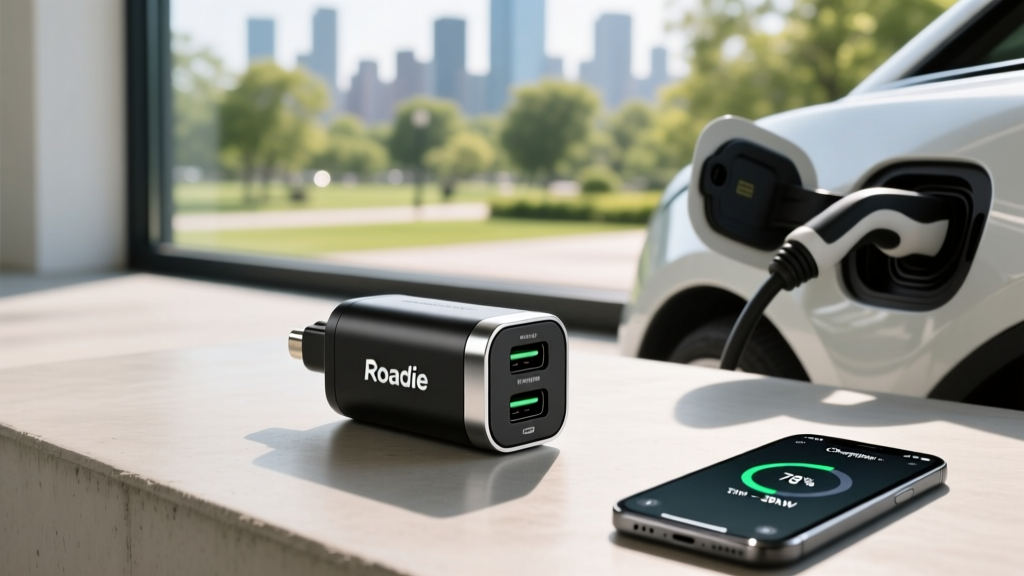
The Roadie is a compact, dual-voltage portable charging unit that ships with interchangeable plug adapters. On a standard NEMA 5-15 household outlet (120V/15A), it operates as a Level 1 charger delivering approximately 1.4 kW. Swap to a NEMA 14-50 receptacle (240V/50A circuit, 40A continuous), and it pushes up to 9.6 kW — legitimate Level 2 territory that can add 30–35 miles of range per hour on an efficient sedan.
The unit weighs roughly 7 pounds, coils into an included carrying case, and features a 25-foot cable. It does not provide DC fast charging — that requires fixed infrastructure delivering 50–350 kW directly to the battery, bypassing the vehicle's onboard charger entirely. The Roadie, like all portable AC units, relies on your EV's onboard charger to convert AC to DC.
| Spec | Value |
|---|---|
| Level 1 Output (120V) | 1.4 kW (12A continuous) |
| Level 2 Output (240V) | 9.6 kW (40A continuous) |
| Cable Length | 25 ft |
| Connector (vehicle end) | J1772 (NACS adapter available) |
| Plug Adapters Included | NEMA 5-15, NEMA 14-50 |
| Weight | ~7 lbs |
| Smart Features | None (no Wi-Fi/app) |
| Outdoor Rating | NEMA 4 (splash-resistant) |
| Estimated Price | $449–$549 |
Charging Levels Explained: What Speed Can You Actually Expect?
Before evaluating the Roadie's real-world performance, it's critical to understand the three charging tiers and how they differ in power delivery. Remember: kW (kilowatts) measures power — the rate of energy flow — while kWh (kilowatt-hours) measures energy capacity, like gallons in a tank.
| Level | Voltage | Power (kW) | Miles of Range Added/Hour | Typical Use Case |
|---|---|---|---|---|
| Level 1 | 120V AC | 1.2–1.9 kW | 3–5 mi/hr | Overnight trickle, emergency top-off |
| Level 2 | 240V AC | 3.3–19.2 kW | 12–70 mi/hr | Home daily charging, workplace, destination |
| DC Fast | 400–800V DC | 50–350 kW | 150–1,000+ mi/hr | Road trips, highway corridors |
At Level 1 (120V), the Roadie adds roughly 4 miles of range per hour on a vehicle rated at 3.5 mi/kWh — meaning a full overnight session (10 hours) nets about 40 miles. Useful for PHEVs with 30–45 miles of electric range, but inadequate as a sole charging strategy for a BEV with a 250+ mile battery.
At Level 2 (240V/40A), the Roadie's 9.6 kW output adds approximately 33 miles per hour on that same efficient sedan. A 75 kWh battery charging from 10% to 80% (roughly 52.5 kWh) would take about 5.5 hours — practical for overnight charging but significantly slower than a hardwired 48A wall unit delivering 11.5 kW.
Real-World Charging Times: 10–80% by Battery Size
Charging speed isn't linear. EVs taper charge rate as the battery fills — the last 20% takes significantly longer than the first 20%. Most owners charge to 80% daily to preserve battery longevity and avoid the steep taper. Here's what the Roadie delivers in practice:
| Battery Size (usable kWh) | Example Vehicles | Level 1 (1.4 kW) | Level 2 (9.6 kW) |
|---|---|---|---|
| 40 kWh | Nissan Leaf S, Mini Cooper SE | ~20 hours | ~3.6 hours |
| 65 kWh | Chevy Equinox EV, Hyundai Kona Electric | ~33 hours | ~5.9 hours |
| 75 kWh | Tesla Model 3 LR, Ford Mustang Mach-E ER | ~38 hours | ~6.8 hours |
| 100 kWh | Tesla Model S, Rivian R1S Max Pack | ~50 hours | ~9.1 hours |
| 130+ kWh | GMC Hummer EV, Chevy Silverado EV | ~65+ hours | ~11.9 hours |
The Level 1 times make clear that 120V charging is a backup plan, not a strategy. If you're relying on the Roadie at 240V, plan your charging sessions around 7–10 hours for most mainstream EVs — easily achievable overnight.
Connector Compatibility: Will It Plug Into Your EV?
The North American EV market has largely standardized around two AC connectors, with a third legacy standard still present on older vehicles:
| Connector | Brands Using It | Roadie Compatible? |
|---|---|---|
| J1772 (legacy standard) | Pre-2025 models from most non-Tesla brands | Yes — native plug |
| NACS (Tesla / new standard) | Tesla (all years), Ford, GM, Rivian, Volvo, Polestar, Hyundai/Kia (2025+ models) | Yes — with NACS-to-J1772 adapter (sold separately, ~$50–$80) |
| CHAdeMO | Nissan Leaf (DC only, not AC-relevant) | N/A — CHAdeMO is DC-only |
By 2026, the majority of new EVs sold in the U.S. ship with a native NACS charge port. The Roadie's J1772 connector requires a NACS adapter for these vehicles. If you drive a 2025+ Ford, GM, or Hyundai/Kia EV, factor in the adapter cost. The adapter adds minimal bulk and does not reduce charge rate at Level 2 speeds.
How Much Does It Cost to Install a 240V Outlet for the Roadie?
The Roadie's Level 2 capability requires a NEMA 14-50 receptacle on a dedicated 50A circuit. If your garage already has one (common for electric dryers or ranges), you're set. If not, here's what a new installation typically costs:
| Component | Typical Cost Range | Notes |
|---|---|---|
| Electrical Permit | $50–$200 | Required in most jurisdictions; varies by municipality |
| Electrician Labor (2–4 hrs) | $300–$800 | Depends on run length from panel to garage |
| Materials (wire, conduit, receptacle, breaker) | $100–$300 | 6 AWG copper wire for 50A circuit |
| Panel Upgrade (if needed) | $1,500–$3,500 | Required if your panel is at capacity (common in pre-1990 homes with 100A service) |
| Total (no panel upgrade) | $450–$1,300 | Most straightforward garage installs |
| Total (with panel upgrade) | $2,000–$4,800 | Older homes or high-load panels |
A licensed electrician should evaluate your panel's available amperage before installation. A 200A panel with existing heavy loads (electric heat, tankless water heater, double oven) may not have headroom for a 50A EV circuit without an upgrade. Per the National Electrical Code, a 50A circuit requires a dedicated double-pole breaker and cannot share with other appliances.
One advantage of the Roadie over a hardwired wall charger: portability. If you move, the 14-50 outlet stays with the house (and adds resale value), and you take the Roadie with you. A hardwired unit requires disconnection and leaves wiring to cap off.
Cost Per Mile: Charging vs. Gasoline
The economic case for home EV charging remains strong in 2026, even as public DC fast-charging prices have risen. Here's how the per-mile cost breaks down across scenarios:
| Scenario | Rate | Cost Per Mile (at 3.5 mi/kWh) |
|---|---|---|
| Home Level 2 — Off-Peak TOU Rate | $0.09/kWh | $0.026 |
| Home Level 2 — Standard Rate | $0.16/kWh | $0.046 |
| Public Level 2 (ChargePoint, EVgo) | $0.25–$0.39/kWh | $0.071–$0.111 |
| DC Fast Charging (Electrify America, Tesla Supercharger) | $0.35–$0.55/kWh | $0.100–$0.157 |
| Gasoline (25 MPG combined, $3.40/gal) | $3.40/gallon | $0.136 |
| Gasoline (30 MPG combined, $3.40/gal) | $3.40/gallon | $0.113 |
Home charging on a time-of-use (TOU) plan delivers fuel costs at roughly one-fifth the price of gasoline per mile. Even at standard residential rates, you're paying less than half. The Roadie itself doesn't change these economics — it's the electricity rate and your vehicle's efficiency that determine cost. According to fueleconomy.gov, the average 2026 EV achieves 3.0–4.0 mi/kWh, with efficient sedans like the Tesla Model 3 and Hyundai Ioniq 6 reaching 4.0+ mi/kWh.
Equipment Comparison: Roadie vs. the Alternatives
The portable charger market has matured. Here's how the Roadie stacks up against three established competitors:
| Feature | Roadie Portable | Tesla Mobile Connector | Lectron V-BOX Pro | Emporia Vue Portable |
|---|---|---|---|---|
| Max Level 2 Power | 9.6 kW (40A) | 7.7 kW (32A) | 11.5 kW (48A) | 9.6 kW (40A) |
| Level 1 Power | 1.4 kW | 1.4 kW | 1.4 kW | 1.4 kW |
| Cable Length | 25 ft | 20 ft | 21 ft | 25 ft |
| Connector | J1772 | NACS (native) | J1772 | J1772 |
| Smart/App Features | None | Tesla app integration | Lectron app, scheduling | Emporia app, energy monitoring |
| Outdoor Rating | NEMA 4 | NEMA 3R | NEMA 4 | NEMA 4 |
| Price (approx.) | $449–$549 | $200 (included w/ Tesla) | $399–$449 | $499 |
The verdict: The Roadie sits in the middle of the pack. Its 9.6 kW output matches the Emporia and exceeds the Tesla Mobile Connector, but falls short of the Lectron's 11.5 kW — which matters if your EV has an 11.5 kW onboard charger (like the Ford F-150 Lightning or some BMW iX configurations). The Roadie lacks smart features and app scheduling, which is a meaningful gap if you want to automate off-peak charging for TOU savings.
For Tesla owners, the Mobile Connector is hard to beat at $200 with native NACS and app integration. For non-Tesla EV owners who want maximum portable Level 2 speed, the Lectron V-BOX Pro's 48A output extracts more from vehicles equipped with larger onboard chargers.
Safety and Electrical Code Considerations
Portable EV chargers carry specific safety requirements that differ from permanently installed wall units:
- Dedicated circuit: The NEMA 14-50 outlet must be on a dedicated 50A breaker — not shared with any other appliance or outlet. EVs draw sustained maximum current for hours, which stresses shared circuits.
- GFCI protection: The 2023 NEC update requires GFCI protection for all receptacles used for EV charging in garages and outdoors. Your electrician should install a GFCI breaker or a GFCI-protected receptacle.
- Outdoor rating: The Roadie's NEMA 4 rating handles rain and splashing water but is not submersible. If you charge outdoors regularly, mount the receptacle under an overhang or use a weatherproof in-use cover.
- No extension cords: Never use an extension cord between the receptacle and the Roadie. The sustained 40A draw can overheat undersized cords and create a fire hazard.
- Receptacle quality: Use a commercial-grade NEMA 14-50 receptacle (Hubbell, Bryant, or Cooper — ~$60–$80). Budget residential-grade receptacles (~$12) have been linked to melting under sustained EV charging loads.
The National Fire Protection Association's NEC Article 625 governs EV charging installations. Any licensed electrician performing your install should be familiar with these requirements. Ask specifically about GFCI compliance and whether your panel can handle continuous 40A draw.
Who Should Buy the Roadie Portable EV Charger?
Choose the Roadie if:
- You rent or live in an apartment and need a portable Level 2 option you can take when you move
- You want a backup charger for road trips to areas with sparse public charging infrastructure
- Your EV has a 9.6 kW or smaller onboard charger, so you won't leave power on the table
- You already have a NEMA 14-50 outlet (dryer, range, or previous EV setup)
Look elsewhere if:
- You own a Tesla — the $200 Mobile Connector is cheaper and natively NACS
- Your EV has an 11.5 kW onboard charger — the Lectron V-BOX Pro at 48A extracts faster speeds
- You want app-based scheduling, energy monitoring, or utility demand-response integration
- You charge exclusively at home and can install a hardwired 48A wall unit (faster, cleaner, no plug/receptacle wear)
Frequently Asked Questions
Can the Roadie portable EV charger be my only charger?
Yes, if you have reliable access to a 240V NEMA 14-50 outlet. At 9.6 kW, it adds enough range overnight for daily driving of up to ~250 miles. However, if you regularly deplete the battery below 20% or drive a large-battery truck (130+ kWh), a hardwired 48A unit charging at 11.5 kW will complete sessions 20% faster.
How fast will each charging level add range?
Level 1 (120V) adds 3–5 miles per hour — adequate for PHEVs, too slow for most BEVs. Level 2 (240V) at 9.6 kW adds roughly 30–35 miles per hour on an efficient sedan. DC fast charging adds 150–1,000+ miles per hour but requires fixed public infrastructure. Your vehicle's efficiency (mi/kWh) determines exact numbers.
Which connector does the Roadie use, and will it fit my EV?
The Roadie ships with a J1772 connector, which fits all pre-2025 non-Tesla EVs natively. For 2025+ vehicles with NACS ports (Tesla, Ford, GM, Rivian, Hyundai/Kia, Volvo, Polestar), you'll need a J1772-to-NACS adapter (~$50–$80). CHAdeMO is a DC-only standard and is not relevant for AC portable charging.
How much does charging cost per mile compared to gas?
Home charging at off-peak rates ($0.09/kWh) costs roughly $0.026/mile — about one-fifth the cost of gasoline at $3.40/gallon in a 25 MPG vehicle ($0.136/mile). Even standard residential rates ($0.16/kWh) deliver $0.046/mile. Public DC fast charging at $0.35–$0.55/kWh narrows the gap to $0.10–$0.16/mile, approaching gas parity on the road.
What electrical upgrades might I need for a 240V outlet?
Most homes with a 200A electrical panel can accommodate a 50A dedicated circuit for $450–$1,300 (permit, labor, materials). Homes with older 100A panels or panels already near capacity may need a service upgrade to 200A, adding $1,500–$3,500. A licensed electrician can perform a load calculation to determine if your panel has headroom.
Is the Roadie eligible for any tax credits or incentives?
Under current IRS §30D rules, the federal EV tax credit applies to the vehicle, not standalone charging equipment. However, the separate §30C Alternative Fuel Vehicle Refueling Property Credit (up to $1,000 for residential charging equipment and installation) may apply if you live in an eligible census tract. Check IRS guidance and consult a tax professional for your specific eligibility.
The Roadie portable EV charger fills a legitimate niche: dual-voltage flexibility for renters, travelers, and drivers who can't commit to a permanent wall unit. Its 9.6 kW Level 2 output is competitive, though the lack of smart features and native NACS support are real gaps in 2026. If your use case aligns with its strengths — portability, simplicity, adequate speed — it's a reliable option. If you need maximum charge speed, app integration, or native Tesla compatibility, the alternatives listed above serve those needs more precisely.