Why Rivian Weight Matters for EV Buyers
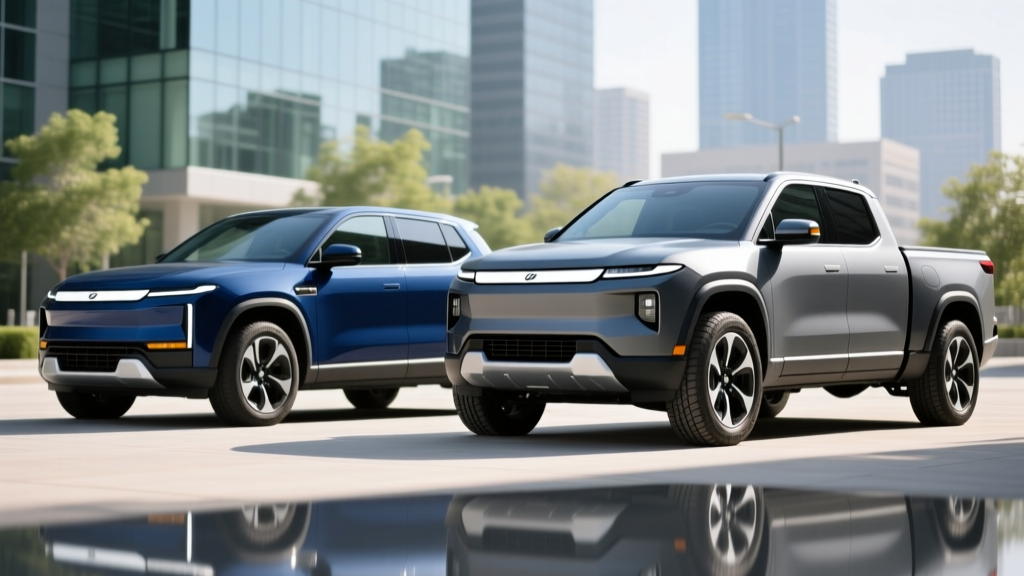
When shoppers compare electric SUVs and trucks, curb weight rarely gets the attention it deserves. Yet for heavy, body-on-frame EVs like the Rivian R1S and R1T, weight is the single largest variable affecting real-world range, tire wear, braking distances, and energy cost per mile. The R1S SUV tips the scales between 6,836 and 7,149 pounds depending on the battery pack and powertrain, while the R1T pickup runs from roughly 6,697 to 7,151 pounds. For context, a Toyota RAV4 Hybrid weighs around 3,800 pounds — the Rivians carry nearly double that mass.
This isn't a flaw. It's a physics tradeoff inherent to electric trucks and large SUVs that haul massive battery packs (92 to 149 kWh usable) plus reinforced frames, air suspension hardware, and towing-capable drivetrains. Understanding exactly how Rivian weight shapes your ownership experience — from highway range loss to charging-curve behavior — is essential before signing a $75,000+ purchase order.
R1S and R1T Curb Weight by Battery Pack and Configuration
Rivian offers three battery tiers for the 2025–2026 R1 lineup: the Standard (92 kWh usable, LFP chemistry), the Large (106 kWh, NMC), and the Max (149 kWh, NMC). Each adds weight, range, and cost. Here's how the numbers stack up across current dual-motor AWD configurations:
| Model | Battery Pack | Usable kWh | Chemistry | Curb Weight (lbs) | EPA Range (mi) |
|---|---|---|---|---|---|
| R1S | Standard | 92 | LFP | 6,836 | 270 |
| R1S | Large | 106 | NMC | 6,967 | 330 |
| R1S | Max | 149 | NMC | 7,149 | 410 |
| R1T | Standard | 92 | LFP | 6,697 | 270 |
| R1T | Large | 106 | NMC | 6,826 | 328 |
| R1T | Max | 149 | NMC | 7,151 | 415 |
The jump from Standard to Max pack adds roughly 300 pounds — essentially carrying an extra adult passenger at all times. That mass is concentrated low in the chassis (the battery skateboard), which helps keep the center of gravity favorable for handling, but it still demands more energy to accelerate and sustain highway speeds.
Range and Efficiency: What the EPA Numbers Don't Show
Rivian's EPA range figures are competitive for the electric-truck segment, but weight ensures those numbers come with real-world caveats. The dual-motor R1S with the Large pack achieves an EPA-estimated 70 MPGe combined, translating to roughly 48 kWh per 100 miles — about 30% thirstier than a lighter Hyundai Ioniq 5 (which sips around 32 kWh/100 mi). The R1T Max pack, despite its 415-mile EPA sticker, still consumes over 50 kWh/100 mi on the highway.
EPA Estimate: 330 miles
Highway (70–75 mph, 65°F): Expect 265–285 miles due to aerodynamic drag and 7,000-lb mass overcoming inertia.
Cold Weather (30°F, cabin heat): 215–245 miles — LFP packs in the Standard tier lose ~25–30% range in deep cold; NMC packs fare slightly better at ~20–25% loss.
Towing (5,000-lb trailer): 140–170 miles — weight doubles when you add trailer mass, cutting range roughly in half.
The efficiency penalty of Rivian's weight is most visible on sustained highway drives. At 75 mph, the R1S must push nearly 3.5 tons of vehicle through the air, and regenerative braking — which recaptures energy in stop-and-go city driving — provides minimal benefit on flat interstates. According to fueleconomy.gov, the R1S Dual-Motor Large Pack logs 70 MPGe combined, while the Max Pack variant drops to 65 MPGe due to its additional 182 pounds and larger battery.
Charging Speed: Does Weight Slow You Down at the Plug?
Rivian weight doesn't directly slow charging speed — that's a function of battery chemistry and thermal management — but heavier Max Pack configurations do take longer to fill from 10–80% simply because there's more kWh to push into a larger battery. Here's the current charging picture for the 2025 R1 lineup on Rivian's second-generation architecture:
| Battery Pack | Max DC Rate (kW) | 10–80% Time | Level 2 Rate (kW) | Level 2 Miles/Hour |
|---|---|---|---|---|
| Standard (92 kWh LFP) | 200 kW | ~30 min | 11.5 kW | ~16 mi/hr |
| Large (106 kWh NMC) | 220 kW | ~28 min | 11.5 kW | ~18 mi/hr |
| Max (149 kWh NMC) | 220 kW | ~42 min | 11.5 kW | ~18 mi/hr |
The charge curve on the Large and Max packs peaks early (220 kW sustains roughly from 10–35% SoC) before tapering to around 120 kW by 60% and further to 50 kW past 80%. This taper is typical for NMC chemistry managed conservatively to protect long-term cell health. The LFP Standard pack can accept higher states of charge more routinely — Rivian recommends charging LFP to 100% regularly, unlike NMC where 80–90% daily is preferred for longevity.
At home on a 48-amp Level 2 circuit (11.5 kW), a full Standard Pack recharge from 10% takes about 7 hours, while the Max Pack needs closer to 12 hours. Most owners will charge overnight and rarely deplete below 20%, making Level 2 home charging practical for all three tiers.
Performance, Drivetrain, and How Mass Shapes the Drive
Rivian's dual-motor AWD system produces 533 horsepower and 610 lb-ft of torque in the Standard and Large pack configurations, enough to hustle a 7,000-pound R1S to 60 mph in approximately 4.5 seconds. The Max Pack Dual-Motor bumps output to 665 hp and achieves a 3.6-second 0–60 time. For context, that's sports-car acceleration from a vehicle heavier than a Ford F-150.
| Configuration | Horsepower | Torque (lb-ft) | 0–60 mph | Drivetrain | Tow Rating (lbs) |
|---|---|---|---|---|---|
| Dual-Motor Standard/Large | 533 | 610 | 4.5 sec | AWD | 7,700 |
| Dual-Motor Max | 665 | 610 | 3.6 sec | AWD | 7,700 |
The weight does manifest in braking distances and tire wear. Expect 135–145 feet from 60–0 mph, roughly 15–20 feet longer than a lighter Tesla Model X. Rivian specifies high-load (HL) rated tires, and owners report replacing rubber every 25,000–35,000 miles under normal use — the mass and instant torque wear tread faster than on a gas truck. Budget $1,200–$1,800 per set for OEM-size all-season tires.
Ride quality benefits from the standard air suspension, which adjusts ride height across six settings and compensates for the vehicle's heft with well-damped compliance. The low center of gravity from the skateboard battery makes the R1S feel planted in corners despite its mass — a trick physics can't fully hide but that Rivian engineers mask impressively.
Pricing, Trims, and Federal Tax Credit Eligibility
The R1S and R1T are premium vehicles, and their pricing reflects the engineering required to move this much weight with this much range. Here's the current MSRP landscape for the 2025 R1S (the R1T is priced within $1,000 of equivalent trims):
| Trim / Pack | Base MSRP | Federal §30D Credit | Effective Price | Eligible? |
|---|---|---|---|---|
| Dual-Motor Standard (LFP) | $74,900 | Up to $3,750 | ~$71,150 | Partial (sourcing rules) |
| Dual-Motor Large (NMC) | $81,900 | Up to $7,500 | ~$74,400 | Yes, if sourcing & income met |
| Dual-Motor Max (NMC) | $91,900 | Up to $7,500 | ~$84,400 | Yes, if sourcing & income met |
The IRS §30D credit has strict eligibility requirements that change based on battery-component and critical-mineral sourcing. As of 2025, Rivian's Large and Max packs (NMC cells sourced from Samsung SDI and LG Energy Solution) have generally qualified for the full $7,500, but the Standard LFP pack — using CATL cells — may only qualify for the $3,750 critical-minerals half or may be ineligible depending on the latest IRS eligible-vehicle list. Always verify before purchasing.
- MSRP Cap: SUVs must be under $80,000 MSRP. The R1S Standard and Large qualify; the Max at $91,900 exceeds the cap and is not eligible for §30D.
- Income Cap: Modified AGI must not exceed $300,000 (joint), $225,000 (head of household), or $150,000 (single).
- Point-of-Sale Transfer: You can transfer the credit to the dealer at purchase, reducing your out-of-pocket cost immediately rather than waiting for a tax refund.
This creates an important buying nuance: the R1S Max Pack's $91,900 sticker puts it above the SUV MSRP cap, eliminating the federal credit entirely. Buyers cross-shopping the Large and Max should factor the $7,500 credit gap into their total cost analysis.
Cargo, Passenger Space, and Practicality
The R1S seats up to seven across three rows, though the third row is best reserved for children given its 30.4 inches of legroom. Behind the third row, cargo space measures 10.4 cu ft; fold the third row and you get 45.2 cu ft; fold both rear rows for a flat 104.7 cu ft floor. The R1T pickup offers a 4.5-foot bed with 1,760 lbs of max payload and a unique Gear Tunnel (11 cu ft of lockable, pass-through storage) on Large and Max configurations.
| Measurement | Row 1 | Row 2 | Row 3 |
|---|---|---|---|
| Headroom (in) | 41.1 | 39.2 | 36.5 |
| Legroom (in) | 41.3 | 38.6 | 30.4 |
| Shoulder Room (in) | 60.5 | 59.0 | 53.5 |
A front trunk (frunk) adds 11.1 cu ft of sealed, drainable storage — useful for muddy gear or groceries that you don't want rolling around in the main cabin. The combination of frunk, Gear Tunnel (R1T), and configurable rear space makes the Rivian lineup among the most practical in the premium EV segment, even if total interior volume trails a longer-wheelbase competitor like the extended Chevrolet Tahoe.
Tech, Driver Assists, and Notable Drawbacks
Rivian runs its own software stack on a 15.6-inch center display with over-the-air updates, native route planning with charging stops, and a mobile app that handles preconditioning, climate control, and vehicle location. The Driver+ system is a Level 2 SAE driver-assist — it provides adaptive cruise control and lane-centering on highways, but the driver must remain fully engaged with hands on the wheel at all times. It is not autonomous driving.
Rivian's Driver+ is a Level 2 system. The vehicle controls steering and speed under certain conditions, but the human driver is responsible for monitoring the road, intervening in construction zones, during lane merges, and in adverse weather. Hands-on-wheel monitoring is enforced. Do not confuse this with Level 4 robotaxi services (Waymo, Zoox) that operate without a human driver.
Standout tech features include the quad-motor option's individual-wheel torque vectoring (on Tri- and Quad-Motor trims), the camp-kitchen accessory for the R1T, a built-in air compressor accessible from the bed, and a gear-guard system that uses the vehicle's cameras to monitor items stored in the bed or Gear Tunnel.
Notable drawbacks tied to Rivian's weight and design:
- Tire cost: 20-inch and 22-inch HL-rated tires wear quickly under 7,000+ lbs and instant electric torque. Expect 25,000–35,000-mile tire life.
- Charging network: Rivian uses NACS connectors and has access to the Tesla Supercharger network via adapter (included). However, the R1's length (215+ inches for the R1S) can make some urban Supercharger stalls difficult to navigate.
- Service center density: Rivian's service network is expanding but still sparse outside major metros. Mobile service vans handle many repairs, but bodywork or suspension issues may require towing to a facility.
- Efficiency vs. lighter EVs: At 48–52 kWh/100 mi, the R1S costs roughly $0.07–$0.09 per mile to charge at home ($0.13/kWh national average) versus $0.04 for a lighter sedan. Over 15,000 miles/year, that's $450–$750 more in electricity.
Who the Rivian R1S and R1T Are For
The Rivian lineup serves a specific buyer: someone who needs genuine truck/SUV utility (towing, cargo, ground clearance, AWD traction) and wants it electrified without compromising on performance or technology. The R1S is ideal for active families who ski, camp, or haul gear on weekends and want three rows. The R1T fits outdoor enthusiasts and tradespeople who value the Gear Tunnel and built-in air compressor over a traditional 6-foot bed.
- You need three-row seating with EV powertrain and 330+ miles of range.
- You tow a boat or camper (7,700-lb rating) on moderate-distance trips.
- You want air suspension for adjustable ride height on trails and highways.
- Your daily commute is the primary use — a lighter EV like the Ioniq 5 or Model Y will cost less per mile and charge faster.
- You live in an apartment without home charging access — the large battery makes public-only charging expensive and time-consuming.
- Budget is under $65,000 — the R1 lineup starts above $74,000 before options.
Rivian R1S vs. Key Competitors: Weight and Range Compared
| Vehicle | Curb Weight (lbs) | EPA Range (mi) | kWh/100 mi | Base MSRP | §30D Credit |
|---|---|---|---|---|---|
| Rivian R1S Large | 6,967 | 330 | 48 | $81,900 | Up to $7,500 |
| Tesla Model X LR | 5,185 | 335 | 36 | $79,990 | Up to $7,500 |
| Kia EV9 GT-Line AWD | 5,037 | 270 | 43 | $73,900 | Up to $7,500 |
| GMC Hummer EV SUV | 9,046 | 314 | 58 | $98,845 | $0 (MSRP cap) |
The Rivian sits in a middle ground: heavier than the Tesla and Kia but far lighter than the Hummer. Its efficiency trails the Model X by 12 kWh/100 mi — a meaningful gap that translates to roughly 1,800 extra kWh consumed per year at 15,000 miles driven, or about $234 at average residential electricity rates. However, the R1S offers off-road capability, 14.9 inches of ground clearance, and a more rugged build that the Model X simply doesn't target.
Warranty Coverage
Rivian backs the R1S and R1T with an 8-year/120,000-mile battery and drive unit warranty, covering defects and capacity degradation below 70% of original capacity. The bumper-to-bumper limited warranty runs 5 years/60,000 miles. These terms are competitive with Tesla's 8-year/120,000-mile battery coverage and exceed the Kia EV9's 10-year/100,000-mile powertrain warranty in mileage on the battery side.
For a vehicle carrying 149 kWh of NMC cells in the Max Pack, a potential out-of-warranty battery replacement would be a significant expense — industry estimates for packs of this size range from $18,000 to $28,000. However, Rivian's LFP Standard Pack chemistry typically exhibits slower degradation (projected 10–15% loss over 150,000 miles) compared to NMC (15–20% over the same distance), offering long-term peace of mind for Standard-pack buyers who don't need maximum range.
Frequently Asked Questions
What is the real-world range of the Rivian R1S?
The EPA rates the R1S Large Pack at 330 miles, but expect 265–285 miles at sustained highway speeds (70–75 mph) and 215–245 miles in freezing temperatures with cabin heat. The Max Pack's 410-mile EPA figure yields roughly 330–350 highway miles in mild weather. Towing a 5,000-lb trailer cuts range to 140–170 miles regardless of pack size.
How fast does the Rivian charge at home and on the road?
On a DC fast charger, the Large and Max packs peak at 220 kW, reaching 10–80% in about 28 minutes (Large) or 42 minutes (Max). At home on a 48-amp Level 2 charger (11.5 kW), expect roughly 16–18 miles of range added per hour of charging, with a full overnight charge restoring the battery in 7–12 hours depending on pack size.
Does the Rivian R1S qualify for the $7,500 federal EV tax credit?
It depends on the trim. The Standard Pack at $74,900 MSRP may qualify for a partial $3,750 credit depending on battery sourcing. The Large Pack at $81,900 has generally qualified for the full $7,500. The Max Pack at $91,900 exceeds the IRS $80,000 SUV MSRP cap and is not eligible for §30D. All trims require the buyer to meet income caps ($300K joint / $150K single). Verify current eligibility on the IRS eligible vehicles page before purchasing.
Is the Rivian R1S worth buying over the Tesla Model X?
If you need off-road capability, a more rugged build, three usable rows, and don't mind 12 kWh/100 mi higher energy consumption, the R1S offers a more adventurous ownership experience. The Model X wins on efficiency (36 vs 48 kWh/100 mi), Supercharger network seamlessness, and faster 0–60 times, but it lacks the R1S's ground clearance, wading capability, and camping-oriented accessories.
What are the biggest pros and cons of Rivian's weight?
Pros: The low-mounted battery skateboard gives a planted ride despite the mass; air suspension compensates well; the weight contributes to a smooth, damped highway feel. Cons: Higher energy consumption (48–52 kWh/100 mi), faster tire wear, longer braking distances, and reduced range when towing or in cold weather compared to lighter EVs.