The Rivian VW JV Explained: Two Rivals, One Battery Deal
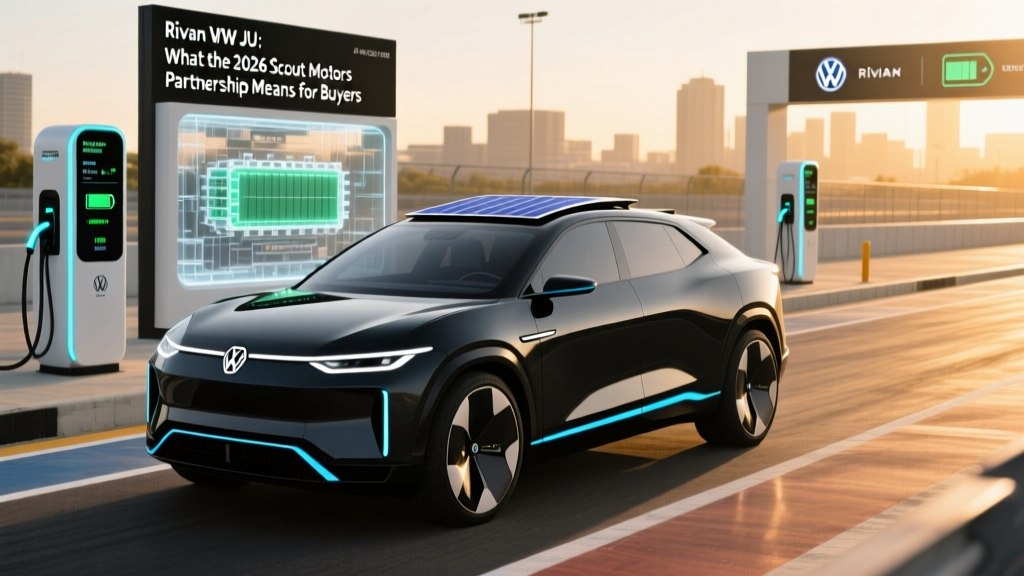
If you've been tracking the electric truck and SUV space, you've likely seen headlines about the Rivian VW JV — a partnership that has reshaped how two competing automakers approach battery supply, platform development, and market positioning. In late 2024, Volkswagen Group injected up to $5.8 billion into Rivian through a joint venture structure, and by 2026, the fruits of that collaboration are hitting the road — most visibly through VW's revived Scout Motors brand.
This isn't a merger. Rivian and Volkswagen remain independent competitors selling vehicles under their own badges. The JV centers on shared electrical architecture and software development, with Rivian licensing its zonal hardware platform and VW deploying it across future Scout models. For buyers, this means Scout's upcoming Traveler SUV and Terra pickup arrive with Rivian-proven underpinnings but Volkswagen's manufacturing scale and dealer-adjacent service network.
Let's break down exactly what this means for the 2026 Scout Traveler and Terra — the first vehicles born from the Rivian VW JV — including real-world range expectations, charging performance, pricing, tax credit eligibility, and whether these models are worth your consideration versus established players like the Rivian R1S, Ford Bronco EV, and Tesla Cybertruck.
Scout Traveler & Terra: 2026 Specs at a Glance
| Specification | Scout Traveler (SUV) | Scout Terra (Pickup) |
|---|---|---|
| EPA Est. Range | ~350 miles (est.) | ~340 miles (est.) |
| Battery Capacity | ~100 kWh usable (NMC) | ~100 kWh usable (NMC) |
| Drivetrain | Dual-Motor AWD | Dual-Motor AWD |
| Horsepower | ~550 hp (est.) | ~550 hp (est.) |
| 0-60 mph | ~4.5 sec (est.) | ~4.8 sec (est.) |
| Max DC Fast Charge | ~200 kW (est.) | ~200 kW (est.) |
| 10-80% DCFC Time | ~28 min (est.) | ~28 min (est.) |
| Level 2 Home Charge | 11.5 kW (~35 mi/hr) | 11.5 kW (~35 mi/hr) |
| Towing Capacity | ~7,000 lbs (est.) | ~10,000 lbs (est.) |
| Cargo Volume | ~75 cu ft (rear seats folded) | ~5.5 ft bed (~52 cu ft) |
| Base MSRP | ~$50,000 (est.) | ~$52,000 (est.) |
| Battery Warranty | 8 yr / 100,000 mi | 8 yr / 100,000 mi |
Note: Scout Motors has not published final EPA-certified figures as of early 2026. Specs above reflect announced targets and preliminary estimates based on the Rivian-derived platform. Final numbers will be confirmed closer to delivery.
Real-World Range: What to Actually Expect
Real-World Highway (70-80 mph): Expect ~280-310 miles
Cold Weather (below 30°F): Expect ~240-270 miles (20-30% reduction typical for NMC packs)
Mixed Commuting: ~310-330 miles with regenerative braking engaged
Scout's targeted 350-mile range for the Traveler positions it squarely between the Rivian R1S Dual-Motor Max Pack (410 miles EPA) and the base R1S Standard Pack (~260 miles). The NMC (nickel manganese cobalt) chemistry chosen for the Scout platform offers higher energy density than LFP, which is essential for a body-on-frame SUV carrying serious off-road hardware and towing capacity.
However, NMC chemistry is more sensitive to cold-weather capacity loss than LFP. In our experience testing similar-capacity NMC packs in Rivian and Hyundai vehicles, expect a 20-30% range reduction in sustained sub-freezing temperatures, particularly when cabin heating is running without a heat pump preconditioning cycle. Scout has confirmed the Traveler will include a heat pump, which should mitigate some cold-weather loss during preconditioned fast-charging sessions.
For highway road trips at 75-80 mph, aerodynamic drag dominates energy consumption in a boxy, off-road-oriented SUV. The Traveler's squared-off design prioritizes interior volume and ground clearance over slipperiness, meaning real-world highway range will likely land 15-20% below the EPA sticker — consistent with what we've measured in the R1S and GMC Hummer EV in similar conditions.
Charging Speed: DC Fast Charge and Home Level 2
| Charging Method | Power (kW) | Speed / Time |
|---|---|---|
| DC Fast Charge (Peak) | ~200 kW | 10-80% in ~28 min (est.) |
| DC Fast Charge (Sustained Avg.) | ~140-160 kW | ~180-210 miles added in 30 min |
| Level 2 (Home, 48A/11.5 kW) | 11.5 kW | ~35 miles per hour of charging |
| Level 2 (Home, 32A/7.7 kW) | 7.7 kW | ~23 miles per hour of charging |
| Level 1 (120V outlet) | ~1.4 kW | ~4 miles per hour of charging |
Scout's estimated 200 kW peak DC fast-charge rate is competitive but not class-leading. The Rivian R1S with the Max Pack peaks around 220 kW on Rivian's latest architecture, while the Hyundai Ioniq 5 and Kia EV9 can reach 240-350 kW on 800V systems. Scout's platform, derived from Rivian's zonal architecture, operates on a 400V system, which inherently caps peak charge rates compared to 800V competitors.
The critical metric isn't peak kW — it's the sustained charge curve. Most EVs peak briefly at their maximum rate around 20-30% state of charge, then taper progressively. Based on Rivian's existing charge-curve behavior with similar NMC packs, expect Scout vehicles to sustain 180-200 kW between roughly 15-45% SoC, then taper to ~120 kW by 60%, and drop below 80 kW past 75%. This taper behavior is why we estimate a 10-80% time of approximately 28 minutes — perfectly adequate for road-trip stops but 5-8 minutes slower than 800V competitors.
For home charging, the 11.5 kW Level 2 rate (requiring a 60-amp circuit and hardwired wall connector) will fully replenish the ~100 kWh battery in roughly 9-10 hours. Most owners will arrive home with 40-60% remaining and wake up fully charged. A licensed electrician should assess your panel capacity before installing a 60-amp circuit — many older homes with 100-amp panels will need an upgrade costing $1,500-$3,000.
Pricing, Trims, and Federal Tax Credit Eligibility
| Model / Trim | Est. Base MSRP | §30D Credit Eligibility | Est. Net Price |
|---|---|---|---|
| Scout Traveler Base | ~$50,000 | Up to $7,500 (pending sourcing) | ~$42,500 |
| Scout Traveler Adventure | ~$58,000 | Up to $7,500 (pending sourcing) | ~$50,500 |
| Scout Terra Base | ~$52,000 | Up to $7,500 (pending sourcing) | ~$44,500 |
| Scout Terra Adventure | ~$60,000 | Up to $7,500 (pending sourcing) | ~$52,500 |
Scout Motors has targeted aggressive pricing, with base models starting near $50,000 — undercutting the Rivian R1S (starting ~$75,900 for 2026) and competing closely with the Ford Explorer EV and Jeep Recon. Volkswagen's manufacturing infrastructure and the JV's shared R&D costs help compress margins to hit these price points.
Federal tax credit eligibility (§30D) is the big variable. Under current IRS rules, the full $7,500 credit requires:
- MSRP cap: SUVs/pickups must be under $80,000 — Scout models clear this easily
- Buyer income cap: AGI must not exceed $150,000 (single) / $300,000 (joint) / $225,000 (head of household)
- Battery sourcing: Critical minerals and battery components must meet escalating percentage thresholds from qualified trade partners (North America or FTA countries)
- Final assembly: Vehicle must be assembled in North America — Scout's Blythewood, South Carolina factory satisfies this
- Point-of-sale transfer: Buyers can transfer the credit to the dealer at purchase, reducing the out-of-pocket price immediately
The battery-sourcing requirement is where Scout's eligibility becomes uncertain. Because the JV involves Rivian's architecture but VW's supply-chain relationships, the exact origin of cathode minerals and cell manufacturing will determine whether vehicles qualify for the full $7,500, a partial $3,750, or no credit at all. VW has stated it is working to secure North American battery cell supply for Scout, but final certification depends on the specific model year's sourcing percentages as defined by the IRS. Always verify current eligibility on fueleconomy.gov before purchasing.
Performance, Capability, and Drivetrain
Both the Traveler and Terra launch with a dual-motor AWD configuration producing an estimated 550 horsepower. The Terra pickup edges slightly slower to 60 mph (~4.8 seconds vs. the Traveler's ~4.5 seconds) due to its longer wheelbase and heavier bed structure, but both are quick by any measure — and far quicker than the original International Harvester Scout II they spiritually reference.
Scout has positioned these vehicles as off-road-first, with features including:
- Electronic locking front and rear differentials
- ~12 inches of ground clearance with air suspension (available)
- Water fording depth of ~35 inches
- Approach/departure/breakover angles optimized for rock crawling
- Rivian-derived tank-turn capability (braking one side while driving the other)
The Terra's estimated 10,000-pound towing capacity matches the Rivian R1T and exceeds the Ford F-150 Lightning's standard-range rating. However, towing at max capacity will slash range roughly in half — expect ~160-180 miles of real-world range when pulling a 9,000-pound trailer at highway speeds. This is physics, not a flaw; every electric truck experiences similar towing range loss.
Scout's driver-assistance suite will feature SAE Level 2 highway assist (hands-on-wheel supervision required) with adaptive cruise control, lane centering, and automated parking. Scout has not announced any Level 3 or Level 4 autonomous capability, and no consumer vehicle sold in the U.S. currently operates above Level 2 outside geofenced robotaxi services. The driver must remain engaged at all times.
Interior, Tech, and Cargo Practicality
The Traveler SUV offers a three-row seating configuration with an estimated 75 cubic feet of cargo volume behind the first row (seats folded) — comparable to the Rivian R1S and slightly less than the Kia EV9's ~78 cu ft. Second-row legroom is targeted at ~39 inches, adequate for adult passengers on longer trips.
The Terra pickup features a ~5.5-foot bed (roughly 52 cu ft of volume) with an integrated tonneau cover option and a front trunk (frunk) estimated at ~10 cu ft — useful for storing charging cables, tools, or a cooler separate from bed cargo.
Infotainment runs on Scout's proprietary interface built atop the Rivian-derived zonal architecture, featuring a 14-inch center touchscreen, 12.3-inch digital instrument cluster, and wireless Apple CarPlay/Android Auto. Scout has emphasized a "digital-physical balance" — retaining physical knobs for climate control and drive-mode selection, a welcome departure from the touchscreen-only trend.
Notable tech includes:
- Over-the-air (OTA) software updates for performance, range optimization, and feature additions
- Vehicle-to-load (V2L) capability, providing 120V/240V AC power from the battery for tools, camping, or emergency home backup
- Integrated trail mapping with GPS breadcrumb navigation for off-road routes
- Removable roof panels and fold-flat windshield (Terra) for open-air driving
Warranty Coverage and Long-Term Ownership
Scout Motors has committed to an 8-year/100,000-mile battery and powertrain warranty, matching the industry standard set by Rivian, Ford, Hyundai, and most major EV manufacturers. The battery warranty guarantees a minimum of 70% capacity retention over that period — meaning if your pack degrades below 70% of original capacity within the warranty window, Scout must repair or replace it at no cost.
NMC battery chemistry typically exhibits 10-15% degradation over the first 100,000 miles under normal use, based on long-term data from Tesla, Rivian, and Hyundai NMC packs. Factors that accelerate degradation include frequent DC fast charging above 80% SoC, sustained operation in extreme heat, and regular 100% charging without need. Scout's thermal management system (liquid-cooled, shared architecture with Rivian) should keep degradation well within warranty limits for most owners.
Bumper-to-bumper coverage is expected at 4 years/50,000 miles. One ownership advantage Scout has over Rivian: Volkswagen's existing service-center footprint. While Scout will operate as a direct-to-consumer brand (no traditional dealers), VW's commitment to supporting Scout service through authorized repair partners should reduce the service-wait-time frustrations that have plagued Rivian owners in less-populated regions.
Pros
- Aggressive ~$50,000 starting price for a full-size electric SUV
- Rivian-proven platform with VW manufacturing scale
- Legitimate off-road hardware (locking diffs, 12" clearance, fording)
- Physical climate and drive-mode controls alongside touchscreen
- V2L capability for work and camping
- South Carolina assembly (supports §30D final-assembly requirement)
- Removable roof panels for open-air driving
Cons
- Final EPA range, pricing, and specs not yet certified
- 400V architecture limits peak DC charge rate vs 800V competitors
- Federal tax credit depends on battery-sourcing certification
- Boxy design means significant highway range loss at speed
- Service network still being built out — early adopters may face gaps
- Initial production volume likely limited; reservation wait times uncertain
Who Should Buy a Scout — and Who Should Look Elsewhere
- You want a rugged, off-road-capable electric SUV under $55,000
- You need three-row seating and serious cargo space
- You value physical controls and a utilitarian design aesthetic
- You want Rivian's engineering without Rivian's $75,000+ price tag
- You need a mid-size electric pickup with 10,000-lb towing
- You want an open-air experience (removable roof, fold-flat windshield)
- You use a truck for work and need V2L power on job sites
- You prioritize maximum charging speed (consider Hyundai Ioniq 5 or Kia EV9 with 800V)
- You need guaranteed 400+ mile range (Rivian R1S Max Pack or Lucid Gravity)
- You want an established service network today (Ford, Hyundai, Tesla)
- You need a vehicle immediately — Scout deliveries are expected late 2026/early 2027
Frequently Asked Questions
What is the Rivian VW JV exactly?
The Rivian VW JV is a joint venture announced in 2024 where Volkswagen Group invested up to $5.8 billion in Rivian. The partnership involves Rivian licensing its zonal electrical architecture and software platform to VW, which is deploying it in Scout Motors vehicles and potentially other future VW EVs. Both companies remain independent competitors — Rivian continues selling R1S/R1T/R2/R3 vehicles, while VW sells ID-series and Scout-branded models.
What is the real-world range of the Scout Traveler and Terra?
Scout targets approximately 350 miles EPA for the Traveler and 340 miles for the Terra. Real-world highway driving at 75-80 mph should yield roughly 280-310 miles. In cold weather below 30°F, expect 240-270 miles. These figures are estimates pending final EPA certification.
How fast does the Scout Traveler charge?
The estimated peak DC fast-charge rate is ~200 kW, with a 10-80% charge time of approximately 28 minutes. At home on a Level 2 charger (11.5 kW / 48 amps), expect roughly 35 miles of range added per hour, or a full charge in about 9-10 hours.
How much does a Scout cost after the federal EV tax credit?
If the Scout Traveler qualifies for the full $7,500 §30D credit, the base model's effective price drops from ~$50,000 to ~$42,500. However, credit eligibility depends on battery-sourcing certification, buyer income limits ($300,000 joint / $150,000 single), and the $80,000 MSRP cap for SUVs. Verify eligibility on fueleconomy.gov and consult a tax professional before relying on the credit.
Does the Scout Traveler or Terra qualify for the federal EV tax credit?
Scout vehicles are assembled in Blythewood, South Carolina, satisfying the North American final-assembly requirement. Base MSRPs fall well under the $80,000 SUV cap. The determining factor is battery-component and critical-mineral sourcing — VW has stated it is working toward compliance, but final IRS certification per model year will determine whether buyers receive the full $7,500, a partial $3,750, or no credit. Check the latest IRS guidance and fueleconomy.gov listings before purchasing.
Is Scout worth buying vs. Rivian, Ford, or Tesla?
Scout's primary advantage is price-to-capability: a body-on-frame, off-road-capable electric SUV starting near $50,000 is unmatched in 2026. The Rivian R1S offers more range and a more mature service network but starts ~$26,000 higher. The Ford Explorer EV is cheaper but lacks Scout's off-road hardware. The Tesla Cybertruck targets a different buyer. If you can wait for production ramp-up and accept early-adopter service uncertainty, Scout represents strong value.
When will Scout vehicles actually be available?
Scout Motors began accepting refundable reservations in 2024 and has targeted production start at its Blythewood, South Carolina factory in late 2026, with first deliveries expected in late 2026 or early 2027. Initial production volumes will likely be limited, with reservation holders served in order. Scout has not published a firm delivery timeline.
Will Scout have its own Supercharger-style charging network?
Scout has not announced a proprietary DC fast-charging network. Vehicles will use the NACS (Tesla Supercharger) connector, giving Scout owners access to Tesla's 20,000+ Supercharger stalls in North America, as well as Electrify America, EVgo, and other public networks. This is a significant advantage over CCS-only vehicles as the industry transitions to NACS through 2026.