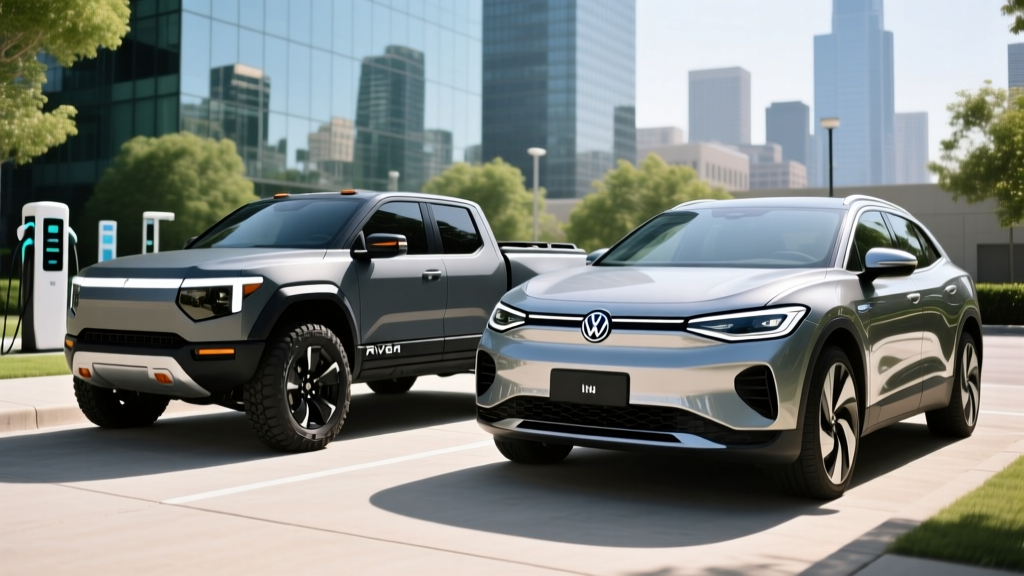
The Rivian Volkswagen licensing deal — a joint venture announced in mid-2024 with Volkswagen Group investing up to $5 billion into Rivian — is one of the most consequential partnerships in the modern EV industry. Rather than a simple badge-engineering exercise, this deal created a new jointly-owned company tasked with developing a shared electrical architecture and software stack that both automakers will deploy across future vehicle lineups. For buyers eyeing a Volkswagen ID.4 or a Rivian R1S/R1T in 2026, the implications touch everything from infotainment responsiveness to long-term over-the-air update reliability.
This article breaks down what the deal actually delivers to consumers, examines the current 2026 Volkswagen ID.4 (the first VW to benefit from the partnership's downstream effects), and assesses whether Rivian's engineering DNA makes VW's electric SUV a stronger buy against rivals like the Hyundai Ioniq 5, Tesla Model Y, and Ford Mustang Mach-E.
The Rivian Volkswagen Licensing Deal: Structure and Timeline
Volkswagen Group committed up to $5 billion in a multi-phase investment into Rivian, starting with an immediate $1 billion equity purchase and a $1 billion loan at closing in July 2024. The centerpiece is a 50/50 joint venture between VW and Rivian engineers to develop:
- A next-generation zonal electrical/electronic (E/E) architecture — replacing the fragmented domain-controller setup that plagued VW's earlier MEB-platform vehicles
- A unified software stack covering infotainment, driver assistance, vehicle dynamics, and OTA update infrastructure
- Shared component libraries to reduce per-unit cost across both brands' future EV lineups
By early 2026, the joint venture had begun delivering integrated software modules to both companies. Rivian's R2 platform (launching late 2026) is the first Rivian vehicle designed from the ground up on the shared architecture. Volkswagen's next-generation SSP-based models, expected from 2027 onward, will fully integrate the JV's E/E architecture. The current 2026 ID.4 benefits from early software refinements and infotainment improvements informed by the partnership, though it still rides on the MEB platform.
Key distinction: The 2026 VW ID.4 is an evolution of the pre-deal MEB vehicle with software and UX improvements. The first fully JV-architecture VW won't arrive until the next-generation SSP models. Rivian's R2 will be the first full deployment on the Rivian side.
2026 Volkswagen ID.4: Specs at a Glance
| Specification | ID.4 Standard Range | ID.4 Pro S AWD |
|---|---|---|
| EPA Range | 206 miles | 263 miles |
| Battery (usable) | 62 kWh (NMC) | 77 kWh (NMC) |
| Drivetrain | RWD (single motor) | AWD (dual motor) |
| Horsepower | 201 hp | 295 hp |
| 0-60 mph | 7.7 sec | 5.4 sec |
| Max DC Fast Charge | 135 kW | 175 kW |
| 10-80% DCFC Time | ~30 min | ~28 min |
| Level 2 Home Charge | 10.9 kW (~33 mi/hr) | 10.9 kW (~33 mi/hr) |
| MPGe (combined) | 104 MPGe | 98 MPGe |
| kWh/100 mi | 32 kWh | 34 kWh |
| Cargo (rear seats up) | 30.3 cu ft | 30.3 cu ft |
| Cargo (seats folded) | 64.2 cu ft | 64.2 cu ft |
| Rear Legroom | 37.6 in | 37.6 in |
| Base MSRP | $40,790 | $49,990 |
| Battery Warranty | 8 yr / 100,000 mi | 8 yr / 100,000 mi |
Sources: fueleconomy.gov, Volkswagen USA
Real-World Range: What the EPA Sticker Doesn't Tell You
EPA Estimated: 263 miles
Real-World Highway (70 mph, 72°F): ~235-245 miles
Real-World Highway (32°F, no heat pump): ~190-210 miles
Real-World Highway (32°F, with heat pump): ~215-230 miles
City/Commuter (mixed stop-and-go): ~255-270 miles
The ID.4's NMC lithium-ion pack delivers range that's competitive but not class-leading. The 263-mile EPA figure for the Pro S AWD holds up reasonably well in moderate climates, but buyers in northern states should budget for a 15-25% reduction in winter highway driving. The available heat pump (standard on Pro S trims for 2026) recovers some of that loss by scavenging waste heat from the drivetrain rather than relying solely on resistive cabin heating.
Compared to the Hyundai Ioniq 5's 303-mile Long Range AWD or the Tesla Model Y Long Range's 308 miles, the ID.4 trails by roughly 40-50 EPA miles. For daily commuters covering under 60 miles round-trip, this gap is academic. For road-trippers planning 400+ mile days, it means one additional charging stop.
Charging Speed: DC Fast Charging and Home Level 2
| Charging Level | Power / Voltage | Miles Added per Hour | Notes |
|---|---|---|---|
| Level 1 (120V household) | 1.2 kW | ~3-4 mi/hr | Emergency/trickle only |
| Level 2 (240V, 48A) | 10.9 kW | ~33 mi/hr | Full overnight charge in ~8 hrs |
| DC Fast Charge (Pro S AWD) | Peak 175 kW | ~190 mi in 30 min | 10-80% in ~28 min; tapers sharply above 80% |
| DC Fast Charge (Standard Range) | Peak 135 kW | ~155 mi in 30 min | 10-80% in ~30 min |
The ID.4's peak DC fast-charge rate of 175 kW (Pro S AWD) is adequate but not exceptional by 2026 standards. The Hyundai Ioniq 5 and Kia EV6, both on 800V architectures, peak at 240+ kW and achieve 10-80% in roughly 18 minutes. The ID.4's 400V architecture limits its ceiling.
The charge curve is the critical detail most spec sheets omit. The ID.4 sustains near-peak rates from roughly 10-45% SoC, then begins a gradual taper. Above 80%, charge speed drops dramatically to protect the NMC cells — expect 80-100% to take as long as 20-80%. On road trips, plan your stops around the 10-80% window for maximum efficiency.
At home on a 48-amp Level 2 circuit (requiring a 60-amp breaker), the 10.9 kW onboard charger replenishes the 77 kWh pack in approximately 8 hours. Most owners charging from a typical 20-30% daily deficit will wake to a full battery every morning. Installation costs for a dedicated 240V/60A circuit typically run $800-$2,200 depending on panel proximity and local permitting, according to Energy.gov guidelines — consult a licensed electrician for your specific setup.
Performance, Ride, and the Rivian Architecture Influence
The 2026 ID.4 Pro S AWD's dual-motor setup delivers 295 hp and a 5.4-second 0-60 mph time — brisk enough for confident highway merging but not in the same league as the Tesla Model Y Performance (3.5 sec) or Rivian R1S Dual-Motor (4.5 sec). The RWD Standard Range model's 7.7-second sprint is leisurely by EV standards.
Where the Rivian-VW partnership's influence is most felt in the 2026 ID.4 is the software experience. Volkswagen's earlier MEB vehicles were widely criticized for laggy infotainment, capacitive steering-wheel controls, and unreliable OTA updates. The 2026 ID.4 features:
- A redesigned 12.9-inch infotainment display with improved processing hardware and faster touch response
- Revised software architecture with more stable OTA capability (informed by JV development)
- IQ.DRIVE Level 2 driver assistance with Travel Assist (adaptive cruise + lane centering), automatic emergency braking, and Park Assist
- Wireless Apple CarPlay and Android Auto
The ID.4's ride quality remains a strong point — compliant, quiet, and well-damped in a way that feels more premium than the Tesla Model Y's firmer setup. Cargo volume at 30.3 cu ft behind the rear seats and 64.2 cu ft with seats folded is competitive with the RAV4 and Model Y, though the lack of a front trunk (frunk) costs it a few cubic feet of utility compared to Rivian's vehicles.
Pricing, Trims, and Federal Tax Credit Eligibility
| Trim | Base MSRP | Federal §30D Credit | Effective Price |
|---|---|---|---|
| Standard Range RWD | $40,790 | Up to $7,500* | ~$33,290* |
| Pro RWD | $44,990 | Up to $7,500* | ~$37,490* |
| Pro S RWD | $47,490 | Up to $7,500* | ~$39,990* |
| Pro S AWD | $49,990 | Up to $7,500* | ~$42,490* |
| Pro S Plus AWD | $53,490 | Up to $7,500* | ~$45,990* |
*Eligibility for the full $7,500 federal EV tax credit under IRS §30D depends on multiple requirements that change frequently. As of 2026, key rules include:
- MSRP cap: SUVs must be priced at or below $80,000 (all ID.4 trims qualify)
- Buyer income cap: Modified AGI must not exceed $150,000 (single), $225,000 (head of household), or $300,000 (joint)
- Battery sourcing: Critical minerals and battery components must meet escalating domestic/free-trade-agreement thresholds — VW's battery supply chain has been adapting, but specific eligibility varies by production batch and model year. Always verify on the IRS clean vehicle credit lookup tool before purchase.
- Point-of-sale transfer: Eligible buyers can apply the credit as an immediate price reduction at the dealership rather than waiting for a tax refund
Because battery-sourcing requirements tighten annually, we strongly recommend checking the current eligibility status on fueleconomy.gov at the time of purchase. A tax professional can confirm your personal eligibility.
Rivian VW Deal vs. Competitors: How Does the ID.4 Stack Up?
| Metric | VW ID.4 Pro S AWD | Hyundai Ioniq 5 Long Range AWD | Tesla Model Y LR AWD | Ford Mustang Mach-E Premium AWD |
|---|---|---|---|---|
| EPA Range | 263 mi | 290 mi | 308 mi | 290 mi |
| Battery | 77 kWh NMC | 77.4 kWh NMC | ~75 kWh NMC | 75.7 kWh NMC |
| Peak DCFC | 175 kW | 240 kW (800V) | 250 kW | 150 kW |
| 10-80% Time | ~28 min | ~18 min | ~25 min | ~34 min |
| 0-60 mph | 5.4 sec | 5.0 sec | 4.8 sec | 5.1 sec |
| Cargo (rear up) | 30.3 cu ft | 27.2 cu ft | 30.2 cu ft | 29.7 cu ft |
| Base MSRP (AWD) | $49,990 | $52,100 | $48,990 | $48,995 |
| Warranty (bat.) | 8yr/100k mi | 10yr/100k mi | 8yr/120k mi | 8yr/100k mi |
- Ride comfort and cabin quietness
- Intuitive controls and physical buttons (vs. touch-only rivals)
- Cargo volume (tied with Model Y, ahead of Ioniq 5)
- VW's dealer network for service
- Range (trails Model Y by 45 mi, Ioniq 5 by 27 mi)
- DC fast-charge speed (175 kW vs. 240-250 kW rivals)
- Infotainment polish (improved but still behind Tesla/Rivian)
- Frunk (none, while Mach-E and Model Y offer front storage)
What the Rivian VW Deal Means for Future VW and Rivian Buyers
The strategic value of this deal extends well beyond the 2026 ID.4. Here's what buyers should anticipate:
For future VW buyers (2027+): The SSP-platform vehicles built on the joint-venture architecture promise a fundamental leap in software reliability, OTA capability, and electrical efficiency. VW's current MEB vehicles carry the baggage of the company's early software stumbles. The JV architecture, designed with Rivian's vertically-integrated software philosophy, should eliminate the domain-controller fragmentation that caused years of infotainment complaints.
For Rivian buyers: The $5 billion investment gives Rivian the capital runway to launch the R2 compact SUV (expected late 2026 at ~$45,000) and scale production without the existential cash-burn pressure that has plagued EV startups. The shared architecture also means Rivian can amortize R&D costs across VW's massive production volume, potentially improving long-term pricing competitiveness.
For the broader market: This deal signals that legacy automakers recognize they cannot build competitive EV software stacks alone. VW chose to partner with a proven EV-native company rather than continue iterating on its in-house CARIAD platform, which had delayed multiple vehicle launches.
Who Should Buy the 2026 ID.4 (and Who Shouldn't)
- You prioritize ride comfort and cabin quietness over maximum range
- You want a mainstream dealer network for service and warranty work
- Your daily commute is under 80 miles round-trip and you charge at home
- You prefer physical climate and volume controls over touchscreen-only interfaces
- You value the improved software trajectory from the Rivian partnership
- Maximum range is your top priority (Model Y or Ioniq 5 are stronger)
- You road-trip frequently and want the fastest possible DC charging (Ioniq 5's 800V architecture)
- You need three rows of seating (consider Rivian R1S or Kia EV9)
- You want the most advanced driver-assist features (Tesla Autopilot or GM Super Cruise)
- You need a frunk for gear storage (Mach-E, Model Y, or Rivian)
Frequently Asked Questions
What exactly does the Rivian Volkswagen licensing deal cover?
The deal created a 50/50 joint venture to develop a shared electrical/electronic architecture and software stack. VW invested up to $5 billion in Rivian (equity + loans). Both companies will deploy the jointly-developed technology in future vehicles — Rivian starting with the R2, VW starting with next-gen SSP models from ~2027. It is not a rebadging or platform-sharing deal for current vehicles.
Does the 2026 VW ID.4 use Rivian technology?
Not directly. The 2026 ID.4 still uses VW's MEB platform and powertrain. However, software refinements and infotainment improvements in the 2026 model year were informed by early joint-venture work. The first VW to use the full JV architecture will be a next-generation SSP-based model expected around 2027.
What is the real-world range of the ID.4 Pro S AWD?
EPA-rated at 263 miles, expect roughly 235-245 miles in warm-weather highway driving and 190-230 miles in cold weather depending on heat pump availability and driving style. City and commuter driving with regenerative braking can yield 255-270 miles.
How fast does the ID.4 charge at home and on the road?
On a 48-amp Level 2 home charger, the ID.4 charges at 10.9 kW, adding about 33 miles per hour and fully replenishing the 77 kWh battery in roughly 8 hours. On DC fast chargers, the Pro S AWD peaks at 175 kW, achieving 10-80% in approximately 28 minutes. Charging slows significantly above 80% SoC.
Does the 2026 ID.4 qualify for the $7,500 federal EV tax credit?
All ID.4 trims fall under the $80,000 SUV MSRP cap. However, eligibility depends on your income (AGI limits apply), and battery component/critical mineral sourcing requirements that tighten annually. Verify current eligibility on the IRS clean vehicle lookup tool and consult a tax professional before relying on the credit. Point-of-sale transfer is available for eligible buyers.
Is the ID.4 worth buying over the Tesla Model Y or Ioniq 5?
The ID.4 is the comfort-and-quietness pick in the segment. If range and fast-charging speed are your priorities, the Model Y (308 mi, 250 kW DCFC) and Ioniq 5 (290 mi, 240 kW 800V DCFC) are objectively stronger. If ride quality, dealer service access, and physical controls matter more, the ID.4 holds its own — and the Rivian partnership signals better software ahead for VW's EV lineup.
Will the Rivian deal make VW's EVs cheaper?
Potentially, yes — over time. By sharing R&D costs across VW's global volume (millions of vehicles), the per-unit cost of the electrical architecture and software stack drops significantly. Whether those savings reach consumers depends on competitive pricing pressure and VW's margin targets. Expect the clearest pricing impact when SSP-platform vehicles launch from 2027 onward.