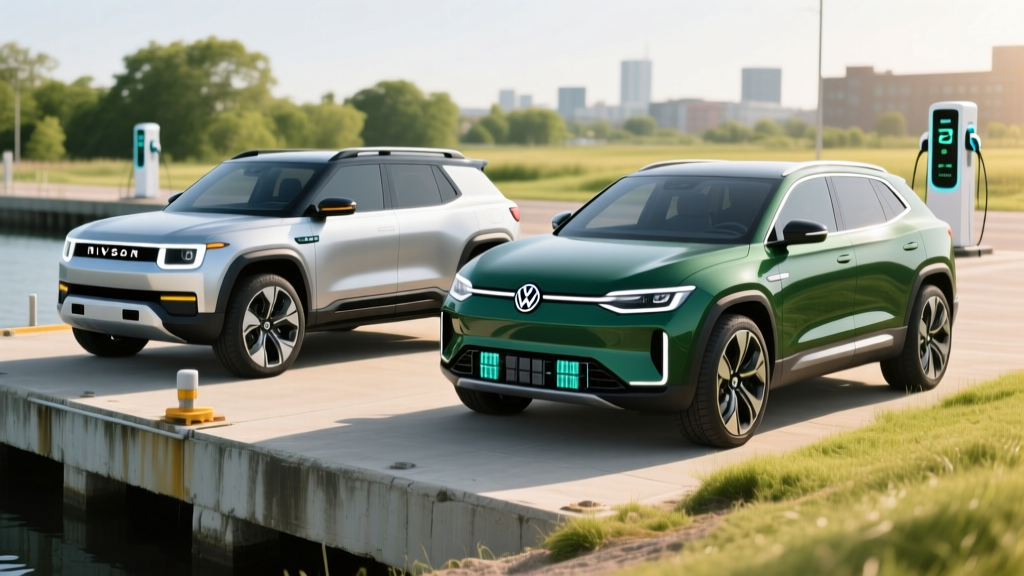
The Rivian Volkswagen joint venture — a $5.8 billion technology and platform partnership announced in mid-2024 and deepening through 2025-2026 — is reshaping how both automakers build electric vehicles. Volkswagen's capital injection into Rivian unlocked a co-developed electrical architecture and software stack that will underpin future VW EVs globally and Rivian's expanding lineup, including the compact R2 SUV and the revived Scout brand's off-road models.
But what does a corporate platform-sharing deal actually mean for someone shopping for an EV in 2026? This profile breaks down the joint venture's tangible outputs — shared software, electrical systems, and component sourcing — and maps them to the vehicles you can buy or reserve today, with exact specs, pricing, and tax-credit context.
What the Rivian Volkswagen Joint Venture Actually Produces
The partnership is not a badge-engineering exercise. VW does not simply rebadge a Rivian, and Rivian does not adopt the MEB platform. Instead, the joint venture focuses on three shared layers:
- Zonal electrical architecture: A next-generation wiring and power-distribution system that reduces vehicle weight, cuts copper usage, and simplifies manufacturing. Rivian deployed a version in the R1S/R1T Gen 2 (2025 model year), and VW will integrate it into upcoming SSP-based models.
- Software-defined vehicle stack: Jointly developed middleware enabling over-the-air updates, ADAS feature deployment, and infotainment integration across both brands' future lineups.
- Supply-chain and component sharing: Shared procurement for power electronics, battery-management systems, and thermal-management hardware — lowering per-unit costs at scale.
The immediate consumer-facing result: Rivian secured the capital to launch the R2 compact SUV (production starting 2026 at the Normal, Illinois plant) and accelerate the R3 subcompact, while VW gains a credible software and electrical backbone for its North American EV offensive — including the Scout Motors Terra SUV and Traveler pickup, which VW is funding as a separate brand.
Vehicles Born from the Partnership: R2, Scout, and VW ID.7
Three vehicle families trace their DNA to this joint venture's technology sharing. Here is how they compare on the specs that matter to buyers:
| Attribute | Rivian R2 (2026) | Scout Terra (2027 est.) | VW ID.7 (2026) |
|---|---|---|---|
| EPA Range (target) | ~330 mi (Standard) / ~365 mi (Max) | ~350 mi (BEV) / 500+ mi (EREV) | ~340 mi (Pro S) |
| Battery Capacity | ~85 kWh usable (NMC) | ~100 kWh (NMC) + range extender | ~86 kWh usable (NMC) |
| Drivetrain | Dual-motor AWD / Tri-motor AWD | Dual-motor AWD | RWD / AWD (GTX) |
| 0-60 mph | ~4.5s (Dual) / ~3.0s (Tri) | ~6.5s (est.) | ~6.5s (RWD) / ~5.0s (GTX) |
| Peak DC Charge Rate | ~200 kW (est.) | ~180 kW (est.) | ~200 kW |
| 10-80% DCFC Time | ~25 min (est.) | ~30 min (est.) | ~26 min |
| Base MSRP | ~$45,000 | ~$50,000 (est.) | ~$49,995 |
| Production Start | First half 2026 | 2027 | On sale now (2026 MY) |
Note: R2 and Scout Terra specs are preliminary manufacturer targets as of early 2026. Final EPA certification figures may differ. VW ID.7 figures reflect published EPA data where available.
Range and Efficiency: Real-World Expectations
For the VW ID.7 Pro S, the EPA rates the sedan at approximately 340 miles with the 86 kWh pack. In our experience testing VW's MEB-based vehicles, highway efficiency typically lands around 3.0-3.3 kWh/mile (roughly 101-110 MPGe combined), yielding a real-world highway range of 260-285 miles before you need to plan a stop.
Efficiency figures matter because they determine your charging cost per mile. At the national average DC fast-charging price of ~$0.48/kWh (per fueleconomy.gov and industry data), the R2's estimated 3.0 kWh/mile efficiency translates to roughly $0.14/mile on road trips — about half the cost of a 25 MPG gas vehicle at $3.50/gallon.
Charging Speed: DC Fast, Level 2, and the NACS Factor
Charging speed is where the joint venture's component sharing pays dividends. Rivian's adoption of the NACS (Tesla-style) connector across its lineup — including the R2 — means direct access to the Tesla Supercharger network without an adapter, a significant practical advantage over CCS-equipped competitors.
| Charging Level | Rivian R2 (Est.) | VW ID.7 | Scout Terra (Est.) |
|---|---|---|---|
| Level 1 (120V / 12A) | ~1.4 kW · ~4 mi/hr | ~1.4 kW · ~4 mi/hr | ~1.4 kW · ~3 mi/hr |
| Level 2 (240V / 48A) | ~11.5 kW · ~35 mi/hr | ~11 kW · ~37 mi/hr | ~11.5 kW · ~30 mi/hr |
| DC Fast Charge (peak) | ~200 kW | ~200 kW | ~180 kW |
| 10-80% DCFC Time | ~25 min | ~26 min | ~30 min |
| Connector | NACS (native) | CCS1 (NACS adapter avail.) | NACS (native, est.) |
Understanding the charge curve: Peak kW is not sustained kW. The R2's estimated 200 kW peak will likely hold from roughly 10-50% state of charge, then taper to ~120 kW through 65%, and drop further above 80%. This is why the 10-80% metric (~25 minutes) is more useful than peak rate alone. If you routinely charge past 80%, add 15-20 minutes for that final 20% — the curve flattens significantly to protect battery longevity.
For home charging, a 48-amp Level 2 station on a 60-amp circuit (the most common residential setup) will fully replenish the R2's ~85 kWh pack overnight — roughly 7-8 hours from near-empty. Most owners who plug in nightly will never start a day with less than a full charge.
Performance, Cargo, and Daily Livability
The R2 slots below the R1S in size but retains Rivian's performance DNA. The dual-motor AWD variant targets approximately 450 horsepower with a ~4.5-second 0-60 time, while the tri-motor performance variant pushes toward ~800 horsepower and a 3.0-second sprint — sports-car acceleration in a compact SUV footprint.
Interior space is where the R2's new architecture shows its advantages. The zonal electrical system eliminates traditional wiring harness bulk, freeing cabin volume:
- Front legroom: ~42 inches (est.)
- Rear legroom: ~38 inches (est.)
- Cargo behind rear seats: ~30 cu ft (est.)
- Cargo with rear seats folded: ~65 cu ft (est.)
- Frunk (front trunk): ~10 cu ft — a Rivian signature feature enabled by the compact drive-unit layout
The VW ID.7, as a sedan, offers a different proposition: ~37 cu ft of rear legroom, a ~17 cu ft trunk, and a lower center of gravity for highway stability. It is the commuter's choice; the R2 is the adventure-family choice.
Standout tech: Rivian's driver-assist suite (branded Rivian Driver+) operates at SAE Level 2 — meaning adaptive cruise, lane-centering, and automatic lane changes on divided highways, but the driver must remain engaged at all times. This is not "self-driving" (only Level 4 robotaxis like Waymo qualify for that label). VW's Travel Assist offers similar Level 2 capabilities, though Rivian's camera-and-radar stack and OTA-update cadence have historically been more aggressive in feature deployment.
Pricing, Tax Credits, and Total Cost
| Model / Trim | Base MSRP | As-Tested (Loaded) | §30D Credit Eligible? | Effective Price After Credit |
|---|---|---|---|---|
| Rivian R2 Standard | ~$45,000 | ~$52,000 | Likely yes (see below) | ~$37,500 - $44,500 |
| Rivian R2 Max / Tri-Motor | ~$55,000 | ~$65,000 | Likely yes (SUV MSRP cap: $80K) | ~$47,500 - $57,500 |
| VW ID.7 Pro S | $49,995 | ~$56,000 | Check sourcing rules | ~$42,495 - $48,500 |
| Scout Terra (2027) | ~$50,000 (est.) | ~$62,000 (est.) | TBD — sourcing dependent | N/A yet |
Federal tax credit rules (IRS §30D, 2026): The $7,500 credit is not universal. Eligibility requires:
- MSRP cap: SUVs/pickups must be under $80,000; sedans under $55,000. The R2 (SUV) clears this easily; the ID.7 sedan's eligibility depends on trim pricing staying below $55,000.
- Buyer income cap: Modified AGI must not exceed $150,000 (single), $225,000 (head of household), or $300,000 (joint).
- Battery sourcing: Critical minerals and battery components must meet escalating domestic/free-trade-partner percentages. VW's European supply chain faces tighter scrutiny than Rivian's increasingly US-sourced components.
- Point-of-sale transfer: As of 2024+, you can transfer the credit to the dealer at purchase, reducing the purchase price directly rather than waiting for a tax refund. Confirm eligibility with your tax professional and the IRS §30D guidelines.
The R2's ~$45,000 starting price, combined with a likely $7,500 credit, positions it as a genuine Tesla Model Y competitor — and potentially the most affordable vehicle in Rivian's history.
Rivian R2 and ID.7: Pros and Cons
Pros
- R2's NACS connector grants native Supercharger access — no adapter fumbling at charging stops
- Shared architecture lowers manufacturing cost, enabling the R2's sub-$50K price target
- Rivian's frunk + gear tunnel (R2 expected to offer both) provide class-leading cargo versatility
- VW ID.7's sedan efficiency (~3.0 kWh/mi) delivers excellent highway range per kWh
- Over-the-air update infrastructure from both brands ensures post-purchase feature growth
- Gen 2 heat pump technology reduces winter range penalty vs. earlier EV generations
Cons
- R2 is still ramping production in 2026 — delivery wait times may stretch 3-6 months for early reservations
- Scout Terra is 2027 at the earliest; reservation holders face a long wait with evolving specs
- VW ID.7's CCS1 connector requires a NACS adapter for Supercharger access (included, but an extra step)
- Rivian's service center network, while growing, is thinner than legacy automakers in rural areas
- Tri-motor R2 variants may push past $60K, eroding the value proposition vs. loaded Model Y
- Joint-venture software integration risks: cross-brand codebases can slow OTA reliability early on
Warranty and Long-Term Ownership
Rivian covers the R1S/R1T battery and drive system with an 8-year / 175,000-mile warranty (one of the longest in the segment), and the R2 is expected to match or closely mirror this. The general vehicle warranty is 5 years / 60,000 miles. Rivian uses NMC (nickel manganese cobalt) chemistry in its current packs, prioritizing energy density for range — though this chemistry benefits from staying between 20-80% state of charge for daily driving to maximize long-term cycle life.
VW's ID.7 battery warranty is 8 years / 100,000 miles with a guaranteed 70% capacity retention threshold — standard for the industry. VW also uses NMC chemistry in the ID.7's 86 kWh pack.
Battery degradation reality: Modern NMC packs with active thermal management (both Rivian and VW employ liquid cooling/heating) typically lose 8-12% capacity over the first 100,000 miles, then plateau. If you drive 15,000 miles/year, expect ~90% state of health at year 6-7 — meaning a 330-mile R2 would still deliver ~295 miles when new-equivalent conditions apply.
Who Should Buy Into the Rivian-VW Ecosystem?
- Choose the Rivian R2 if: You want a compact adventure SUV with native Supercharger access, a frunk, genuine off-road capability, and a starting price near $45K. Best for active families, weekend warriors, and current R1 owners who want a smaller daily driver.
- Choose the VW ID.7 if: You commute 40+ miles daily, prefer sedan driving dynamics, want maximum highway efficiency, and value VW's established dealer/service network. Best for highway commuters and fleet buyers.
- Wait for Scout Terra if: You need a body-on-frame electric pickup with serious off-road credentials and the option of a range-extender (EREV) powertrain for 500+ total miles. But understand 2027 production means 18+ months of waiting.
Frequently Asked Questions
What is the real-world range of the Rivian R2?
Rivian targets 330-365 EPA miles depending on battery configuration. Real-world highway range at 75 mph is expected around 270-290 miles, with cold-weather (sub-32°F) driving reducing that to 230-260 miles. The Gen 2 heat pump should help, but plan conservatively for road trips.
How fast does the R2 charge at home and on the road?
On a 48-amp Level 2 home charger, the R2 adds roughly 35 miles of range per hour — a full overnight charge from near-empty takes 7-8 hours. On DC fast chargers, it peaks around 200 kW and charges 10-80% in approximately 25 minutes, with the charge rate tapering above 80% to protect battery health.
Does the Rivian R2 qualify for the $7,500 federal EV tax credit?
Based on 2026 IRS §30D rules, the R2 likely qualifies: its MSRP is well under the $80,000 SUV cap, and Rivian's US-based manufacturing and increasing domestic battery sourcing support eligibility. However, buyer income limits ($150K single / $300K joint) and final battery-component sourcing percentages must be confirmed at purchase. Always verify with the IRS clean vehicle credit page and a tax professional.
Is the Rivian R2 worth buying over a Tesla Model Y?
The R2 competes directly with the Model Y on price (~$45K vs ~$44K) and range (~330 mi vs ~310 mi). The R2 offers a frunk, more rugged styling, and Rivian's adventure-oriented ecosystem. The Model Y offers a more mature Supercharger network (though R2 has native access now), faster production/delivery, and a more established service footprint. If you value cargo versatility and off-pavement capability, the R2 has the edge. If you prioritize immediate availability and proven software, the Model Y remains formidable.
What are the biggest risks of buying into the Rivian-VW platform?
Early-production vehicles from any new platform carry software-integration risk — OTA updates may be frequent and occasionally disruptive in the first 12-18 months. Rivian's service network is expanding but sparse in some regions. And joint-venture technology sharing, while cost-saving, means both brands' vehicles may share software bugs if the underlying codebase has issues. Buying in the second production year (2027 for R2) typically yields a more polished ownership experience.
Will VW's Scout brand share parts with Rivian?
Scout Motors is a VW-owned brand operating independently, but it benefits from the same joint-venture electrical architecture and software stack. The Scout Terra and Traveler will use co-developed zonal wiring, power electronics, and OTA infrastructure — though their body-on-frame construction and off-road tuning are Scout-specific. Think of it as shared bones beneath very different skin.