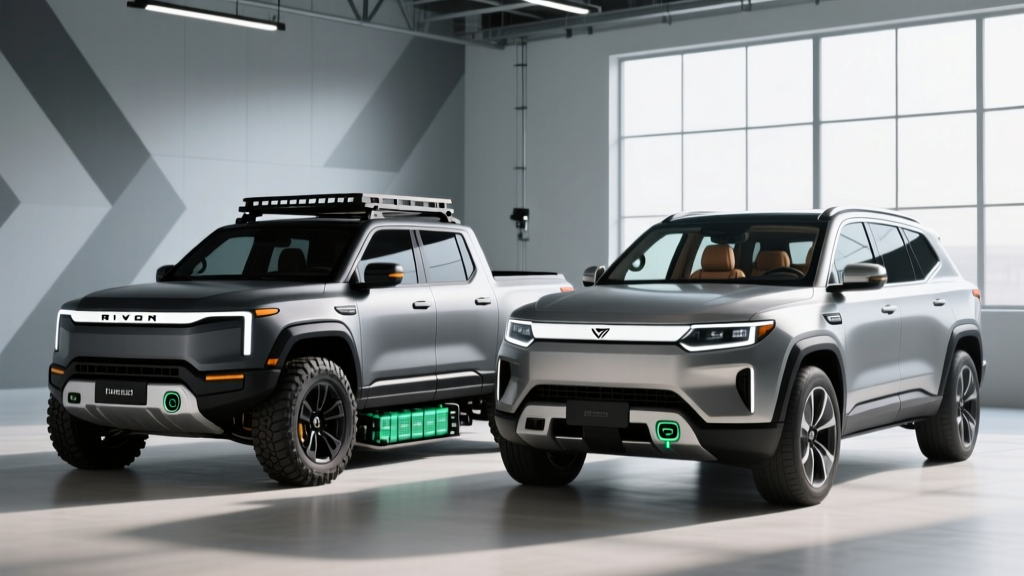
Every Rivian R1T truck and R1S SUV carries a 17-character Vehicle Identification Number that encodes its exact factory build: battery pack size, motor configuration, paint color, model year, and the Normal, Illinois assembly plant where it rolled off the line. For buyers evaluating a used Rivian, verifying a pre-order build, or confirming whether a specific vehicle qualifies for the federal EV tax credit, a Rivian VIN decoder is the fastest path to ground truth — cutting through listing ambiguity and dealer shorthand.
This guide explains how to read a Rivian VIN position by position, what each code means for real-world range, charging, and performance, and how to cross-reference the decoded build against 2026 EPA data and IRS §30D tax credit rules. We'll also profile the current-generation R1 Dual, R1 Tri, and R1 Quad powertrains so you know exactly what the decoded specs translate to on the road.
How the Rivian VIN Is Structured
The 17-character VIN follows the global ISO 3779 standard, but Rivian uses specific codes in positions 4–8 (the Vehicle Descriptor Section) to identify the model, battery chemistry, and drivetrain. Here is the breakdown for current-generation R1 vehicles:
| Position | Field | Rivian Codes & Examples |
|---|---|---|
| 1–3 | World Manufacturer Identifier (WMI) | 7FC — Rivian IP, LLC (USA, light truck/SUV) |
| 4 | Vehicle Line | R = R1T (truck), S = R1S (SUV) |
| 5 | Body / Cab Style | Specific to model year — consult Rivian service docs |
| 6 | Motor Configuration | D = Dual Motor, T = Tri Motor, Q = Quad Motor |
| 7 | Battery Pack | S = Standard (~92 kWh), L = Large (~109 kWh), M = Max (~141 kWh) |
| 8 | Restraint / Trim Series | Varies by model year and trim tier (Adventure, Ascend) |
| 9 | Check Digit | Calculated per DOT formula — validates VIN authenticity |
| 10 | Model Year | P = 2026, R = 2024, N = 2022, L = 2020 (per NHTSA year codes) |
| 11 | Assembly Plant | N = Normal, Illinois |
| 12–17 | Sequential Production Number | Unique serial — confirms build order |
Key takeaway: Positions 6 and 7 are the most consequential for buyers. They tell you whether you're looking at a 665-hp Quad-Motor Max Pack or a 533-hp Dual-Motor Large Pack — a difference of over 100 miles of EPA range and $20,000+ in MSRP.
What a Decoded Rivian VIN Tells You About Range and Efficiency
Once you've extracted the motor and battery codes, you can map them to EPA-certified range figures. The second-generation R1 platform (introduced for the 2025 model year and continuing into 2026) uses a new 925-volt electrical architecture with three battery sizes and up to four motor configurations. Here is how the decoded build translates to range:
| Motor Config (VIN Pos 6) | Battery (Pos 7) | Battery kWh (Usable) | Chemistry | EPA Range (R1T) | EPA Range (R1S) | MPGe (Combined) |
|---|---|---|---|---|---|---|
| Dual Motor | Standard (~92 kWh) | ~92 kWh | NMC (Lithium-ion) | 270 mi | 270 mi | 2.0 kWh/mi (~169 MPGe) |
| Dual Motor | Large (~109 kWh) | ~109 kWh | NMC | 330 mi | 330 mi | ~1.9 kWh/mi (~178 MPGe) |
| Dual Motor | Max (~141 kWh) | ~141 kWh | NMC | 420 mi | 410 mi | ~1.8 kWh/mi (~187 MPGe) |
| Tri Motor | Large (~109 kWh) | ~109 kWh | NMC | 320 mi | 315 mi | ~2.0 kWh/mi (~169 MPGe) |
| Tri Motor | Max (~141 kWh) | ~141 kWh | NMC | 400 mi | 390 mi | ~1.9 kWh/mi (~178 MPGe) |
| Quad Motor | Max (~141 kWh) | ~141 kWh | NMC | 380 mi | 370 mi | ~2.1 kWh/mi (~161 MPGe) |
The EPA numbers above assume moderate temperatures and mixed driving. In real-world use, expect the following adjustments:
- Highway-only at 75 mph: Subtract 10–15% from EPA range. A Dual-Motor Large Pack R1T rated at 330 miles EPA will deliver approximately 280–295 miles on an interstate run.
- Cold weather (below 30°F): Expect 20–30% range reduction without preconditioning. The Max Pack's 420-mile EPA rating can drop to 300–335 miles in freezing conditions — still usable, but plan charging stops accordingly.
- Towing (R1T rated 11,000 lbs): Range roughly halves under a heavy trailer load. Budget 180–210 miles between charges when towing near capacity.
The 925V architecture and standard heat pump on second-gen R1s improve cold-weather efficiency over the first-gen 400V platform, but physics still governs the pack.
Charging Speeds by Decoded Battery Pack
The battery code in position 7 determines your charging experience more than any other VIN field. The second-generation 925V architecture enables significantly faster DC fast charging than the outgoing 400V system.
| Battery Pack | Max DC Fast Charge | 10–80% Time | Level 2 Home Charge Rate | Miles Added per Hour (L2) |
|---|---|---|---|---|
| Standard (~92 kWh) | 200 kW peak | ~25 minutes | 11.5 kW (48A) | ~23 mi/hr |
| Large (~109 kWh) | 220 kW peak | ~22 minutes | 11.5 kW (48A) | ~25 mi/hr |
| Max (~141 kWh) | 250 kW peak | ~21 minutes | 11.5 kW (48A) | ~27 mi/hr |
Charging curve reality: Peak kW is not sustained kW. The R1 Max Pack hits 250 kW around 15–25% State of Charge and tapers progressively above 60%. The 10–80% time of ~21 minutes reflects this taper. If you arrive at a DC fast charger at 5% SoC, preconditioning (automatic when navigation routes to a charger) is essential to hit peak rates — without it, cold-soaked cells may limit initial charging to under 100 kW for the first several minutes.
At home on a Level 2 wall connector, expect a full overnight charge to add roughly 185–215 miles of range in 8 hours, depending on pack size. Rivian ships the vehicle with a portable charger that supports Level 1 (120V, ~3 mi/hr) and Level 2 (240V, up to ~16 mi/hr on a NEMA 14-50 outlet). For the full 11.5 kW onboard charger rate, a hardwired Level 2 station is required.
Performance Specs: Dual, Tri, and Quad Motor Decoded
The motor configuration code in VIN position 6 directly maps to horsepower, torque, and acceleration. Here is what each decoded configuration delivers:
| Configuration | Horsepower | Torque (lb-ft) | 0–60 mph | Drivetrain | Towing (R1T) |
|---|---|---|---|---|---|
| Dual Motor | 533 hp | 610 lb-ft | 4.5 sec | AWD (2 motors) | 11,000 lbs |
| Tri Motor | 850 hp | 1,100 lb-ft | 2.9 sec | AWD (3 motors) | 11,000 lbs |
| Quad Motor | 1,025 hp | 1,198 lb-ft | 2.5 sec | AWD (4 motors) | 11,000 lbs |
The Quad Motor uses four independent motors (one per wheel), enabling torque vectoring and tank turns — a party trick, but also genuinely useful for low-speed off-road maneuvering. The Tri Motor adds a rear-axle dual-motor setup for massive passing power while preserving more range than the Quad. For most buyers, the Dual Motor's 4.5-second 0–60 time and 533 hp are more than sufficient — and it offers the longest range of any configuration.
Pricing, Trims, and Federal Tax Credit Eligibility
Decoding the VIN also tells you the original build MSRP, which matters for tax credit eligibility and resale valuation. Here are the 2026 starting prices by configuration:
| Configuration | R1T Base MSRP | R1S Base MSRP | §30D Credit Eligible? |
|---|---|---|---|
| Dual Motor Standard Pack | $69,900 | $75,900 | R1T: Yes (under $80K cap). R1S: Yes (under $80K cap). Subject to income + sourcing rules. |
| Dual Motor Large Pack | $75,900 | $81,900 | R1T: Yes. R1S: Exceeds $80K SUV cap — NOT eligible. |
| Dual Motor Max Pack | $84,900 | $89,900 | R1T: Exceeds $80K truck cap — NOT eligible. R1S: NOT eligible. |
| Tri Motor Large Pack | $85,900 | $91,900 | NOT eligible (exceeds MSRP cap for both body styles). |
| Quad Motor Max Pack | $99,900 | $104,900 | NOT eligible. |
To claim up to $7,500 on a qualifying Rivian R1T (Dual Motor Standard or Large Pack), all of the following must be true per current IRS rules:
- MSRP cap: Vehicle base price + dealer-installed options must not exceed $80,000 for trucks (R1T) or $80,000 for SUVs (R1S).
- Buyer income cap: Modified AGI must not exceed $150,000 (single), $225,000 (head of household), or $300,000 (married filing jointly).
- Battery sourcing: Critical minerals and battery components must meet escalating domestic-content thresholds (phased in annually through 2029). Verify current-year compliance on the DOE Fuel Economy site.
- Point-of-sale transfer: As of 2024, the credit can be transferred to the dealer at purchase for an immediate price reduction — you don't need to wait until tax filing.
Always consult a tax professional and check IRS.gov for the latest rules before purchasing. Eligibility thresholds and sourcing requirements change annually.
Interior, Cargo, and Technology
The R1T and R1S share a common cabin architecture, but their cargo profiles differ significantly. The decoded VIN will confirm which body style you're evaluating:
| Dimension | R1T (Truck) | R1S (SUV) |
|---|---|---|
| Seating Capacity | 5 passengers (2 rows) | 7 passengers (3 rows) |
| Front Legroom | 41.3 in | 41.3 in |
| Second-Row Legroom | 38.2 in | 36.5 in |
| Bed / Rear Cargo | 54.0 cu ft (bed, 4.5 ft box) | 104.7 cu ft (behind 1st row, seats folded) |
| Front Trunk (Frunk) | 11.0 cu ft | 11.0 cu ft |
| Max Towing | 11,000 lbs | 7,700 lbs |
| Ground Clearance (max) | 14.9 in (air suspension) | 14.9 in (air suspension) |
Standout tech features:
- 15.6-inch center touchscreen running Rivian's in-house OS with native trip planning, DC fast-charger routing, and battery preconditioning
- Rivian Driver+ (SAE Level 2) — adaptive cruise + lane centering on highways; requires hands-on-wheel supervision at all times
- Over-the-air updates that have historically added features like enhanced regen profiles, tow-mode refinements, and new drive modes post-purchase
- Standard air suspension with adjustable ride height (up to 14.9 inches of ground clearance for off-road use)
- Integrated camp kitchen option (R1T) — slides out from the gear tunnel with a two-burner induction cooktop
Notable drawbacks:
- No Apple CarPlay or Android Auto — Rivian relies entirely on its native infotainment; Bluetooth audio streaming is the workaround
- Service center density remains limited outside major metro areas; mobile service covers many regions but not all
- Second-row seat comfort in the R1S is adequate but not class-leading compared to three-row luxury SUV competitors
- Rivian Driver+ is competent but trails GM Super Cruise and Ford BlueCruise in hands-free highway coverage
Warranty Coverage and Battery Longevity
A decoded VIN also lets you verify the original in-service date, which is essential for calculating remaining warranty coverage on a used Rivian:
| Coverage | Duration |
|---|---|
| Basic (Bumper-to-Bumper) | 5 years / 60,000 miles |
| Battery & Drive Units (Powertrain) | 8 years / 175,000 miles |
| Battery Capacity Retention | Warranted to retain ≥70% of original capacity over 8 yr / 175,000 mi |
| Corrosion Perforation | 5 years / unlimited miles |
| Roadside Assistance | 5 years / 60,000 miles |
Rivian uses NMC (nickel manganese cobalt) chemistry across all current R1 battery packs. NMC offers higher energy density than LFP, which is why the Max Pack achieves 420 miles in a truck form factor — but it also means Rivian recommends charging to 80% for daily use and reserving 100% charges for road trips. This is standard practice for NMC packs and is managed through the vehicle's configurable charge-limit settings.
Long-term degradation data on second-gen R1s (2025+) is still accumulating. First-generation R1 owners have reported approximately 5–8% degradation over 60,000–80,000 miles, which is consistent with industry averages for liquid-cooled NMC packs. The 8-year/175,000-mile battery warranty with a 70% retention floor is competitive with Tesla, Ford, and Hyundai.
Who the Rivian R1 Is Built For
Choose the R1T if: You need a daily-drivable truck with genuine 11,000-lb towing, off-road capability (14.9" ground clearance, quad-motor torque vectoring), and a lockable gear tunnel for adventure gear. It's the best electric truck for buyers who actually use a truck bed — not just a tailgate for show.
Choose the R1S if: You want a three-row electric SUV with real off-road chops, 7-passenger seating, and 400+ miles of available range (Max Pack). It competes most directly with the Tesla Model X and the upcoming electric Grand Cherokee, but offers superior ground clearance and build quality.
Look elsewhere if: You prioritize infotainment ecosystem (no CarPlay), need hands-free highway driving over long stretches (Super Cruise has broader coverage), or want the lowest possible cost of entry — the R1 Dual Standard at ~$69,900 is still a premium-priced vehicle.
Rivian VIN Decoder: Frequently Asked Questions
Where can I find the VIN on my Rivian?
The VIN is located on the driver's side dashboard (visible through the windshield), on the driver's door jamb sticker, and in the Rivian mobile app under your vehicle profile. It also appears on the window sticker (Monroney label), registration, and title documents.
Can a Rivian VIN tell me if the vehicle was in an accident?
The VIN itself only encodes factory build specifications — it does not contain accident history. However, you can use the VIN to pull a vehicle history report from NHTSA, Carfax, or AutoCheck, which will show reported accidents, title brands, and recall status.
Does the Rivian VIN reveal the battery chemistry?
Indirectly, yes. All current-generation Rivian R1 vehicles use NMC (nickel manganese cobalt) lithium-ion chemistry. Rivian has not offered an LFP pack in the R1 lineup as of 2026. The battery size (Standard, Large, Max) is encoded in VIN position 7, and all three sizes use NMC cells.
How do I verify if a used Rivian still has warranty coverage?
Use the VIN to confirm the original in-service date (available through Rivian's service team or a vehicle history report). The battery and drive unit warranty runs 8 years / 175,000 miles from that date. For a 2022 R1T first delivered in June 2022, coverage extends through June 2030 or 175,000 miles — whichever comes first.
Can I use a third-party VIN decoder for a Rivian?
Generic VIN decoders (like those built for legacy automakers) often return incomplete or incorrect data for Rivian because the manufacturer's WMI and descriptor codes are relatively new and not yet indexed in all databases. For accurate results, cross-reference any third-party decode against Rivian's official specs or contact Rivian support directly with the VIN. The position guide in this article covers the key fields for 2022–2026 models.
Is the Rivian R1T eligible for the $7,500 federal tax credit in 2026?
The R1T Dual Motor with the Standard Pack ($69,900) and Large Pack ($75,900) fall under the $80,000 MSRP cap for trucks and can qualify — provided the buyer meets IRS income limits and the vehicle's battery satisfies current-year critical-mineral and component sourcing thresholds. The Max Pack R1T ($84,900+) and all Tri/Quad Motor configurations exceed the cap and are not eligible. Always verify on IRS.gov before purchasing.