Bi-directional charging has been the EV industry's most anticipated feature for years, and Rivian V2H (vehicle-to-home) capability places the R1S SUV and R1T pickup squarely into the conversation about home energy resilience. But what does Rivian's V2H system actually deliver in 2026, how does it integrate with the larger R1 platform, and does the math work for a real homeowner facing outage risk or high time-of-use rates?
This review covers the full Rivian R1S and R1T lineup — tri-motor and dual-motor trims — with a focused lens on V2H hardware, battery capacity, range, charging speeds, and the ownership economics including federal tax credit eligibility under IRS §30D.
Rivian R1S and R1T: Platform Overview and V2H Readiness
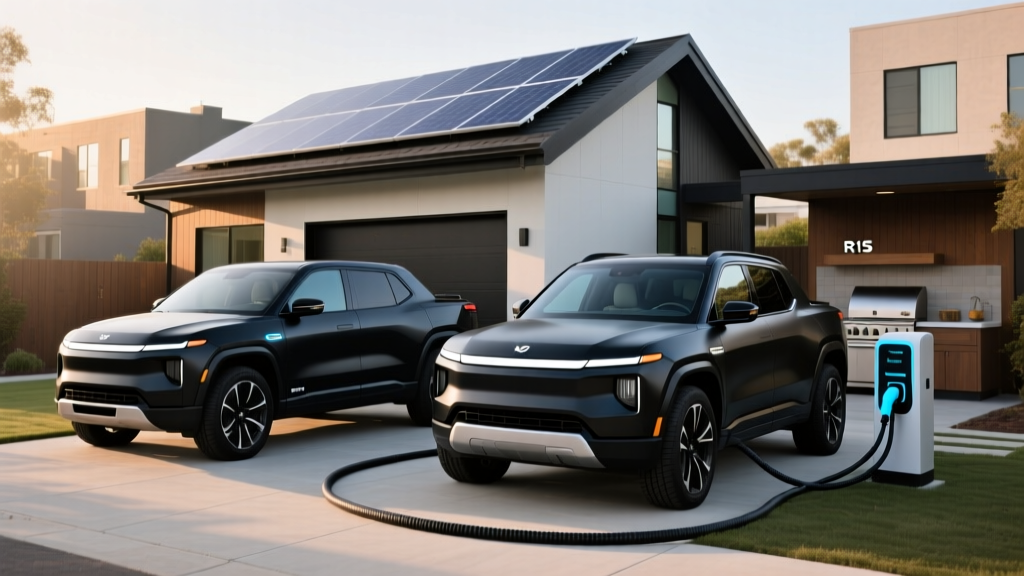
Both the R1S (three-row SUV) and R1T (crew-cab pickup) share Rivian's skateboard architecture. As of the 2026 model year, Rivian offers dual-motor (Standard and Large battery packs) and tri-motor (Max battery pack) configurations. The critical hardware for Rivian V2H is the on-board bi-directional inverter and the compatible home energy gateway — Rivian calls its home integration system the Rivian Home Power setup, which requires a professionally installed bidirectional charger unit and a transfer switch or energy gateway to isolate your home panel from the grid during an outage.
V2H capability is available on models equipped with the Large and Max battery packs. The Standard pack (LFP chemistry) models, introduced for the dual-motor trims, do not currently support V2H output — an important distinction for buyers who prioritize the feature.
| Spec | Dual-Motor Large | Tri-Motor Max |
|---|---|---|
| Battery Capacity (usable) | ~106 kWh (NMC) | ~141 kWh (NMC) |
| Battery Chemistry | NMC | NMC (2170 cells) |
| EPA Range (R1S) | 352 miles | 410 miles |
| EPA Range (R1T) | 352 miles | 420 miles |
| Horsepower | 533 hp | 850 hp |
| 0-60 mph | 4.5 sec (R1S) | 2.9 sec (Tri-Motor) |
| Drivetrain | Dual-Motor AWD | Tri-Motor AWD |
| Max DC Fast Charge | 220 kW (peak) | 220 kW (peak) |
| 10-80% DC Fast Charge | ~28 min | ~38 min |
| Level 2 Home Charge Rate | 11.5 kW (~25 mi/hr) | 11.5 kW (~25 mi/hr) |
| V2H Output | Up to 9.6 kW | Up to 9.6 kW |
| Towing Capacity (R1T) | 11,000 lbs | 11,000 lbs |
| Cargo (R1S behind 3rd row) | 10.4 cu ft / 57.5 cu ft (folded) | 10.4 cu ft / 57.5 cu ft |
| Bed Length (R1T) | 54.3 in (4.5 ft) | 54.3 in |
| Battery/Powertrain Warranty | 8 yr / 175,000 mi | 8 yr / 175,000 mi |
Real-World Range: What the EPA Sticker Doesn't Tell You
R1S Dual-Motor Large: EPA 352 mi → Expect ~290-310 mi highway (70-75 mph), ~240-260 mi in freezing temps with cabin heat.
R1T Tri-Motor Max: EPA 420 mi → Expect ~340-365 mi highway, ~280-310 mi in cold weather.
Rivian's boxy aerodynamics (drag coefficient ~0.30-0.34) and 6,800+ lb curb weight hit efficiency hard above 70 mph. Cold-weather range loss of 20-30% is typical for NMC packs without consistent preconditioning.
The R1 platform is remarkably efficient around town thanks to aggressive regenerative braking and Rivian's thermal management system, which includes a heat pump on 2025+ models. On the highway, however, the large frontal area and truck-grade weight erode the advantage. Plan for 2.8-3.2 kWh/mi on the highway in the Tri-Motor Max, versus the EPA combined rating that implies closer to 2.4 kWh/mi.
For V2H use, this matters: if you arrive home with 40% state of charge after a road trip, a Max pack still holds ~56 kWh of usable energy — enough to run an average US home (roughly 30 kWh/day) for nearly two days. A Large pack at 40% SoC yields roughly 42 kWh.
How Rivian V2H Actually Works
Rivian's V2H system delivers up to 9.6 kW of continuous AC power back to your home through a compatible bidirectional charger (similar in concept to Ford's Intelligent Backup Power for the F-150 Lightning). The vehicle connects to a home energy gateway or automatic transfer switch that isolates your home's electrical panel from the grid, then feeds power from the truck's battery through the on-board inverter.
At 9.6 kW, the system can sustain most essential home circuits simultaneously — refrigerator, furnace blower, well pump, lighting, Wi-Fi, and a few outlets. It will not, however, comfortably run a central air conditioner (which can draw 3.5-5 kW on its own) alongside other heavy loads without tripping the inverter's limit. Rivian's app allows you to set a minimum state-of-charge reserve (e.g., stop discharging at 20% SoC) to ensure you retain driving range.
The R1T also offers V2L (vehicle-to-load) through bed-mounted and cabin 120V outlets rated at up to 2.4 kW combined — useful for job-site tools or tailgating without engaging the full home system. This feature works without the bidirectional home charger installation.
Compared to Ford's F-150 Lightning Pro Power Onboard (also 9.6 kW V2H-capable), Rivian's advantage lies in the Max pack's 141 kWh capacity: the Lightning's Extended Range pack is ~131 kWh usable. The Hyundai Ioniq 5 offers V2L only (3.6 kW) without full V2H, making the Rivian platform one of the few consumer vehicles with true whole-home backup.
Charging Speed: DC Fast Charge and Home Level 2
| Charge Level | Power | Miles Added per Hour | Notes |
|---|---|---|---|
| Level 1 (120V) | ~1.4 kW | ~3-4 mi/hr | Emergency/trickle only |
| Level 2 (240V, 48A) | 11.5 kW | ~25 mi/hr | Full charge in ~10-13 hr |
| DC Fast Charge | 220 kW peak | N/A | 10-80% in ~28 min (Large), ~38 min (Max) |
| V2H Output | 9.6 kW | N/A (discharge) | Powers home during outage or TOU arbitrage |
Rivian's DC fast-charging curve peaks at 220 kW on both Large and Max packs but tapers meaningfully above 60% state of charge. The Large pack sustains above 180 kW through roughly 50% SoC before stepping down. The Max pack, with more cells to fill, holds peak rate slightly longer but takes proportionally more total time to reach 80%.
On the Rivian Adventure Network (their proprietary chargers at adventure destinations) and via the expanding NACS adapter compatibility with Tesla Superchargers, Rivian owners now have access to the two most reliable DC networks in North America. The switch to the NACS charge port on 2025+ models eliminated the need for a CCS adapter for most public charging.
For home Level 2 charging, Rivian recommends a 60-amp circuit with a 48-amp wall connector. A full home install — panel evaluation, 240V run, permit, and Rivian Wall Charger — typically costs $1,200-$3,500 depending on panel proximity and whether a 200A service upgrade is needed. If you're also installing the V2H bidirectional gateway, expect an additional $2,500-$5,000 for the gateway hardware, transfer switch, and electrician labor.
Pricing, Trims, and Federal Tax Credit Eligibility
| Model / Trim | Base MSRP | §30D Credit Eligible? | Est. Net Price (with credit) |
|---|---|---|---|
| R1S Dual-Motor Standard | $75,900 | Yes (MSRP under $80K cap) | ~$68,400 |
| R1S Dual-Motor Large | $83,400 | No (exceeds $80K SUV cap) | $83,400 |
| R1S Tri-Motor Max | $99,900 | No | $99,900 |
| R1T Dual-Motor Standard | $69,900 | Yes (MSRP under $80K truck cap) | ~$62,400 |
| R1T Dual-Motor Large | $77,400 | Yes (under $80K truck cap) | ~$69,900 |
| R1T Tri-Motor Max | $94,900 | No | $94,900 |
The IRS §30D federal EV tax credit offers up to $7,500 for qualifying new EVs, but eligibility hinges on three constraints: MSRP caps ($80,000 for SUVs and vans, $80,000 for pickups), buyer income limits (AGI ≤ $300K joint / $150K single), and critical mineral + battery component sourcing requirements that tighten annually. As of 2026, Rivian's US-built vehicles with their Samsung SDI battery supply chain generally meet the sourcing thresholds, but buyers should verify current eligibility on fueleconomy.gov before purchasing.
Point-of-sale transfer of the credit is available, meaning the $7,500 can be applied as a down-payment reduction at delivery rather than waiting for a tax refund. Consult a tax professional for your specific situation — rules change and state-level incentives vary.
Efficiency, Cargo, and Daily Livability
The R1S Dual-Motor Large achieves an EPA-rated 73 MPGe combined (approximately 46 kWh/100 mi). The Tri-Motor Max, with its heavier drivetrain and wider tires, drops to roughly 70 MPGe. These figures trail the Tesla Model X (102 MPGe) but are competitive with the Mercedes EQS SUV and far better than any ICE truck.
Interior space is a highlight. The R1S seats up to seven across three rows, though the third row is best suited for children (31.1 inches of legroom). Behind the third row, cargo space is a modest 10.4 cu ft — expanding to 57.5 cu ft with the third row folded. The R1T's 54.3-inch bed is shorter than a standard short-bed truck but includes the innovative Gear Tunnel (an 11.7 cu ft pass-through storage compartment behind the cab) and a front trunk (frunk) of 11.0 cu ft.
The infotainment system runs on Rivian's proprietary software with a 15.6-inch center touchscreen, 12.3-inch driver display, and a 6.8-inch rear touchscreen. Wireless Apple CarPlay and Android Auto are not supported — Rivian uses its own native interface, which most users find intuitive but which limits phone-mirroring preferences. The Rivian Driver+ system provides SAE Level 2 highway assist with lane centering and adaptive cruise; it is not a self-driving system and requires continuous driver attention.
Who Should Buy a Rivian with V2H?
The R1T and R1S with V2H capability are strongest for three buyer profiles:
- Homeowners in outage-prone areas (Texas grid, California PSPS events, Gulf Coast hurricane zones) who want a dual-purpose vehicle that serves as both daily driver and backup generator — without the maintenance, fuel storage, and noise of a gas generator.
- Time-of-use rate arbitrageurs who can charge overnight at off-peak rates ($0.08-$0.12/kWh) and discharge back to the home during peak hours ($0.30-$0.55/kWh), potentially saving $1,500-$3,000/year depending on utility rates and solar integration.
- Adventure-oriented families who need genuine off-road capability (Rivian's quad-motor tank turns and 14.4 inches of ground clearance in Max mode), towing capacity, and campsite power — with V2L handling everything from induction cooktops to CPAP machines.
This platform is not ideal for urban apartment dwellers without home charging access, budget-focused commuters (the Standard pack without V2H starts at ~$70K), or buyers who prioritize maximum third-row comfort over capability.
Pros and Cons at a Glance
- True V2H at 9.6 kW — genuine whole-home backup
- Massive Max pack (141 kWh) provides 1.5-2+ days of home power
- Excellent off-road capability and 11,000-lb towing
- NACS port + Supercharger access (2025+)
- 8-year/175,000-mile battery warranty
- OTA software updates continuously improve features
- MSRP exceeds §30D cap on Large and Max trims
- Highway range drops significantly at 75+ mph
- V2H home gateway installation adds $2,500-$5,000
- No Apple CarPlay / Android Auto
- 220 kW peak DC charge rate trails Hyundai/Kia's 350 kW
- Third-row space tight for adults
Competitor Check: R1T vs. F-150 Lightning for V2H
The Ford F-150 Lightning Extended Range remains the closest V2H competitor. At ~$80,000 for the Lariat trim, it undercuts the R1T Large while offering similar 9.6 kW V2H output. The Lightning's 131 kWh usable battery is slightly smaller than Rivian's 141 kWh Max, but Ford's Pro Power Onboard ecosystem has been in market longer and has broader dealer support for the home integration hardware.
Where Rivian wins: the R1T's build quality, off-road geometry (approach/departure angles), and software-driven feature set are a generation ahead. Where Ford wins: lower entry price, more service centers, and the familiarity of the F-150 brand for truck buyers who are new to EVs.
Frequently Asked Questions
What is the real-world range of the Rivian R1S and R1T?
Expect 290-310 highway miles from the Dual-Motor Large (EPA 352 mi) and 340-365 highway miles from the Tri-Motor Max (EPA 420 mi). Cold weather reduces these figures by 20-30% depending on temperature and preconditioning habits. Source: fueleconomy.gov.
How fast does the Rivian charge at home and on DC fast chargers?
Home Level 2 charging at 11.5 kW adds roughly 25 miles per hour, fully replenishing a Large pack in about 10 hours. DC fast charging peaks at 220 kW, reaching 10-80% in approximately 28 minutes (Large) or 38 minutes (Max). Charging slows significantly above 80% SoC — avoid DC fast charging past 80% unless necessary to protect battery longevity.
How much does a Rivian cost after tax credits?
The R1T Dual-Motor Standard starts at $69,900 and qualifies for the full $7,500 §30D credit (net ~$62,400), assuming buyer income and sourcing requirements are met. The R1S Dual-Motor Standard at $75,900 also qualifies. Trims above $80,000 MSRP do not qualify for the federal credit under current SUV/pickup caps.
Does the Rivian qualify for the federal EV tax credit?
Yes, but only for trims priced at or below the $80,000 MSRP cap for SUVs and pickups, and only for buyers with AGI at or below $300,000 (joint) or $150,000 (single). Battery sourcing requirements also apply and tighten yearly. Always verify current eligibility on the IRS qualified vehicles list.
Can Rivian V2H power my entire house?
At 9.6 kW, the system can power most essential circuits — fridge, lights, HVAC fan, well pump, Wi-Fi, and outlets. It cannot typically sustain a full-size central A/C compressor alongside other heavy loads simultaneously. For whole-home coverage including A/C, you may need a paired home battery (e.g., Tesla Powerwall) or a load-management panel.
Is Rivian V2H worth buying vs. a gas generator?
If you already plan to buy an R1T or R1S, V2H adds roughly $3,000-$5,000 in home installation costs and eliminates the need for a separate generator ($3,000-$7,000 for a standby unit plus fuel and maintenance). The dual-purpose value proposition is strong for outage-prone areas. If you don't need a truck or large SUV, a dedicated home battery system may be more cost-effective than buying a $75,000+ vehicle primarily for backup power.
What is the battery warranty on Rivian vehicles?
Rivian covers the battery pack and drive units for 8 years or 175,000 miles, whichever comes first, with a capacity retention threshold of 70%. This is more generous in mileage than the industry-standard 100,000-mile warranty, reflecting Rivian's confidence in their thermal management and NMC cell durability.