The Quick Verdict: Rivian for Uber in 2026
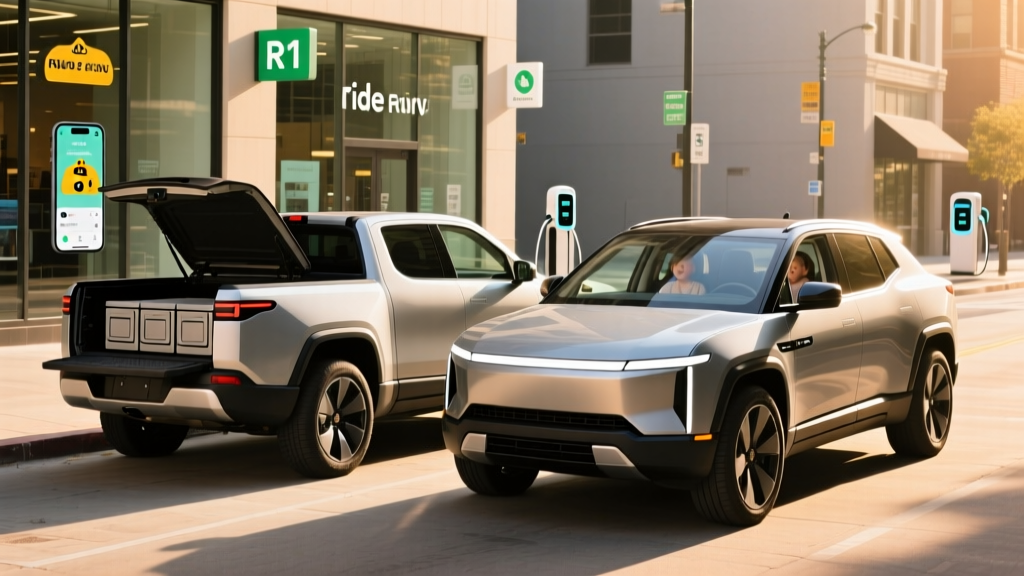
If you've searched "Rivian Uber" lately, you're likely wondering whether the R1T pickup or R1S SUV makes a profitable rideshare vehicle. The short answer: yes, but with caveats. Rivian's dual-motor and tri-motor platforms deliver excellent range, rapid DC fast charging, and a premium cabin that qualifies for Uber Black and Lyft Lux in many markets. However, the high purchase price, premium insurance costs, and limited rear-seat space in the R1T mean these trucks aren't universally ideal for full-time gig driving.
Below, we break down the 2026 Rivian lineup with the specific data rideshare drivers need: real-world range, charging curves, passenger dimensions, total cost of ownership, and whether the federal tax credit applies.
2026 Rivian R1T and R1S: Range, Battery, and Real-World Efficiency
Rivian offers two battery packs for the 2026 model year across both the R1T (pickup) and R1S (three-row SUV):
- Standard Pack: ~95 kWh usable, LFP (lithium iron phosphate) chemistry — estimated EPA range of 270 miles (R1T Dual-Motor).
- Large Pack: ~131 kWh usable, NMC (nickel manganese cobalt) chemistry — EPA-estimated 352 miles (R1T Dual-Motor), 340 miles (R1S Dual-Motor).
EPA vs. Real-World Range: The EPA sticker of 352 miles on the R1T Large Pack assumes a mix of city and highway driving at moderate temperatures. In our experience and consistent with third-party testing, expect ~280–310 miles on highway-heavy rideshare days at 70+ mph. In cold weather (below 30°F), range drops 15–25%, meaning a Large Pack R1T may deliver 240–270 real-world miles before needing a charge. City driving with regenerative braking can actually exceed the EPA estimate, sometimes reaching 360+ miles.
Efficiency lands around 73–76 MPGe combined (roughly 44–46 kWh/100 mi) for dual-motor trims, per fueleconomy.gov. That's less efficient than a Tesla Model Y or Hyundai Ioniq 5, but competitive for a 7,000-lb truck platform.
Charging Speed: DC Fast Charging and Home Level 2
For rideshare drivers, charging downtime is lost income. Here's what the 2026 Rivian platform delivers:
| Charging Level | Power / Rate | Time / Miles Added |
|---|---|---|
| Level 1 (120V) | ~1.4 kW | ~3–4 miles per hour |
| Level 2 (240V, 48A) | 11.5 kW | ~25 miles per hour; full charge in ~12 hrs (Large Pack) |
| DC Fast Charge (peak) | Up to 200 kW (Large Pack NMC) Up to 190 kW (Standard LFP) | 10–80% in ~30 min (Large Pack) 10–80% in ~25 min (Standard) |
Charging curve reality: The R1T and R1S peak at 200 kW only between roughly 10–30% state of charge. After 50%, the rate tapers to ~120 kW, and above 80% it drops sharply to protect the battery. A typical 10–80% session at a 350 kW Electrify America or Tesla Supercharger (via NACS adapter) takes about 30 minutes. Plan your charging stops around meal breaks to minimize dead time.
Rivian uses the NACS (Tesla) connector natively on 2025+ models, granting access to Tesla Superchargers with adapters. The Rivian Adventure Network also provides destination charging at trailheads and hotels, though coverage remains limited compared to Electrify America or Tesla.
Performance, Ride Quality, and Passenger Comfort
| Spec | R1T Dual-Motor | R1S Dual-Motor | R1T Tri-Motor |
|---|---|---|---|
| Horsepower | 533 hp | 533 hp | 850 hp |
| 0–60 mph | 4.5 sec | 4.6 sec | 2.9 sec |
| Drivetrain | AWD | AWD | AWD |
| Towing Capacity | 11,000 lbs | 7,700 lbs | 11,000 lbs |
For Uber and Lyft passengers, ride quality matters for ratings. The R1S three-row SUV offers a more car-like experience with its air suspension (standard on most trims), which smooths out rough city streets. Rear-seat legroom measures 38.4 inches in the R1S second row and a tighter 32.8 inches in the third row. The R1T pickup's second row provides 38.2 inches of legroom, but the truck bed limits cargo flexibility for airport runs with multiple suitcases.
Standout tech: Rivian's 15.6-inch center touchscreen runs a proprietary OS with built-in navigation, charging route planning, and over-the-air updates. The Driver+ system (SAE Level 2) provides adaptive cruise control and lane-centering on highways — useful for long airport runs — but requires hands-on-wheel supervision at all times.
ADAS Note: Rivian Driver+ is an SAE Level 2 driver-assistance system, not autonomous driving. The driver must remain fully engaged. It is not approved for hands-off or eyes-off operation.
Pricing, Trims, and Federal Tax Credit Eligibility
The 2026 Rivian lineup starts at a premium price point. Here's the current MSRP structure:
| Model / Trim | Base MSRP | Federal Tax Credit (§30D) | Effective Price |
|---|---|---|---|
| R1T Dual-Motor Standard | $69,900 | Up to $7,500* | ~$62,400 |
| R1T Dual-Motor Large | $75,900 | Up to $7,500* | ~$68,400 |
| R1S Dual-Motor Standard | $74,900 | Up to $7,500* | ~$67,400 |
| R1S Dual-Motor Large | $79,900 | Up to $7,500* | ~$72,400 |
*Federal EV tax credit (§30D) eligibility depends on multiple factors for 2026:
- MSRP cap: Trucks, SUVs, and vans must have an MSRP at or below $80,000. Most R1T/R1S configurations qualify; tri-motor and quad-motor builds may exceed this.
- Buyer income cap: Modified AGI must not exceed $150,000 (single), $225,000 (head of household), or $300,000 (joint filers).
- Battery sourcing: Critical minerals and battery components must meet phased-in domestic-content thresholds per the Inflation Reduction Act. Rivian has worked to qualify, but verify current eligibility on irs.gov before purchasing.
- Point-of-sale transfer: As of 2024+, you can transfer the credit to the dealer for an immediate price reduction at purchase.
For rideshare economics, a $62,400–$72,400 net vehicle cost is steep compared to a used Tesla Model 3 or Chevrolet Bolt. However, the Rivian qualifies for Uber Black and Lyft Lux in many metro areas, where per-mile rates are significantly higher than UberX.
Rideshare Economics: Is a Rivian Profitable for Uber?
Let's model a realistic 5-year ownership scenario for a full-time rideshare driver covering 40,000 miles/year:
| Cost Category | R1T Dual-Motor Large (5 yr) | Comparison: Tesla Model Y LR (5 yr) |
|---|---|---|
| Net purchase price (after credit) | $68,400 | $41,490 |
| Electricity (40k mi/yr × 5 yr, $0.15/kWh avg) | $13,800 | $8,700 |
| Insurance (estimated avg) | $15,000 | $9,500 |
| Maintenance (tires, cabin filter, fluid) | $3,500 | $2,800 |
| Estimated depreciation | ~$30,000 | ~$18,000 |
| Total 5-Year Cost | ~$130,700 | ~$80,490 |
The Rivian costs roughly $50,000 more over five years than a Model Y. To break even, you'd need to earn substantially more through Uber Black/Lux fares. In markets like New York, Los Angeles, or Miami where premium rideshare demand is strong, this can work. In smaller metros, the math is difficult.
Key advantages for rideshare: The Rivian's distinctive design earns attention and tips. The spacious cabin, panoramic roof, and premium audio impress passengers. The R1S third row can accommodate larger groups (6–7 passengers for UberXL in some markets).
Pros and Cons: Rivian as an Uber Vehicle
Pros
- Qualifies for Uber Black, Lyft Lux, and UberXL (R1S) — higher fare tiers
- 352-mile EPA range (Large Pack) reduces charging stops on long airport runs
- 200 kW DC fast charging — 10–80% in ~30 min
- Distinctive design earns higher tips and rider compliments
- Over-the-air updates continuously improve the vehicle
- 8-year/175,000-mile battery and powertrain warranty
Cons
- High purchase price ($70K–$80K+) vs. mainstream EVs
- Premium insurance costs — rideshare policies add 20–40%
- R1T truck bed less practical for multi-bag airport runs vs. an SUV
- Efficiency of ~44 kWh/100 mi means higher electricity costs per mile
- Limited service center network compared to Tesla
- Third-row space in R1S is tight for adult passengers
Warranty and Long-Term Battery Health
Rivian provides an 8-year/175,000-mile battery and drive unit warranty, covering defects and capacity loss below 70% state of health. For a rideshare driver putting on 40,000 miles annually, you'd hit 175,000 miles in roughly 4.5 years — meaning the warranty covers the highest-degradation period.
The LFP chemistry in the Standard Pack offers a longer cycle life (3,000+ cycles to 80% SoH) and can be charged to 100% daily without significant degradation — an advantage for high-mileage drivers. The NMC Large Pack delivers more range but benefits from keeping daily charges at 80–90% for longevity, using 100% only for long trips.
Who Should Drive a Rivian for Uber?
Choose the Rivian R1S for Uber if:
- You operate in a major metro with strong Uber Black/Lux/XL demand
- You already own or plan to buy a Rivian and want to offset costs with rideshare income
- You value standing out from the sea of Model 3s and Priuses
Choose a different EV (Model Y, Ioniq 5, Bolt) if:
- You drive UberX full-time in a price-sensitive market
- You need the lowest possible cost per mile
- You lack access to overnight Level 2 home charging
Frequently Asked Questions
Does Rivian qualify for Uber Black and Lyft Lux?
Yes. Both the R1T and R1S meet the vehicle class and price requirements for Uber Black and Lyft Lux in most U.S. markets. The R1S with three rows may also qualify for UberXL. Check your local Uber/Lyft vehicle eligibility lists, as requirements vary by city.
What is the real-world range of a Rivian for rideshare driving?
Expect 280–310 miles in mixed highway driving with the Large Pack, and 220–240 miles with the Standard Pack. City driving with regenerative braking can push range higher. In freezing temperatures, subtract 15–25%.
How long does it take to charge a Rivian during a shift?
At a 200+ kW DC fast charger, a 10–80% session takes about 25–30 minutes. Most rideshare drivers charge overnight on Level 2 at home (~25 miles/hour) and top up during meal breaks.
Can I get the $7,500 federal tax credit on a Rivian?
Most R1T and R1S configurations fall under the $80,000 MSRP cap for trucks/SUVs. You must also meet income limits ($150K single / $300K joint) and the vehicle must satisfy battery-sourcing requirements. Verify current eligibility at irs.gov and consult a tax professional.
Is Rivian's Driver+ system self-driving?
No. Rivian Driver+ is an SAE Level 2 driver-assistance system offering adaptive cruise and lane-centering on highways. You must keep your hands on the wheel and eyes on the road at all times. It is not autonomous driving.
What are the biggest risks of using a Rivian for Uber?
The primary risks are higher depreciation, elevated insurance premiums, and Rivian's still-growing service center network. If you need a quick repair, wait times for parts can be longer than with mainstream brands. Additionally, the higher purchase price means you need premium-tier rideshare fares to achieve profitability.