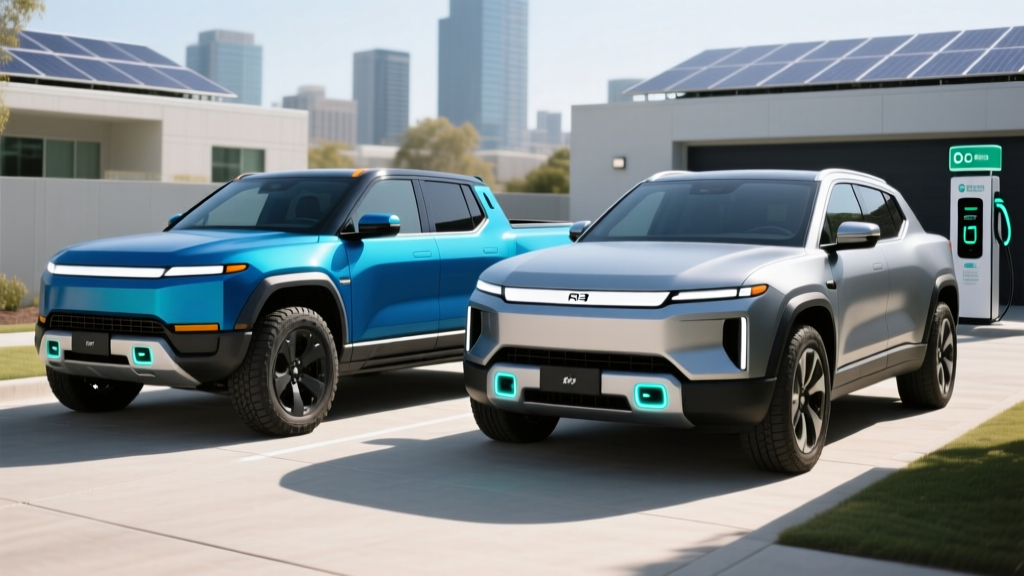
Storm Blue isn't a separate Rivian model — it's one of the most popular exterior paint options across the 2026 R1T pickup and R1S SUV lineup, and it's the color most shoppers search for when configuring a dual-motor or quad-motor Rivian. This review covers what you actually need to know before ordering a Storm Blue R1T or R1S: real-world range on the Max and Large packs, DC fast-charge curves on the upgraded electrical architecture, Level 2 home charging, §30D tax credit eligibility, and how the 2026 Rivians stack up against the Tesla Cybertruck, Ford F-150 Lightning, and Jeep Wrangler 4xe.
Quick Verdict: Who the Storm Blue Rivian Is For
A Storm Blue 2026 R1T (Dual-Motor Max Pack) is the best all-around configuration for buyers who need a 5-passenger truck with genuine off-road chops, a ~420-mile EPA ceiling, and a tow rating north of 10,000 lbs. The R1S in Storm Blue suits three-row families who want an electric SUV with air suspension, a usable frunk, and a more distinctive look than a Model X or Escalade IQ. Skip the Standard pack if you live above the 40th parallel or plan to tow — cold weather and trailer loads compress range by 25–40%.
2026 Rivian Storm Blue: Spec Table (R1T & R1S)
| Spec | R1T Dual-Motor Max | R1S Dual-Motor Max | R1T Tri-Motor |
|---|---|---|---|
| EPA Range | 420 mi | 410 mi | 380 mi |
| Battery (usable) | 141 kWh NMC | 141 kWh NMC | 109.4 kWh NMC |
| Horsepower | 665 hp | 665 hp | 850 hp |
| 0–60 mph | 3.5 sec | 3.6 sec | 2.9 sec |
| Drivetrain | AWD (dual-motor) | AWD (dual-motor) | AWD (tri-motor) |
| Peak DC Charge | 220 kW | 220 kW | 220 kW |
| 10–80% DC Time | ~41 min | ~41 min | ~32 min |
| Level 2 (11.5 kW) | ~25 mi/hr | ~25 mi/hr | ~25 mi/hr |
| Max Tow Rating | 11,000 lbs | 7,700 lbs | 11,000 lbs |
| Base MSRP | $99,900 | $104,900 | $115,900 |
Source: Rivian R1T specs and fueleconomy.gov. Tri-Motor uses the Large pack.
EPA Range vs. Real-World Miles in a Storm Blue Rivian
EPA sticker: 420 miles (R1T Dual-Motor Max Pack)
Real-world highway (70 mph, 65°F): ~330–350 miles
Real-world winter (30°F, mixed driving): ~275–300 miles
While towing a 5,000-lb trailer: ~180–210 miles
The 420-mile EPA number is achievable only in low-speed, mild-weather city/suburban driving where regenerative braking recovers energy. Rivian's boxy aero profile — flat windshield, truck bed, roof rack — punishes efficiency at highway speeds. On fueleconomy.gov, the R1T Dual-Motor Max is rated at 73 MPGe combined, which translates to roughly 46 kWh/100 mi. Expect to see closer to 50–55 kWh/100 mi on a 75-mph interstate run, which is what compresses highway range to the low 300s.
Cold weather compounds this: NMC chemistry loses roughly 15–20% of usable capacity below freezing, and cabin heating (even with Rivian's heat pump) adds load. If your typical day includes a 150-mile round trip in a Minnesota winter, plan on charging every other day rather than every third.
Charging Speed: DC Fast, Level 2, and the Curve You Should Know
| Level | Power | Miles Added per Hour | Notes |
|---|---|---|---|
| Level 1 (120V) | 1.4 kW | ~3 mi/hr | Emergency/trickle only |
| Level 2 (240V, 48A) | 11.5 kW | ~25 mi/hr | Full overnight charge in ~13 hrs |
| DC Fast (CCS/NACS) | Peak 220 kW | Up to ~140 mi in 15 min | Sustained ~150 kW avg to 80% |
Rivian migrated to the North American Charging Standard (NACS) port on 2025+ models, so a Storm Blue 2026 R1T plugs natively into Tesla Superchargers (V3 and V4) without an adapter. Peak charge rate is 220 kW on the Max Pack, but the curve is the story: the truck sustains roughly 180–200 kW from 10–40% SoC, then tapers to ~130 kW through 70%, and drops sharply above 85%. A 10–80% session on a 350-kW Electrify America or Tesla V4 stall takes about 41 minutes on the Max Pack — good, but not class-leading against the Cybertruck's ~15-minute 10–80% on a V4 Supercharger.
For home charging, Rivian's Wall Connector at 48 amps / 11.5 kW adds about 25 miles of range per hour. A full 0–100% on the 141 kWh Max Pack takes roughly 13 hours — fine for overnight top-ups but worth knowing if you arrive home nearly empty and need a full pack by morning. A 200-amp panel is usually sufficient; older 100-amp homes often need a $1,500–$3,000 service upgrade.
Performance, Drivetrain, and Off-Road Capability
Every 2026 R1T and R1S uses an AWD layout with independent motors per axle (dual-motor) or an additional rear motor (tri-motor). The Dual-Motor Max makes 665 hp and 829 lb-ft of torque, hitting 60 mph in 3.5 seconds — absurd for a 7,100-lb truck, and genuinely useful for highway merging with a trailer. The Tri-Motor drops the 0–60 to 2.9 seconds and adds torque vectoring across the rear axle, which matters off-road more than on pavement.
Off-road, Rivian's air suspension offers up to 14.9 inches of ground clearance, a wading depth of 3+ feet, and quad-motor-style tank turns on the Tri-Motor. The gear tunnel on the R1T (the pass-through behind the cab) remains a standout — roughly 11 cu ft of lockable, weather-sealed storage that no competitor matches. Bed volume is ~54 cu ft (R1T); cargo behind the third row on the R1S is tight at ~10 cu ft, expanding to ~58 cu ft with the third row folded.
Pricing, Trims, and Federal Tax Credit Eligibility
| Configuration | MSRP | Est. After §30D Credit | Credit Eligible? |
|---|---|---|---|
| R1T Dual-Motor Standard | $71,700 | $64,200 | Yes, if income + sourcing met |
| R1T Dual-Motor Max | $99,900 | $92,400 | Yes, if income + sourcing met |
| R1S Dual-Motor Max | $104,900 | $97,400 | Yes, if income + sourcing met |
| R1T Tri-Motor | $115,900 | $108,400 | Yes, if income + sourcing met |
The IRS §30D clean vehicle credit provides up to $7,500, split between a critical-minerals component ($3,750) and a battery-component component ($3,750). To qualify for the full amount in 2026, the buyer must meet income caps ($300k joint / $150k single modified AGI), the vehicle MSRP must be at or below $80,000 for trucks/SUVs (R1T qualifies; some R1S trims exceed the cap — verify your exact build), and the battery's critical minerals and components must meet domestic-sourcing thresholds that tighten annually. Point-of-sale transfer is available, so you can apply the credit as a down-payment reduction at delivery rather than waiting for tax filing. Always confirm your specific VIN's eligibility on fueleconomy.gov before ordering.
Warranty, Ownership Costs, and the Battery Question
Rivian covers the battery and powertrain for 8 years / 175,000 miles, whichever comes first — one of the longer EV warranties on the market and above the industry-standard 8/100,000. The bumper-to-bumper is 5 years / 60,000 miles. The battery warranty guarantees at least 70% capacity retention over the term. Real-world degradation data from early 2022 R1T owners (Large Pack, NMC) suggests roughly 5–8% loss at 60,000 miles, tracking well with the warranty floor.
Insurance is a real cost factor: expect $2,800–$3,800/year for a Storm Blue R1T depending on zip code and driving record — roughly 25–40% higher than a comparably priced F-150. Rivian has partnered with specific insurers to offer bundled rates, so quote through their portal before assuming your existing carrier is cheapest.
Standout Tech, Drawbacks, and Driver Assistance
Rivian's 15.6-inch center display runs a proprietary OS that's responsive and visually clean, with integrated navigation that preconditions the battery en route to DC chargers — a must-have for maximizing charge speed. The driver display is a 12.3-inch cluster, and there's no HUD (a notable omission at this price). Over-the-air updates are frequent and substantive; Rivian shipped gear-guardian mode, improved regen profiles, and enhanced camp-mode heating across multiple OTA cycles in 2025.
Driver assistance is branded Driver+ and operates at SAE Level 2: adaptive cruise, lane-centering, and automatic lane changes on divided highways. It is not self-driving, and hands must remain on the wheel (Rivian uses a capacitive touch sensor, not a camera-based eye monitor like GM's Super Cruise). It's competent for long highway stints but noticeably less confident in construction zones and faded lane markings than Tesla's FSD Supervised or Ford's BlueCruise 1.4.
Driver+ is SAE Level 2, not autonomous. You are the driver. Eyes on the road, hands on the wheel, liability on you. Do not treat it as a nap-capable system.
Storm Blue Rivian vs. Cybertruck, F-150 Lightning, and Wrangler 4xe
Against the Tesla Cybertruck (AWD, ~340 mi EPA, $79,990), the R1T trades peak charge speed and Supercharger network maturity for a more conventional truck bed, better interior materials, and a real gear tunnel. Cybertruck wins on raw efficiency and charging curve; R1T wins on livability and build quality.
Against the Ford F-150 Lightning (Extended Range, ~320 mi EPA, ~$73k), the R1T is pricier but offers ~100 more miles of EPA range, air suspension, and a more premium cabin. The Lightning remains the value play for fleet and budget-conscious buyers.
Against the Jeep Wrangler 4xe (PHEV, 21 mi electric-only, ~$52k), the comparison is apples-to-oranges: the 4xe is a part-time EV with a gas backup and far lower range. Choose the 4xe only if you cannot charge at home and need unlimited range without planning.
Pros and Cons of the Storm Blue 2026 Rivian
Pros
- Class-leading 420-mile EPA range on Max Pack
- Gear tunnel + frunk storage is unmatched in trucks
- Air suspension + 14.9" clearance for real off-roading
- 8-yr / 175,000-mi battery warranty
- Native NACS port for Supercharger access
- Storm Blue is a no-upcharge premium color
Cons
- MSRP often exceeds §30D $80k SUV cap (verify VIN)
- 220 kW peak charge rate trails Cybertruck & Ioniq 5
- No head-up display at a $100k price
- Driver+ is competent, not class-leading ADAS
- Highway efficiency drops sharply above 70 mph
- Insurance premiums 25–40% above gas trucks
FAQ: Storm Blue Rivian Buyer Questions
What is the real-world range of a Storm Blue R1T?
Expect 330–350 miles on a 70-mph highway day in mild weather, 275–300 in freezing temps, and 180–210 while towing a 5,000-lb trailer. The 420-mile EPA figure is a best-case suburban cycle.
How fast does the Storm Blue R1T charge?
Peak 220 kW on DC fast, with 10–80% in about 41 minutes on the Max Pack. Home Level 2 at 11.5 kW adds ~25 miles per hour, so a full charge takes ~13 hours.
Does the Storm Blue Rivian qualify for the $7,500 federal tax credit?
Many R1T configurations do, but eligibility depends on your modified AGI (under $300k joint / $150k single), the exact MSRP of your build (truck cap is $80k), and the battery's domestic sourcing. Verify your VIN on fueleconomy.gov before ordering.
Is Storm Blue a paid color option?
As of the 2026 model year, Storm Blue is typically a no-upcharge standard color on R1T and R1S, though Rivian rotates its palette periodically. Confirm on the configurator at order time.
Is the Rivian R1T worth it over the Cybertruck?
If you value interior quality, a conventional truck bed, gear tunnel storage, and off-road air suspension, yes. If peak charge speed, Supercharger maturity, and lowest MSRP matter more, the Cybertruck AWD wins.
What's the battery warranty on a 2026 Rivian?
8 years / 175,000 miles with a 70% capacity-retention guarantee — one of the strongest in the segment.
Bottom Line
A Storm Blue 2026 Rivian R1T Dual-Motor Max Pack is the configuration to beat if you want an electric truck that can genuinely serve as a daily driver, a weekend trail rig, and a 400-mile road-trip vehicle without a trailer. Budget $92k–$100k out the door after credits, install a 48-amp Level 2 at home before delivery, and plan your tow trips around the 200-mile-realistic range ceiling. The color itself is one of Rivian's best — a deep metallic blue-gray that reads premium without being flashy — and it doesn't add a dime to the build. Configure it, verify the §30D eligibility on your specific VIN, and order 6–10 weeks ahead of your target delivery.