The Real Reason Investors Are Watching Rivian in 2026
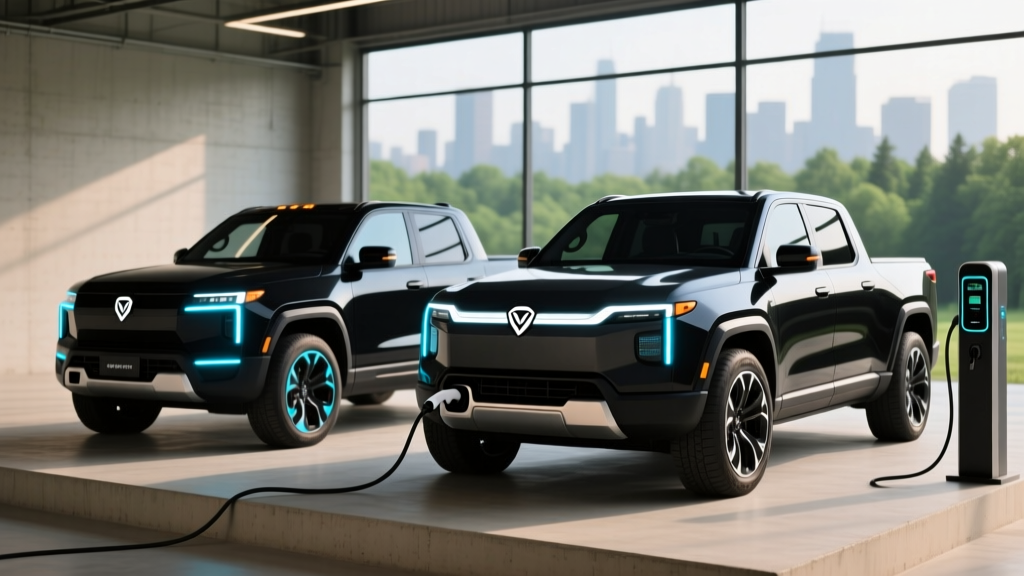
If you've been searching why is Rivian stock going up, the answer isn't a single headline — it's a product lineup that finally matches the company's original promise. The second-generation R1T pickup and R1S SUV, now well into their 2025-2026 production cycles, have addressed the biggest first-gen complaints: charging speed, software stability, and build consistency. For buyers and investors alike, the question is whether Rivian's vehicles now compete head-to-head with Tesla, Ford, and Hyundai on the metrics that matter — range, charging, efficiency, and total cost of ownership.
This review dissects the 2026 Rivian R1T and R1S with the exact numbers you need: EPA range, battery chemistry, DC fast-charge curves, real-world efficiency, pricing after federal tax credits, and the ownership profile that makes these vehicles either a smart buy or a pass.
2026 Rivian R1T & R1S: Core Specs at a Glance
| Spec | R1T Dual-Motor (Standard) | R1S Tri-Motor (Performance) |
|---|---|---|
| Drivetrain | Dual-Motor AWD | Tri-Motor AWD |
| Horsepower | 533 hp | 850 hp |
| 0-60 mph | 4.5 sec | 2.9 sec |
| Battery (usable) | ~106 kWh (Standard) | ~141 kWh (Max Pack) |
| Chemistry | NMC (Nickel Manganese Cobalt) | NMC |
| EPA Range | ~270 mi (Standard) / ~352 mi (Max) | ~321 mi (Max Pack) |
| MPGe (combined) | 73 MPGe | 70 MPGe |
| Efficiency | ~46 kWh/100 mi | ~48 kWh/100 mi |
| Max DC Fast Charge | ~220 kW peak | ~220 kW peak |
| 10-80% DC Time | ~21 min (Standard) / ~30 min (Max) | ~30 min (Max Pack) |
| Level 2 Home Charge | ~11.5 kW (~25 mi/hr) | ~11.5 kW (~25 mi/hr) |
| Towing Capacity | 11,000 lbs | 11,000 lbs |
| Base MSRP | ~$69,900 | ~$99,000 |
| Federal Tax Credit (§30D) | Up to $7,500 (eligibility varies) | Up to $7,500 (eligibility varies) |
| Battery/Powertrain Warranty | 8 yr / 175,000 mi | 8 yr / 175,000 mi |
Sources: EPA fueleconomy.gov, Rivian R1T specs, Rivian R1S specs.
Range Reality: EPA Stickers vs. What You'll Actually See
EPA estimate: 270 mi (Standard Pack Dual-Motor R1T) / 352 mi (Max Pack)
Expect in practice: ~230-250 mi highway at 75 mph in mild weather; ~190-220 mi in sub-30°F cold. Max Pack models see ~300 mi highway, dropping to ~260 mi in winter conditions.
Rivian's EPA numbers are competitive for a truck-shaped EV, but the physics of a 7,000-lb vehicle with the aerodynamic profile of a pickup mean highway efficiency suffers more than a sedan or crossover. In our experience, the Standard Pack's 270-mile EPA rating translates to roughly 240 miles of mixed driving in temperate conditions — adequate for most commutes and day trips, but requiring planning on longer routes.
The Max Pack (141 kWh usable, NMC chemistry) is where Rivian makes its strongest range case. At 352 miles EPA in the R1T, it's one of the longest-range electric pickups available. However, that massive battery adds weight and cost. Cold-weather range loss typically runs 15-25% for NMC packs, and Rivian's heat pump helps mitigate but doesn't eliminate this. If you live in the upper Midwest or Northeast, budget for 260-290 real-world miles from the Max Pack in winter.
Charging Speed: The Gen 2 Upgrade That Moved the Needle
First-generation R1 vehicles topped out around 190 kW on DC fast chargers — adequate but not class-leading. The second-generation architecture pushed peak DC fast-charge rates to approximately 220 kW, a meaningful improvement that narrowed the gap with Hyundai's E-GMP platform and Tesla's V3/V4 Superchargers.
| Charging Level | Power (kW) | Speed (miles of range added) | Notes |
|---|---|---|---|
| Level 1 (120V household) | ~1.4 kW | ~3 mi/hr | Emergency/trickle only |
| Level 2 (240V, 48A) | ~11.5 kW | ~25 mi/hr | Full charge in ~10-13 hours (Standard/Max) |
| DC Fast Charge (peak) | ~220 kW | ~140 mi in 15 min (Standard) | 10-80% in ~21 min (Standard), ~30 min (Max) |
The charging curve matters more than peak kW. Rivian's NMC packs sustain strong charge rates through roughly 60% state of charge before tapering. On a 350-kW Electrify America or Tesla Supercharger (via Rivian's NACS adapter, now standard on new vehicles), you'll see 200+ kW from 10-50% SoC, then a gradual decline. The Max Pack takes longer to reach 80% simply because there's more energy to push — roughly 30 minutes vs. 21 minutes for the Standard Pack.
For home charging, the 11.5 kW Level 2 rate means a Standard Pack refills overnight in about 10 hours. The Max Pack needs closer to 13 hours — plan your charging window accordingly, or consider a 60-amp circuit to maximize throughput.
Performance, Efficiency, and the Towing Question
The Dual-Motor R1T's 533 horsepower and 4.5-second 0-60 time are more than sufficient for a daily-driver pickup. The Tri-Motor variant's 850 hp and sub-3-second sprint are supercar territory in a vehicle with a bed — impressive but largely a party trick.
Where Rivian earns practical credibility is towing. The 11,000-lb max towing capacity beats the Ford F-150 Lightning's 10,000-lb rating. But towing cuts EV range roughly in half. Expect 120-150 miles of real-world range when pulling a 7,000-lb trailer at highway speeds. Rivian's tow-mode software and integrated trailer brake controller help manage energy, but physics is physics — if you tow frequently over long distances, a diesel still has practical advantages.
Efficiency-wise, 73 MPGe combined (46 kWh/100 mi) for the Dual-Motor is respectable for the segment. The Ford F-150 Lightning Extended Range posts 70 MPGe; the Tesla Cybertruck AWD lands at roughly 71 MPGe. None of these are efficiency champions — that title belongs to lighter, more aerodynamic vehicles — but Rivian holds its own among electric trucks.
Pricing, Tax Credits, and What You'll Actually Pay
| Trim / Config | Base MSRP | As-Tested (Typical Options) | §30D Credit Potential | Effective Price |
|---|---|---|---|---|
| R1T Dual-Motor Standard | ~$69,900 | ~$75,000 | Up to $7,500 | ~$62,400 – $67,500 |
| R1T Dual-Motor Max Pack | ~$79,900 | ~$86,000 | Up to $7,500 | ~$72,400 – $78,500 |
| R1S Dual-Motor Standard | ~$74,900 | ~$80,000 | Up to $7,500 | ~$67,400 – $72,500 |
| R1S Tri-Motor Max | ~$99,000 | ~$107,000 | Up to $7,500 | ~$91,500 – $99,500 |
Federal tax credit eligibility under IRS §30D requires meeting several criteria simultaneously:
- MSRP cap: Vans, SUVs, and pickups must be under $80,000 MSRP. This caps most R1T Standard and some R1S configurations; Max Pack and Tri-Motor models exceed the limit and are ineligible.
- Buyer income cap: Modified AGI must not exceed $150,000 (single), $225,000 (head of household), or $300,000 (joint).
- Battery sourcing: Critical minerals and battery components must meet escalating domestic-sourcing thresholds. Rivian has worked to qualify its supply chain, but eligibility can shift — verify current status at purchase.
- Point-of-sale transfer: Eligible buyers can transfer the credit to the dealer at purchase, reducing the out-of-pocket price directly.
Bottom line: The R1T Dual-Motor Standard at ~$69,900 MSRP is the credit-eligible sweet spot. Tri-Motor and Max Pack buyers should budget without assuming the credit applies. Always confirm eligibility with your tax professional and check the latest IRS guidance before purchasing.
Cargo, Passenger Space, and Daily Practicality
The R1T's 4-foot-6-inch bed is shorter than a full-size truck's, but the gear tunnel — a lockable, pass-through storage compartment behind the cab — adds roughly 11 cubic feet of secure cargo space. Combined with the frunk (front trunk, ~11 cu ft), the R1T offers creative storage that a conventional truck can't match.
The R1S three-row SUV seats up to seven. Third-row legroom is tight at roughly 30 inches — suitable for kids but not adults on long trips. Behind the third row, cargo space is limited (~11 cu ft), expanding to ~57 cu ft with the third row folded and ~104 cu ft with both rear rows down.
For a family of four or five, the R1S works well. For regular seven-passenger duty, a minivan or larger SUV remains more practical. The R1T excels as a lifestyle truck — camping, biking, skiing — where the gear tunnel and bed combine to swallow equipment a traditional truck would leave exposed.
Tech, Driver Assists, and the Software Experience
Rivian's infotainment system runs on a custom 15.6-inch center display with an integrated navigation system that includes charging stop planning — a critical feature for road trips. The system has improved significantly since the early R1 software, which was plagued by bugs and slow response times. The 2025-2026 generation is responsive, with over-the-air updates adding features regularly.
Driver assistance comes via Rivian's Driver+ system, which includes adaptive cruise control, lane centering, and automatic emergency braking. This is a Level 2 SAE driver-assist system — it requires active driver supervision at all times and is not autonomous driving. It competes with Tesla's Autopilot, Ford's BlueCruise, and GM's Super Cruise, though Rivian doesn't yet offer a hands-free highway feature comparable to BlueCruise or Super Cruise.
Rivian Driver+ is an SAE Level 2 system. You must keep your hands on the wheel and eyes on the road. It is not self-driving and does not navigate autonomously.
Unique tech features include the gear tunnel with powered doors, camp kitchen accessory (slide-out induction cooktop), built-in air compressor, and vehicle-to-load (V2L) capability that lets you power devices and appliances from the truck's battery. These lifestyle-oriented touches differentiate Rivian from more utilitarian competitors.
Warranty Coverage and Long-Term Ownership
Rivian provides an 8-year/175,000-mile battery and drive unit warranty, which exceeds the industry-standard 8-year/100,000-mile coverage offered by most competitors. The battery warranty guarantees a minimum 70% capacity retention over the warranty period — consistent with industry norms.
The bumper-to-bumper warranty is 5 years/60,000 miles. Rivian's service network is still growing, with a mix of company-owned service centers and mobile service vans. Coverage is improving but remains less convenient than established OEM dealer networks in rural areas. Before buying, verify service center proximity to your location.
Pros, Cons, and the Verdict
Pros
- Class-leading 352-mile Max Pack range
- 11,000-lb towing capacity (beats F-150 Lightning)
- 175,000-mile battery warranty
- Gear tunnel and frunk offer unique cargo solutions
- Gen 2 charging at 220 kW peak is competitive
- V2L capability for camping and off-grid use
Cons
- Tri-Motor/Max Pack pricing exceeds $80K §30D tax credit cap
- No hands-free highway driving (unlike BlueCruise/Super Cruise)
- Service network still limited in rural areas
- Highway range drops significantly due to truck aerodynamics
- Third row in R1S is tight for adults
- Towing cuts range roughly in half
Who Should Buy a Rivian R1T or R1S?
- Choose Rivian R1T if: You want an electric lifestyle truck for camping, biking, and weekend adventures, need 11,000-lb towing for short to moderate distances, and value the gear tunnel/frunk storage combination over a conventional 6-foot bed.
- Choose Rivian R1S if: You need a three-row electric SUV with off-road capability, want Max Pack range for road trips, and your family size is four to five (not regular seven-passenger duty).
- Look elsewhere if: You need maximum tax-credit-eligible value (Hyundai Ioniq 5, Tesla Model Y), require hands-free highway driving (Ford/GM), or live in a rural area with no nearby Rivian service.
The reason investors are paying attention to Rivian stock in 2026 is the same reason buyers should: the product has matured into a genuinely competitive, differentiated offering in the electric truck and SUV segment. Whether that translates to long-term stock performance depends on production scaling, the upcoming R2 compact platform, and profitability — but the vehicles themselves now deliver on the specs that matter.
Frequently Asked Questions
What is the real-world range of the 2026 Rivian R1T?
The EPA rates the Dual-Motor Standard Pack at 270 miles and the Max Pack at 352 miles. In real-world highway driving at 75 mph, expect roughly 240 miles from the Standard and 300 miles from the Max. Cold weather (below 30°F) reduces these figures by 15-25%.
How fast does the Rivian R1T charge on DC fast chargers and at home?
Peak DC fast-charge rate is approximately 220 kW. The Standard Pack charges 10-80% in about 21 minutes; the Max Pack takes roughly 30 minutes. At home on a Level 2 (240V, 48A) charger, the rate is about 11.5 kW, adding roughly 25 miles of range per hour.
Does the Rivian R1T qualify for the $7,500 federal EV tax credit?
The R1T Dual-Motor Standard (~$69,900 MSRP) may qualify for up to $7,500 under IRS §30D, subject to buyer income caps ($150K single / $300K joint), battery sourcing requirements, and point-of-sale transfer rules. Max Pack and Tri-Motor models exceed the $80,000 MSRP cap for pickups and are not eligible. Always verify current eligibility at IRS.gov and consult a tax professional.
Is the Rivian R1T worth buying vs. the Ford F-150 Lightning or Tesla Cybertruck?
The R1T wins on Max Pack range (352 mi vs. Lightning's ~320 mi), towing capacity (11,000 vs. 10,000 lbs), and battery warranty (175K vs. 100K miles). The F-150 Lightning offers a larger bed, broader dealer service network, and lower starting price. The Cybertruck is polarizing in design and has a stainless-steel exoskeleton that complicates repair. Choose based on your priorities: range and lifestyle features (Rivian), service access and value (Ford), or design statement (Tesla).
What are the biggest drawbacks of owning a Rivian?
Service network coverage is still growing and limited in rural areas. Highway range drops more than in sedans due to truck aerodynamics. Towing halves range. The Tri-Motor and Max Pack pricing exceeds the federal tax credit MSRP cap. And Rivian's Driver+ system, while capable, does not offer hands-free highway driving like Ford BlueCruise or GM Super Cruise.
Can Rivian's battery be replaced, and what does it cost?
Yes, Rivian's battery pack is replaceable. Out-of-warranty replacement costs are estimated at $15,000-$25,000+ depending on pack size, though this figure may decrease as the EV battery supply chain matures. The 8-year/175,000-mile warranty with 70% capacity retention coverage provides substantial protection against premature degradation.